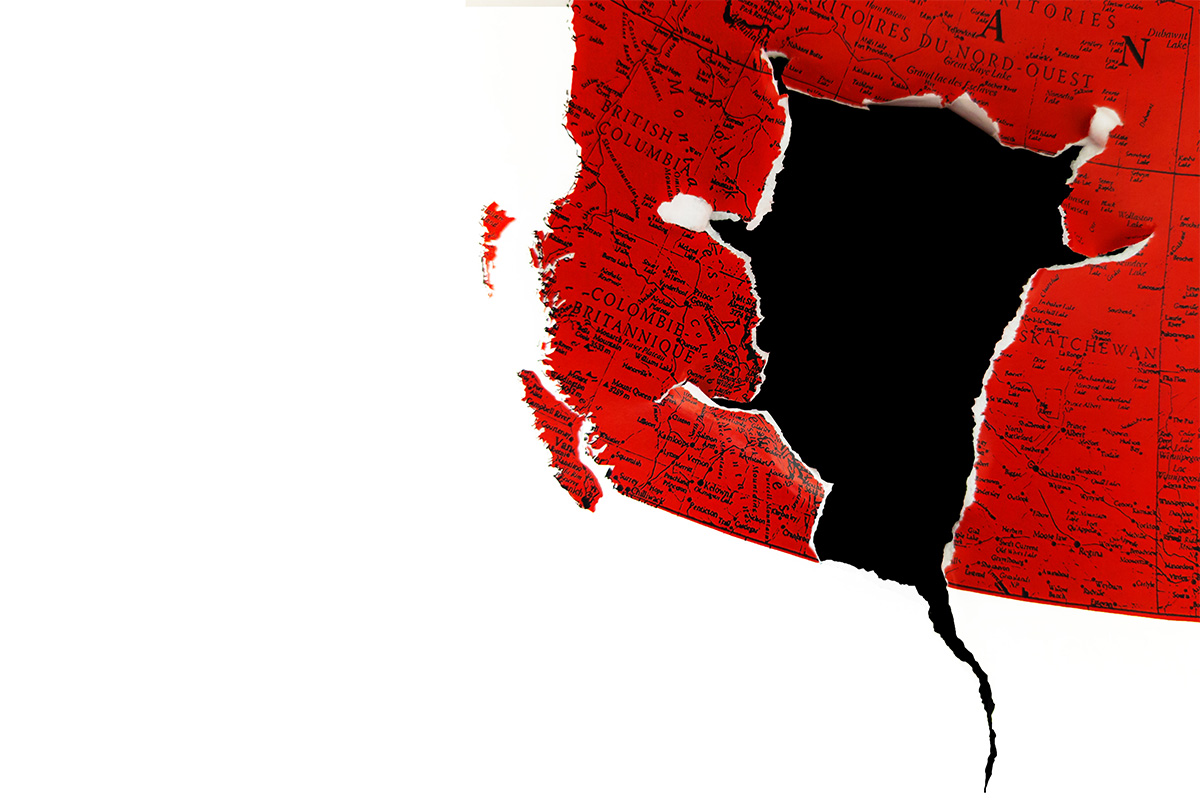
On Oct. 19, Albertans will participate in a referendum to decide whether to have a referendum on separation. This confusing question has infuriated both hardline separatists and staunch federalists.
But beneath the procedural confusion lies a deeper crisis. How did we get here? Will Alberta actually separate? And what is the communist response?
A decade of decline
To understand the rise of separatism, we must first understand the economic collapse of 2014.
Alberta is heavily dependent on oil and gas development. This means that fluctuations in the price of oil have an enormous effect on the province, resulting in either dizzying prosperity or mass layoffs.
In the early 2000s oil prices climbed to historic highs. This led to a literal bonanza where hundreds of billions of dollars flowed in. Alberta was a land of milk and honey with the highest GDP per capita in the country.
But when the Americans started fracking oil in the 2010s, they glutted the market and tanked prices. This was particularly damaging to the Albertan economy which extracts oil from tar sands, a far more costly procedure.
A hundred thousand workers were laid off from 2014 to 2017—nearly one third of all jobs in the energy sector. Since 2014, the province’s real disposable income per capita has fallen by 13 per cent on average, the steepest decline in the entire country.
This economic catastrophe has had far-reaching effects on the consciousness of all classes of society. This is the soil in which anti-establishment movements of both the left and right varieties flourish.
Failed NDP
The anger caused by the crisis found its initial expression in the Alberta NDP’s first-ever election win in 2015. Workers flocked to the party, which went from 10 per cent to over 40 per cent of the vote.
The 44-year Progressive Conservative (PC) dynasty was brought to an end and working-class people were elated. Rachel Notley’s NDP stood for an increased minimum wage and promised a review of the royalties that oil companies pay.
But the election of the NDP sent the ruling class into a frenzy. The entire Albertan political establishment exerted massive pressure on the NDP. Their message was clear: don’t touch oil and gas profits!
The NDP capitulated to corporate pressure. They didn’t raise oil royalties and as a result implemented a public sector wage freeze because the government was strapped for cash. They even offered subsidies to oil and gas companies.
An enormous opportunity was thus squandered. The refusal to take the fight to the oil bosses weakened the left and the labour movement, and created fertile ground for right populism to flourish.
Lunatics take over the asylum
In 2017, the fractured conservative movement reunited, creating the United Conservative Party (UCP). But it was an unhappy marriage of establishment conservatives and rural populists.
The first UCP leader, and Danielle Smith’s predecessor, was establishment conservative Jason Kenney. After taking power in 2019, he passed a whole series of anti-union laws and imposed brutal austerity measures.
The labour leaders, instead of fighting back in the streets and on the picket lines, shied away from a direct confrontation and adopted the strategy of waiting until the next election. This proved to be fatal. Just as with the refusal of the NDP to take on the oil bosses, the initiative was handed to the right-wing.
The mass anger against Kenney found its expression in an internal coup against him inside the UCP. A right-populist faction represented by the Take Back Alberta movement backed Danielle Smith as leader. Describing this moment, Kenney said that “the lunatics have taken over the asylum.”
While a Kenney-led UCP was headed for certain defeat, Smith’s brand of prairie populism completely changed the game.
Western alienation—the sentiment that “the West” is an afterthought in the calculations of the politicians in the population-dense East—has been widespread ever since the creation of Canada. When the economy was booming, this was relatively easy to forget. But as the economy entered a deep crisis, this faultline resurfaced with a vengeance.
Smith skillfully directed legitimate anger stemming from collapsing living conditions away from her government and towards Ottawa.
Will Alberta separate?
Smith wants to simply use the threat of separation to wring concessions from Ottawa. She has threatened a “national unity crisis” unless the oil barons get another pipeline to the west coast. But this is a dangerous game. She now has unleashed a monster beyond her control.
While Smith signed a Memorandum of Understanding with Carney on the question of building a new pipeline, her supporters have lost all faith in Canada. She was even booed at the UCP convention last year and the separatists swept the election for the executive posts.
The original “lunatic” has now become the responsible steward, warding off the new lunatics from taking over the asylum. Smith has clearly recognized that things have gone too far. This explains why she put forward such a convoluted question:
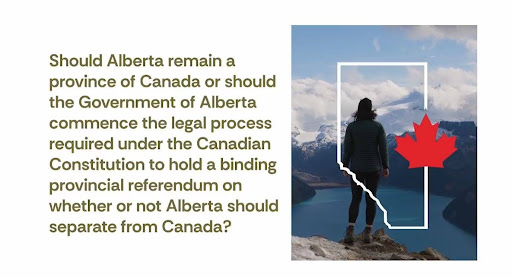
Unsurprisingly, most people consider this to be a confusing question and Smith has subsequently lost popularity.
While it seems like people will vote to remain in the Oct. 19 referendum, this won’t be the end of Smith’s problems. The separatists, who catapulted her into power, feel betrayed. David Parker, the founder of Take Back Alberta, said, “Danielle Smith has betrayed her base. Time for a new leader.”
How long Smith will be able to hold onto the reins is not clear. But a likely flash point will be the UCP convention later this year.
Smith, who knows things have gone too far, has started campaigning in favour of remaining in Canada. This has taken the form of fear mongering about the projected cost to leaving the Canadian federation, claiming that it will cost over $400 billion.
All of this will lead either to a separatist takeover of the UCP or a split in the conservative movement. But the latter is something that both sides don’t want, as that would most likely lead to another NDP government.
In the meantime, there is always the possibility that people could actually vote in favour of holding a binding referendum. Polls show that 60 per cent would vote to remain in Canada—not an insurmountable majority. Historical precedent also suggests that support for independence tends to increase in the run up to referendums.
If people do vote to hold a separation referendum, it would open a new can of worms. As the Brexit referendum showed, anti-establishment anger can easily express itself in a vote to separate. Alberta is the fourth-most populous province in Canada and the third largest contributor to the GDP—if Alberta did leave, it would pose serious questions as to the viability of Canada as a nation state.
Of course the ruling class and the federal government have many ways to stop a referendum, even in the event of it succeeding. But none of this bodes well for the Canadian ruling class, who could be confronted with a prolonged constitutional crisis at the worst possible moment.
How not to fight back
The prospect of Alberta separating has shocked many people around the country. This is amplified by the fact that the movement is being led by some of the most deranged rightwing demagogues imaginable. For example, David Parker is a libertarian Christian nationalist who believes in privatizing healthcare and education and abolishing unions entirely.
In response, the NDP and the labour leaders have united with establishment conservatives and Liberals to “Make Alberta Canada Again.” They supported the “Forever Canadian” petition launched by former Progressive Conservative deputy premier Thomas Lukaszuk. The nurses’ union and the AFL even bankrolled it.
On May 13, a judge threw out the separatist petition. The justification was that the provincial government failed to consult with First Nations who may be negatively affected by a potentially successful referendum on separation.
All the forces of the establishment as well as much of the left applauded this decision. Carney also came out saying that a separation referendum would have to abide by the Clarity Act—an anti-democratic law put in place after the 1995 Quebec referendum—which leaves it up to the Canadian parliament to decide what a “clear majority” is.
All of this has reactionary consequences, as it allows the separatists to paint themselves as repressed freedom fighters. Blocked by unelected judges, threatened to have their decision-making taken away by Carney, and told they are anti-democratic by the entire establishment— all for wanting to be able to vote!
The question of democracy gets to the heart of one of the most potent aspects of western alienation, which is that people feel left out of the political process. The fact is that ordinary people feel left out of the process because they are.
They can vote every four years, but then everything is left in the hands of the “experts” in Ottawa. The votes of people in the west don’t seem to matter much as the elections are decided in the population-rich areas in Quebec and Ontario.
Instead of trying to unite with the establishment to block the referendum, communists point out that under capitalism, there can be no genuine democracy. Real democracy is only possible by extending democratic decision-making to the economic sphere. This is the only true way to have control over our lives and the only real way to guarantee that the fruits of our labour are not syphoned away by some clique of capitalists or unelected bureaucrats.
The communist response
The separatists claim that people are getting ripped off and it resonates because they are getting ripped off. The problem is that the separatists are dead wrong about who’s exploiting hard-working Albertans.
People will not fight to maintain the status quo, which is getting worse by the day. In Alberta specifically, very few people will be motivated to fight on the side of Ottawa.
The separatist leaders maintain their support because they claim to fight for the workers of Alberta against the “eastern elites”. They have actually theorized that the essential difference between the east and west is that westerners are “builders and providers”, while easterners are “takers and moochers”.
We can only fight against this rhetoric by demonstrating that there are “moochers and takers” in every single province, including Alberta. There is a definite class which dominates the economy of the entire country—the capitalist class. These people are the reason why things have gotten so bad in Alberta, just as in the rest of the country.
Actually, following the 2014 oil crash, oil and gas companies retooled their operations. This allowed them to produce a record number of barrels with fewer workers. Between 2021 and 2023, profits for oil companies reached $135.2 billion, far exceeding the $64.2 billion made at the height of the boom from 2011-2014.
One factor in these profits was that Jason Kenney cut the corporate tax rate from 12 to eight per cent in 2019. But this created zero jobs. The common conservative argument that what is good for the oil and gas capitalists is good for the working class has been proven wrong in practice.
It goes without saying that communists are opposed to Alberta separating under the leadership of these right-wing libertarians. That certainly would be a nightmare for working class people.
But we cannot fight against this by uniting with establishment conservatives and liberals as they use all manner of anti-democratic measures to try to block the referendum.
We must fight for unity—but unity with whom? “Workers of the world unite!” has been a slogan of the workers movement since the Communist Manifesto. In Canada, this is more relevant than ever as the fractured federation is coming apart at the seams.
But uniting the working class from various provinces with diverging and competing industries can never be done on a liberal or reformist basis which accepts the right of the capitalists to own industry.
This can only be done with a socialist program. One that argues to expropriate the oil and gas capitalists and place the industry and its massive profits under the control not of the federal government but of the working class as a whole. Only in this way can we embark on a harmonious development of the economy which is not prey to the fluctuations of the world market.

