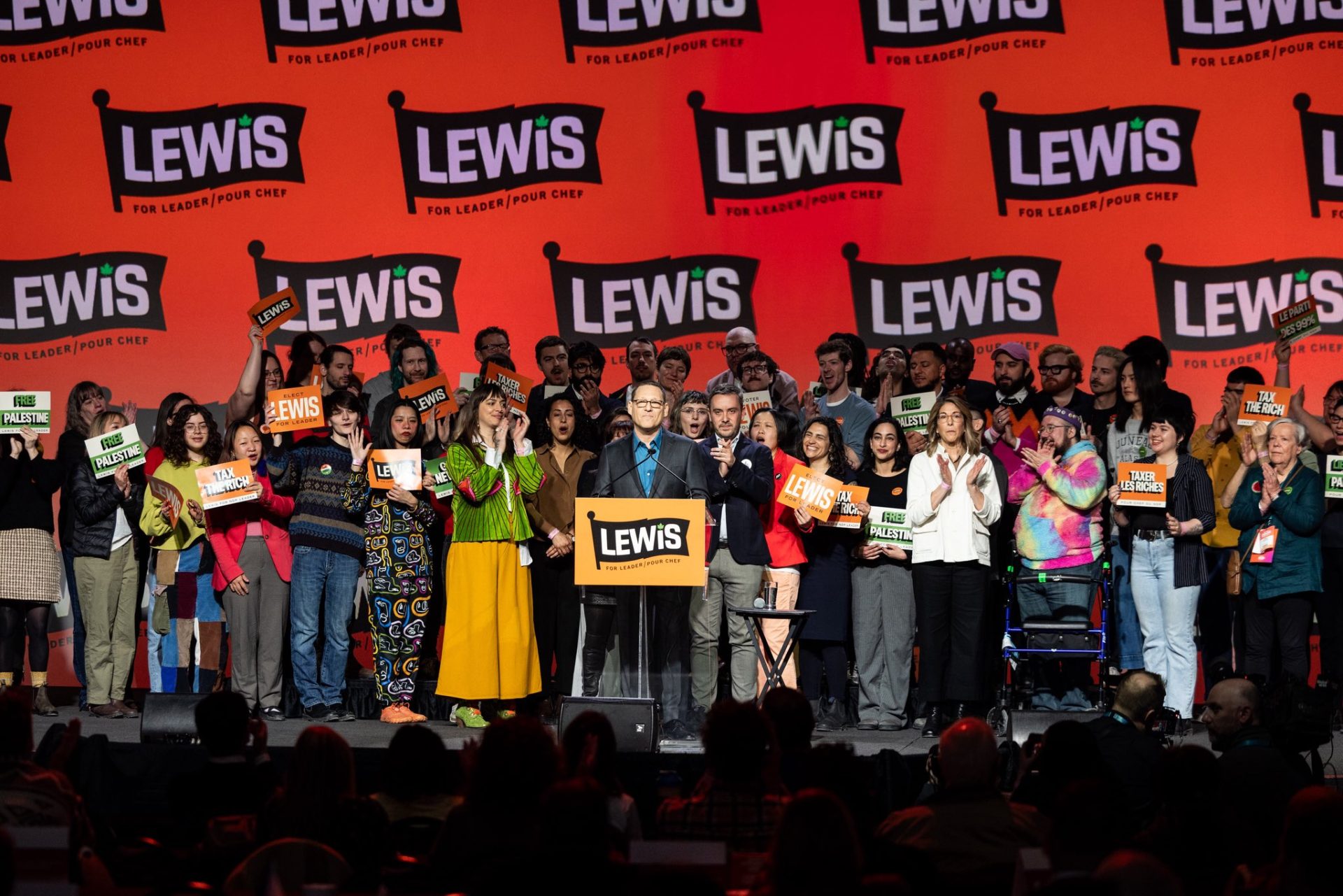
Avi Lewis, a self-described democratic socialist, is the new leader of the New Democratic Party. After decades of the party drifting to the right, now the NDP has a leader who is a notable step to the left. With capitalism embroiled in a deep crisis and millions looking for answers, Lewis stood out in the race, denouncing the billionaires and arguing for public ownership.
Old guard discredited
In many ways, Lewis’ victory was not surprising. He led in fundraising numbers—bringing in well over $1.4 million—far in advance of all of the other candidates. The crowds he drew out across the country were also the largest.
The party bureaucracy meanwhile, following the NDP’s worst election result, found itself severely weakened and discredited. Heather McPherson, the main establishment candidate, failed to garner any enthusiasm. Her meetings were notably small gatherings of mostly older people. She tried to frame the race as a choice between a Lewis “purity test” versus her tried-and-true “electability”. But this fooled no one. The attacks against Lewis from the corporate media and party establishment figures fell on deaf ears.
Rob Ashton, who enjoyed very public endorsements from the leaders of the Canadian Labour Congress and the United Steel Workers, finished fourth with just 4,193 votes, behind Tanille Johnston, a social worker who had no backing from any significant part of the party or union brass.
Lewis’ victory is a defeat for the strategy of the party brass in the last decades, who increasingly made the NDP indistinguishable from the Liberals. They removed socialism from the party constitution and embraced ex-Liberal Thomas Mulcair as leader, who destroyed the opportunity to win the 2015 election. Under Jagmeet Singh, they propped up the Trudeau government during the cost-of-living crisis and the genocide in Gaza.
The reward for this strategy was a pummeling at the polls, with the NDP receiving just 6.29 per cent of the vote and winning just seven seats last year. With the party tops having abysmally failed, Lewis stormed to victory, winning 56 per cent of all votes cast on the first ballot. In total, his 39,734 votes are more than anyone has ever won in an NDP leadership contest. The race also had a record turnout with over 70 per cent of NDP members casting a vote, up from 52.8 per cent in 2017.
Also of note is that a last-minute slate of Lewis supporters swept the NDP executive. This was led by Libby Davies, a former NDP MP who had publicly clashed with Mulcair on the question of Palestine. They defeated a slate of incumbents backed by the labour bureaucracy as well as standing MPs.
Public ownership
The key to Lewis’ victory was the fact that he calls himself a socialist and criticizes capitalism. He has also placed public ownership back into the mainstream public debate for the first time in generations, claiming that he will use the “unmatched power of public ownership to ensure the fundamentals of a good life.”
Obviously inspired by the new, democratic socialist mayor of New York, Zohran Mamdani, Lewis has promised a public grocery store chain to bring down the cost of groceries for working class families. He also put forward the idea of establishing a public telecommunications company to offer cheap cell phone rates for consumers.
In his program, he argues that dental, pharma, vision, hearing and mental health should all be brought under the public healthcare system. He argues that long-term care homes should be publicly owned. He also wants to establish a government agency to build hundreds of thousands of off-market housing units.
With the capitalist system failing all around us, this was a breath of fresh air and set Lewis apart from the other candidates.
Faced with the crisis, Lewis has argued for “public ownership as a response to market failure.” When asked about what should happen with the Stellantis plant in Brampton, he argued that it should be nationalized. He also made a similar point about the GM CAMI plant in Ingersoll and Algoma Steel in Sault Ste. Marie.
Unsurprisingly, his election has been met with virulent attacks and red-baiting from the right wing. Saskatchewan Premier Scott Moe says Lewis is hell-bent on “destroying half of the economy, and then nationalizing the other half.” Alberta Premier Danielle Smith said that the NDP under Lewis is “pretty communist.”
The National Post described Lewis as “not just left-wing, but way off in a universe of his own.” The Calgary Herald argued that “Under new leader Avi Lewis, the federal NDP looks more communist than social democratic.” But the claims that Lewis is a “communist” who wants to “nationalize the economy” or “scrap capitalism” are not based in fact.
Lewis himself has been forced to clarify multiple times on the news that this is not his plan. Far from being a socialist program to challenge the capitalists’ right to own the means of production, Lewis’ program seems to have been crafted carefully to avoid this question altogether.
While he wants to use the “unmatched power of public ownership to ensure the fundamentals of a good life,” he is not arguing to nationalize the big monopolies. Instead, he is arguing to create “public options” to compete with private companies. His hope is that through competition, this will force prices to come down.
If we are to be honest, this is the weak part of his program. For example, a public telecom network will either be forced to purchase bandwidth from the big private companies or spend a ridiculous amount of money to build entirely new infrastructure. A similar problem arises with his proposition to build a public grocery store network. Creating public options that compete with the capitalists would be far more inefficient and costly than simply taking over the existing network of large stores and warehouses, to say nothing of the furious resistance that will be put up by the large chains and their distributors to sabotage a low-cost public option.
The fight against capitalism
The capitalist system is mired in a deep crisis. The capitalist market, which we are told is a miraculous solver of all problems, is demonstrating its failure. Millions barely scrape by as the cost of food and rent has gone through the roof. Home ownership is completely out of reach for the vast majority of young people, and the hope of finding a good job for many young people has evaporated.
The vitriol and red-baiting directed at Lewis is fueled not so much by his actual program, but because he dares to question the benefits of corporate domination over the economy at all—in however limited a manner. Lewis’ election and the response to it has opened a debate on the merits of public ownership in Canada. From this, many will draw conclusions that go far beyond Lewis’ program—and even beyond the limits of capitalism. This is what the powers-that-be are most afraid of.
His propositions beg the question: Why go around the problem, spending billions on creating new infrastructure, when we could just nationalize these parasites? Lewis’ proposition to nationalize long-term care homes and other aspects of healthcare already enjoys majority support of the population. It goes without saying that nationalizing the big grocery stores and telecom companies who are so detested would be massively popular.
While the NDP old guard, in league with the mainstream media, have strained to demonstrate how unpopular and unelectable Lewis is, these people have their heads in the past.
Even Thomas Mulcair has recognized the attractive potential in Lewis’ proposals in a CTV article titled Avi Lewis is on to something with his plans to nationalize everything from Pharmaceuticals to groceries. Mulcair writes: “Young people today are putting a bullseye on capitalism as the source of all woes, from wars to weather, and it’s feeling very 1960s on many campuses.”
For once, Mulcair is correct about something.
The youth, who have had their future robbed from them, are just the first layer of society to openly question the system. The struggle for socialism, which the NDP bureaucrats and union leaders tried to expunge from the labour movement, is making its way back into the mainstream discourse. After a long period of political degeneration, we are just at the beginning of a generalized reawakening. Lewis’ election as leader of the NDP is just part of this process.
But the problems of capitalism that Lewis has highlighted cannot be solved with public options competing with the giant private monopolies. Nor can they be solved simply by taxing the one per cent as Lewis proposes. Only through mobilizing the working class for a full socialist transformation of society will we be able to break the stranglehold that the billionaires have over our lives and fight for a future worth living.

