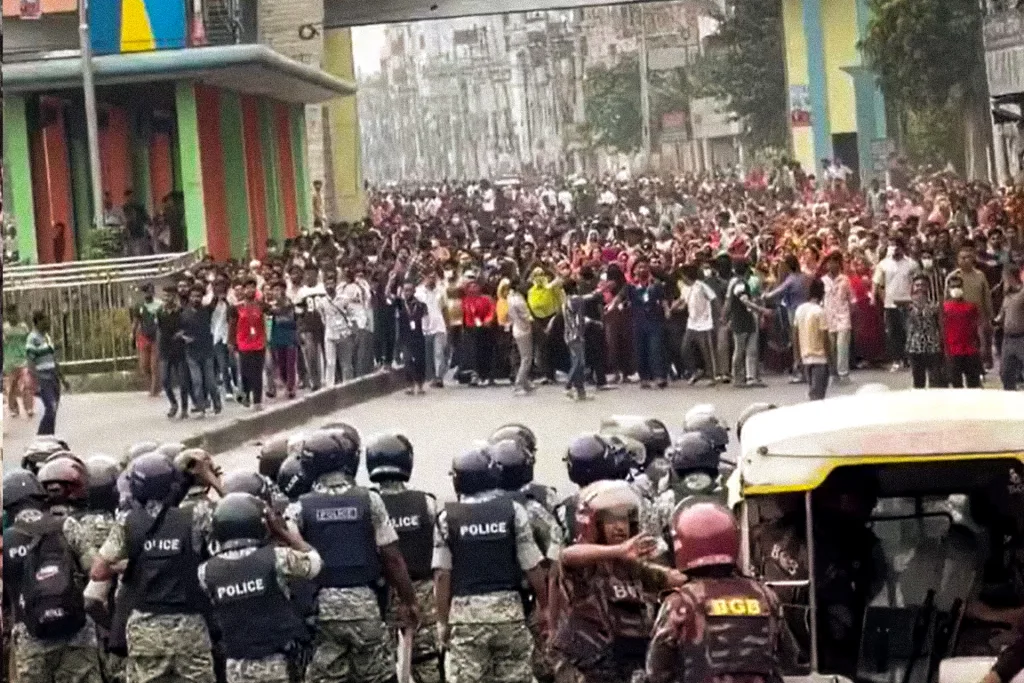
Since Oct. 31, garment workers in Bangladesh have been mobilizing on a level not seen since the July 2024 uprising that brought down the tyrant Sheikh Hasina. Almost one million garment workers, facing intolerable working conditions and an ever-increasing cost of living, struck and protested across hundreds of factories to force the new government to fulfil its promise of raising the minimum wage.
The new government and its “opposition,” staring down a rapidly diminishing garments industry—the engine of the Bangladeshi economy—have been intransigent. In scenes reminiscent of Hasina’s bloody attempt to crush the revolution, it has sicced its police lapdogs and hired thugs on the workers. Hundreds have been injured, and one worker has been killed.
Two years on from the July uprising, the revolution is unfinished. Now that all its promises have been tarnished, it is crystal clear that the lines dividing the country are not Hasina versus everyone else, but worker versus boss. Both classes face an existential crisis. Neither can afford to give in.
Fighting to survive
The rise of the garments industry, which accounts for 80 per cent of the country’s exports, has been based on its unbelievably “competitive” labour costs—i.e. slave wages. Whereas competitors like Cambodia and Vietnam pay their garment workers a minimum of about 210 USD a month, Bangladeshi garment workers survive on a minimum wage of 100 USD (12,500 BDT) a month.
This wage forces workers to work countless hours of overtime just to make ends meet. They work in dangerous conditions and face violence and blacklisting if they organize to better them.
An ex-garment worker shared with us that although there was a union in her factory, it was an open secret that the ledger of those who complained was shared with the bosses. She recounted one incident where a senior garment worker who tried to organize a protest was taken to the manager’s office and threatened at gunpoint.
It was exactly these conditions that led them to rally behind the students for a general strike, which led to the downfall of Hasina’s government. For them, the revolution offered hope for a real change in their conditions of life. As one garment worker put it:
“If they [students] wanted a better country, so did we. That’s why I risked my life…
“Everyone was happy when Hasina fled. It felt like we had succeeded… I noticed that our supervisors at the factory hurled fewer abuses at us.”
However, the revolution brought no relief. Months later, a protest for a 15 per cent wage increase, a demand of workers under Hasina’s dictatorship, was met by Yunus’ interim government with a hail of bullets.
The elections in February offered a ray of hope. In order to get into power, the parties promised to raise the minimum wage. A year since the new BNP government took office, this has not happened. Meanwhile, conditions have dramatically worsened.
Salaries for government officials have increased, but the last time there was a minimum wage increase for garment workers was in 2023. Even then, it only covered an estimated 71 per cent of living costs.
But with the closure of the Strait of Hormuz, prices of gas, medicine, food, and other essentials have skyrocketed, wiping out the purchasing power of workers. Inflation stands at nine percent, and energy prices have risen by 35 per cent.
One sewing machine operator described:
“My rent is 6,000 taka ($48). Cooking gas now costs 2,300 ($18.50). I earn 13,500 ($108) [a month]. This year I can’t afford my children’s schooling. Tell me, what’s left for food?”
Workers are forced deep into debt or to work even more overtime to survive. With the prohibitive rise in the cost of gas, some have been reduced to burning discarded paper in order to cook.
Meanwhile, the economic crisis has worsened conditions inside the factories. Over the summer, workers were forced to toil in 40-degree heat without fans, in order to save on energy costs. Energy shutdowns have compelled bosses to implement compulsory overtime to meet deadlines.
While yesterday’s revolutionary leaders have been feathering their nests, two million more Bangladeshis have fallen below the $3-a-day poverty line. The situation of the workers is worse than ever.
Workers on the move
It was in response to this hyper-exploitation that workers from over 600 factories mobilized spontaneously across Bangladesh’s industrial belt in strikes and blockades.
This is remarkable. There is no organization. The official unions play a lamentable role as lackeys of the bosses, and only small groups are active among the workers. The workers themselves have organized this. They go to the factory, clock in, then head straight out of the factory where they amass in the street.
As one worker from Mirpur put it, responding to the slander that the movement is a conspiracy:
“The high cost of living is hitting our stomachs. We are protesting out of sheer necessity to survive.”
They demand the raising of the minimum wage to Tk 30,000 (~$250), as well as a ban on blacklisting and the reinstatement of fired workers.
At its height last week, almost one million workers were on strike. In total, over 1.7 million garment workers—out of four million—were affected, as hundreds of factories declared “holidays” to contain the unrest.
Instead of relief, the bourgeois state’s response has been to force the workers back into the factories through violence. Peaceful protests were met with tear gas, sound grenades and baton charges. At least 10 workers’ leaders have been arrested, along with hundreds of other protesting workers. The police were supported by BNP goons armed with bamboo sticks who, like the Awami League’s goons in 2024, guarded the factories, attacked workers, and handed them over to the police.
In response, barricades were set up and police vehicles were torched. Violent clashes between the police and workers have left hundreds injured. One worker, Toufiq Hossain, was beaten to death while trying to film the protests, allegedly by thugs hired by a factory owner.
In all this, the government has had the total support of the “opposition,” the parties that yesterday celebrated the revolution and the end of Hasina’s “fascism.” The leader of Jamaat-e-Islami immediately came out to implore the BNP to take a “firm stance” against “conspirators.”
Despite the verbal support of the NCP—party of the students—for the workers’ demands, its Chittagong division organized a panel called “Domestic and Foreign Conspiracies Surrounding Bangladesh’s Garment Industry and Ways to Address Them.” In other words, they are smearing the workers, implying that they are being manipulated by the Awami League and Indian agents.
For all their disagreements, they represent the same class—the factory owners of Bangladesh, and the multinational corporations on whom they depend. For them, there can be absolutely no talk of wage rises. The garment industry is in crisis as is.
With input and shipping costs flying upwards because of the Ukraine and Iran wars, and with foreign multinationals, wary of social unrest, withholding investments, 402 factories have closed in the past three years alone, leaving hundreds of thousands jobless.
Giving the workers a livable wage would translate to a mere 13.3 cent extra on a $2 shirt for foreign buyers. But with three per cent profit margins on average, cents are too much to give.
Bangladesh’s world-leading garment industry is built on dirt-cheap wages. To raise them, in the context of increasing competition from textile producers like China and India and slowing demand from western buyers, would undermine its competitiveness and drive the money elsewhere.
Bangladeshi capitalism depends on this money. Either the industry is eclipsed, or prices are held down. As they have no control over the Strait of Hormuz, that means making the workers pay. They are under enormous pressure to do so. One factory owner explained:
“An American buyer recently sought a three-cent reduction per piece on a knitwear order after Indian manufacturers offered lower prices. We had no choice but to accept… Costs are rising from all sides, but buyers are still pushing for lower prices.”
An official representing a long-time Swedish buyer threatened directly:
“If unrest persists, we plan to cut orders for the next two months.”
Concessions?
However, the scale and intensity of the movement caught the state off guard. At the same time as they tried to crush the movement, they were forced to offer “concessions” to calm it down.
On Nov. 4, the government set up the wage board it promised months ago. It was immediately obvious that this was a delaying tactic and a sham.
The two “workers’ representatives” appointed to the board are the leader of the Trade Union wing of the ruling BNP, and the leader of the trade union affiliated with Jamaat-e-Islami. Even before it had agreed to any wage rise, these “workers’ representatives” were urging workers back into the factories.
This was enough for the rest of the trade union leaders, who insist workers wait for the board to meet in January. But it was not enough for the workers themselves. Strikes continued after the board was announced. It was only when the government announced that the wage board would raise wages in January—they haven’t said by how much—that the strikes began to ebb.
At time of writing, thousands of workers in Ashulia and Gazipur are still striking and rallying other factories to come back out.
They are right to do so. Make no mistake: the bosses and politicians have no intention of conceding the 150 per cent rise the Bangladeshi workers need. They want to stabilize the situation, but sooner or later they will go back on the offensive. A section of the bosses yesterday started implementing the “No work, no pay” clause, and will start shutting down factories indefinitely where workers continue striking. They are locking out the workers to starve them into submission.
Unfinished revolution
Two years ago, workers bled and died with the students to sweep away the Awami League regime. Back then, the soldiers were refusing to shoot at protesters, the police had disappeared from the streets, and the running of society was being taken over by local committees of students, and in some cases of students and workers. Power was in their hands.
But instead of these new, popular organizations taking control, the student leaders handed power to the Nobel Prize-winning banker Mohammed Yunus. As a result, although Hasina’s dictatorship was lifted, nothing changed socially—behind Yunus stood the army, the old state functionaries, and the capitalist class. The crisis that has shaken Bangladesh since is a product of that fatal course.
Of course, Yunus’ government had to make promises. It even implemented a new, democratic constitution. But the workers were fighting for more than words and job quotas. For them, the fight for democracy meant changing their situation. As one garment worker said after the February elections:
“We hope BNP fulfills our expectations, increases our salary, so that our life gets slightly better. We will take to the streets again if we have to.”
Now they have.
Today the workers see that the corruption and repression they fought in 2024 still exist. They see that yesterday’s “revolutionaries” are engaged in the same old careerism and gangsterism. They see that the changing faces at the top have not altered their exploitation. And they understand that, like in July 2024, it is their direct, mass action that will force a change.
But where are the leaders?
The ex-garment worker we spoke to said that most workers she knows would be eager to protest en masse if some group led them, or if the students came out—but they have not! As she said, many workers are left wondering why the students aren’t coming into the streets, considering how bad the situation is.
NCP party leader Nahid Islam has supported the workers’ demands. In parliament, however, he revealed his real intentions, saying:
“If the government cannot control the garment workers’ movement, it can ask us. We know how to organize movements and manage them.”
During the election campaign, NCP coordinators were caught calling protests and charging money to call them off. Islam wants to do the same thing, raising popular discontent to opportunistically strengthen his own party—either for or against the BNP. He will not be able to do so, given the NCP has squandered all its credibility propping up the Yunus government and allying with Jamaat-e-Islami.
The “left” and the “communist parties,” meanwhile, have been much more concerned with Bangladesh’s trade deals than with the uprising of nearly a million workers. They have either been silent or have offered nothing more than solidarity statements urging peace and a “negotiated solution,” i.e. the wage board. They have already faded into obscurity, either because of their Faustian pact with Hasina, or because of their reformist attitude towards the state.
None of them offer real leadership, which would mean joining the struggle to connect the practical demands of the workers with the fight against the system that exploits them.
Finish the revolution! Build a revolutionary communist party!
This lack of leadership poses a critical danger.
In the midst of all this, the fallen Awami League has tried to capitalize on the strikes to undermine the BNP, destabilize the country, and prepare their return.
One overthrown Awami League (AL) minister even retweeted leading comrade of the RCI Jorge Martín’s post about how workers are striking since conditions have deteriorated since Hasina’s overthrow. He forgets that the conditions his party presided over were so bad that workers and students made a revolution against them, in spite of the attempts of his allies to massacre them in the streets.
On Nov. 10 , the AL’s banned student organization, the Chhatra League, called for a day of action, which was followed by protests in AL strongholds and a wave of arson. Meanwhile, over 50 crude bombs were set off across Dhaka. Hasina herself is promising to return to the country in December.
This was a gift for the BNP government, which was already claiming the protests were incited by the AL. With the pretext of the AL’s attacks, it is intensifying repression against the movement, deploying dozens of battalions of border guards to occupy the industrial areas. Without leadership or national coordination, the continuing sporadic mobilizations of the workers in individual factories are being attacked and quickly broken apart by the police.
Unless the workers can forge a new path, this is a glimpse of the reaction that awaits them—on top of the looming economic catastrophe. As we warned in August 2024, whoever emerges from the bloody struggle of the bourgeois parties will strive to restore “law and order” for the capitalists—which means decisively crushing the workers—to place the cost of the crisis entirely on their shoulders.
Another revolution is necessary. As the BNP’s AL tactics have made apparent, such a revolution would have to go far beyond changing the party at the top. It would have to strike at capitalism itself, the root of their exploitation, and the real root of Hasina’s dictatorship.
The garment workers have the power to do this. Bangladesh is built on their backs. If they united and struck together; if they took control, which they proved they could do in July 2024, they could win not only a wage rise, but the dignified existence they deserve. There is more than enough wealth to grant this—if only it weren’t for the capitalist parasites!
A socialist revolution is the only way out. This is no utopia. The ex-garment worker we spoke to lit up when we talked about socialism, though she had never heard the word. She explained how enthusiastic her colleagues would be about our ideas—if only we were big enough to spread them.
The way is open for a powerful revolutionary party to unite the individual streams of unrest into a mighty torrent capable of washing away the current system. If that party existed, we would now be writing of Bangladesh’s October Revolution! It does not. The urgent task facing revolutionary workers and students is to build it.
There is no other road. The current situation does not allow for both the workers and the bourgeoisie to come out unscathed. Either the workers, united in a communist party, take power themselves and abolish capitalism—or the state will save the Bangladeshi bourgeoisie over their bones.
Down with the government of the bosses!
Organize a general strike! Organize workers’ councils across every factory!
Fight for wages that keep up with inflation; for an end to blacklisting and freedom for arrested workers!
Most importantly:
Join us! Build the party of revolutionary communism in Bangladesh!

