2026 began with a bang. More precisely, it began with bombs exploding in Caracas and the kidnapping of Venezuelan president, Nicolas Maduro. In case you weren’t aware, that’s not supposed to happen in the “rules based international order.”
At first, Canadian Prime Minister Mark Carney tried to avoid the uncomfortable truth. In response to Trump’s actions in Venezuela, he made a bland statement which failed to mention what had actually happened while simultaneously counseling “all sides” to adhere to “international law.”
But now the truth is unavoidable, the so-called “rules based order” is dead—and it’s not coming back.
The Davos revelation
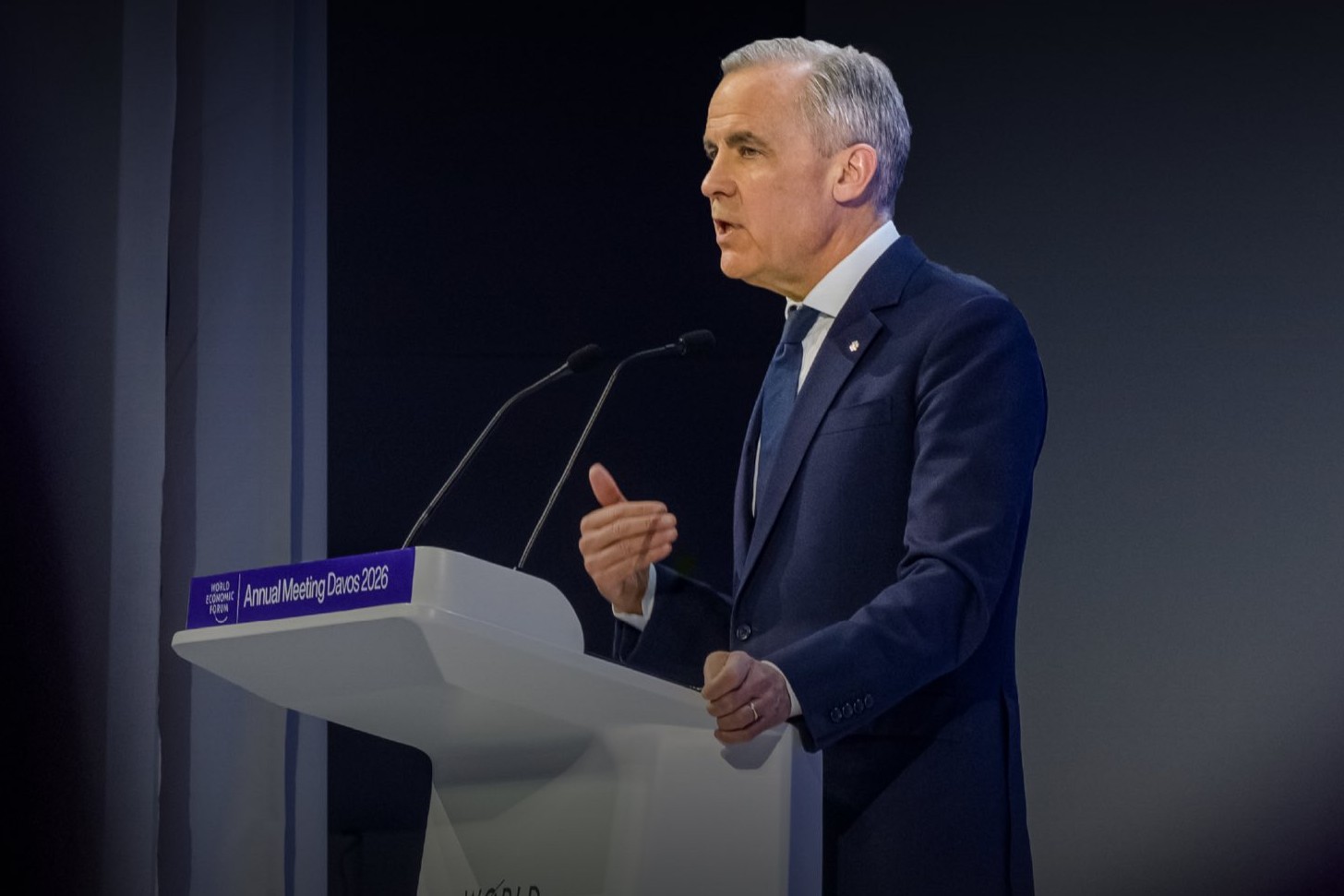
Carney’s speech at the World Economic Forum meeting in Davos has been called the “eulogy for the old world order,” by the CBC. In it, Carney explained that the new world situation is one where “great powers abandon even the pretense of rules and values for the unhindered pursuit of their power and interests.”
Pundits across the political spectrum have praised Carney for this honest and blunt assessment of the world situation. But the fact is it was inevitable that reality was going to come to bear and force world leaders to admit that the so-called rules-based order was dead. Carney has simply been the most honest about this so far.
Indeed, Carney’s speech was remarkable for its blunt honesty. Rarely do we hear imperialist politicians speak so clearly about the system they have created to rule the world. In his speech, Carney described the international rules-based order as a “useful fiction,” dominated by “U.S. hegemony.” He explained that “the strongest would exempt themselves when convenient, that trade rules were enforced asymmetrically, and we knew that international law applied with varied rigour, depending on the identity of the accused or the victim.”
While many liberals have decried Trump’s actions as a “return” to imperialism, Carney’s comments have blown up this argument. Carney’s admissions confirm everything that Marxists have always explained about the United Nations, international law and the entire hypocritical international order.
Carney’s utopian gamble
One thing that Carney did not speak so plainly about is what “use”, exactly, Canadian imperialism found in this old world order. The truth is that in this order, Canada was a junior partner to U.S. imperialism. Canada benefited from the military might of NATO (primarily the U.S.) and developed as a mining and banking power with interests all over the world. The “useful fiction” allowed Canadian imperialism to employ double speak and talk about “peace keeping” and “democracy” while they pillaged the wealth of Africa and Latin America.
But with the break up of the old world order, Canada’s imperialist interests abroad are threatened. Not only this, Canada’s close economic ties with the United States, once a source of immense strength, are now its Achilles’ heel.
Carney’s “solution” is to try to form an alliance of the “middle powers,” because “if we’re not at the table, we’re on the menu.”
But this is a massive utopian pipe dream.
While middle powers like India and Brazil have been able to rely on China when bullied by America, the situation is different with Canada. While 18 per cent of Indian exports and 12 per cent of Brazilian exports went to the United States in 2024, this number is 76 per cent for Canada.
Canada overwhelmingly relies on the American market and it will be far more difficult for Canada to pivot away from America. As well, as the Business Council of Canada president Goldy Hyder has argued: “Many things have changed this year, but two haven’t: geography and math.” The Canadian and the American economies are more integrated than any other two economies in the world. The shared border is the largest border shared by any two countries. And the U.S. consumer market is the largest in the world, and it’s right next door.
These difficulties are compounded by the fact that there is a crisis of overproduction everywhere and the ruling class of each country is struggling to find a market for their goods. In this context, to think that Canada is somehow going to find a replacement for the United States is frankly utopian. While Carney has rushed through trade deals with a dozen countries in the last six months, these will not replace the American market. In the unlikely event that they do to some degree, it will be at great cost.
And then there is the elephant in the room: What does Trump think about all of this? At Davos, Trump has made a veiled threat, stating: “They should be grateful to us, Canada. Canada lives because of the United States. Remember that, Mark, the next time you make your statements.”
With the CUSMA trade negotiations right around the corner, the situation does not look good for Canadian capitalism.
Workers of the world unite!
In his speech, Carney employed an anecdote about a grocer in the U.S.S.R.-satellite state of Czechoslovakia, who had been living a fiction by putting up the sign “workers of the world unite” while knowing no one believed the slogan.
It indeed was an empty phrase in the Stalinist Soviet Bloc countries. The bureaucracy, in prioritizing its own survival, sacrificed countless revolutions around the world to maintain “peaceful coexistence” with the western imperialists.
But this anecdote doesn’t mean working class internationalism is a fiction—precisely the opposite!
What failed in the Soviet Union was not socialism or communism but Stalinism. What the 20th century taught us is that “socialism in one country” does not work.
In this new world order, we can put no faith in any capitalist government, whether it’s Trump or Carney, who look out for the interests of their own ruling class above all else.
In Carney’s frank words, this new world order will be “poorer, more fragile and less sustainable.”
But who will be poorer exactly?
According to Oxfam, billionaire wealth increased faster in 2025 than the previous five years. Meanwhile, the living conditions of working class people have steadily declined.
Make no mistake, in this new world order, just like in the old, workers will be the ones who are made to suffer from the consequences of these inter-imperialist rivalries.
In his speech, Carney made that clear when he bragged that he plans on doubling military spending by the end of the decade. He also mentioned cutting capital gains and business taxes to try to spur investment. To pay for this, Carney’s government is already handing out layoff notices to thousands of government employees. And this is clearly just the beginning of a massive phase of attacks on social services, layoffs, attacks on unions etc.
What we are facing is a new world order of internecine imperialist conflict where the workers of each country will be forced onto the road of struggle. In this struggle they will rediscover their revolutionary traditions and learn who their real friends and enemies are.
It is up to us to build a movement imbued with the spirit of working class internationalism. A movement that does not brandish “workers of the world unite” as a convenient fiction—but as the guiding theory to our struggle against the barbarism of capitalism in decline.
Our allies are not in the boardrooms of Bay Street or the Parliament in Ottawa but in the streets of Minneapolis, the poor neighbourhoods of Paris and London, in the barrios of Venezuela and the factories and mines of China.
Faced with this new world order of war, imperialist conflict, misery and decline, workers can rely only on our own strength.

