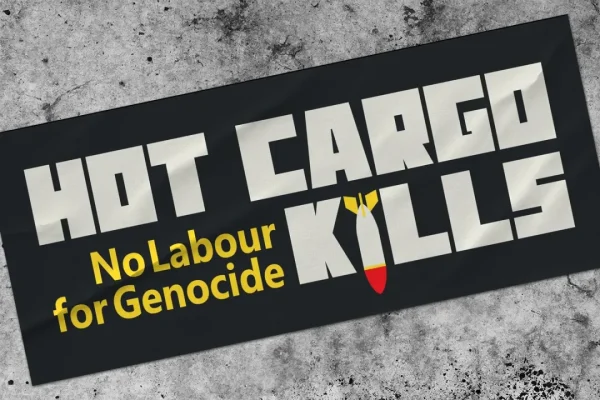
On Oct. 28, the Canadian Labour Congress voted in favour of a resolution that declares goods and services destined for Israel “hot cargo.” The resolution also calls on the CLC to work with relevant unions to put this into practice—meaning that workers organized in Canadian unions will not touch goods destined for Israel.
After more than three years of the genocide in Palestine, this is a long-overdue and welcome development in the Canadian labour movement. Ever since the beginning of the genocide, the RCP has explained that only the working class can stop imperialism. Only the working class, who work the docks, the ships, and the arms factories, have the ability to paralyze the war machine. But as hundreds of thousands protested in the streets, the leaders of the Canadian labour movement did not use their power to mobilize the rank-and-file workers to stop arms shipments to Israel. All kinds of campaigns have been tried but none of them have had the desired effect, because none of them relied on the power of the working class.
This led to the launch of the Hot Cargo Kills campaign by Labour4Palestine in 2025. The campaign called on unions to declare goods destined for Israel “hot cargo”, which workers would refuse to handle. The RCP enthusiastically supported this campaign. We even passed a resolution in CUPW local 710 demanding that the labour movement mobilize its forces to stop arms shipments to Israel.
Finally, after a lot of mobilization, the tops of Canada’s largest trade union center have now bent to the pressure and adopted this resolution.
Follow the example of the dockworkers
Just a day after the CLC endorsed the Hot Cargo resolution, dockworkers around the world showed how to put it into practice. Thousands of dockworkers across six continents, 22 countries, and 113 ports went on strike against militarism and war. The fact that work stoppages and walkouts were coordinated to occur simultaneously, all over the world, and in particular across the Mediterranean, meant that hot cargo could not simply be re-routed. This caused major disruptions to supply routes and cost an estimated $2.8 billion. Marx long ago said “workers of the world unite”. Here we have the power of this principle in action.
This was the culmination of months of preparation. Back in May, port unions across Europe and the Mediterranean pledged themselves to “step up vigilance, inform workers, expose war cargoes and organize constant, collective mass resistance using all available means.” Unions coordinated with each other to organize joint work stoppages and made plans to mobilize their workers in solidarity in the event of repression against any individual workplace. It is this kind of preparation that the Canadian unions must undertake to put the Hot Cargo resolution into practice.
It is encouraging that the two main dockworker unions, the ILWA and the ILA both spoke in favour of the resolution. It is equally encouraging that Unifor, the largest private sector union, voted in favour of a Palestine solidarity resolution last year. What is now needed is to pass from words to action.
The trade union movement, following the example of our brothers and sisters in Europe, should link opposition to the militaristic war drive with the question of cuts to social services and public sector layoffs. In the words of one Italian worker: “Your government moves five per cent of GDP into the military, and then you sit at a table with them and they tell you, we don’t have the money. There’s a fucking political problem. It’s not a union problem.”
Next year, Carney plans to spend $89 billion on the military—$32 billion more than will be spent on health care. This will be paid for down the line by the working class. The money that goes to war is money that doesn’t go to healthcare, education, and other social services.
We have an example of what can happen when the struggle against militarism is linked to the struggle against attacks on living conditions. Last September, Italian workers paralyzed the country in a general strike for Palestine. Workers saw that the same governments who were implementing austerity measures that led to worsening living conditions and rising cost of living were the same ones supporting and profiting off of the genocide. In the words of the dockworkers of Genoa:
“We don’t want our governments and the European Union to turn the economy into a war machine, while privatising ports, reducing wages, and depriving people of education, health, social services, bread and a dignified life, […] We dockworkers have common enemies and a common struggle.”
The Italian general strike scared the living daylights out of the ruling class and even played a role in leading to a ceasefire in Palestine.
Labour leaders must take the lessons of these strikes and implement them in Canada.
Actions speak louder than words
The CLC’s Hot Cargo resolution is a step in the right direction in the struggle against the genocide in Palestine. It is a recognition that Canadian workers have the power to strike blows against the Canadian imperialists. But actions speak louder than words. Resolutions passed at trade union conventions too often have been brushed under the rug and not acted upon. Massive pressure must be exerted on the trade union leaders to develop a plan to put this resolution into action.
The CLC announced passing this resolution with the call “on the Government of Canada to end all direct and indirect transfers of arms and military equipment to Israel.” But this misses the point entirely. Demands have been placed on the government for years and they have continued to find ways to send arms to Israeli imperialism.
There are 3.3 million workers across Canada organized through the CLC and tens of thousands of them work in industries involved in the manufacturing and transportation of weapons of war: railways, docks, freight, steel manufacturing, postal services, etc. These workers, with the power to withhold their labour, have the ability to bring Canada’s war machine to a grinding halt, which would have a direct impact on stopping the genocide. Not only do the workers have the power to halt the war machine, but they have the power to run society without the bosses altogether. This is the way to put an end to all war and suffering, and to ensure that every worker has a dignified life.

