
The following is the featured article for issue #27 of Communist Revolution. Subscribe here or order a copy of the new issue in our store.
Prime Minister Mark Carney has released his “AI for All” strategy, in an attempt to convince ordinary people that implementing AI will benefit them.
With the AI arms race underway, Carney is clearly worried Canada will be left behind. His strategy talks about increasing “Canada’s business adoption of AI from 12 per cent today to 60 per cent by 2034” and about “the unlocking of a three per cent increase in GDP… from labour productivity.” It also proposes to build “sovereign AI infrastructure”—a fancy way of talking about building data centres here.
But this AI push has a problem: massive opposition to AI across Canada. A 2023 poll showed that half of Canadians perceive AI as a threat to humanity, and 79 per cent worry about AI replacing jobs. Trust in AI amongst Canadians is one of the lowest in the world.
In reality, this strategy is not much more than a PR operation for an industry that is hated by most people—and understandably so.
Data centre backlash
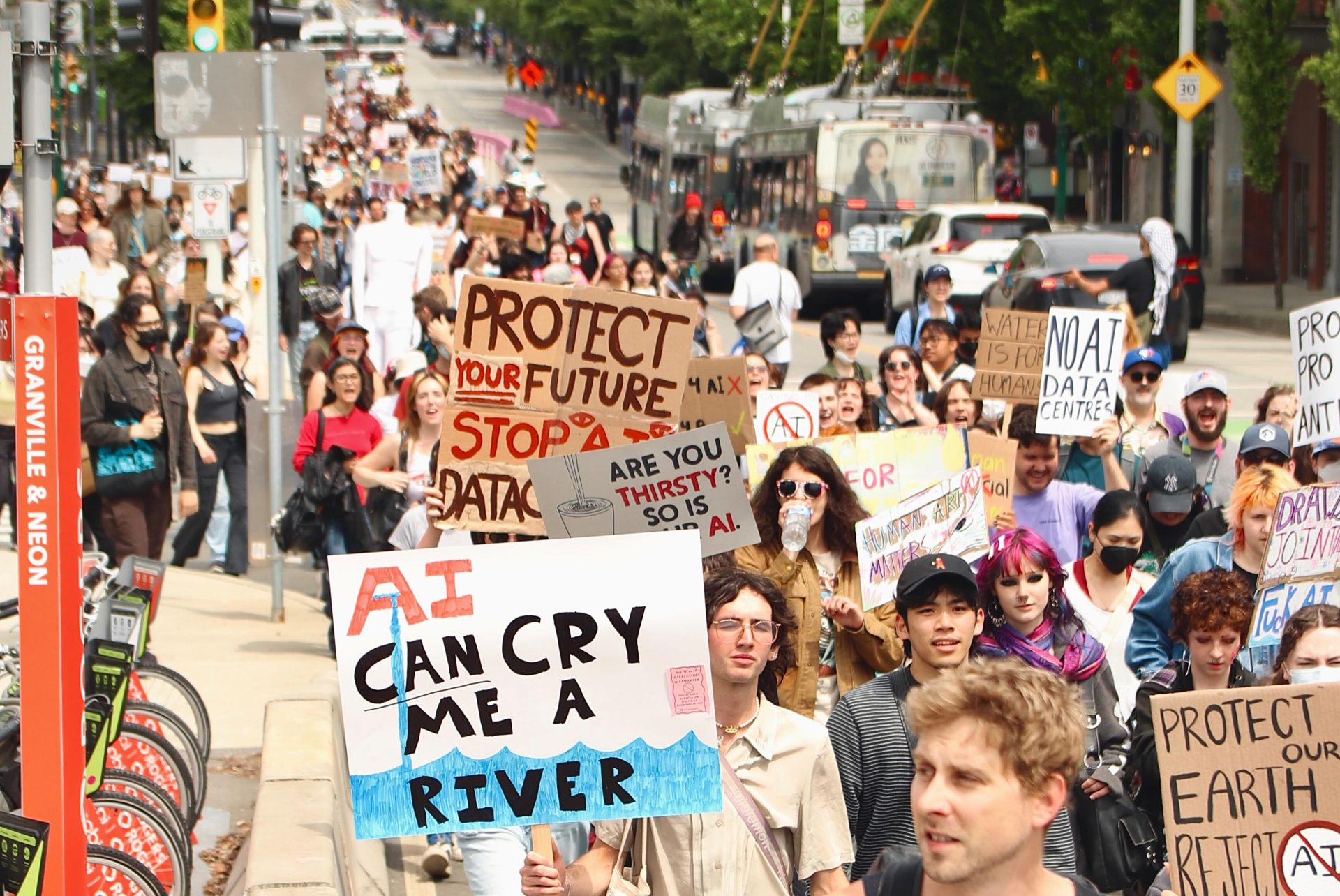
Recently, protests have spread across the country attempting to stop the building of AI data centres. Eight of these projects are underway and about 30 are in the planning stage. In every province they’ve been announced, they’ve been protested.
This opposition is not simply about an abstract fear of AI or mistrust of technology, although that does exist. Rather, much of the opposition stems from very real class issues related to the data centres, which are important no matter how one feels about AI in general: rising energy rates, blackouts and brownouts, pollution, water usage and surveillance.
There is a reason that these projects tend to get stuck in poor, racialized communities. Tech companies target these communities because there tends to be cheaper land, fewer regulations, and less political opposition. As one Southern Memphis resident, who lives near an xAI data centre put it, these are “sacrifice zones.” South Memphis has become one of the most polluted, asthma stricken parts of the United-States.
There, the company was able to use its backup gas generators without following regulations, because they were supposed to be temporary. It was this data centre which xAI’s owner, Elon Musk, referred to when he assured investors that Grok 3 (xAI’s chatbot) would be up and running in time, “We have generators on one side of the building, just trailer after trailer of generators until we can get the utility power to come in.”
In Alberta, the recently announced Meta data centre was supposed to supply its own energy to avoid price hikes, but now they’ve been given approval to tap into the power grid. Since Alberta has Canada’s only completely deregulated privatized power grid, consumers are already subject to the most volatile, expensive rates in the country. It’s not hard to see that plugging a mega AI data centre into the power grid will lead to a huge spike in the cost of electricity for millions of working class people.
Some of these protests have had significant results. This spring, the small town of Olds, Alberta drew national attention for organizing against a proposed $10 billion data centre right inside their town. Seemingly, they got developers to back off.
In Hamilton, the city’s planning committee decided to stop development after a packed and raucous town hall meeting. One city official said, “In a lot of years, I’ve never seen that kind of outcome from the public.”
And on the same day Carney released “AI for All,” Manitoba Premier Wab Kinew announced that they would not be going ahead with a proposed data centre in the rural community of Île des Chênes, after a petition against it gathered over 13,000 signatures—more people than live in the community.
At the same time, the backlash against data centres in the United States has been growing. In the first three months of 2026 alone, protests and organizing blocked or delayed about $130 billion worth of investments across at least 75 developments. That’s more than were blocked in the entire year of 2025.
Carney is saying: don’t do that here—let the data centres in.
Tech bros versus Canadian workers
In order to sell Canadians on data centres, Carney’s strategy makes big promises. It argues that AI could create up to 250,000 jobs in the next five years.
A big portion of those jobs are supposed to come from a $500 million fund to incentivize businesses to implement AI. But this seems to simply mean paying for companies to purchase AI agents like ChatGPT, and getting them consultants to help them determine how to use AI for their business.
How this would create tens of thousands of jobs is unclear. The figure of 250,000 seems to come from some OECD modelling, based on the most aggressive estimates. And nowhere in the plan does it address how many jobs would be lost from the implementation of AI. In the United States for example, an estimated 165,000 workers have already been victims of AI-related layoffs.
Another plank of the strategy sets aside $1.2 billion in subsidies for “sovereign” data centres and AI companies, even promising a “world-leading public AI supercomputer.”
Typical of Carney, he is trying to tap into Canadian nationalism, which exists in large part in opposition to American domination. The only problem is that American tech billionaires dominate the AI industry in North America.
This means that any data centres built in Canada will overwhelmingly benefit Silicon Valley. A small handful of US tech firms control over 80 per cent of the market for key components needed inside any data centre, like software, cloud computing capacity and chips. So even where Canadian data centres are being built, they will be built hand in hand with the big US tech companies like Microsoft and NVIDIA, who will make a tidy profit.
Because Canadian tech companies are small and weak compared with their American counterparts, Carney will be providing a significant amount of state money to get these data centres off the ground. This means subsidies for private companies which will largely benefit American tech companies.
This is what happened with the incredible case of Canadian AI company Cohere, which received $240 million specifically to enhance Canada’s “AI sovereignty,” only for an American company to build the data centre itself.
Insofar as “Canada” benefits, it’s mostly going to be the Big Three telcos—Bell, Rogers, and TELUS—as well as the big banks and investment firms, like Brookfield, which has invested $100 billion in AI infrastructure so far.
Despite Carney’s rhetoric about sovereignty, job creation, and the public good, everyone knows that this push for data centres is being driven by a handful of American tech billionaires—the likes of Elon Musk, Bill Gates, or Peter Thiel.
Meanwhile, these projects create almost no jobs relative to the amount of investment. For example, the $13 billion Meta data centre being built in Alberta is projected to create just 300 permanent jobs.
In light of this, Carney’s talk of job creation is ludicrous, especially since the tech capitalists cannot stop publicly fantasizing about literally destroying all jobs. When Amazon announced last year that they plan to replace half a million jobs with robots, Musk took the opportunity to post, “in the future, AI and robots will replace all jobs.”
Even if the idea of robots replacing all jobs is a tech bro fantasy, the prospect of devastating unemployment while the social safety net is being gutted represents a genuine fear many working class people have. And the backlash against data centres represents a protest against everything that is wrong with capitalism: control by a small group of people who do whatever they want while we are made to suffer.
Overthrow the tech billionaires
In his introductory speech for “AI for All,” Carney quoted Pope Leo XIV who said of this technology, “never has humanity had such power over itself.” This couldn’t be further from the truth.
Never has humanity been so dominated—not by AI, but by the elite billionaires who profit from it. This means the tech capitalists, yes, but also the entire billionaire class which they belong to.
Under capitalism, people are right not to trust the construction of these giant data centres in their communities. These projects are driven by the tech bro billionaires, with no say from the working class people whose lives they will irreparably change. Without a push back from the general population, everyone knows what will happen—our lives will become more expensive while a few billionaires will make massive profits.
Despite this, AI is a revolutionary technology. With the working class in control of society, AI would be a valuable technology used to plan the economy. It could advance healthcare, replace menial labour, shorten working days, and advance research of all kinds. It could be a force for liberation—but only if it is taken out of the hands of the elites who currently control it.
Then, we will not be dominated by machines, because we will not be dominated by the people who own them.

