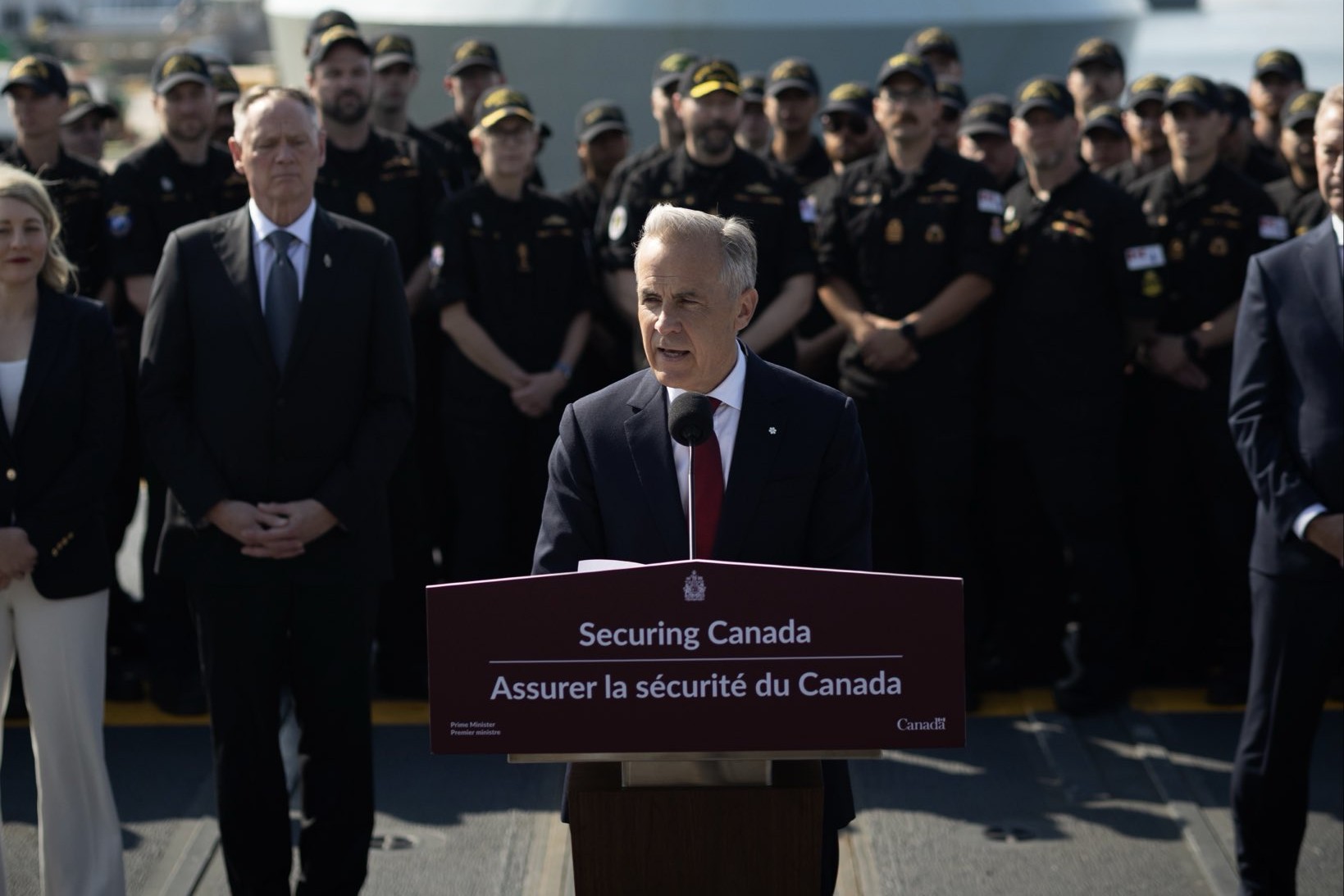
On July 6, Carney announced that German company, ThyssenKrupp Marine Systems (TKMS), would build the Canadian navy’s new fleet of submarines. It’s estimated that the lifetime cost to the public for purchasing and maintaining this fleet could run up to an eyewatering $100 billion.
This is expected to be the largest single military acquisition in Canadian history, occurring at a time when public debt has reached critical levels. It is therefore unsurprising that the Prime Minister’s office has been quick to reassure us that this expense will lead to an economic boom. While sparse on details, Carney has stated that part of the deal would be TKMS’s obligation to invest tens of billions in infrastructure that would benefit everybody coast to coast, and provide up to 100,000 jobs.
One hundred thousand is a staggering number of new jobs—and almost certainly a lie. In their rush to applaud Carney, the capitalist media has simply taken him at his word. So far, Carney himself is the only source for the 100,000 jobs figure—a number he has every incentive to inflate in order to justify this monster purchase to the Canadian public.
One might wonder where these 100,000 jobs will come from, particularly when the submarines will be built in Germany—not in Canada. Moreover, the bill just to procure the vessels from Germany is $24 billion. That’s nearly half the annual federal health transfers to all provinces combined. That’s a huge cost for no jobs.
While the government floated the idea that an investment in the Canadian automotive sector may be a part of this deal, any mention of this was absent from Carney’s announcement. TKMS has made agreements with Seaspan ULC, one of Canada’s largest marine builders, to construct maintenance facilities on both coasts, as well with EllisDon Corp, one of the country’s construction giants, to build training facilities. But these jobs will be temporary jobs dealing with the construction, not long-term jobs. The long-term, stable jobs created will most likely be nominal at best.
When the full cost of the program is considered, what few jobs it might create would pale in comparison to what is demolished. $100 billion is a cost the indebted federal government can’t afford without making cuts to the public sector. Tens of thousands of public sector jobs will be cut, meaning this isn’t really about “creating jobs”. What this is really about is Carney militarizing Canada in response to pressure from Donald Trump and the new imperialist order being formed.
Carney’s sales pitch that any jobs will go to local workers is also dubious. The type of labour required to build the infrastructure associated with the subs will be highly technical, and likely draw skilled trades workers away from other industries rather than create opportunities for the unemployed. Irving Shipbuilding, a company with current operations on the east coast, has publicly questioned whether the federal project will poach their employees.
In the words of one expert we face a “slow motion crisis in the making,” as older trades people retire without being replaced. This labour shortage extends beyond the shipbuilding industry. Paul Mitchell, a professor at Canadian Forces College, stated that the success of the project will depend on “the ability of industry to hire very, very arcane types of technological skill sets, which are actually in competition with things like pipelines.” Given that federal and provincial governments have announced not one, but two new pipelines to be built, it is likely that this project will suck workers away from other projects.
It is not surprising that Carney has made it a central priority to train 80-100,000 new trades workers in the next five years. However, this money will largely be channeled through private companies and organizations in the form of grants and wage subsidies. Public oversight will doubtless be minimal. The Ontario government was recently embarrassed when it was discovered that a similar program was used to fund government-aligned groups, even when it was determined that their ability to train workers was poor.
The working class has nothing to gain from Carney flushing $100 billion down the drain with this submarine purchase. Most of the money will not create any jobs and most of the jobs created will be temporary at best—while tens of thousands of public sector jobs will be axed as a consequence.
The breakdown in the postwar order means the Canadian ruling class can no longer rely on America’s aegis. The result is that the so-called “peace dividend” is over and while they have lots of money for armaments, they increasingly have no money for healthcare, education and social services in general.
This is why Communists say:
Books not bombs!
Healthcare not warfare!
Homes not drones!

