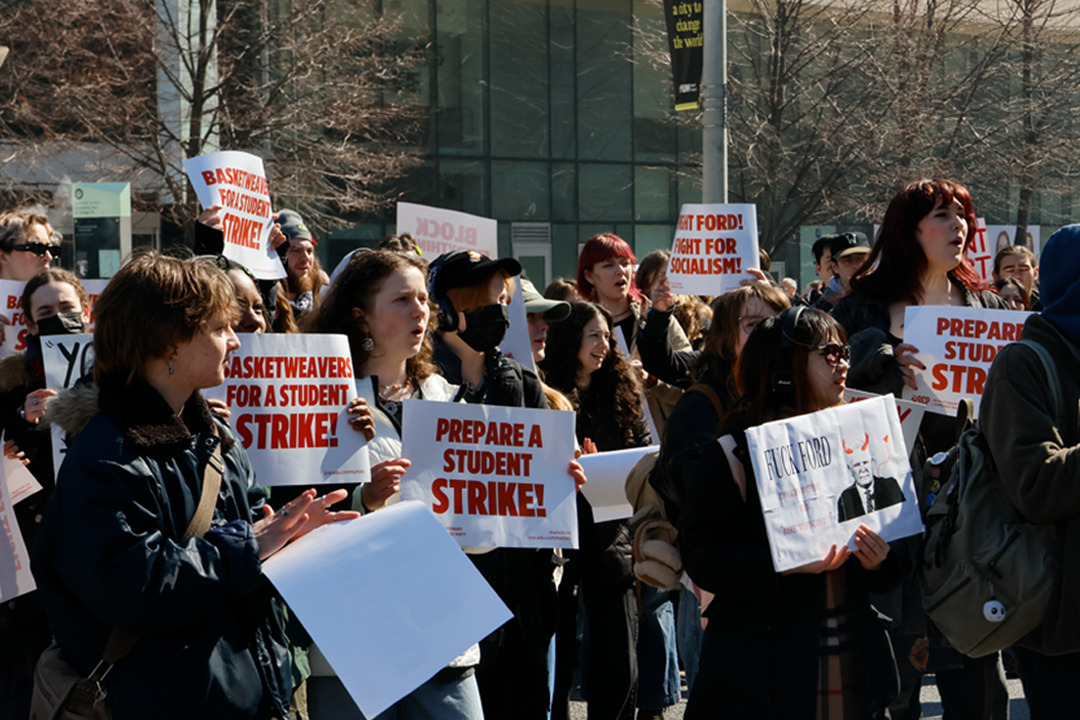
Doug Ford’s move to cut student financial aid this past spring was met with widespread anger. Thousands demonstrated, high schoolers walked out and talk of the need for a student strike was widespread. Now, with the fall semester starting, the Canadian Federation of Students-Ontario (CFS-O) has officially endorsed a province-wide, one-day student strike on Nov. 5.
This could be a launchpad for a mass movement to stop the cuts to OSAP and bring down the hated Ford government. The student unions must begin dedicating resources and mobilizing power now to make this a success on every campus in the province.
The need for a strike
When Ford announced the OSAP cuts last spring, he was faced with an immediate outburst of anger from students all across the province. The successful rally at Queen’s Park on March 4, along with hundreds of high school walkouts, showed the desire of students to fight back against these attacks on their education.
But there was another important feature of the movement: the idea of a student strike quickly gained popularity among a relatively wide layer of students. Immediately after the announcement of the cuts, “student strike” social media accounts and WhatsApp channels for seemingly every campus in Ontario sprung up organically, often gaining large followings.
At some campuses, like McMaster and OCAD, there were successful votes for a student strike in the fall. And at the University of Waterloo, a one-day strike actually took place after thousands of students voted in favour of the action. This was a new development for the student movement in Ontario, which has no real tradition of strikes.
From the start, the RCP has argued that a student strike is the only way we will be able to defeat these cuts, and that the CFS has to take the lead in organizing it. As the largest student federation in Ontario, representing around 350,000 students, it is the only organization with the authority and resources to truly shut down the campuses and lead the movement to victory.
Before now, the CFS leadership spent a lot of time pouring cold water on the idea of organizing a strike, claiming that it would “take time”, etc. What we explained at the time was that yes, a strike takes time, but it is the duty of the student union leadership to therefore start the mobilizations right away and use their resources to explain to students why a strike is necessary.
With the fall semester approaching and the OSAP cuts hitting the bank accounts of hundreds of thousands of students, pressure mounted on the CFS leadership to do something. They eventually bent to the pressure and the result is this strike resolution being passed at their recent meeting. The task now is to make this strike day a big success.
What next?
The question now is: how can this actually succeed?
The aftermath of the March 4 rally showed that without clear direction, even a strong movement can fizzle out quickly. After making a real show of force, with thousands of angry students coming to Queen’s Park, the opportunity was ripe to escalate. But no such lead was given, and the momentum dissipated.
While the endorsement of a strike is a positive step, it is worth noting that the CFS adopted a similar motion in 2019, but subsequently did nothing to actually mobilize students. The motion was barely mentioned, and the idea of a strike was not promoted or explained on the campuses. As a result, nothing really came of it.
A strike cannot just be a resolution on paper. To make it into a reality, the student unions on every campus need to take on the task of making it happen. This means developing a concrete plan and dedicating resources to mobilize as many students as possible leading up to Nov. 5.
Lessons from Quebec 2012
The Quebec 2012 student strike is a model for how this can be done. Student leaders spent months talking to students every single day, educating them on the need for a student strike, and building up support through mass meetings and votes. In this way, the movement was put in the hands of the students themselves. Once enough support had been gathered, they organized a series of smaller actions to build up to an all-out, unlimited strike.
The Quebec students’ first real show of strength came in Nov. 2011, with 200,000 students on strike for two days and a mass demonstration of 20,000 students. This was used to build momentum and for students to see their strength in numbers. By February 2012 they had launched an unlimited strike, and before the end of the year they had brought down their government. This was only possible because the leadership clearly stated their aim of a student strike from the outset, and had a plan to make it happen.
This can be replicated in Ontario. Every union should organize emergency general assemblies where they can make the case for a strike, and students can democratically shape the course of the movement through open discussions and votes. This needs to be done as quickly and energetically as possible.
From there, clear plans must be made to drum up wide-reaching support for a strike and get the biggest turnout possible on Nov. 5. This should include a campaign of escalating actions, like walkouts and protests, to build up confidence among students and show them the real potential of a strike. All of this is doubly true for the campuses that have already passed strike votes.
Bring down Ford!
Ultimately, no matter how successful, a one-day strike will not be enough to force Ford to back down. As in Quebec 2012, this needs to be a stepping stone towards an unlimited, province-wide student strike.
The conditions are ripe for an all-out fight against the Ford government. Ford is brutally unpopular and hated by wide layers of society. This year alone, he has turned workers and students against him through his cuts to public services, the underfunding of firefighting resources as wildfires raged throughout the province, and the blatant corruption of his whole administration.
A student strike, if properly carried out, could easily spread to the faculty, other workers on campus, and the wider labour movement. Nov. 5 can be the opening shot in a broader struggle, not just to repeal the OSAP cuts, but to bring down Ford for good.

