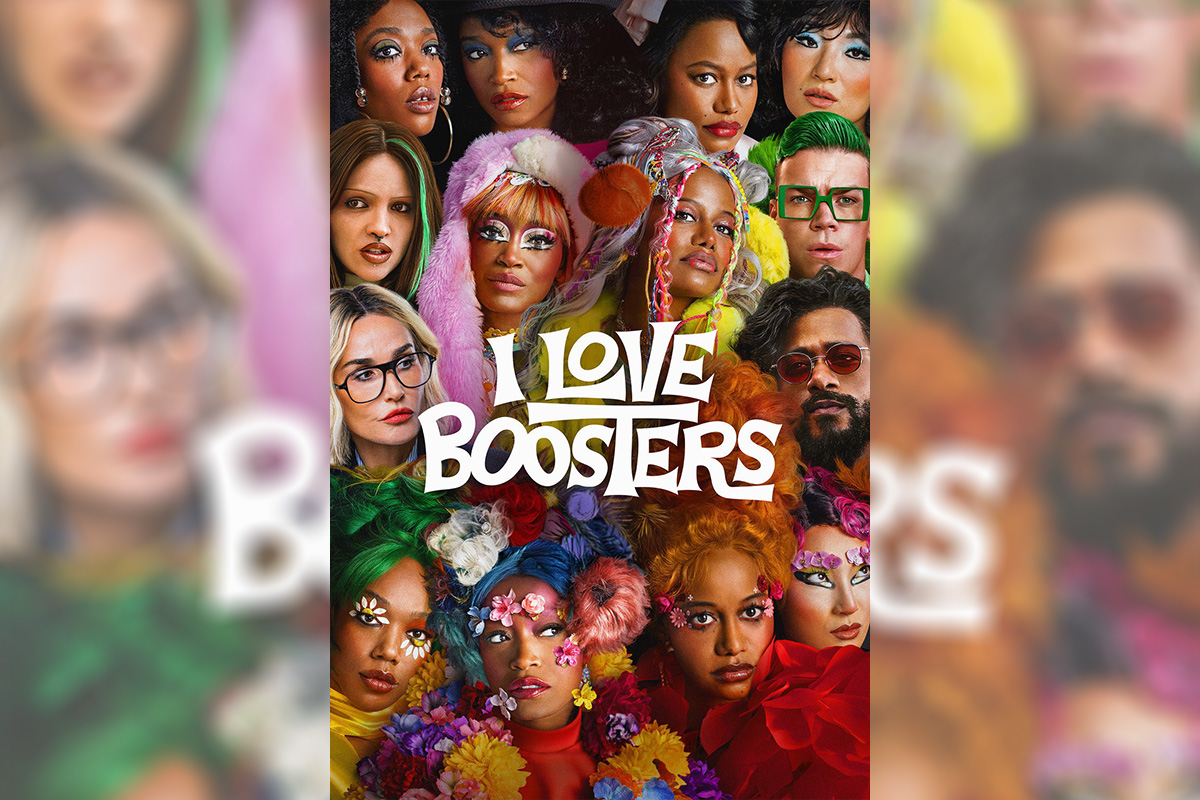
Corvette wants to be a designer, but the conditions of poverty under capitalism have conspired against her. She squats in an abandoned fastfood chicken joint, and makes ends meet by stealing high-end clothes with her gang to resell at discount prices. She’s plagued by alienation, feeling lonely even as her friends and partners-in-crime lend an ear to her worries. Those worries loom over her, visualized as a giant ball of bills and notices that rolls after her threateningly.
This is self-proclaimed communist Boots Riley’s I Love Boosters, at its best: when it weaves anticapitalist ideas organically through Corvette’s struggles.
There’s a lot to enjoy about Boosters. Its trippy, surrealist flair is eyecandy unlike anything else in theatres. The bluntness with which Riley depicts the exploitation of workers, and the hypocrisy of capitalists, is a breath of fresh air. Keke Palmer plays Corvette with sympathy and humour. Her love/hate antagonism with the self-serving capitalist designer Christie Smith (Demi Moore) is entertaining.
But then Riley takes a hard didactic turn and I Love Boosters stops functioning so much as art as propaganda.
Corvette and crew get a hold of a sci-fi device powered by dialectical materialism (the philosophy of Marxism), that can both deconstruct and accelerate contradictions (and also teleport). In the climactic scene Corvette uses it to accelerate the dissatisfaction of workers into strike action.
The plot screeches to a dead stop for a union activist to explain the “dialectical materialism” powering the device, and, frankly, it’s bad. Instead of actually explaining dialectical materialism, the character repeats the misconception that it’s the same as the Aristotelian dialectic: “thesis+antithesis=synthesis.” A mullet is used to clumsily illustrate “synthesis”, and the changes the device accelerates happen linearly rather than through sharp turns and explosions—i.e. dialectically.
A sci-fi accelerationism machine is simply a poor choice as a device to illustrate dialectical materialism, because it necessarily removes the subject from the material forces acting upon it. This isn’t just bad theory, it has narrative consequences: the climactic strikes pop into existence magically, and so feel hollow and surface-level.
With a literal accelerationism machine on-hand, we also have to wonder, why would a communist filmmaker stop at a strike? Why not go for full revolution? In the denouement Riley gestures towards the strikes inspiring a broader worldwide movement, but it’s all very vague. Corvette doesn’t end up a revolutionary, she just runs a clothing swap. There’s very little that a common trade union bureaucrat wouldn’t agree with. As communist propaganda it’s weak sauce.
Art doesn’t have to have perfect Marxist politics to be good. The vast majority of art doesn’t have Marxist politics. Artists can be observant, insightful and poignant whatever their political leanings. But in I Love Boosters Riley drops propaganda on top of art like an anvil. Even if the propaganda was better it would still be hamfisted.
Towards the end of I Love Boosters, Corvette confronts Christie Smith, and tells the designer who sees human beings as the medium for her own creative impulses, “I don’t think people want to be the art, they want to be the artist.”
It’s a pointed comment on how, under capitalism, only a select few have the freedom of self-expression.
The irony is that I Love Boosters itself trips up at being art and slips towards being a textbook in a colourful disguise. By trying to turn art into propaganda, Boots Riley ends up with both mediocre art and bad propaganda.
Leon Trotsky said that “Art must make its own way and by its own means. The Marxian methods are not the same as the artistic.” Art and politics are different things, their social function is different and they’re judged by different standards.
A really Marxist approach to film would probably leave the dialectical materialism didactics on the cutting room floor.

