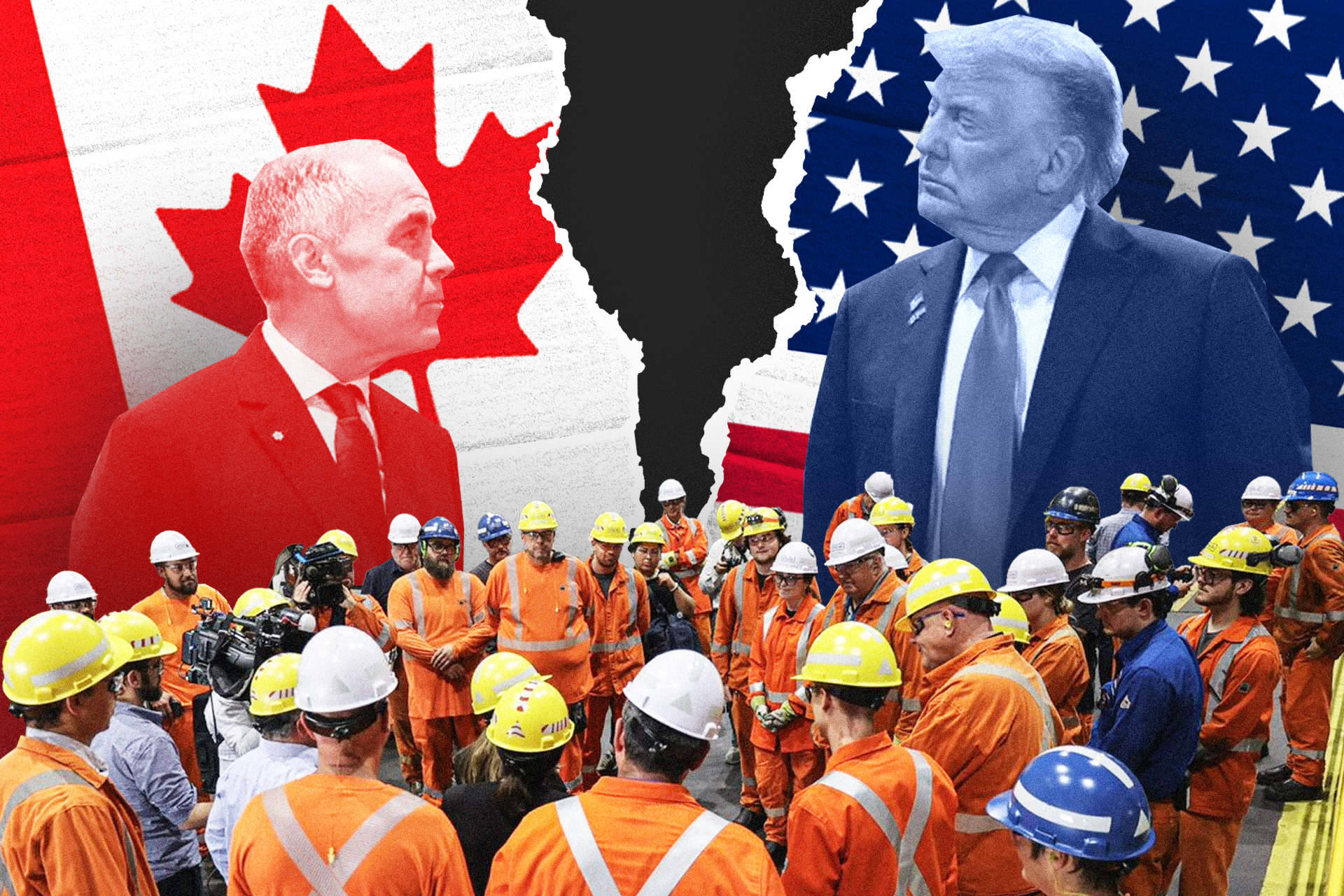
For the last year and a half, Mark Carney has made concession after concession to Trump. He quietly dropped most of the counter-tariffs against the U.S. He agreed to raise military spending to Trump’s target of five per cent of GDP. He bent the knee on the Gordie Howe International Bridge and then tried to lie about it.
None of these capitulations stopped Trump from announcing his latest round of 50 per cent tariffs. In the ensuing negotiations, it became an open secret that Carney was once again prepared to give a lot for little in return.
According to inside sources, Carney was ready to drop all of its counter-tariffs; to return U.S. booze to store shelves; to modify supply management policies to make more room for American dairy; as well as complete the $88-billion purchase of American fighter jets; give the U.S. first pick over its critical minerals; and opt into Trump’s Golden Dome continental missile program.
In exchange, the U.S. would cancel the planned 50 per cent tariffs but only lower the existing tariffs against autos, steel, aluminum, and lumber. Negotiations around the CUSMA free trade agreement would also be re-opened.
While the press mused about the deal being a tough sell for Carney, Manitoba Premier Wab Kinew reported that Carney had begged him to return U.S. alcohol to liquor store shelves.
In the end, the Americans made last-minute demands that would have been utterly humiliating for Mr. Elbows Up to accept. Namely: modifications to tariffs on Canadian autos and limits on Canada’s ability to make free trade deals with other countries. Apparently they also demanded the relaxation of laws requiring French language on packaging sold in Canada as well as laws protecting Canadian cultural content.
Carney has since announced he will be retaliating with tariffs of his own.
Team Canada
Now that Carney has changed his tune, an unholy chorus has lined up behind him to sing his high praises.
Conservative Leader Pierre Poilievre implores “all Canadians” to “stand united for our workers, our businesses and our country.” NDP Leader Avi Lewis writes that “the Prime Minister was right to walk away from the negotiating table last night” and that “Canadians are united at this crucial moment, on this crucial point: better no deal than a bad deal.” Support for Carney came from Ontario Premier Doug Ford in Ontario, Quebec Premier Christine Frechette and B.C. Premier David Eby.
Bea Bruske, head of the Canadian Labour Congress, believes that though “the road ahead will be tough … we are all in this together.”
Across the political spectrum, the message is the same: we must all unite to defend Canada. Three cheers for Carney!
But whose Canada is Carney defending?
It is understandable why more than half of Canadians support retaliating against Trump. The trade war means job losses and uncertainty for thousands of workers. At the same time, many hate Trump because he seems like the distilled expression of American capitalism.
On the other hand, the Canadian ruling class fundamentally agree with much of Trump’s program and want to see it carried out at home. For the last year and a half, Carney has been doing so loyally.
With one hand he slashes environmental regulations. With the other, he fast-tracks oil pipelines and mines. He’s spent billions building up the military and plans to spend more on it than on healthcare and education combined. He’s spent more on border patrol and armed the government with more powers to spy on its own citizens. Currently, the Parliament and the Senate are planning sweeping changes to the Labour Code to prevent strikes.
Many of these were long-desired measures on the ruling class’s wishlist. But they were unpopular. Now Trump has provided the perfect pretext for Carney to carry them out: the need to “protect the nation”.
These changes are exactly the ones the White House has been trying to push on its allies. In a recent leaked speech, U.S. Vice President J.D. Vance explained that the trade war is not just about markets. Instead, “the whole point of this is to change Canada’s behaviour,” which he thinks has been successful, since “they’ve certainly shifted in a Trumpian direction.”
Though the Canadian capitalists may try to protect this or that market from the Americans, they agree on the need for more cuts, more attacks, and more military spending.
Fight the trade war with class war
The deal Carney almost signed would have been disastrous for Canadian workers. Even lowered tariffs against Canadian autos would have spelled the end of the auto sector in the long run.
But a tit-for-tat escalating trade war will be no picnic either. In fact, it could wind up being worse. One estimate sees 90,000 jobs being lost due to Trump’s 50 per cent tariffs. Counter-tariffs would not protect jobs: they would only lead to higher prices, economic dislocation, and reduced trade. More job losses would follow.
Faced with this catastrophic situation, both the federal and provincial governments are rolling out programs providing billions in support for businesses negatively impacted by the trade war. While Carney says these supports will remain in place “as long as it takes,” the government cannot prop up the private sector forever. The federal and provincial governments already spent massive sums propping up the economy a few years ago during the COVID crisis. Debt levels are at historic heights.
It’s doubtful these programs will be enough to entirely prevent job losses, unless governments take on huge levels of debts that they cannot afford—and even then, as we saw during the pandemic, some corporations will take the subsidies and still lay off workers. So while these corporate support programs will further increase the debt crisis, and therefore provoke austerity and cuts in the public sector, they will not stop job losses. Either way, the working class will be made to suffer.
We can have no faith in the Canadian ruling class who are only trying to defend their profits and market share. Faced with an onslaught of layoffs and factory closures we cannot rely on counter-tariffs which only lead to increased prices, or corporate subsidies which only lead to austerity measures. What we need is a working-class response to the trade war, with the labour movement mobilizing against any attempts to make workers shoulder the burden.
Sooner or later, companies will close up shop, or reduce their work force, or cut benefits and wages to deal with the lost profits from the trade war. Even before the latest tariffs, 42 per cent of Canadian manufacturers revealed they were either planning to or had already moved production to the States.
When a company cites the trade war as the reason for attacking workers, we demand that they open up their books to prove it. If they refuse to do so, they obviously can’t be trusted.
Any workplace shut down must be occupied and nationalized as the only way to concretely guarantee that workers aren’t made to pay for this trade war. That is the socialist response.
The capitalist system is dragging society into the abyss. In the place of free trade and cooperation, the ruling class of America are now exacting concessions from former allies. Either way this pans out, the results will be disastrous for the working class.
Only under socialism, with the working classes of Canada, Quebec, and the U.S. in control, would we be able to put an end to this fratricidal bickering and economic blackmailing. The vast wealth of the Americas, rather than being squandered by the few, could finally go towards addressing the needs of the many.

