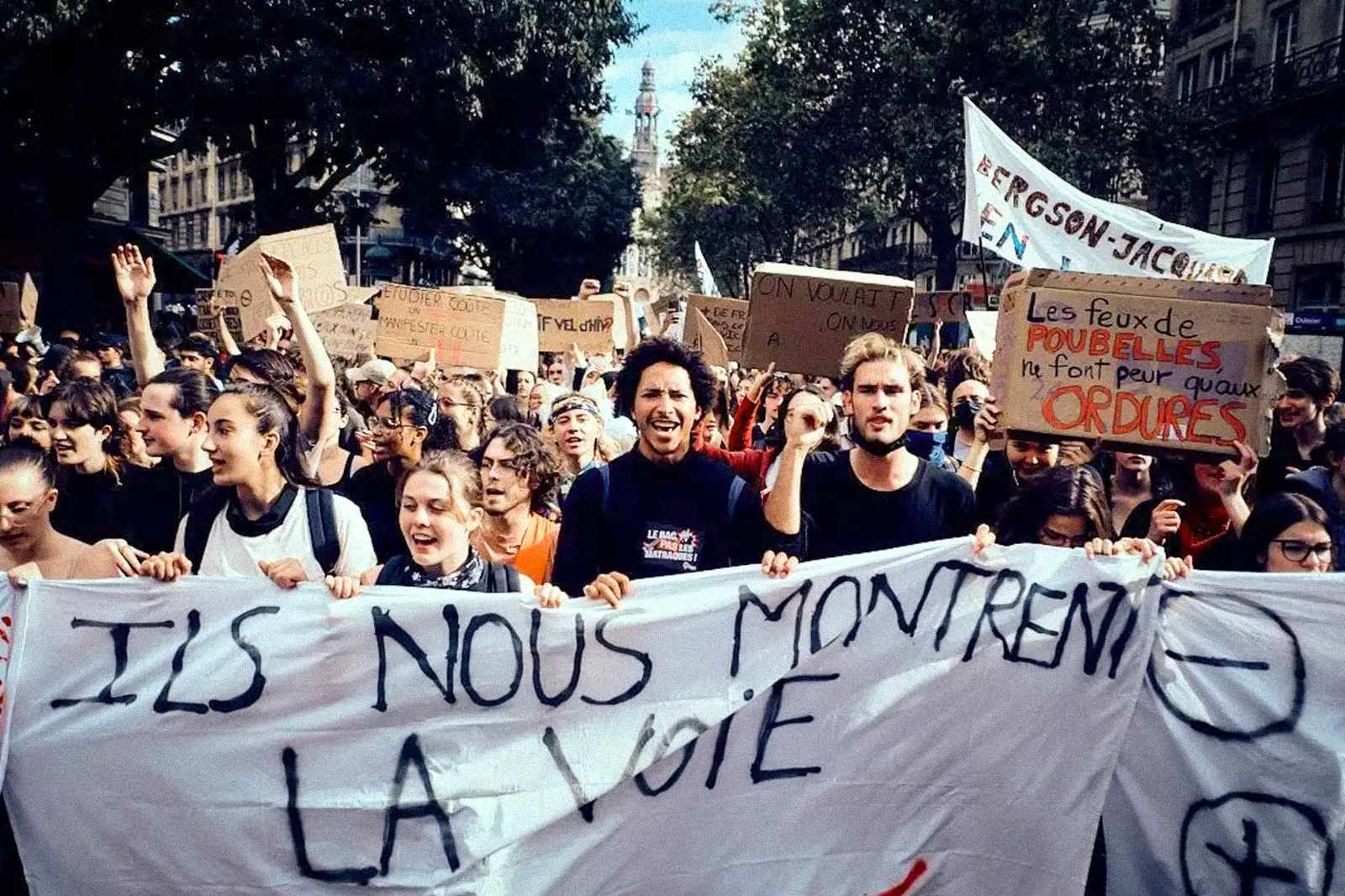
On Oct. 13, hundreds of thousands of workers and youth mobilised across France for the latest in the recent wave of student-led protests sweeping the country. With 90 per cent of French universities and hundreds of schools shut yesterday, it is clear that this youth-led movement has not been cowed or diminished in scale, despite brutal police repression.
We publish below an article by Jérôme Métellus originally published in French at marxiste.org, which lays out the tasks ahead, if the successes of yesterday’s protests are to be turned into a struggle that can deal a killing blow to the hated Macron government.
On 13 October, university and high school students mobilised massively once again. They have repeated 6 October’s show of force. This confirms the depth of the movement, its enormous reserves of fighting spirit – and its revolutionary potential.
All eyes are now on 17 October. The idea was launched before the start of the magnificent mobilisation of high school students. But they, like the university students, naturally seized upon it. They have made 17 October a major step in their fight against the dismantling of the national education system. Many workers will also be taking action this Saturday.
Everyone is now talking about 17 October – or more precisely, everyone except the national leadership of the trade unions. As of now, there isn’t a single mention of 17 October in their official communications over the past six weeks. On 12 October, in response to a journalist’s question about the CGT’s participation in the 17 October demonstrations, Sophie Binet didn’t take the opportunity to issue a call to action.
She simply offered a cryptic statement: “Wherever the conditions are right, the CGT will be there.” What could that possibly mean? Isn’t one of the CGT’s roles to ensure that the conditions are right for a powerful social mobilisation, like the one expected on 17 October?
We have emphasised this dozens of times in recent years: the leadership of the trade union confederations – including that of the CGT – fears nothing more than an explosive social movement that escapes their control. Hence their call for mobilisation on 5 November, aimed at defusing the potential impact of 17 October. We saw the same scenario in September 2025 with the ‘block everything’ movement, which also emerged on social media, that is, independently of the major union organisations.
13 months later…
Nevertheless, just like on 10 September, 2025, young people will mobilise in large numbers on Saturday, and probably even in much larger numbers than 13 months ago.
10 September, 2025, was a Wednesday: among the many workers who supported the movement, most did not strike and, therefore, were unable to demonstrate. This was all the more understandable given that, as we have just mentioned, the union leadership had done everything possible to defuse the explosive potential of 10 September. Only federal and local union structures, alongside political parties, had called for mobilisation.
17 October – a Saturday – will take place in a slightly different context. Many workers of all ages will be able to mobilise without having to go on strike. There will therefore be massive gatherings in the streets of high school students, university students, workers, but also the unemployed, retirees – and even, no doubt, a segment of the lower middle class: shopkeepers, artisans, farmers, professionals, etc.
Above all, the living conditions of the masses have continued to deteriorate since September 2025, and particularly since the imperialist aggression against Iran last February. Inflation has risen sharply. Fuel prices have skyrocketed and show no sign of falling, while the bosses of French oil multinational TotalEnergies are raking in huge profits. This summer, the climate crisis and government negligence have left their mark on people’s bodies and minds, killing thousands of elderly people, burning 76,000 hectares of forest, and devastating the agricultural sector.
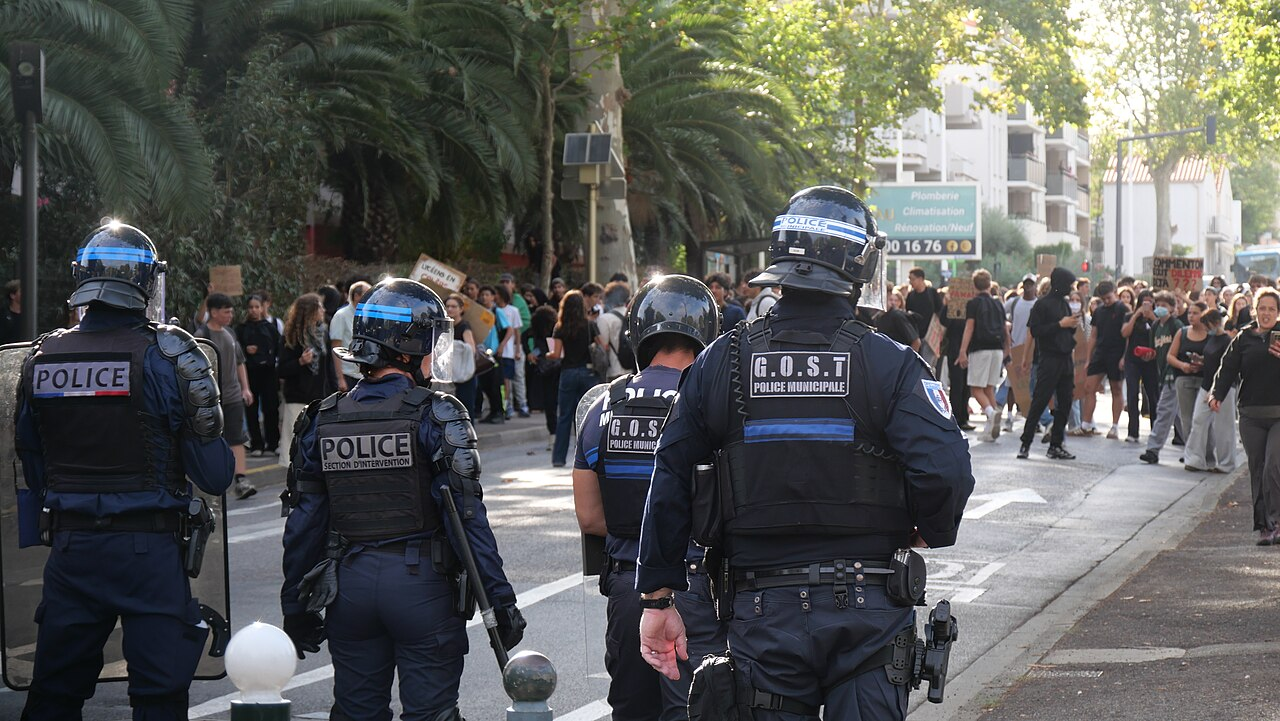
Young people view their future with dread and wonder what kind of world they will live in – or survive in. When they mobilise to demand decent learning conditions, the government responds with insults, police brutality, and unprecedented judicial repression.
Millions of ordinary citizens are shocked by the images circulating on social media. The unleashing of police violence, the beatings, mutilations, and humiliations inflicted by the ‘forces of order’ on mobilised youth. The way they filter access to demonstrations and confiscate placards they dislike. The way they systematically provoke protesters, including through more or less blatant and grotesque infiltration methods. All of this constantly fuels revolt and a thirst for revenge among a growing number of the exploited and oppressed. Thus, the conditions for a revolutionary explosion are rapidly ripening in the hearts of millions.
‘Let the rich pay for their crisis!’
It is in this general context that the government wants to impose further drastic cuts in social spending – and that the press announces daily a sustained deterioration of the economic situation.
This is an element of the equation that is sometimes overlooked on the left. The masses do not mobilise solely under the unbearable pressure of accumulated suffering; to this fundamental factor is added that of immediate prospects, including those related to the economic situation.
When the cup is already overflowing, the prospect of further suffering, further cuts, and a further increase in unemployment and poverty can play a major role in triggering a powerful social movement. In May 1968, for example, the beginnings of a deterioration in the economic situation played a certain role in precipitating the revolutionary crisis.
Bourgeois journalists and politicians are doing everything they can to convince the people that a new austerity budget is an absolute necessity. They say people must tighten their belts in their own interest, that it is ‘a necessary evil’, that the (very real) public debt crisis leaves the government no room for budgetary maneuver. They say that Lecornu must try to reassure the financial markets by imposing tens of billions of euros in additional cuts – and that the only alternative to this reactionary policy is the French economy’s descent into hell.
But hell already exists for the growing number of young people, workers, the unemployed, and retirees who are slipping deeper into the abyss every day. And an ever-increasing number of these people refuse to bear the brunt of an economic crisis for which they are not responsible. In a more or less muddled way, they are demanding that the real culprits – the rich and powerful – should themselves take responsibility for the consequences of their economic collapse.
A very clear expression of this mindset, on the political level, is the extraordinary momentum surrounding Jean-Luc Mélenchon’s election campaign, more than six months before the presidential election. But even among Marine Le Pen’s working-class electorate, albeit in a more confused form, one can find this simple and clear aspiration: “The rich should pay for their crisis!”
The revolutionary implications of this idea are obvious: ultimately, only the expropriation of the wealthiest, that is, the bourgeoisie, will put an end to the ongoing social turmoil. It is true that most workers are still far from having reached this conclusion. But it is gaining ground and progressing a little more each day, particularly among young people.
How to win?
The general conditions for a massive mobilisation on 17 October are therefore in place. The minimal – or rather, negative – contribution of the union leadership will paradoxically give the scale of this mobilisation a very particular significance. If millions of people mobilise despite the deliberate sabotage by the national union leadership, the country will take another step toward a revolutionary crisis.
Until then, of course, the most militant trade unionists, the trade union structures that are not paralysed by conservatism, and, more generally, all activists devoted to the cause of our class must multiply their initiatives to promote a massive mobilisation on 17 October.
However, they must also prepare for what comes next. Whatever the scale of 17 October, it will be a step in a movement whose reserves of energy, anger, and fighting spirit are considerable. How can they ensure that these reserves are not exhausted in vain, under the guidance of trade union leaders whose sole ambition is a ‘return to calm’, demobilisation, and, in short, the defeat of the movement?
A repeat of June 1936 or May 1968 in France – when strike movements broke out and feverish spread in both the private and public sectors – is a possibility that, these days, haunts the nightmares of the bourgeoisie… and the union leadership. If 17 October is powerful, this possibility will become very real.
The role of the most militant activists, however, is clearly not to rely on the spontaneity and revolutionary traditions of the French working class. Their role is to do everything possible to ensure that a rolling strike movement begins, encompassing a growing number of businesses and public services. In short, the movement must lead to the paralysis of the country, as in June 1936 and May 1968.
We know full well that this is easier said than done. But to embark on this path, we must begin by explaining to all workers that only a movement of this magnitude will offer them the prospect of a decisive victory. In other words, we must launch a vast campaign of agitation in as many workplaces as possible, based on a militant programme that incorporates all the demands of the mobilised youth – and adds to them demands such as a substantial wage increase, wage indexation to inflation, the expropriation of TotalEnergies, and the repeal of all the counter-reforms of the last ten years.
Under increasing pressure from the financial markets, the Lecornu government would rather hang itself than meet a single one of these demands. Consequently, the movement’s programme must culminate in a demand that is both general and, fundamentally, very concrete: ‘Down with the government of the rich! For a government of the workers!’
If a powerful movement of rolling strikes develops across the country in the coming weeks, it will demonstrate concretely to the working class that it creates all wealth. The working class is the decisive force in modern society – and it is therefore up to the working class to lead it, that is, to expropriate the big bourgeoisie, repudiate the public debt, and reorganise the economy on socialist principles.

