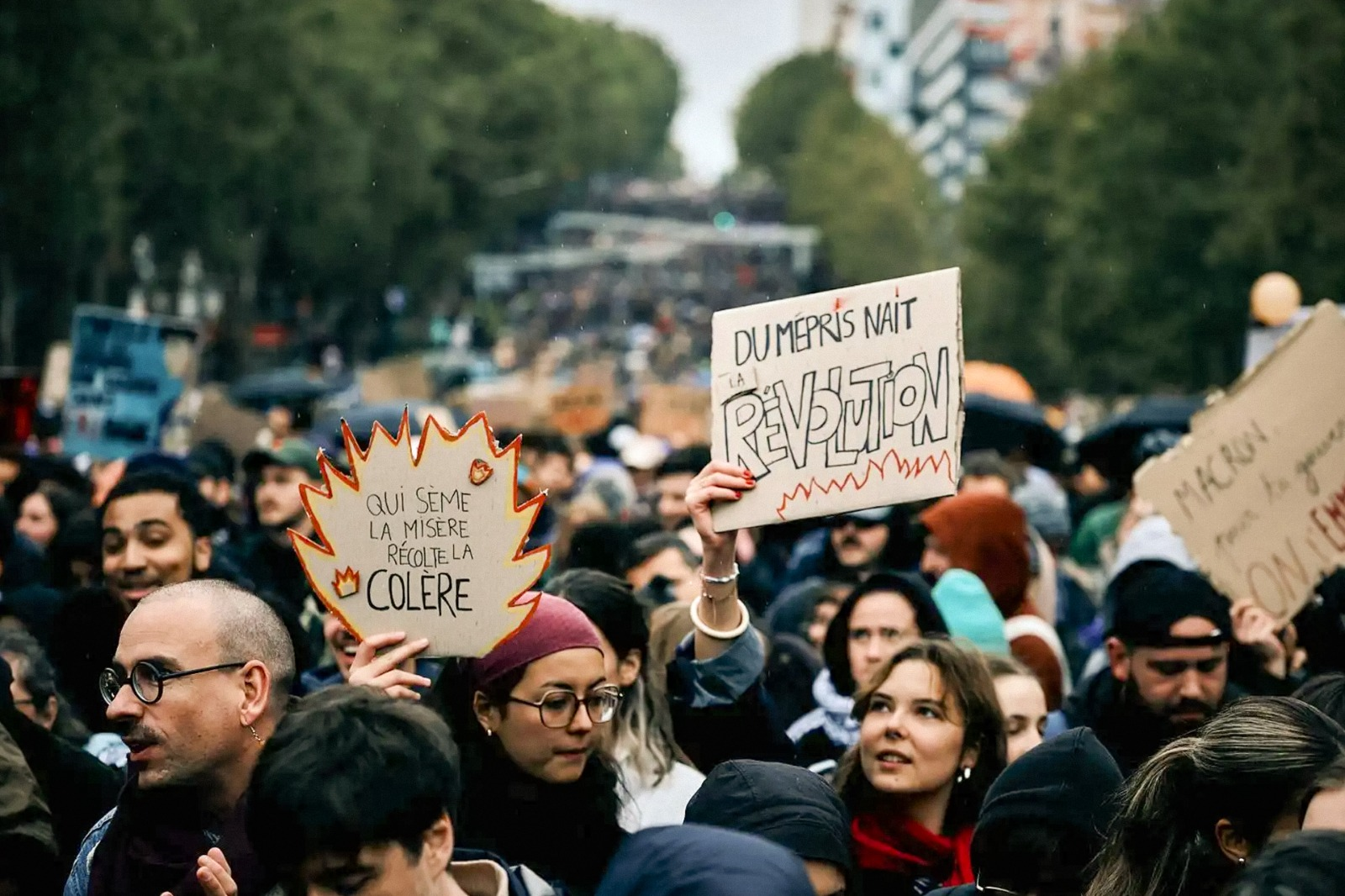
17 October marked a turning point in the development of the class struggle. On that day, a vast number of workers joined the protests with the high school pupils and university students. Every sector of the economy was represented. The atmosphere was exceptionally radical. Many demonstrators were not merely demanding this or that measure, but a complete change of the government and the system – in short, a revolution.
[Originally published in French at marxiste.org]
In response, the government is striving to stifle the movement with a blanket of threats, lies, and state violence. Having labelled the high school pupils’ movement as ‘urban violence’, bourgeois politicians and journalists are screaming blue murder, day and night, about the ‘unprecedented violence’ of the ‘far left’ and ‘thugs’ – this ‘coalition’ whose architect and supreme leader is said to be Jean-Luc Mélenchon. To save the country from the clutches of La France Insoumise (LFI), the government is stepping up police and judicial repression. They are imposing curfews, banning demonstrations, and have announced the mobilisation of the army, the elite counter-terrorism police taskforces.
The demonstrations on 24 October were just as massive and radical as those on the previous Saturday. This latest show of strength is all the more remarkable given that Macron had stated on Thursday: “The recommendation is not to demonstrate”. To back up this “recommendation”, the government threatened the demonstrators, announced a massive police presence, banned demonstrations, changed routes at the last minute, and so on. Everything was done to reduce the scale of the mobilisation – to no avail. It was a total failure for the government, and a resounding success for the young people and workers who took to the streets.
Many demonstrators were discussing the next steps for the movement, and in particular the upcoming mobilisation on 5 November. On Wednesday 21 October, Sophie Binet (secretary-general of the CGT) issued a call to:
“… take the mobilisation to a new level. The strike must take over. That is why the CGT, together with the inter-union coalition, is calling for the widest possible mobilisation on 5 November. We call on workers to organise general assemblies everywhere, in all their workplaces, with all their colleagues, in all departments, in all factories, to ensure the strike spreads on 5 November and beyond. The strike must be on the agenda. When work stops, the country comes to a standstill, the economy grinds to a halt, and this will ensure that our demands are finally heard.”
This statement marks a turning point in the attitude of the leadership of the trade union confederations. For a long time, they deliberately ignored the call – issued in early September – to mobilise on 17 October; but the enormous success of that day and the radicalism it expressed have prompted them to take a significant step (in words) towards an escalation of the struggle. When Sophie Binet speaks of “spreading the strike on 5 November and beyond”, she is pointing very precisely to the path the movement must take to thwart the government’s despicable strategy.
The most militant political and trade union activists must seize Sophie Binet’s call with both hands. We must do everything in our power to build a broad movement of renewable strikes from 5 November onwards. How should we go about this, and on the basis of what programme? We shall answer this question later, but first we must analyse the general situation facing our class enemies: the bourgeoisie, its government and all its politicians.
The economic basis of the crackdown
Lenin emphasised that politics is ‘concentrated economics’. The current situation is a striking illustration of this. The government’s crackdown in recent weeks cannot be understood in isolation from the deep crisis in the French economy, and in particular its public debt.
The interest rate on 10-year government bonds stood at around 3.7 percent last June; on 21 October, it broke through the five percent mark. For the French state, this represents tens of billions of euros in additional payments to its creditors in the long term.
The eurozone’s second-largest economy is following a similar trajectory as Greece in the years following the 2008 global financial crisis. The Greek government was borrowing at 4.5 percent in 2007, then at five percent in 2009. In January 2010, the interest rate stood at six percent; by December of the same year, it had soared to 12 percent. This surge continued, but from 2010 onwards the IMF and the ECB took over from the financial markets. The so-called ‘bailout’ of Greece was conditional on budget cuts on a scale not seen since the end of the Second World War. Within the space of a few years, the Greek masses were severely impoverished.
‘France is not Greece,’ bourgeois analysts emphasise. They dismiss the prospect of such a surge in interest rates and, a fortiori, of having to turn to the IMF. What they do not dismiss at all, however, and indeed demand at every turn, is a series of counter-reforms and extremely severe budget cuts – in precisely the ‘Greek style’. At the end of this proposed massive wave of austerity, public services would be in ruins and the vast majority of the population would be bled dry, but national honour would remain intact, for the IMF would not have intervened!
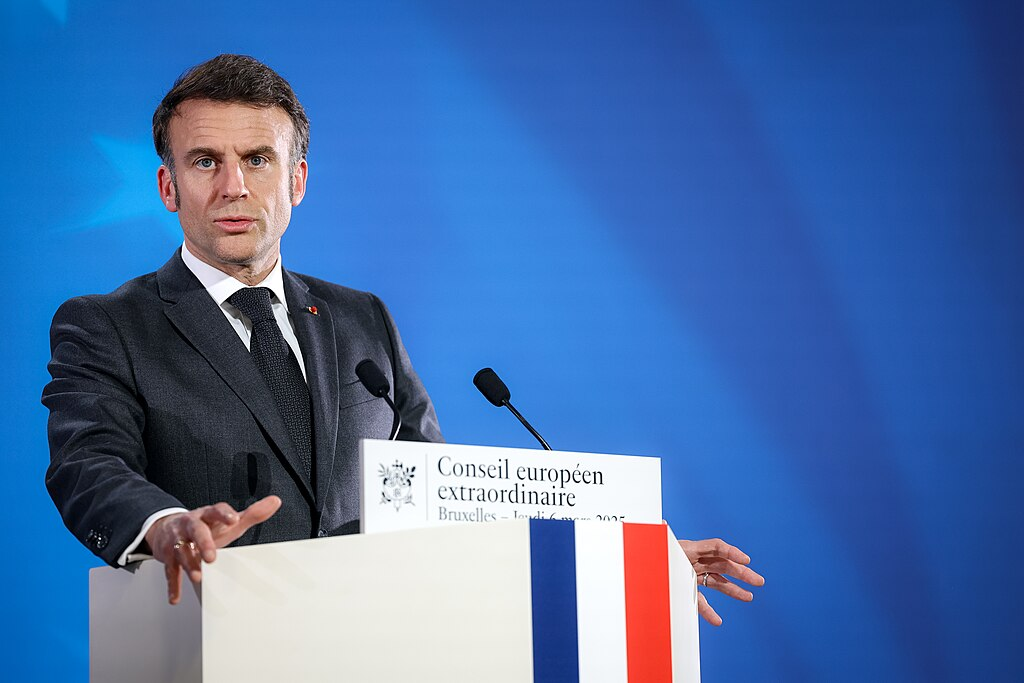
This is the agenda that the bourgeois politicians wish to impose on the overwhelming majority of the French population. The only ones to benefit from it would be the handful of filthy-rich exploiters who own the banks and the key means of production.
With this in mind, and under growing pressure from the bond markets, the bourgeoisie and its government prefer to resort to unprecedented repression, and no-less-outrageous lies, rather than make any substantial concessions to the legitimate demands of the demonstrating school pupils, students, and workers.
In doing so, the bourgeois state is resorting to every underhand tactic, every form of police infiltration and provocation. Thus, the ‘collapse’ of the repressive forces of the state on 17 October stemmed not only from the explosive power of the mobilisation, but also from the orchestration of ‘chaos’ by a regime thirsty for sensational imagery. Since then, images of this ‘chaos’ have been shown on a continuous loop. They are being used as the pretext for a brutal offensive against our most basic democratic rights, starting with the right to demonstrate.
Let us quote Marx’s words during the bloody repression of the Paris Commune in May 1871:
“The working men’s Paris, in the act of its heroic self-holocaust, involved in its flames buildings and monuments […] The government of Versailles cries, ‘Incendiarism!’ and whispers this cue to all its agents, down to the remotest hamlet, to hunt up its enemies everywhere as suspect of professional incendiarism. The bourgeoisie of the whole world, which looks complacently upon the wholesale massacre after the battle, is convulsed by horror at the desecration of brick and mortar!”
The bourgeois journalists and politicians who, nowadays, “complacently” support police and judicial repression, also indulge in hypocritical convulsions in the face of “the desecration of brick and mortar.”
If the government’s repressive strategy fails in the coming weeks and the struggle gains even more momentum, the bourgeoisie will prefer to sacrifice Macron – that is, to bring the presidential election forward by a few months – rather than make significant concessions to the movement. Such concessions would be the exact opposite of what the financial markets demand.
The newspaper Le Monde, amongst others, emphasises every day that the option of Macron’s resignation is on the table. This long-established newspaper of the ‘liberal’ bourgeoisie suggests that, at a certain stage, only an early presidential election could defuse the growing momentum of the struggle.
In truth, this is not even certain: the mobilised masses might not be satisfied with a minor adjustment to the electoral calendar. But there is another problem inherent in this option for the bourgeoisie. Macron’s resignation would have contradictory effects on the mood and calculations of the speculators who finance France’s public debt – and not necessarily positive ones from the perspective of the bourgeoisie, on balance. That is why the ruling class, at this stage, is clinging to the hope of crushing the movement under an avalanche of threats, repression and police provocations.
In doing so, it runs the risk of further fuelling the flames of revolt, rather than extinguishing them. Millions of exploited and oppressed people are outraged by police brutality and the brutal curtailment of democratic rights. They are also sickened by the torrent of lies and distortions spewed out by the bourgeois media, round the clock, in flagrant contradiction to what people see with their own eyes – either directly or via the numerous videos posted on social media. Similarly, the silence surrounding the circumstances in which two people died on 17 and 18 October is fuelling mistrust in a government whose moral authority lies in ruins.
Finally, everyone understands the link between the shooting of a French-Congolese man and the wounding of several others in Trappes on Friday and the racist propaganda that all bourgeois politicians and journalists (from the far right as well as the so-called ‘centre’) have been constantly peddling for many years. Macron is attempting to exploit this tragedy for his own ends, but this cynical manoeuvre only serves to heighten the anger of the masses.
The campaign against LFI
Against this backdrop, the ongoing campaign against LFI is reaching new heights. Mélenchon and his comrades are being called upon to ‘strongly condemn’ the ‘violence’ of which they are accused – by the very same people – of being the instigators. Logically, therefore, they are being asked to ‘condemn’ themselves very ‘firmly’, or even to hand themselves over to the courts, demanding the most exemplary sentences against themselves!
The statements by the president of Les Républicains, Bruno Retailleau, and senator Gérard Larcher on the possibility of “banning” LFI are, of course, driven by ulterior electoral motives. Les Républicains and their sinister candidate fear another crushing defeat in the presidential election. Caught in a vice between the more ‘moderate’ Edouard Philippe and Marine Le Pen, Bruno Retailleau is seeking breathing space and is aiming to win right-wing votes from Le Pen’s National Rally (RN).
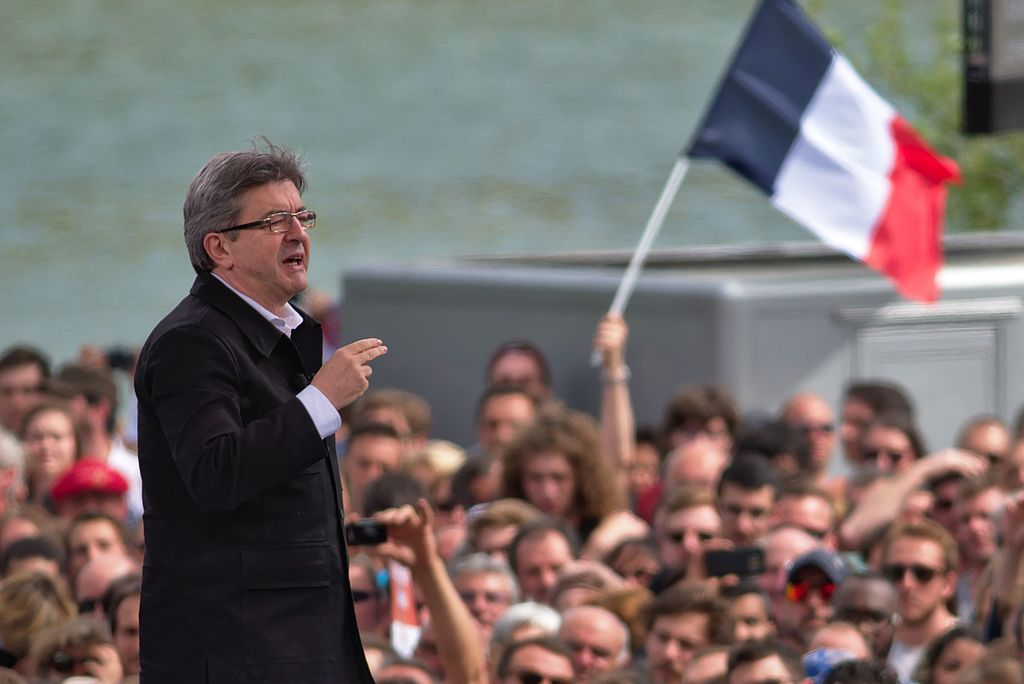
Now that the question of banning LFI has been raised, the mainstream media are weighing up the ‘pros’ and ‘cons’. In reality, all this is nothing but absurd and, at heart, desperate propaganda. It is obvious that the state will not ban LFI. The explosive reaction of the masses – extending far beyond the movement’s regular voters – could sweep away the entire political regime.
Generally speaking, it is not in the bourgeoisie’s interest to set France on the path towards a Bonapartist regime – that is to say, a military-police dictatorship – because at this stage it would stand a good chance of losing everything. What we are witnessing does not mark the advent of a Bonapartist regime, as is all too often claimed.
The current repression serves as a reminder of what the Yellow Vest movement in 2018 and 2019 already demonstrated: police brutality and the curtailment of democratic rights are compatible with the basic mechanisms of a bourgeois ‘democracy’. This does nothing to alter the essence of the state, which, as Lenin emphasised, consists of “special bodies of armed men”, defending the power and privileges of the ruling class.
During explosive phases of the class struggle, such as at present, the bourgeois ‘democratic’ state unleashes its hounds. In response, we must wage a massive and unyielding struggle against any encroachment on the rights of workers and the oppressed in general.
Instead of constantly predicting the advent of a fascist or Bonapartist regime, the leaders of the labour movement must seriously fight against all the current attacks by the ‘democratic’ bourgeoisie, and in particular against the scandalous imprisonment of numerous young protesters. On Friday, L’Humanité reported a figure of 174 arrests since 17 October. The entire labour movement must demand their immediate release and the dropping of all charges!
We need a battle plan
Since it is unwilling to make any serious concessions, the government has embarked on a repressive strategy which, far from undermining the mobilisation, has broadened it to include new sections of society.
It is against this backdrop that Sophie Binet, on behalf of the inter-union coalition, has called for “a widespread strike on 5 November” and in the days that follow. If this call is heeded, and if a vast movement of renewable strikes gets underway on 5 November, it will put the government on the back foot and force it to change its strategy. The best way to force the authorities to put away their truncheons, ‘flash-balls’, and tear gas is through a massive mobilisation of the working class in the form of indefinite strikes. In other words, the paralysis of the economy.
Sophie Binet calls on workers to “organise general assemblies everywhere, in all their workplaces, with all their colleagues, in all departments, in all factories”, to put renewable strikes on the agenda. This is exactly what is required. However, we are well aware that not all workplaces are in the same position, nor do they all have the same level of trade union organisation or the same traditions of struggle.
Furthermore, not all companies carry the same economic weight and cannot play the same role in bringing production to a standstill. Sophie Binet is right to call on the entire working class to mobilise, but this general call must absolutely be accompanied by a concrete, precise plan of action, based on the actual state of our forces – and in particular those of the trade unions.
The first priority must be to mobilise those sectors of the working class which, on the one hand, have strong organisations and a tradition of struggle, and, on the other, occupy key positions in the country’s economic life. This is particularly true of workers in the transport, energy and port sectors. If they launch a strong renewable strike, they can provide a decisive impetus for the mobilisation of other key sectors of the working class – including the metalworking industry, the banking sector and the civil service as a whole.
It is no coincidence that we mention transport, energy and port workers. Over the past two decades, these three sectors have launched several waves of renewable strikes. However, the governments of the time made no concessions because, on each occasion, the renewable strikes failed to spread to other sectors.
The workers involved still remember these defeats. We must take this into account and learn from it. This time, the mobilisation of these strongholds of our class must be based on a clear plan of action, known to all, discussed by all, and which provides for the rapid extension of the renewable strike to other key sectors of the economy. Otherwise, workers in the ports, energy and transport sectors may be reluctant to commit, once again, to a protracted struggle.
We do not claim to provide the specific details of the required battle plan. The trade unions and their various structures – both local and national – know far better than we do what the mood is like in the different sectors. They can and must play a central role in organising and coordinating the strike movement, starting on 5 November.
All forces within the trade union movement, supported by all forces of the radical left (including LFI), must be mobilised. At the same time, the strike must be firmly controlled by the strikers themselves. Sophie Binet calls on all workers to come together in general assemblies. These can take the form of inter-professional general assemblies, which bring together workers from different sectors and facilitate the spread of the strike movement. They can also elect delegates tasked with coordinating the struggle and implementing the decisions taken at the general assemblies in practice.
High school pupils and university students, too, can play a very important role in this new phase of the struggle. During the mass movement against attacks on workers’ rights in 2006, the general assemblies at universities organised marches of students and high school pupils towards railway stations and workplaces to trigger work stoppages, often with success. This was a central factor in the movement’s victory.
Students and school pupils – who are fully aware of the decisive role played by workers – must reconnect with these great traditions of struggle. To this end, student organisations must not shut down the universities prematurely, but rather organise massive, daily general assemblies there, open to school pupils and workers, with the aim of making a concrete contribution to the development of renewable strikes. This must be the priority of the student movement as soon as the universities reopen on 2 November, in close coordination with the high school movement and workers’ organisations.
The programme for the struggle
A strong, renewable strike must be based on a proactive programme. Workers will not embark on a movement of this scale in the hope of securing mere crumbs. It must be worth the effort – the movement’s objectives must be commensurate with the sacrifices made.
In its statement on 19 October, the CGT’s confederal executive put forward the following demands:
“an end to Parcoursup [the portal used to apply for higher education]; funding for high schools and universities; increases in wages, the minimum wage, and the salaries for civil servants; increases in pensions, student grants and all social benefits; an end to the taxation of the sick and cuts to public services, starting with hospitals; a price freeze; and a halt on redundancies.”
Taken together, these demands – to which the nationalisation of TotalEnergies must be added if we are serious about ‘freezing prices’ – are no small matter. At present, achieving them would be seen as a resounding victory for the movement. However, not only does the government have no intention whatsoever of meeting these demands, but it is also relentlessly pushing ahead with a budget that imposes €54 billion of additional ‘austerity measures’ on the overwhelming majority of the population.
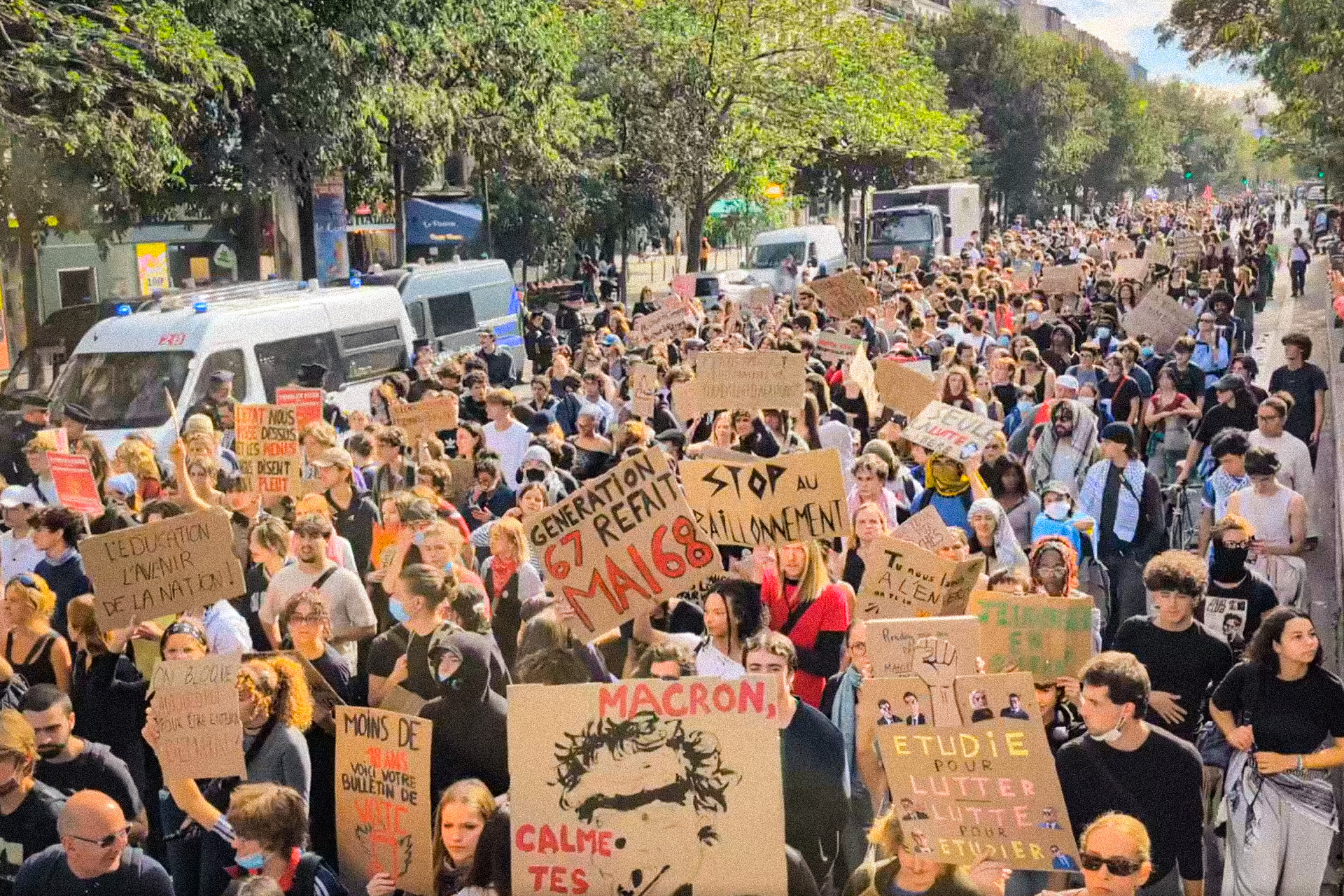
Once again, the Lecornu government has only one thing on its mind: proving to the bond markets that it is capable of imposing a new austerity budget. Consequently, if a powerful wave of renewable strikes takes hold, the bourgeoisie will prefer to play the card of Macron’s resignation – that is to say, a snap presidential election – rather than make any serious concessions to the movement’s demands.
That said, the bourgeoisie may well play this card too late. If a movement on the scale of May ‘68 were to take off, as Sophie Binet is calling for, the paralysis of the economy would have a huge impact on workers’ consciousness. As always, an indefinite general strike would raise the question of power – that is to say, the question: which social class should lead society? The giant parasites who gorge themselves on profits at the expense of the people – or the working class, which creates all wealth and will be able to manage the economy for the benefit of the greatest number?
This is why our party, the Parti Communiste Révolutionnaire, insists that the programme for the struggle must be crowned with one simple demand: ‘Down with the government of the rich! For a workers’ government!’ We must prepare our class right now for the prospect of seizing power. Whatever the actual developments in the struggle over the coming weeks, we must constantly defend this idea and this objective amongst all sections of the working class and the youth.
Sophie Binet herself emphasised this: “When work stops, the country comes to a standstill, the economy grinds to a halt”. Precisely so, and that is why workers must take control of the economy and reorganise society on a socialist basis. We must expropriate the big bourgeoisie and replace the chaos of the ‘free market’ with rational and democratic planning of production. The CGT must urgently return to this fundamental idea, which has long been the central pillar of its programme.

