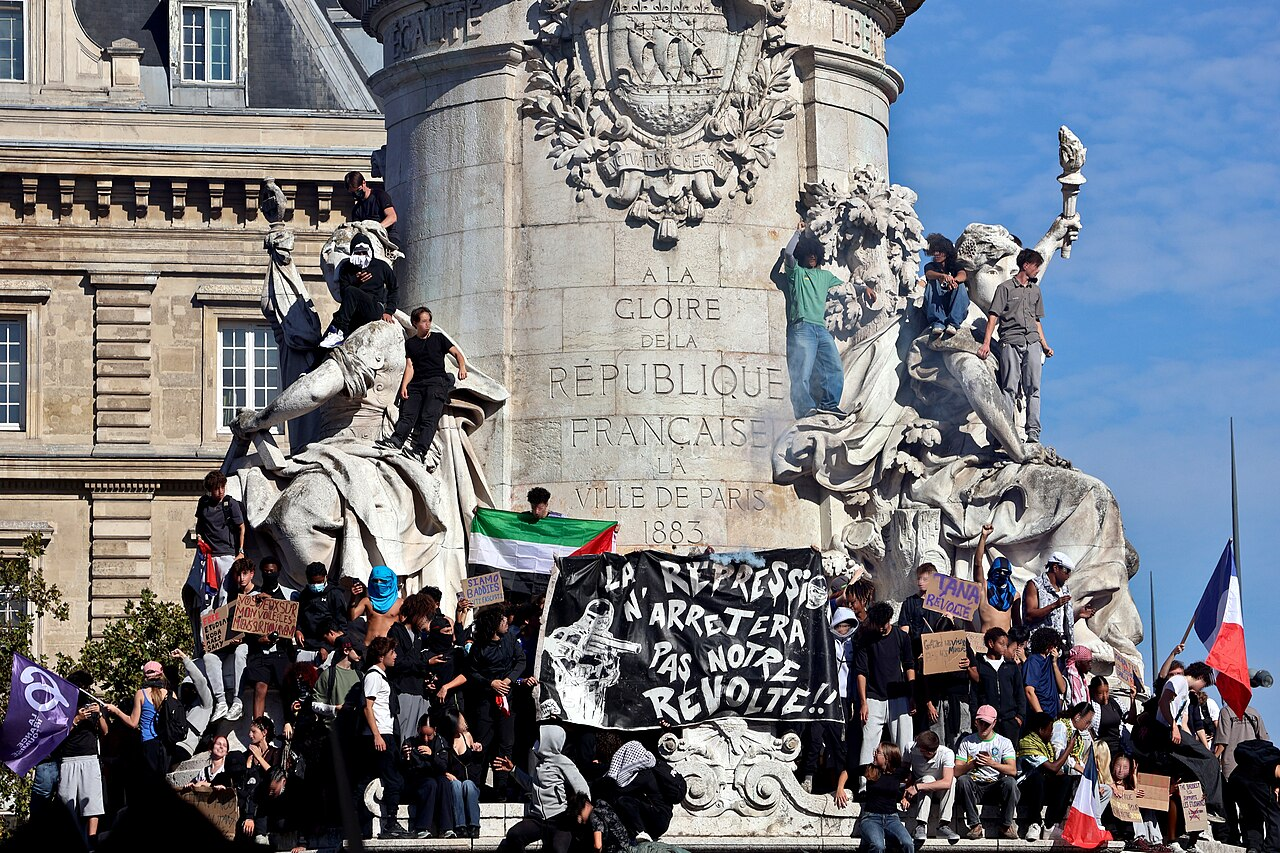
The massive wave of protests in France on Saturday was a militant escalation of a movement that has swept the country and is striking fear in the heart of the Macron government. Despite brutal repression, workers and youth have continued to mobilise in increasing numbers. With a bold, revolutionary programme, these protests have the potential to bring down not only the hated government, but the entire rotten system.
Much has been made in the capitalist press internationally of the ‘violent riots’ engulfing France. The same press fails to mention the day-to-day violence of the French ruling class, or of the violent repression with which peaceful youth have been met when coming out to protest the country’s crumbling education system and deteriorating living conditions.
On Saturday, a 17-year old boy lost his right hand after a police officer shot him with a ‘crowd-control’ grenade. This is the second protestor within two weeks to lose a hand. This is on top of countless brutal injuries including blindings, shattered jaws, etc.
Nor does the right-wing press mention the provocations: eye witnesses have reported tear gas and water cannons being unexpectedly unleashed as protesters peacefully gathered on Saturday morning. Footage is circulating of clear police provocateurs being set upon by protesters for throwing rocks at emergency vehicles. The French state deliberately manufactured the scenes we saw on Saturday.
The French ruling class is now gripped with anxiety. Last night, Macron used a televised address to cynically acknowledge the “legitimate grievances” of some demonstrators, whilst condemning “insurrectionists from fringe far-left groups, joined by numerous criminals.” This is a panicked attempt to divide the movement, and justify an intensification of police repression.
We publish below the most recent analysis from Jérôme Métellus of the Parti Communiste Révolutionnaire, which details Saturday’s events and explains the tasks ahead.
[Originally published in French at marxiste.org]
The demonstration on 17 October marks a major milestone in the development of a movement which is clearly far from having exhausted its reserves of energy, determination and fighting spirit.
Gen Z – school students, university students, young workers and the unemployed – dominated the marches and infused them with a contagious radical mood. Older workers also turned out in large numbers. Every sector of the economy and every vital force in the country was represented.
The figures reported by the press – between 500,000 and 800,000 people nationwide – underestimate the scale of the mobilisation. In Paris, in particular, even the streets adjacent to the official route of the demonstration were teeming with people. Entire neighbourhoods were buzzing with slogans and chants. Local residents came out of their homes or shops to join in the electric atmosphere of a people in revolt. We would be curious to know the method used – apart from making a rough guess – to accurately count such a seething mass of people!
Many demonstrators – some of them wearing yellow vests – held up placards brimming with humour and imagination. Their demands, puns and humour all converged in a radical rejection of the government, the ultra-rich, their state, their police and their system. Many placards referred to the great revolutionary traditions of the French people, in particular May ’68 and the Great French Revolution of 1789–94.
The police brutality of recent weeks was on everyone’s minds. Young people from the poorest neighbourhoods were prepared to take on the police force from whom they have suffered racism, harassment and brutality on a daily basis – and for far too long.
As soon as it was shouted out, the slogan ‘ACAB’ was taken up by hundreds of demonstrators, a number of whom had been unaware of its existence or meaning just a few weeks earlier.
‘Violence’: the government’s double standards
Having absolutely no intention of responding to the people’s basic demands, the government is sinking deeper into its ritual condemnation of ‘urban violence’ – described as ‘extreme’, ‘unprecedented’, and so on. By contrast, Macron, Lecornu, Nuñez and their ilk consider police violence to be wonderfully ‘proportionate’. As for the economic and social violence that lies at the root of the popular uprising, they say nothing about it and have no intention of addressing it.
On 12 October, a report by Action Against Hunger revealed that in mainland France, seven million adults face food insecurity. This affects 25 percent of 18-24-year-olds. This ‘unprecedented’, ‘extreme’ social violence leaves the rich and powerful utterly unmoved – indeed, they are preparing further drastic cuts to public spending and social benefits.
With their hands on their hearts, those in power swear that they are defending the right to demonstrate ‘peacefully’. Yet at the same time, Macron, Lecornu and their entire clique are organising brutal police repression and announcing that they cannot meet any demands.
In other words, the people must ‘peacefully’ accept being despised, exploited, impoverished and repressed. Isn’t that what usually happens? Yes, but this time the masses will no longer accept it and are demanding concrete answers – or, failing that, the downfall of the ‘government of the rich’. That is the essence of the current situation.
What now?
Just as during the 24-hour general strike of 13 May 1968, the mobilised youth and workers sent a powerful message to the entire working class. In 1968, the show of force on 13 May marked the starting point of a wave of indefinite strikes which, within the space of a week, had completely paralysed the economy and left all the institutions of the bourgeois state hanging in the balance.
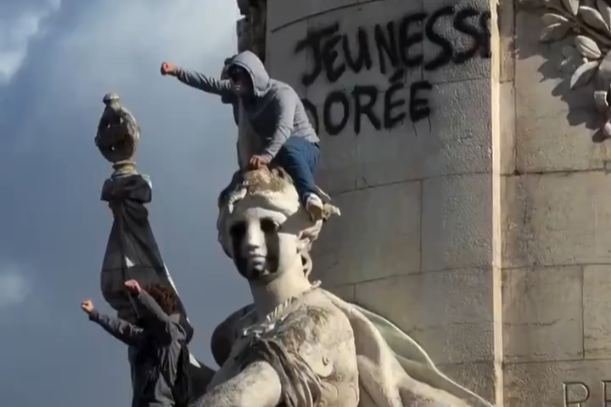
In the coming days and weeks, the movement could set out on the same revolutionary path as in the spring of 1968. 17 October marked a very clear step in that direction. In a country brimming with anger and fighting spirit, it might be enough for workers in large companies to set an example and take the initiative to ignite the fire of a powerful movement of indefinite strikes.
One thing is certain: when the exploited and oppressed masses set themselves in motion, as they did yesterday, they are not satisfied with harmless marches – at the rate of one or two a month. This is the usual ‘strategy’ of the leaders of the trade union federations. Moreover, these leaders were not involved in organising the 17 October demonstration, which they deliberately ignored for many weeks.
These same trade union leaders issued a call for action on 5 November. Originally, this was intended to defuse the explosive power of 17 October. Now, however, the events of 5 November could spiral out of the organisers’ control. In the meantime, other initiatives will no doubt be taken, and further demonstrations organised. This outburst of anger and militancy will not conform to the ‘strategy’ of the trade union leaders, whose sole ambition is to channel and contain the movement.
The most militant political and trade union activists must take stock of the situation and the enormous opportunities it presents for the development of the class struggle. We must capitalise on the momentum generated by the youth, to put a broad movement of rolling strikes on the agenda.
As we wrote on Tuesday 13 October, the organisations of the labour movement must build a strike movement “based on a militant programme that incorporates all the demands of the mobilised youth – and adds to them demands such as a substantial wage increase, wage indexation to inflation, the expropriation of TotalEnergies, and the repeal of all the counter-reforms of the last ten years.”
“Under increasing pressure from the financial markets, the Lecornu government would rather hang itself than meet a single one of these demands. Consequently, the movement’s programme must culminate in a demand that is both general and, fundamentally, very concrete: ‘Down with the government of the rich! For a government of the workers!’
“If a powerful movement of rolling strikes develops across the country in the coming weeks, it will demonstrate concretely to the working class that it creates all wealth. The working class is the decisive force in modern society – and it is therefore up to the working class to lead it, that is, to expropriate the big bourgeoisie, repudiate the public debt, and reorganise the economy on socialist principles.”

