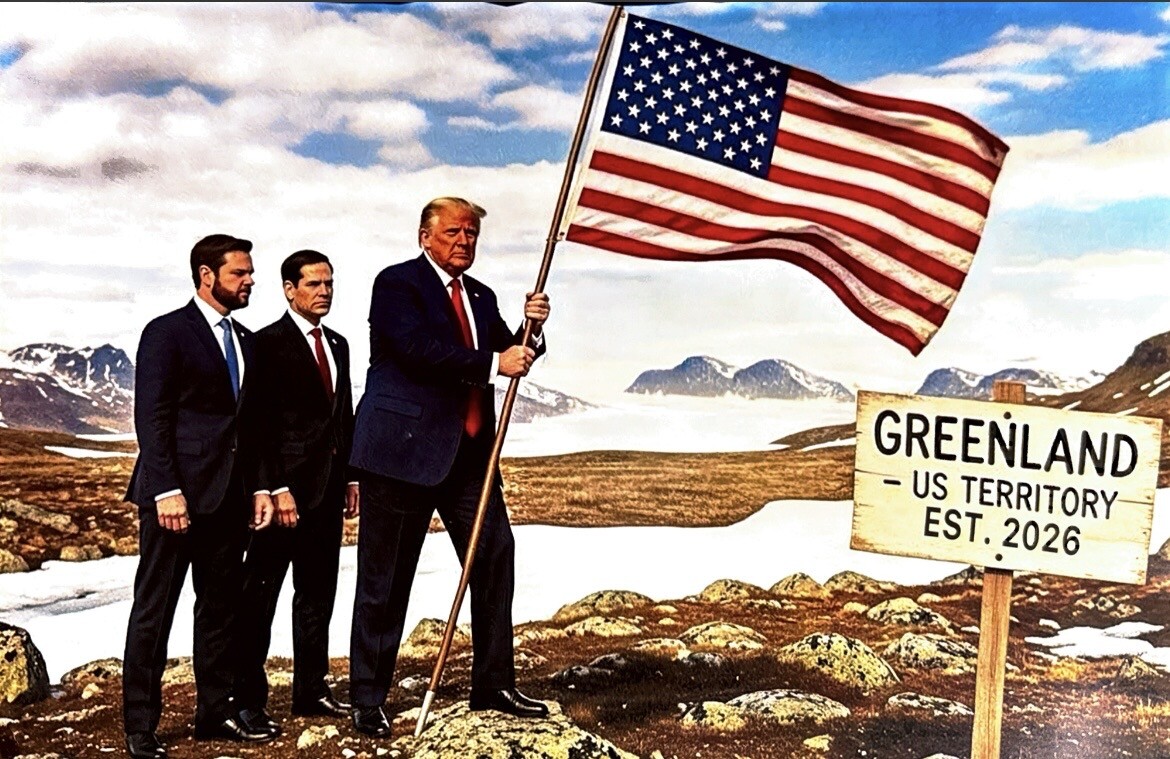
Donald Trump’s desire to seize control of Greenland and its resources has brought US imperialism into conflict with Europe. This puts Starmer in a quandary, as he and the British establishment attempt a delicate, unsustainable balancing act.
Keir Starmer’s knees must be feeling pretty worn out by now. After all, the British Prime Minister has spent the last 18 months crawling around on them, in an effort to appease his masters in Washington.
There are many names for such subservient behaviour: grovelling, fawning, toadying, kowtowing, bootlicking, ass-kissing – and many other more impolite euphemisms beside.
Whatever you call it, this sorry spectacle is a truly nauseating and embarrassing sight to behold.
And the latest dramatic events surrounding Greenland – with Donald Trump threatening to take a wrecking ball to the old western order in pursuit of the giant, resource-rich, strategically-important island – have only put Starmer and the rest of the British establishment in an even more compromising, painful position.
Trump’s ‘Donroe Doctrine’
Trump has consistently mused about taking possession of Greenland, even before returning to the White House a year ago. But these rumblings and ruminations have crescendoed in recent weeks, following US imperialism’s brazen move to kidnap Venezuelan President Nicolas Maduro on 3 January.
The American President’s call for Greenland to become part of the USA – either through a negotiated deal or by force if necessary – suddenly has more gravitas in the wake of Maduro’s abduction.
The Trump administration has been increasingly hawkish of late in regards to its rhetoric surrounding the new ‘Donroe Doctrine’: Washington’s attempts to flex the muscles of US imperialism more assertively and aggressively in its own backyard – that is, anywhere and everywhere in the western hemisphere.
After making a grab for Venezuela and its oil, Greenland seems to be next in the President’s sights. When quizzed about his goals regarding the semi-autonomous Arctic territory this week, Trump declared that “we have to have it”: an open proclamation of US imperialism’s nakedly reactionary aims and ambitions.
This has set off alarm bells in Copenhagen, London, Paris, and Berlin – not to mention Strasbourg and Brussels, home to NATO and the EU, respectively.
Greenland belongs to Denmark, a member of NATO, the western security alliance, for which American imperialism acts as an irreplaceable keystone. Yet this has not stopped Trump from contemplating the use of US armed forces to seize the Arctic island and its minerals.
This has brought the entire western world order and its institutions into question.
“If the United States decides to militarily attack another NATO country, then everything would stop,” stated Mette Frederiksen, the Danish Prime Minister, on 5 January. “That includes NATO and therefore post-second-world-war security.”
Imperialist tensions
Tensions between the US and Europe have escalated rapidly over the last week.
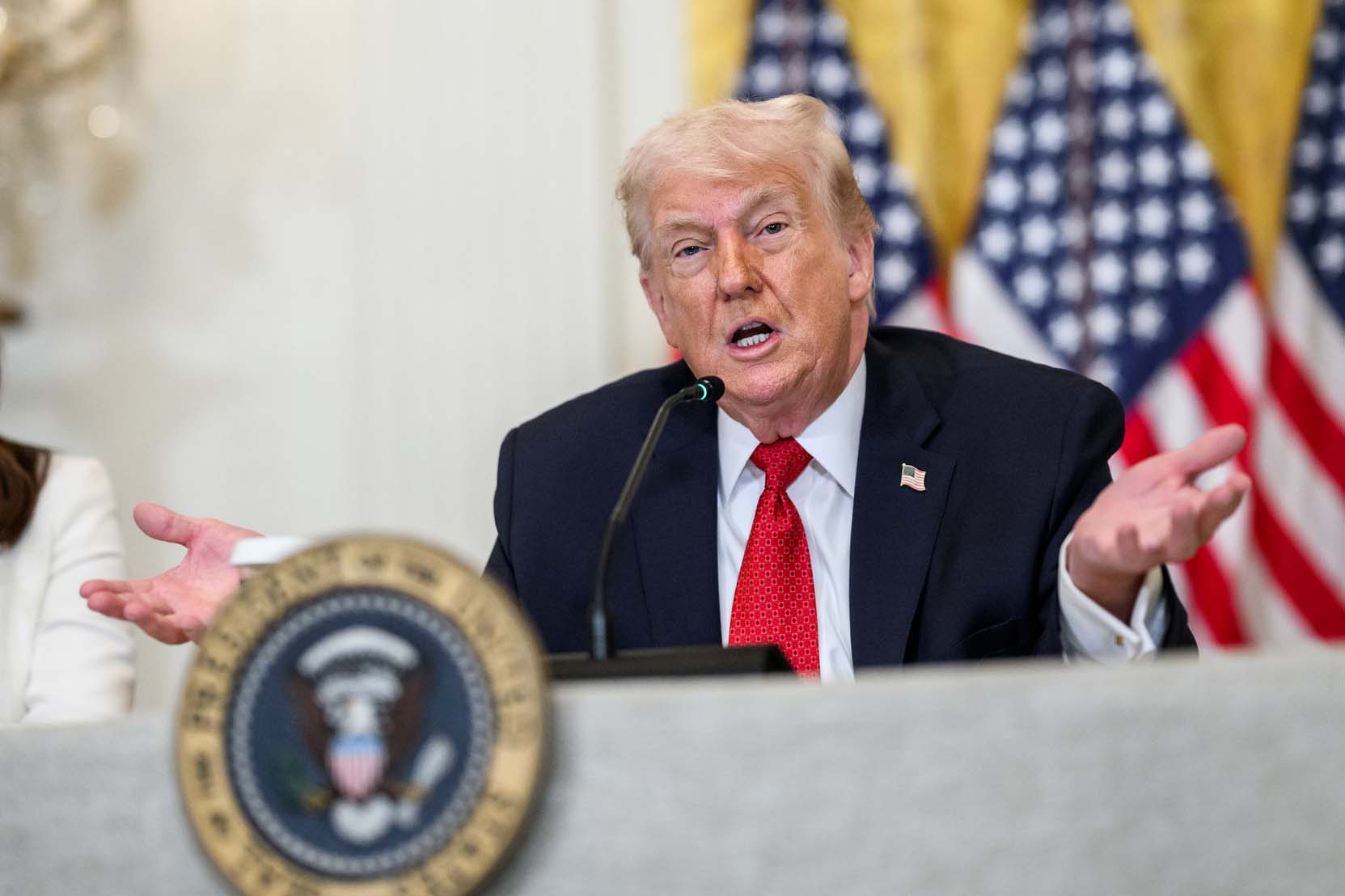
Amongst Trump’s many justifications for wanting American control over Greenland is that he does not trust the rest of NATO to pull their weight when it comes to securing the Arctic Circle.
In order to assuage the US President’s concerns, therefore, a number of European countries recently sent additional military personnel to Greenland, supposedly as part of a large NATO exercise.
This included hundreds of soldiers from Denmark, accompanied by the tokenistic deployment of 15 from France, 13 from Germany, two from Norway, and a paltry one from Britain.
The White House, however, interpreted this move not as a reassurance, but as a challenge; a form of sabre-rattling on the part of the Europeans.
“The message coming from Europe wasn’t clear, nor was the rationale,” commented Italian Prime Minister Giorgia Meloni. “The risk is that initiatives of some European countries could have been interpreted as anti-American.”
“I’m not sure this was Denmark’s finest hour,” stated one senior European diplomat. “The messaging felt a little too subtle. We understood the intention was to show we were taking care of Arctic security. But we were worried Trump could see this as being to defend against him.”
In response, Trump has warned those countries involved in this Arctic adventure that they could face immediate additional tariffs of 10 percent, rising to as much as 25 percent in the coming months, if they do not cede to his demands for US ownership over Greenland.
Prussian military theorist Carl von Clausewitz correctly stated that “wars are a continuation of politics by other means”. And now we see how trade wars are a continuation of imperialist interests by other means.
Such tariffs would be devastating for European capitalism, at a time when manufacturers and industries across the continent are already struggling to compete on the world market.
At the same time, to allow Greenland to be sold off would be a humiliating blow to the European ruling class. Forceful seizure of the island by US imperialism, meanwhile, would irreparably undermine the unity of NATO, Europe, and relations with America.
This would sound the death knell of the transatlantic alliance, and of the entire western order that has been built up over the last 80 years around this.
And it would signal to the rest of the world that Europe is a spent force; a set of impotent, declining nations, which can easily be trampled over in this new ‘might makes right’ epoch of clashes between the big imperialist powers.
All roads lead to ruin
The prospect of severance with the USA has left the European establishment aghast.
Out of desperation, some plucky politicians like Emmanuel Macron have vowed that they will not succumb to Trump’s blackmail, but will respond in kind to any punitive US tariffs.
“No intimidation nor threat will influence us, neither in Ukraine, nor in Greenland, nor anywhere else in the world when we are confronted with such situations,” the French President asserted on social media.
“Tariff threats are unacceptable…Europeans will respond to them in a united and coordinated manner…We will ensure that European sovereignty is upheld.”
Along similar lines, Germany’s finance minister Lars Klingbeil declared that “we will not allow ourselves to be blackmailed”, adding that “a line has been crossed”.
More sober voices, however, realise that Europe has little strategic leverage or economic ammunition when it comes to a potential confrontation with the US.
Even worse, by engaging in a fight with Trump by standing up to him over Greenland, the Europeans could provoke the US President into withdrawing all American support for Ukraine and NATO, presaging the end of the transatlantic partnership.
The dilemma facing the European leaders is clear. Either they defer now and let Trump have his way in regards to Greenland, marking a rupture between the USA and Europe; or they stand their ground, and thereby arrive at the same disastrous outcome by another – more torturous – path.
In medieval times, European writers were fond of saying that ‘all roads lead to Rome’. Today, their contemporary counterparts might equally say that ‘all roads lead to ruin’.
All for nothing
The fact is that Europe as a whole is extremely dependent on its relationship with America – far more so than vice-versa. The European ruling classes cannot afford to lose their trade and security links with the US. And Trump knows this.
The relatively one-way nature of this relationship has consistently been on display in recent years. Europe’s leaders have bent over backwards to appease Washington, only to find themselves rebuffed and rejected in every instance.
They have thrown billions into the black hole that is the Ukraine war, all to no avail. They have utterly failed in their mission to convince Trump to back their farcical ‘coalition of the willing’. And now their man in Kyiv – Zelensky – is staring defeat in the face, as the US President looks to abandon Ukraine altogether.
They refused to retaliate when it came to the imposition of US tariffs of 15 percent on EU goods, naively hoping to avoid being embroiled in an escalating trade war. Yet Trump has now bulldozed through the already-humiliating trade ‘deal’ that they begrudgingly agreed to last summer, with his threats of additional duties for those European countries that have dared to deploy troops to Greenland.
And they have enraged domestic voters by supporting – financially, militarily, and diplomatically – the crimes of US imperialism and its allies across the world: whether it be the genocide in Gaza; the recent coup in Venezuela; or America’s bombing campaigns in Iran and Yemen.
Militarily, economically, and politically, then, European leaders have prostrated themselves before their American overlords. Yet all of their servility and appeasement has yielded precisely nothing. In fact, it has left Europe and its political representatives in a far worse position: broke and broken.
Friend or foe?
Remarkably, the thick-skulled Europeans have endlessly acted shocked by Trump’s destructive decisions, unable to comprehend how the US President could be so hurtful towards America’s close, longstanding friends.
“We’re living through uncharted territories,” pronounced France’s finance minister Roland Lescure. “We’ve never seen this before. An ally, a friend of 250 years, is considering using tariffs […] as a geopolitical weapon.”
Yet Trump’s conduct should come as no surprise. He and his MAGA advisors have repeatedly spelt out their aims and attitudes towards Europe in black and white – perhaps most clearly and emphatically with the administration’s latest National Security Strategy document.
In short, Trump and his top team do not consider Europe a friend but a foe; not an ally but an adversary. ‘America First’ means the rest of the world last.
In the eyes of the US President and his sidekicks, Europe is not a united continent to be admired and respected, but a loose collection of weak powers and smaller nations, to be divided and exploited by American capital.
And truth be told, Trump and his key spokespersons have a point. Their low estimation of the Europeans is far closer to the mark than the puffed-up image that Macron and Merz hold of France and Germany, respectively, and of the old world more broadly.
Under pressure
Enter Keir Starmer, perhaps the most deluded and pathetic of all the European leaders (a tough competition).
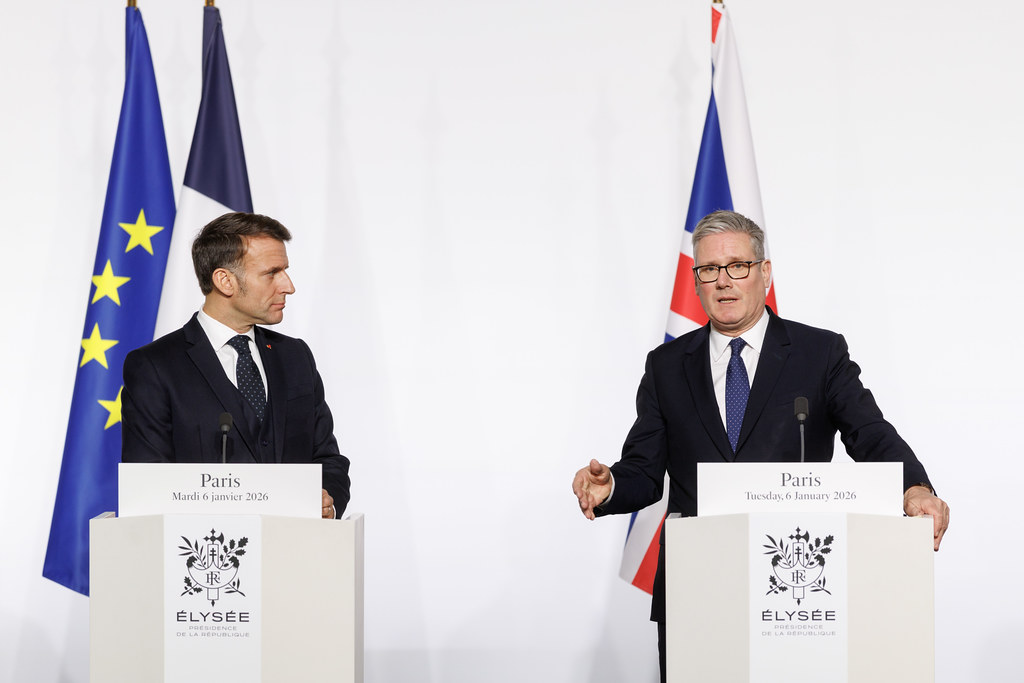
While his outraged European counterparts consider how they might counter Trump’s bullying and threats, Starmer has been appealing for calm, reminding western establishments of the vital importance – economically, militarily, and politically – of the transatlantic alliance.
Similarly, the Labour leader has resisted pressures from politicians on both sides of the House of Commons, with both backbench and opposition MPs calling on the Prime Minister to adopt a more strident stance against Trump’s latest imperialist aggression.
With the exception of Starmer, the leaders of all of Britain’s main political parties – including Nigel Farage – have attacked Trump for his belligerence and bullying over Greenland.
Tory leader Kemi Badenoch, for example, said that recent events showed the need for Britain to beef up its own defences: “Otherwise we will end up being poodles as the US annexes Greenland and we’re slapped with tariffs because we have not shown any strength.”
Various Labour MPs, meanwhile, have called for Starmer to utilise the conflict over Greenland as an opportunity to reforge stronger ties with Europe.
“Trump’s tariffs and threats mean it’s make-your-mind-up time,” suggested Stella Creasy, a Labour backbencher. “If we can’t rely on America…the answer is to get serious about our strategic future with Europe.”
Balancing act
Rather than echo these sentiments, and be drawn into criticising Trump, Starmer has sought to balance between America and Europe.
On the one hand, the UK PM has acknowledged that Trump’s intimidation towards Greenland and Europe is “completely wrong”. On the other hand, Starmer has denounced “performative” politics, saying that he prefers “solutions over slogans”.
Such tactful language has nothing to do with any political acumen or diplomatic deftness on Starmer’s part, and everything to do with the precarious position of British capitalism.
“There is a potential for this to cause huge damage to the UK, whether that’s a trade war or the weakening of alliances,” Starmer has stated, adding that:
“We do have to remember at all times that it is in our national interest that we continue to work with the Americans when it comes to defence, to security, and to intelligence.”
“Our nuclear deterrent is our foremost weapon, and deterrent, when it comes to, securing the safety of everybody in the United Kingdom, my primary duty. And that requires us to have a good relationship with the United States.” (our emphasis)
In other words, while Europe has little leverage over Washington, Britain has none.
The British establishment therefore has no choice but to cling on to the so-called ‘special relationship’ at all costs.
Hence Starmer’s endless displays of demeaning obsequiousness and sycophantic brown-nosing towards the kingpin in the Oval Office: whether it be rolling out the red carpet and all the Royal pageantry for Trump’s latest UK visit; or biting his tongue while his American counterpart emasculated him on a recent trip to Scotland.
And yet even this has not stopped the US President from lumping Britain in with the rest of Europe, accusing Starmer’s government of committing “an act of GREAT STUPIDITY” with its decision to hand over the Chagos Islands – home to an American military base – to Mauritius.
Clinging to the past
After decades of degeneration and decay, British capitalism finds itself even more vulnerable than its peers in relation to Trump’s capriciousness and ‘America First’ agenda.
For decades, from the postwar period onwards, as the sun began to set on its Empire, the British establishment clung to the coattails of US imperialism, in an effort to maintain any relevance on the world stage.
Institutions and agreements like NATO, the WTO, and the UN helped to uphold the liberal ‘rules-based order’, providing declining powers like Britain with military security, free trade, and a seat at the table.
Britain benefited from this arrangement, economically and politically, finding their place within the US-woven web of western imperialism.
Inside the EU, Britain gained from its role as the USA’s Trojan Horse within the walls of the Single Market, acting as a bridgehead for American capital’s excursions into Europe. In this way, the UK became a global hub for financial and legal services, acting as the ‘butler to the world’.
Brexit upended this cosy affair: cutting Britain adrift from her largest trading partner – Europe – and making the diminished island nation even more economically reliant on the USA, whilst simultaneously reducing the UK’s importance to Washington.
Fast forward to today, and the UK economy is clearly struggling, with the financial markets knocking at Britain’s door, demanding repayment of the country’s considerable debts.
The imposition of further protectionist tariffs on its exports would be another nail in the coffin for British capitalism. Starmer and his government are therefore desperate to maintain the UK’s trade and investment links with the US.
At the same time, with Britain’s armed forces in a dire and dilapidated state, the UK is in no position to pursue ‘strategic autonomy’ when it comes to military and security matters.
In short, the British establishment needs Trump, the USA, NATO, and the postwar western order far more than Trump needs Britain or any of these other freedloaders and hangers-on.
This explains Starmer’s fawning behaviour since entering Number 10: the constant efforts and gushing overtures by Britain’s political representatives to curry favour with their boss on the other side of the Atlantic – as well as the complete ineffectiveness of this grovelling.
Breaking point
On the other hand, despite Brexit-related barriers, the European Union is still the largest overall market for British goods and services – accounting for almost double the share of UK exports than the USA (at around 41 percent compared to 22.5 percent).
Similarly, such is British capitalism’s reliance on foreign trade and investment, that the country has to remain open for business with China, India, and other rising powers that are increasingly clashing with US imperialism and the Trump administration.
The result is that Starmer and his government are having to undertake a delicate tightrope act – attempting to maintain cordial relations with everyone, even as these various trading partners squabble and sabre-rattle with one another.
The conflict over Greenland shows how impossible this contortionism is in the long-run. Starmer wants trade and security arrangements with both the US and Europe, even as the two diverge from – and clash with – one another.
A vocal wing of serious bourgeois strategists are beginning to conclude that this unsustainable situation is reaching a breaking point; that the Greenland episode represents a final straw – a line in the sand when it comes to British and European backsliding.
For generations, the British and European establishments relied on their ‘special relationship’ with US imperialism – the former even more so than the latter. But now they are increasingly worried of being jilted and jettisoned; questioning whether their once-reliable ally can still be trusted.
Hence the recent headlines by leading Financial Times columnists like Gideon Rachman, asserting that “Europe must not appease Trump on Greenland” and that “Europe needs to think the unthinkable on NATO”.
This will lead to – and already is producing – splits in the ruling classes of all these waning powers. While one wing bends ever-further backwards to maintain transatlantic relations, another wing will begin to look for more reliable partners elsewhere, including Delhi and Beijing.
At the same time, this shift in the tectonic plates of world relations will only further accelerate the decline of British and European capitalism: squeezed out of the global market by rising competitors, and crushed underneath the stamping feet of clashing Titans.
Overthrow imperialism!
It is impossible to say exactly how the dispute over Greenland will unfold; whether Trump will capture the Arctic island through ‘peaceful’ or forceful means.

Tariff and military threats could all just be the latest display of braggadocious bluster on Trump’s part: an aggressive negotiating tactic by the US President; an attempt to divide Europe and extract more concessions from European leaders, as they booze and schmooze at the annual billionaires’ jamboree that is Davos.
One way or another, however, Trump will get what he wants from his gunboat diplomacy: control – officially or otherwise – over Greenland and its resources. The Europeans can kick and scream all they like, but in reality there is nothing they can do to stop US imperialism in this endeavour.
Added to this, the White House is likely to reiterate its demands for greater military spending from Europe, if these warmongers want to maintain NATO.
Whatever the eventual outcome, it is clear that the working class will pay the price for all this heightened imperialist tension and discord: through protectionism and militarism; trade wars and armed conflicts; inflation and instability; crisis and chaos.
This is all that capitalism has to offer. The system has reached a dead-end. Only world revolution – to overthrow imperialism and establish a new socialist global order – can provide a way forward for humanity.

