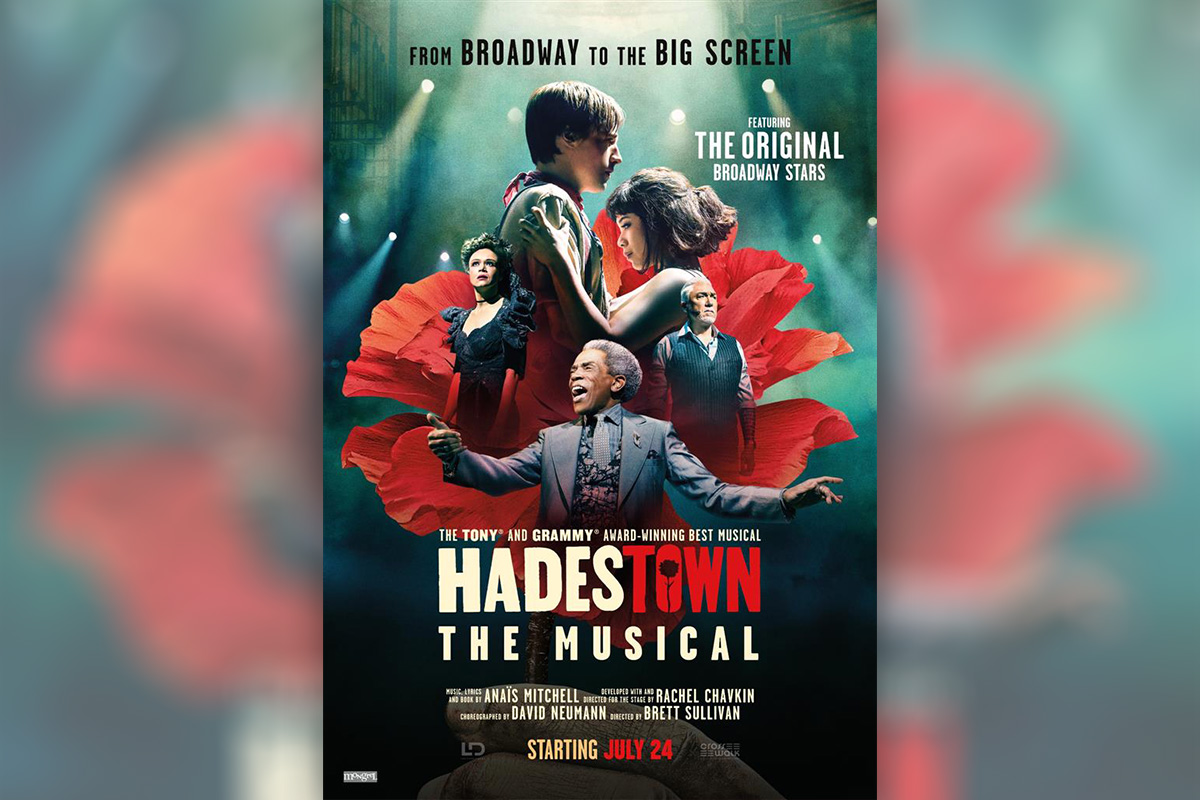
Hit Broadway musical Hadestown is coming to movie theatres from July 24-Aug. 5.
A re-telling of Orpheus and Eurydice by folk singer-songwriter Anaïs Mitchell, the show is a remarkably seamless blend of myth, romance, and anti-capitalist allegory.
The show begins by acknowledging that it’s telling a familiar story, and everyone knows what’s going to happen. Orpheus and Eurydice fall in love, she dies, Orpheus travels to the underworld to save her. Hades and Persephone are moved by Orpheus’ song, and he’s given the chance to lead Eurydice back to the land of the living—on the condition that he doesn’t look back to check that she’s following him. As they approach freedom, Orpheus loses faith and looks behind him, sending Eurydice back to the underworld. So goes the myth.
What makes this version of the tale come to life is that the tragedy doesn’t come from hubris, or trying to cheat fate. The tragedy is capitalism.
Orpheus is “a poor boy” with the ability to “make you see the way the world could be” through the power of his music. Eurydice is “a hungry young girl” cynical because “she saw how the world was”. They fall in love amid hard times. When the two are torn apart, it’s not by a snake bite, but by hunger. Hades—referred to as “the king of the mine” and “a mean old boss”—appears to Eurydice, promising to save her from poverty if she chooses to come with him. But it’s no choice at all; as The Fates sing directly to the audience, “wouldn’t you have done the same?”
So Eurydice goes with him, not to the ancient Greek land of the dead, but to an industrial company town. There, workers “sign their life away” for the promise of “freedom”—which turns out to be the freedom to “work themselves into the ground”. Instead of losing their memories in the River Styx, they lose their identities on the production line. The imagery would fit right in among some of Marx’s more poetic passages from Capital.
Mitchell didn’t set out to tell an anti-capitalist parable, simply to tell a story set amid poverty and economic exploitation, saying, “I would rather raise questions than provide answers.” In fact, over the show’s long evolution—from community theatre in 2006 to Broadway in 2019—the political themes have softened while the parallel romances of Orpheus and Eurydice, and Hades and Persephone, have become more developed (readers who are interested in earlier versions can listen to the 2010 concept album and 2017 off-Broadway cast recording). But by staying true to the world and the characters she created, Mitchell she tells a more complete allegory for class struggle than she could have ever intended.
Orpheus goes to Hadestown to challenge Hades and free Eurydice. After his initial attempt fails, it’s the indignation of the workers that encourages him to keep going, to keep questioning the way things are, and he becomes a rallying figure for them in turn. Hades has a change of heart after listening to Orpheus’ appeal, but no matter how sympathetic he becomes, he’s bound to set Orpheus up for failure, because Hades can’t risk him becoming an inspiration to the workers.
Orpheus is not a revolutionary, just an artist who believes that “if no one takes too much, there will always be enough.” Forbidden from looking behind him, he is isolated from Eurydice, and from the workers who supported him. He listens to his doubts and loses perspective. That’s when he fails, and looks back. It’s not just Orpheus’ tragedy, it’s the tragedy of a revolution lacking sufficient leadership, and one that’s more heartfelt and moving than if it had been deliberately constructed that way.
The best thing about Hadestown is that it doesn’t end there. It doesn’t use tragedy as an opportunity for catharsis, but to make a call for determined optimism in the face of hardship. The show dwells on the loss just long enough for it to hurt—and then it starts again, “as if things might turn out this time.” It asks the audience if they, like Orpheus in the beginning, can see the way the world could be. The characters themselves are doomed to tell the same story, again and again, performance after performance. But we, the audience, can learn from the past and go back to the real world, to something that we can change.

