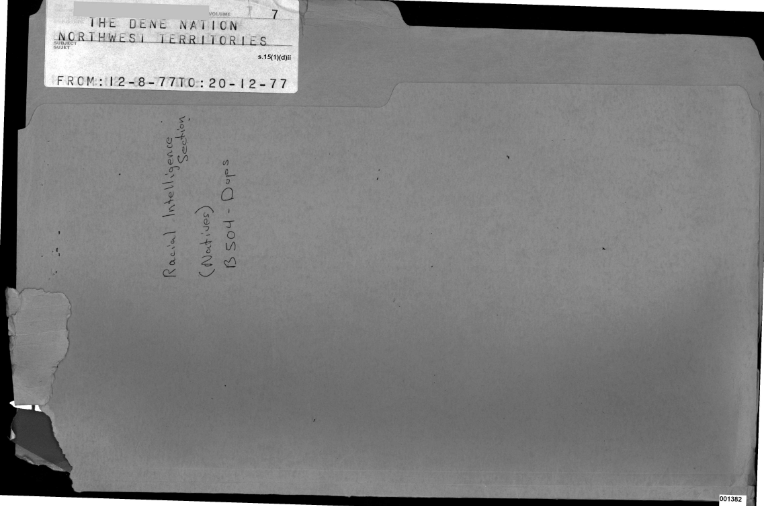
A recent investigation by CBC journalists has dug up thousands of RCMP files from the 1960s and 1970s, exposing a widespread program of surveillance and infiltration called the “Native extremism” program. Part of the RCMP’s Security Service, it was designed to gather “racial intelligence” (a term borrowed from the FBI’s COINTELPRO) to prevent “violence” or “extreme acts” by Indigenous people.
In reality, this program was an attempt by the state to undermine Indigenous peoples’ ability to organize for democratic rights and self-determination—using means both ridiculous and illegal, usually at the same time.
The repression of Indigenous people by the RCMP is nothing new. Without it, Canadian capitalism could never have established itself. But the Native extremism program reflects a particular moment in which the Indigenous struggle was becoming more conscious and organized, anti-colonial revolutions shook the globe, and the not-so-Quiet Revolution was raging in Quebec. The state was seeking to destroy the Indigenous movement from within, before it could grow into a revolutionary threat.
This period was sparked by Pierre Trudeau’s 1969 White Paper, which sought to destroy the extremely limited rights guaranteed to Indigenous people under the Indian Act, and absolve Ottawa of any responsibility for the conditions of Indigenous communities. At the same time, welfare agencies were removing tens of thousands of Indigenous children from their families in the so-called “Sixties Scoop.”
This sparked a wave of political organizing, and a desire to establish unity and direction across the Indigenous movement. For example, Cree activist Harold Cardinal and the Indian Association of Alberta issued the “Red Paper” as a rebuke to Trudeau, asserting the right to self-determination, public services and land rights. It was officially adopted by Indigenous organizations across the country. While the White Paper was revoked in 1970, the state continued to pursue countless resource projects on native land, deny land claims, and violate treaty rights—and Indigenous communities continued to fight back.
It was fear of this movement linking up with the American Indian Movement (AIM) that led the RCMP to expand the Native extremism program. AIM represented the most militant wing of the Indigenous movement in the United States, and it succeeded in bringing public support to the side of Indigenous communities, especially after the 1973 occupation of Wounded Knee. That same year, 150–200 Indigenous youth occupied the Ottawa office of the Department of Indian Affairs for 24 hours, inspired by a similar action by AIM in Washington. In an internal report, the RCMP concluded that the Security Service was “unprepared,” and “unable to respond” to the growing movement.
This report expresses what the program was actually about. What the RCMP feared most was not really “violence,” but the broadening and strengthening of the Indigenous movement. The RCMP contacted the FBI in 1974, asking them to “alert their sources and pass any details to us” about AIM chapters developing in Canada. Where chapters were being set up—in B.C. and Toronto—the Security Service placed informants in and around the groups.
The Native extremism program then developed into a widespread spying operation that surveilled hundreds of Indigenous people and at least 30 political groups. While any and all Indigenous political groups were targets—“legitimate” or otherwise—the RCMP had particular interest in any groups who built broader support amongst non-Indigenous workers or international groups, as well as those who used more militant tactics like occupations, armed demonstrations, and blockades.
For these reasons, the RCMP saw the Dene Nation as a special threat. They had links to AIM, and the RCMP was also concerned with “subversive foreign contacts,” as well as influence from a group of “white radicals”—communist advisors hired by the Dene Nation leadership. “We must remain alert,” the Security Service wrote, “should efforts be made to secure aid from communist governments or Marxist oriented liberation movements.”
The Security Service paid five different informers to infiltrate the Dene Nation, including one full-time, salaried spy. Despite this, the Security Service investigation was often directionless and sloppy. When one of the activists discovered a bug in the office, they reported it. François Paulette, then-chief of Smith’s Landing First Nation (now Tthebatthie Denesųłiné Nation) and a leader of the Dene Nation at the time, told CBC, “We brought it to the RCMP and they denied it. They didn’t say it was theirs, or somebody must have planted it there. They just totally denied it.”
The RCMP also broke into the Dene Nation’s offices to steal documents and intimidate the group in the midst of a public inquiry over the development of a pipeline in the Mackenzie Valley. When the judge overseeing the inquiry was sympathetic to the Dene’s case, the RCMP saw it as a conspiracy. In an internal report, one RCMP officer asked if the judge was “a willing tool or just naive” and whether there were “any way or means open to us to discredit” non-Indigenous people who were sympathetic to the Dene Nation.
The files are full of evidence of blunders, racism, and idiotic and invasive tactics, applied against dozens of Indigenous communities and people. The RCMP tried to use other COINTELPRO techniques to sow division and paranoia among activists. But this largely failed, and they accomplished nothing but the senseless harassment and criminal repression of Indigenous people.
This paranoia reflects the anxiety of the Canadian ruling class at the time. Canadian capitalism in the 1970s was facing a global oil crisis as well as the threat of a constitutional crisis stemming from the struggle for self-determination of both the Québécois and Indigenous populations. In this context, the state sought to clamp down on anything that could be an obstacle to their energy profits or further stress the already-fragile confederation.
In 1977, the federal government opened the McDonald Commission—an investigation into what they called the RCMP’s “wrong-doings”, focusing particularly on their harassment of the Quebec left, and exposing a number of criminal tactics used by the Security Service. While this did lead to the closure of the Security Service, this was not the end of the Native extremism program, nor the end of the Canadian state’s war against Indigenous people.
With the creation of the Canadian Security Intelligence Service (CSIS) in 1984, the Native extremism program found a new home. In cooperation with the Mounties, CSIS continued the program well into the 1990s. More recently, they’ve scrapped the old name, but the systematic surveillance of Indigenous groups and militarized assaults on protests and blockades carries on. A years-long campaign against the Wet’suwet’en land defenders included violent raids, as well as intrusive surveillance.
As long as Canadian capitalism exists, the state will always be suspicious of Indigenous people. Their land and their rights are an obstacle to the profits of oil barons and bankers—and the state in the last analysis is nothing but a tool in the hands of the latter.
With Canadian capitalism now in hot water, Prime Minister Mark Carney’s government has made clear they want to fast-track major projects, and are ready to bypass environmental regulation. They also recently increased the RCMP’s budget. It’s clear that the Canadian state is preparing to use every means at their disposal to smash those that stand in their way. Indigenous people risk once again finding themselves in the crosshairs of the state. What’s needed more than ever is a united, militant movement of the working class, oppressed, and Indigenous communities to bring down this rotten system. When such a movement surfaces, no amount of spying, infiltration, or harassment will be able to stop it.

