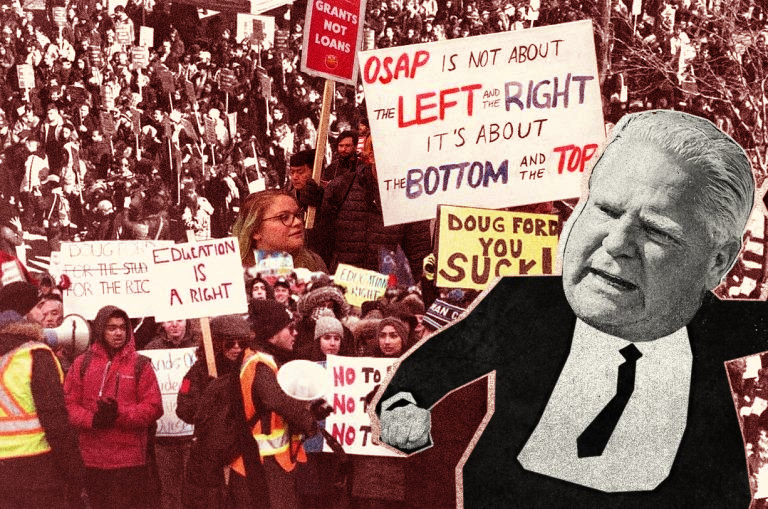
On Nov. 5, the Canadian Federation of Students in Ontario launched one of its most significant days of action in decades. Student unions across the province organized walk-outs and one-day strikes to protest Doug Ford’s cuts to OSAP.
On the same day, a general strike was launched in France, spurred on by the heroic movement of the French students. In the time since, Quebec students launched a week-long student strike, and students across Europe organized a “youth strike” against militarism and austerity on Nov. 20.
Everywhere, it is the youth who are taking up the struggle against attacks on education, and all the miseries of the capitalist system today. The mood and potential for an escalation in the struggle against Ford are immense, and post-secondary students are well-positioned to stand at the forefront. To take this fight to the next level, we need to spread the youth revolt to Canada. But how can we make this happen?
How to organize a real student strike
Nov. 5 was the broadest day of action that the CFS has called in a very long time. It encompassed nearly all of the biggest campuses and urban centres in the province.
Walkouts, rallies, and strikes were called at TMU, York, OCAD, UofT, UTSC, UTM, Humber, and George Brown in Toronto; Carleton and University of Ottawa; University of Waterloo; Brock in St. Catharines; University of Windsor; and McMaster in Hamilton, amongst other campuses.
This was a big step forward. But if we are to be honest, mobilization efforts left something to be desired. Although the CFS voted in August to endorse a one-day strike on Nov. 5, at many campuses promotion didn’t start until only a few weeks before. Throughout September and October, when the campuses are at their busiest, there was next to no mobilization at most campuses. Most students either did not know about the strike or walkout, or if they did know about it, they did not know much more than the fact that it was happening.
As a result, the rallies were not as big as they could have been. For example, at TMU and University of Toronto, we counted about 250-300 students, and at York, 100-200. These are some of the biggest campuses in the entire country. There are certainly more than a few hundred students on each campus who are angry about OSAP.
This was even worse at the universities led by student unions unaffiliated to the CFS. At the University of Waterloo and Brock University the student unions only hopped on at the very last minute. Days of actions were called with mere days notice, and got very small responses.
As a result, no campus was shut down which means that even when the actions were called “strikes,” they weren’t really strikes. Even when some campuses called for “pickets,” no entrances were blocked.
A movement is only as powerful as the number of people involved and their level of active participation. This requires maximum effort to win over the student body, with widespread and sustained efforts to convince students and mobilize them.
Leading up to the triumphant 2012 student strike in Quebec, student unions poured all of their resources into a vast initiative to win over the student population to the idea of a student strike. For example, Gabriel Nadeau-Dubois, the main leader of the 2012 strike, explained that at the beginning only “10 to 15 per cent of the students were against this tuition increase.”
But through a vast campaign of education and mobilization, the student leaders led one of the largest mass movements in the history of Quebec—in fact the history of Canada as a whole—defeating the hated Charest government and reversing the tuition increase.
Student unions in Ontario must follow this example. They should wage a broad educational campaign explaining the issue of OSAP cuts and the crisis of postsecondary education, what a student strike is, and why one should be organized. Even many people in the movement who support the idea of a student strike in the abstract don’t actually know what it entails. This process of clarification will be essential to winning students over to the idea.
Organize strike votes
The 2012 Quebec student strike didn’t materialize out of nowhere. It began with a group of leading activists campaigning relentlessly for a strike. But while the initiative came at first from a dedicated core of the student leadership, as the movement developed, rank and file students took it into their own hands. This gave the movement immense power. But for that to happen, students need to have a sense of ownership over the movement.
In Ontario, with the exception of a few campuses, there were no general assemblies where students were allowed to openly discuss and debate the merits of a student strike and vote on a plan of action to launch one. Instead, student union leaders called one-off actions with next to no notice or mobilization. When students showed up to these, they were not told what the next steps were nor were they given anything to do to help further the struggle.
For the movement to be strong, the direction of the movement must be placed into the hands of the student body. To this end, we call on the CFS and its locals to organize mass strike assemblies all across the province, so that students can debate and vote on the path forward.
Assemblies should not be seen as an organizational formality. On the contrary, they are already an essential part of a strike movement. Both the preparation for a strike vote and the vote itself will serve to popularize and build confidence in the idea, and build a genuine sense of ownership for the strike among students.
These assemblies should be promoted as widely as possible, using the full resources of the student unions, with the goal of maximum participation. They should use whatever funds they have at their disposal to print off mass amounts of flyers and posters promoting the assembly. There should be constant information booths on campus and a steady stream of promotional and educational resources all across social media. There should be class visits in every class to inform the students of the upcoming assembly.
The plan to mobilize for the assemblies should involve as wide a layer of sympathetic students as possible. Mobilization teams should be set up everywhere with two aims: to educate and inform as many students as possible about the strike vote, and to form everyone who supports the idea into new mobilization teams. A movement organized along these lines could snowball massively, leading to a truly mass strike, shutting down the post secondary education system in Ontario.
This is the only way to stop Ford’s attacks.
Spread the youth revolt!
A few days after the Nov. 5 day of action, Doug Ford was mocking students during a press conference, calling them “sheep” who simply follow what social media tells them to do.
Ford’s arrogant comments show two things. They show, first of all, that the movement against the OSAP cuts will not represent a real threat to Ford unless we escalate significantly. But it also shows that Ford is not aware that he is playing with fire.
The past few years have proven that once pushed into action, next to nothing can stop the youth. Over and over since 2019, heroic students and young workers across the world have shattered the illusion of “apathetic” Gen-Zers, sparking mass movements and even toppling political regimes which previously seemed unassailable.
There is nothing fundamentally different about the situation here in Canada. The exact same mood exists among students here, fueled by the crushing cost of living today and the declining prospects of a good life after graduation. There is a widespread anger towards the system for robbing us of our futures.
Rumblings of this mood are already making themselves felt more strongly. In Quebec, a week-long student strike culminated in a demonstration of 5,000 students demanding affordable, high quality education.
While English Canada may not have the same tradition of militant student struggles as Quebec and other countries, that only makes it all the more important for the leadership of the movement to explain and promote the necessary next steps as energetically as possible.
New traditions have to be forged somehow. And right now, when students everywhere are taking up the fight for their futures with the most courageous and militant attitude, is the perfect time to bring these methods here. This will form the basis, not just for the fight against the OSAP cuts, but against all austerity and against the capitalist system as a whole.
The path forward is clear:
Organize a mass student strike movement!
Hold strike votes on every campus!
Bring the youth revolt to Canada!

