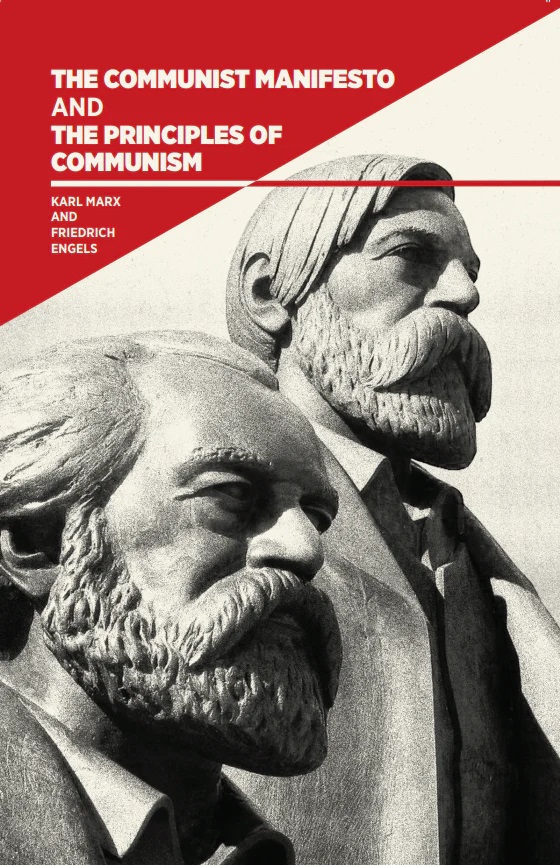
We publish here the introduction to the Camilo Cahis Publishing House’s edition of The Communist Manifesto. This introduction was written to help today’s revolutionaries get the most out of this essential foundational text.
You can purchase The Communist Manifesto here.
Written in 1848 by Karl Marx and Friedrich Engels, The Communist Manifesto is the founding text of Marxism—or, to use its original name: scientific socialism.
The Manifesto laid the foundations for a completely new worldview that revolutionized human thought. In contrast to bourgeois history, which revolves around great men like monarchs and generals, Marx and Engels restored ordinary people to their rightful place in history. The Manifesto explains how it is ordinary men and women, who toil and struggle through hardship every day of their lives, who are the true agents of historical change.
That is why the Manifesto, far more than a work of philosophy or history, is above all a guide to action. The ideas it contains inspired generations of revolutionaries to rise up and fight against the capitalist system and the horrors it produces.
The contents of the Manifesto are not just of historic interest. This incredibly modern book can still help us to understand and change our world today.
The relevance of the Manifesto
Nearly 180 years have passed since the Manifesto was written. And yet, it remains strikingly relevant.
In the time of Marx and Engels, capitalism was still in its youth. Small-scale production made up most of the market. The working class or proletariat—those who have to sell their labour-power for a wage to live—was still relatively small in number.
Despite this, Marx and Engels predicted the tendency of capital to accumulate endlessly, concentrating into fewer and fewer hands. Marx would later explain this more fully in Capital, where he showed how free-market competition inevitably gives rise to its opposite: the domination of monopolies.
A 2023 study by Kwon, Ma and Zimmerman found that the top one per cent of U.S. corporations now own 97 per cent of all U.S. corporate assets, up from 70 per cent in the early 1930s—a stunning confirmation of Marx’s predictions.
But that was not all. Marx and Engels predicted that the tendency of capital to devour everything in its path would also ruin the intermediate classes between big capital and the workers—small business owners, small artisans, and small peasants—dispossessing them and turning them into wage earners forced to depend on the capitalists. History has proven them right: today, wage workers make up a majority of the global population—something which was far from the case in the mid-1800s.
Marx and Engels also foresaw the tendency of capital towards globalization. Today, national economies are more interconnected than ever. In 2025, there is almost no corner of the earth left untouched by the capitalist market.
The genius of Marx and Engels—so clearly distilled in the Manifesto—was to foresee decades in advance the direction capitalism was heading. That is why the Manifesto is not just still relevant today—in many ways, it describes the situation much better than it did when it was first written.

Scientific socialism
In their day, the tendencies of capitalism that Marx and Engels described only existed in embryonic form. Despite this, they were able to look past its appearances and identify the essential mechanics of capitalism—thus anticipating its future evolution. But how was this achieved?
It is worth noting that Marx and Engels were not the first communists or socialists in history. Many had come before them and inspired them—especially those known as the utopian socialists. These figures represented the early, confused expressions of revolt against the newly emerging capitalist order, which had begun to replace the decaying feudal system.
The historical immaturity of the then-nascent proletariat was matched by the theoretical immaturity of utopian socialists. They had no scientific understanding of how capitalism worked, or of how to replace it with the new socialist society. Their ideal society was just that—an ideal, a utopia, a perfect world dreamed up in their heads.
The central contribution of Marx and Engels was to raise socialism to the level of a science. This they achieved through a study of history and the examination of class society by a definite method of analysis: dialectical materialism. This new method was one they developed themselves, but not out of thin air. They drew from the most advanced ideas of their time.
Marx and Engels were, among others, students of the great German philosopher Hegel. From him they took dialectical philosophy—the idea that everything in the universe is in constant motion and transformation, and that “all that exists deserves to perish.”
The dialectical method explains that change and movement involve contradictions, the struggle of forces, and that things don’t evolve in a purely linear, gradual way—slow, cumulative changes are punctuated by sudden, explosive qualitative leaps.
Equipped with this method, Marx and Engels explained that capitalism was not simply an evil aberration of humanity—as the utopians tended to argue—but a necessary step in the process of historical development. Moreover, they outlined how capitalism was beset by contradictions that in time would lead to its dissolution and replacement by a higher form of social and economic organization—that is, communism; a truly democratic society, without social classes or exploitation.
Historical materialism
The scientific foundation of their socialism was not just dialectics—it was also materialism.
Throughout modern European history, philosophical materialism was the primary ideological arsenal in the fight against obscurantism, superstition and mysticism—all products of feudalism and the church in the minds of men.
Marxist materialism holds that there is only one world: the material world. In the natural sciences, it is well established that things unfold according to definite and understandable laws. These laws originate in the behaviour of matter and the many forms in which it organizes itself. The discovery of these laws in fields like biology, chemistry and physics has contributed to our understanding of the world and thus enabled us to gain mastery over it.
But these laws do not stop at nature. Human history and society are also organized according to certain laws. It was the discovery of these laws that the two fathers of Marxism undertook.
By applying philosophical materialism and the dialectical way of thinking to human history, they developed historical materialism—the materialist conception of history.
Marx and Engels argued that the entire structure of society—its institutions, culture, dominant philosophy and religion—ultimately rests on the foundation of a particular mode of production, whether it be primitive communism, slavery, feudalism, or capitalism. Marx wrote, “The mode of production of material life conditions the general process of social, political and intellectual life. It is not the consciousness of men that determines their existence but, on the contrary, their social existence that determines their consciousness.”
Human beings are shaped by their environment, but they are not passive reflections of it. They also act upon it. The driving force of history lies in humanity’s ability to transform its environment by developing the productive forces: industry, agriculture, science, and technology.
In transforming their environment, humans also transform themselves—and with them, all of society.
Each form of society is transitory. It arises by supplanting the old one, and thrives for as long as it succeeds in developing the productive forces—i.e., increasing human power over the forces of nature.
Once this society has exhausted its historical potential, it enters into crisis, and creates the conditions for its revolutionary overthrow and its overcoming by a higher socio-economic system better able to drive human progress forward.
With this idea—developed clearly and decisively in the Manifesto—Marx and Engels gave socialism a solid scientific foundation.
Class struggle
But we must add: historical change does not happen on its own. It is the work of human beings. “History does nothing,” wrote Marx in The Holy Family; “it ‘possesses no immense wealth,’ it ‘wages no battles’. It is man, real, living man who does all that, who possesses and fights”.
The central struggle in all societies, Marx and Engels showed, is the class struggle—sometimes open, sometimes hidden—between the exploited working classes and the ruling exploiting classes over the products of labor.
In modern capitalist society, bosses pay workers only a fraction of the value they produce. The rest is their profit, which increases their capital. Capitalists fight to increase their exploitation of workers; workers fight to win back more of the stolen value.
Capitalism has created the industries that could free humanity from toil. But the development of the productive forces is hampered by their private appropriation by parasitic billionaires.
One of the primary manifestations of this hindrance to the productive forces is the phenomenon of the crisis of overproduction. Since workers are paid only a fraction of the value they produce, they cannot buy back all the goods they produce.
This overproduction leads to cyclical crises every decade or so. For the first time in history, a socio-economic system enters into crisis because it generates too much wealth.
Today, this fundamental contradiction of capitalism has reached a level not seen since the Great Depression of the 1930s.
Markets are saturated and growth rates have been low for years. Capitalists prefer to speculate rather than invest in real production, which in turn exacerbates the productivity crisis.
Meanwhile, workers are being battered by the housing crisis, the cost-of-living crisis and the underfunding of social services. Everywhere, capitalism in crisis is leading to poverty, famine and war, and ever greater exploitation of the environment in the name of profit.
Socialism is thus no longer just a good idea, as it was for the utopians. Capitalism’s technological advances have created the material basis for socialism. At the same time, socialism has become a vital necessity for the very survival of our species.
Writing the Manifesto
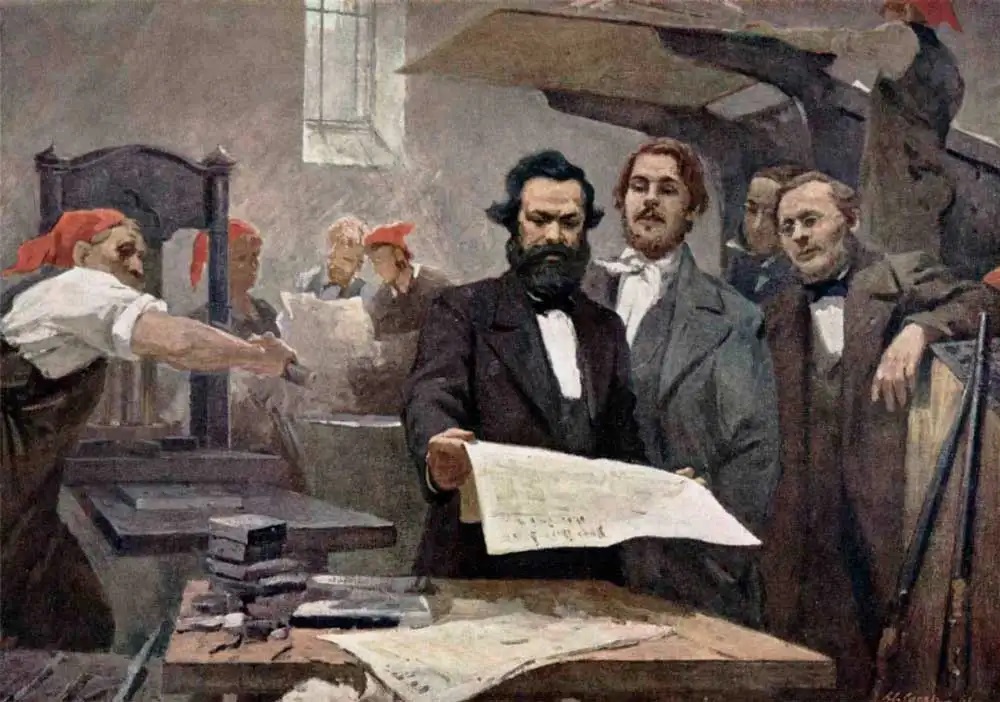
Marx and Engels wrote The Communist Manifesto in February 1848. It became the founding manifesto of the Communist League. Founded on June 1, 1847, in London, the Communist League was the result of a merger between the League of the Just and the Communist Correspondence Committee in Brussels, in which Marx and Engels played a leading role.
Engels drafted a first version of the program, titled Draft of a Communist Confession of Faith. He wrote a second draft between October and November 1847, in preparation for the second congress, titled Principles of Communism.
We include this brilliant text by Engels in the present edition. Though less well-known than the Manifesto, Principles of Communism provides a useful supplement to it and will help deepen the reader’s understanding of what Marx and Engels stood for.
However, Engels remained unsure that Principles, written in a simple question-and-answer format, should serve as the founding document of their movement. He wrote to Marx on November 24, 1847:
“Dear Marx […] Give a little thought to the Confession of Faith. I think we would do best to abandon the catechetical form and call the thing Communist Manifesto. Since a certain amount of history has to be narrated in it, the form hitherto adopted is quite unsuitable.”
Thus, the second congress of the Communist League (Nov. 29–Dec. 8, 1847) tasked Marx and Engels with writing the Manifesto.
The spectre of communism
The Manifesto opens with the famous words: “A spectre is haunting Europe—the spectre of communism.” At the very moment of its publication in February 1848, old monarchic Europe was shaken by the greatest wave of revolutions it had ever seen: the revolutions of 1848, also known as the Springtime of the Peoples. The working masses rose up against tyranny and attempted to take their fate into their own hands.
At that time, wage workers made up only a small portion of the population. They lacked the numbers, consciousness, and organization to overthrow capitalism.
But what about today? The working class now makes up the vast majority of humanity. Nothing is produced without them. Through a general strike, they can paralyze the entire economy.
Every day that capitalism sinks deeper into crisis and the bosses attack workers’ conditions, new layers of young workers become aware of the need for revolution.
In Canada, a 2023 survey from the Fraser Institute showed that 1 million young Canadians believe communism is the ideal economic system. In the United States, 20 per cent of young people shared that view.
“The bourgeoisie produces its own gravediggers,” declares the Manifesto. The spectre of communism is back, and the ruling class is once more beginning to tremble.
But we lack organization. The socialist revolution will only be victorious if we build a worldwide mass communist party beforehand. Marx and Engels recognized the necessity of this task, and so ended the Manifesto with a call for its urgent completion. It is a job that still remains to be achieved today.
The Revolutionary Communist International is the only force seriously carrying out the work of building such a party today. The ideas of Marxism, of which the Manifesto is but an introduction, will offer you a profound insight into our world like no other. More importantly, it will show you how to change it. However, it is up to you to help build the party that can transform those ideas into reality.

