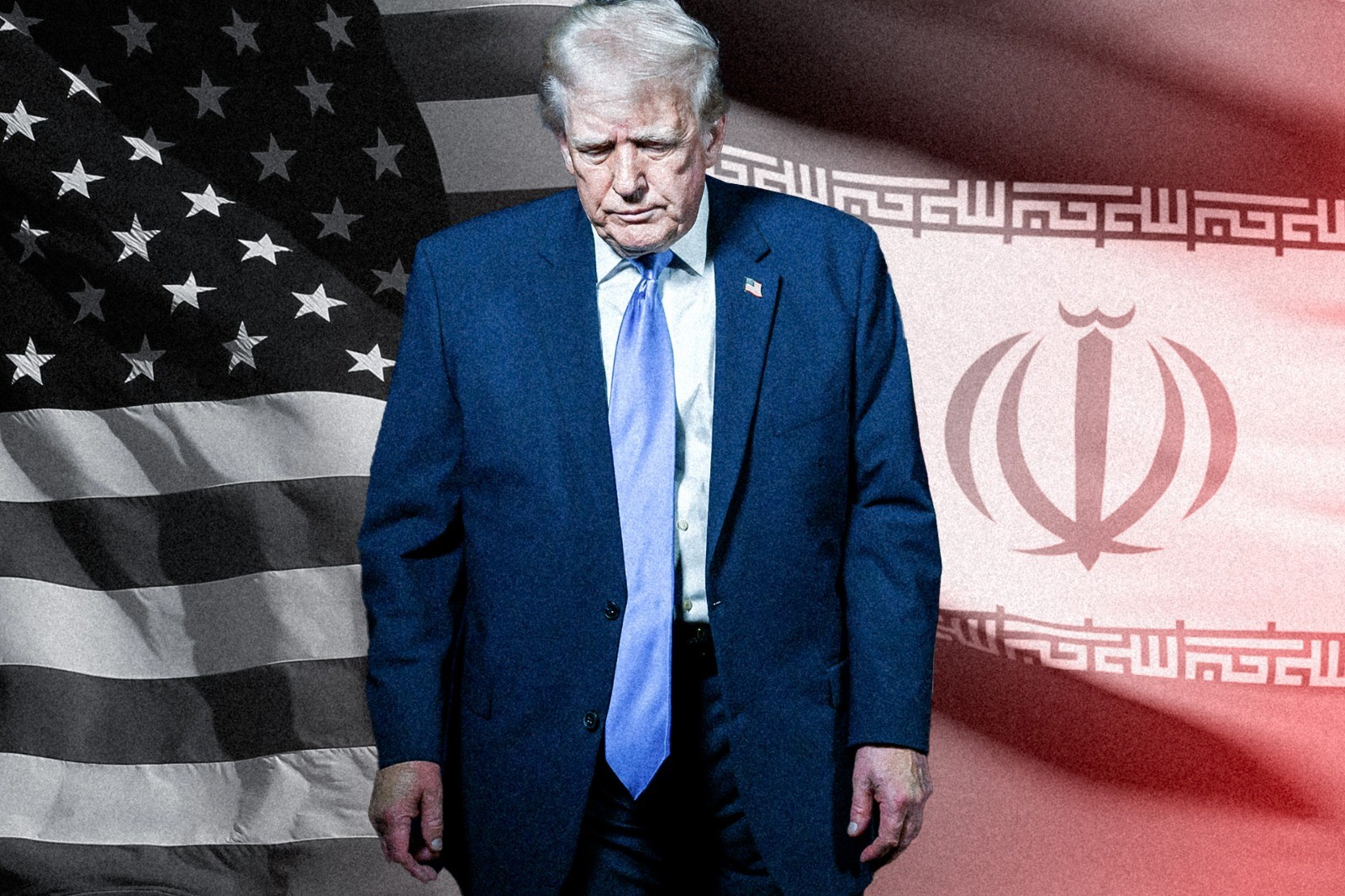
“Total and complete victory. 100 percent. No question about it.” With these words, Donald Trump described the two-week ceasefire with Iran announced last night.
Just hours prior, Trump had threatened that “an entire civilization will die” – which elicited not a word of criticism from America’s allies. But shortly before his own deadline expired, Trump chickened out before the eyes of the world. He has now, at least in words, agreed to discuss on the basis of a 10-point Iranian proposal, mediated by Pakistan, as a step toward a permanent end to hostilities.
If you believe the White House, the ceasefire is the result of the US having “met and exceeded” all military objectives. Trump is now claiming that a “Golden Age of the Middle East” awaits. Spokesperson Karoline Leavitt boasted of the “unbelievable capabilities of our warriors” and credited Trump with having “got the Strait of Hormuz reopened” – the apparent grand prize of the war, never mind that it was open before the US and Israel attacked Iran on 28 February.
The ceasefire is very fragile and could fall apart at any minute. But whether it holds or not, this is a serious defeat for the US and Trump personally.
The last month has exposed both the limits of Trump’s gunboat diplomacy and of US imperialism in general. The world economy has suffered severe damage, the US’ allies have been systematically alienated, Trump’s base is divided, and now a question mark hangs over the future of US influence in the Middle East.
The art of the deal?
Looking at the actual contents of the plan, as published by Iranian state media, tells a very different story from Trump’s triumphant statements. Far from conceding to the US from a position of weakness, Iran has, on paper, secured concessions the US would never have dreamed of granting before the war began.
The deal demands a complete and permanent cessation of hostilities not only in Iran, but across Iraq, Lebanon, and Yemen – effectively forcing the US to curb not just its own ambitions, but Israel’s as well. Any breach would give Iran legitimate grounds to resume attacks, whether Netanyahu targets Iran or its proxies. The Strait of Hormuz is to be governed by an agreed ‘navigation security protocol,’ one in which Iran will effectively act as toll keeper, demanding a healthy tribute in exchange for safe passage.
On the economic front, the US would be required to pay full reconstruction compensation to Iran, lift all sanctions, and release all frozen Iranian assets. Iran, in turn, merely commits to not pursuing nuclear weapons – something it had already agreed to many times before the war.
For Iran, victory was always defined by mere survival. By surviving, it has exposed the limits of US military strategy, demonstrating that it can be countered through asymmetric warfare and control of key geostrategic chokepoints. Iran’s missile and drone campaign damaged at least 11 US bases, forcing the evacuation of their military personnel, as well as countless energy facilities across the region. By simultaneously closing the Strait of Hormuz, Iran exploited the world economy’s vulnerability to energy shocks – including in the US itself, where average gas prices have risen 45 percent since February.
Trump’s constant flip-flopping – shifting his war aims and repeatedly switching between claiming early victory and escalating the conflict even further – has dealt unprecedented damage to his already faltering popularity. A wedge has been driven through his MAGA movement, with former Trump influencers demanding his impeachment.
For now, declaring ‘victory’ and walking away from the war is his least bad option.
Iran strengthened
Iran, meanwhile, comes out with its head held high. As a lengthy statement from Iran’s National Security Council makes clear, its leadership heads to Islamabad holding all the cards. If the US accepts any version of the 10-point plan, Iran will have the political and economic breathing room it needs to rebuild.
In Israel, Trump’s retreat has already been met with rage and panic from the rabid Zionists, who want nothing less than to see the complete collapse of Iran. They will surely have been egging on Trump to actually go ahead with yesterday’s genocidal threats. But an end to the war on Iran’s terms – which the ceasefire represents – would be the worst of all worlds. It would leave it stronger than before, undermining the possibility of Israel becoming the dominant power in the region – the very goal for which it drew the US into the conflict in the first place – and it would force America to back out of the region, exposing Israel and placing it in existential jeopardy at a time when it is engaged on six fronts.
Israeli opposition leader Yair Lapid did not mince words when commenting on the ceasefire:
“There has never been such a political disaster in all of our history. Israel wasn’t even at the table when decisions were made concerning the core of our national security. Netanyahu failed politically, failed strategically, and didn’t meet a single one of the goals he himself set. It will take us years to repair the damage he wrought through arrogance, negligence, and a lack of strategic planning.”
This is a damning statement, which accurately shows the weakened position that Israel now finds itself in. Not only have they been taken by surprise by Iran’s ability to hit targets across Israel, but Hezbollah has reemerged as an imposing force, which is causing serious losses to the invading IDF.
Netanyahu will do everything in his power to drag the US back into the conflict. Tellingly, Iran’s 10-point proposal includes an end to Israel’s war on Lebanon – yet Netanyahu has already moved to undermine the ceasefire by rejecting this clause and launching the largest wave of strikes on the country since the war began, hitting over 100 supposed Hezbollah positions across Beirut, the Beqaa Valley, and southern Lebanon. This morning alone 300 people have been killed in Beirut with hospitals appealing for emergency blood donations.
As at the end of the 12-Day War last year, the diverging aims of Israel and Trump are once again becoming apparent. For Israel, any outcome that leaves the Iranian regime standing is tantamount to a crushing defeat.
Economic recovery?
Ultimately, what forced Trump’s hand were the economic consequences of the war. The 38-day closure of the Strait of Hormuz caused chaos across the global economy, pushing up the price of oil, gas, fertiliser and nearly every industrial chemical. Growth forecasts fell, inflation spiked, and markets reeled.
Ordinary people are already feeling the strain. A prolonged closure of the strait would have made things significantly worse, as reserves dried up and real shortages and price gouging began to take hold. By sending the prices of oil, gas and their derivatives flying, the crisis threatened to push the world economy over the precipice into stagflation or even a depression, which would wipe out years of economic ‘recovery’ in a matter of months.
With this in mind, and midterm elections inching closer, Trump decided to pull the plug and cut his losses. But while the reactions of the markets will be jubilant today, the consequences of the war will still be felt for months, if not years to come – and this is assuming hostilities don’t break out anew.
Shipping analysts are already saying that there will be no ‘mass exodus’ from the Persian Gulf, with one commenting that the ceasefire “still requires ships to essentially seek permission [from Iran], and that’s the key. That means that nothing has changed – no permission, no transit.” Energy facilities, meanwhile, have been critically damaged over the course of the war and are far from being repaired. Some are expected to be under reconstruction for years to come.
The war has exposed the extreme vulnerability of global trade and supply chains, which can be exploited by countries that, on paper, are much weaker than the US. By taking the Strait of Hormuz ransom in the war, Iran has successfully turned the tables of economic warfare on the US, making a healthy profit in the process.
US decline
Despite what Trump might claim, his debacle in Iran has, in a matter of weeks, become the biggest foreign policy blunder in living memory. The position that the US had built up across the Middle East decades prior – with military bases across the Gulf supposedly protecting key infrastructure vital to the world economy – has proven to be no match for Iran’s arsenal of missiles.
As such, the US has been exposed. America’s Gulf allies – which rely entirely on America for their defence – were left to fend for themselves as the US focused on protecting Israel and its own bases. Realising this, many Gulf States even pushed Trump to continue the war in hopes of finishing the job and removing Iran as a threat to their interests. But with the ceasefire, their hopes have so far been dashed.
Inside the Trump administration itself, there is far from agreement that rapprochement with Iran is the way forward. Notably, Steve Witkoff, Trump’s negotiator extraordinaire, is “very angry”, calling the 10-point plan “a disaster, a catastrophe”, according to reports. He will now go to Islamabad together with JD Vance.
Trump’s method of trying to bulldoze his way through foreign policy with quick deals and ‘surgical’ military operations is coming up against the objective limits to US power across the world. Swinging from one position to the next, he is acting like a bull in a china shop, destabilising the US and world economy in the process.
Whether the ceasefire will actually hold and lead to some kind of longer-lasting deal in the coming weeks, only time will tell. There is still undoubtedly the possibility of another 180-degree turn.
Fall from grace
The Iran War has already had a profound effect on consciousness in the US. Iran can now claim at least a temporary victory, leading to the inevitable question from even the most loyal Trump supporters: what was all of this supposed to achieve?
In the MAGA camp, the Iran War has sparked a fierce backlash, greater than the backlash to any of Trump’s previous policies, including the kidnapping of Nicolás Maduro. Prominent MAGA influencers like Candace Owens, Joe Rogan and Tucker Carlson have all publicly turned on Trump for his involvement in the war. Alex Jones said yesterday that “Trump literally sounds like a deranged supervillain from a Marvel movie. THIS IS NOT WHAT WE VOTED FOR!!” Theo Von who hosted Trump on his podcast during the 2024 elections – now calls the US and Israel the real terrorists in the war against Iran.
Meanwhile, Trump’s approval ratings are the lowest since his inauguration. Support for the war has likewise been consistently low, with over 60 percent disapproving, while 69 percent of Americans say rising gas prices are their top concern. On Israel as well, 57 percent of young Republicans – a group that was reliably pro-Israel just a few years ago – now hold an unfavourable opinion of the country.
The significance of this should not be underestimated. As we pointed out before Trump came back to power, his social base is made up of contradictory elements. The section of the working class who voted for Trump did not do so because they wanted to launch new wars in the Middle East, but because Trump promised an end to foreign wars, while improving the lives of ordinary Americans.
The war in Iran has proven to be an immense blunder. Whether or not the ceasefire holds, 38 days of indiscriminate bombing have come at an enormous cost for American capitalism and its regime – now known to many as the warmongering ‘Epstein class’ – who are becoming increasingly distrusted and even hated by the general population.
As Lenin pointed out, imperialist war intensifies all contradictions – a defeat even more so. Workers and youth will draw important conclusions from these events, seeing the ceasefire for what it really is. They will increasingly seek a revolutionary road not from theoretical reasoning, but from living through the bitter experience of US decline and the dead end of Trumpism.
Living standards are being seriously affected in the United States, and in the coming period Trump will be seen not as the man who solved the problems of the working people, but as the man who aggravated them. All his noisy talk, all his bombastic bluster, will be seen for what it really is: the rantings of a president who has no answers to the real problems. Rather than the president who is making America great again, he will be seen as having governed over a further steep decline in the might of the United States.
The crisis in the Middle East has brought all this out very clearly and this has a deep impact on the consciousness of millions. And as the coalition of forces that brought Trump to power breaks down along class lines, the prospect that opens up is one of intense class struggle in the coming period.

