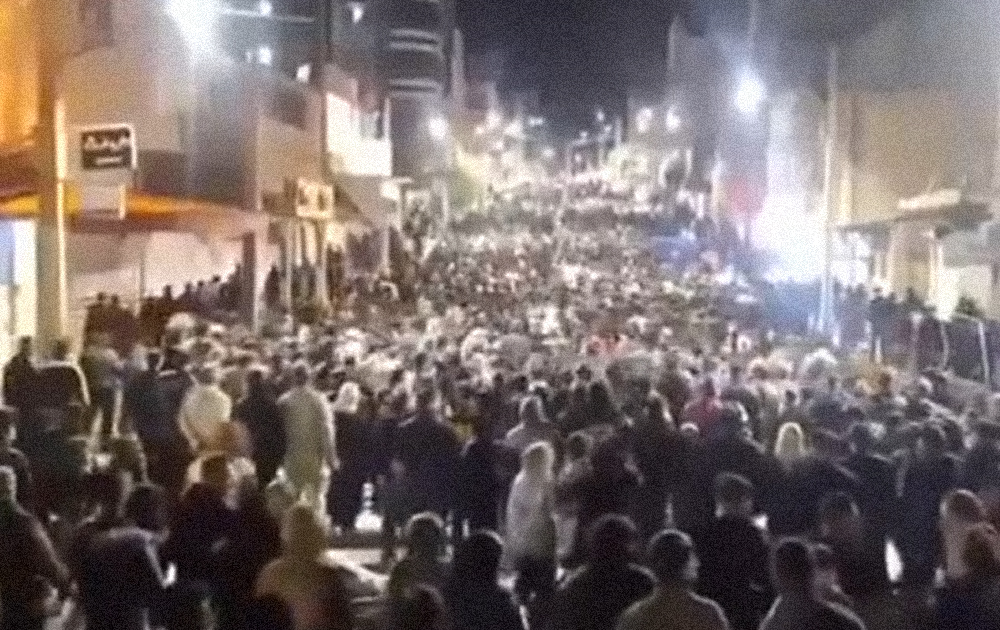
On 29 December, the Iranian rial fell to a record low against the dollar, sparking a bazaar strike in Tehran with massive processions in the main streets chanting the slogans: “Close, close!”, “Death to the dictator!”, “Death to high prices!”, and, “This is the final message; the target is the entire regime.”
Since then, the protests have turned into street clashes between the youth and the security forces across the country. Over 70 cities and towns in 26 out of the country’s 31 provinces have been affected. They remain particularly strong in ethnic minority areas and in the provinces. The situation is moving very fast, and it is unclear whether this will rapidly transform into another national uprising or fizzle out.
By the second day, the bazaar strikes rapidly spread to Hamadan, Qeshm, Mashhad, Isfahan, and Zanjan. At the same time, student protests erupted at universities in Tehran, raising the slogans: “Death to all tyrants! Be it the Shah or Supreme Leader”, “I swear on the blood of our comrades, we will stand until the end!”, and “freedom, freedom, freedom!”
Security forces adopted a passive role, primarily observing the demonstrations. The regime’s attempts to mobilise counter-rallies among its supporters at the universities were strikingly feeble compared to this revolutionary momentum.
During the bazaar protests, elderly participants frequently positioned themselves between the younger demonstrators and the security forces, often challenging the latter to attack them. Simultaneously, at Amir Kabir University and other institutions in Tehran, students successfully expelled both the security forces and pro-regime students from their campuses.
In panic, the regime declared 31 December a public holiday and hoped that this would stop the protests spreading across the country. At the same time, dozens of students were arrested at night, leading to rallies breaking out near student dorms. Security forces started using live ammunition, martyring the first youths. This had the opposite effect and has only enraged the youth further.
The backlash of the youth, as they began actively resisting the regime and its security forces, involved setting up barricades and setting fires, and attacking state infrastructure, including burning courts, police stations, and the offices of Friday imams. In one significant act, they even stormed the governor’s palace in the town of Fasa.
The bazaar strikes returned on 1 January, spreading to 32 cities across Iran. The student protests began spreading to the streets as most universities were either shut down entirely or restricted to remote learning by the regime. The protests have reached even greater proportions in the provinces among the areas of the ethnic minorities, including the Lurs, Bakhtaris, Balochis and Kurds.
Exact figures are difficult to find, but in under a week, dozens have been martyred by the regime, and their funerals are already becoming focal points. In Marvdasht, a mass of mourners chanted the slogan: “I will kill those who killed my sister.” The presence of the security forces at funerals often leads to violent clashes in which they are driven out.
Since 2018, Iran has experienced a period of intensive class struggle, marked by constant protests over economic demands, sector-wide strikes involving truckers, teachers, oil workers, and others, as well as nationwide youth-led uprisings in 2018, 2019, and 2022. All of these movements have ultimately failed, including the 2022 ‘Woman, Life, Freedom’ uprising, which lasted four months and spread to every city and town but never penetrated deeply into the working class.
Already, some independent workers’ organisations have declared their support for the ongoing protests, including the Truck Drivers’ Union, the Coordination Council of Iranian Teachers’ Unions, and the Haft Tappeh Sugarcane Workers’ Syndicate. Declarations of support, however, are not enough. Such statements were issued in 2022. There were even attempts by workers to spark a general strike. But a clear class alternative was lacking, which is especially dangerous in the face of the western imperialists’ attempt to co-opt the movement.
The death agony of the Islamic Republic
Despite the constant external threat of Israeli and American imperialism, the current situation of the Iranian masses is unbearable. Even the regime admits that the overwhelming majority of Iranians live in poverty.
According to the regime, last year alone food inflation was 42 percent. Already, meat consumption has nearly halved, and among the poorest workers it has become commonplace to buy bread on credit. At the same time, power cuts are regular occurrences, along with severe water shortages that are impoverishing farmers and forcing rationing onto the urban population.
The imperialists have played a criminal role in creating this waking nightmare for the Iranian masses through US-led sanctions, which have been tightened by Donald Trump and his lackeys in the EU. But the hypocrisy of the Islamic Republic also enrages the masses. While these pious thieves talk of a “resistance economy”, Iran under them has become number 14 in the world for the largest number of dollar millionaires. The capitalist class that stands behind the regime does not suffer as a result of these sanctions. No, they have enriched themselves at the expense of the working class.
There are constant scandals coming to light of financial pyramid schemes run by regime-affiliated cronies. At the same time, they treat the massive state-run sector as their private fiefdom. They much prefer plundering factories to making actual use out of them. Meanwhile, the regime prefers to run deficits by printing money instead of escalating austerity measures. But this is increasingly untenable. It is anticipated that the upcoming budget in March will include cuts to subsidies.
For a long time, the masses could endure the regime. At least, they reasoned, the regime kept the constant military adventures of western imperialism at bay. And yet now, not only are the masses suffering devastating economic hardship, but the regime has shown itself to be impotent to stop the imperialist onslaught, which has seen the collapse of the Assad regime in Syria, and devastating blows struck against Hezbollah. Above all, the 12 Day War exposed to everyone the weakness of the regime and the culture of corruption that exists among regime cronies. It was this that allowed Israel to infiltrate Iranian society and the regime itself. Despite possessing impressive ballistic missiles, Iran is more vulnerable than at any point since the Iraq-Iran war.
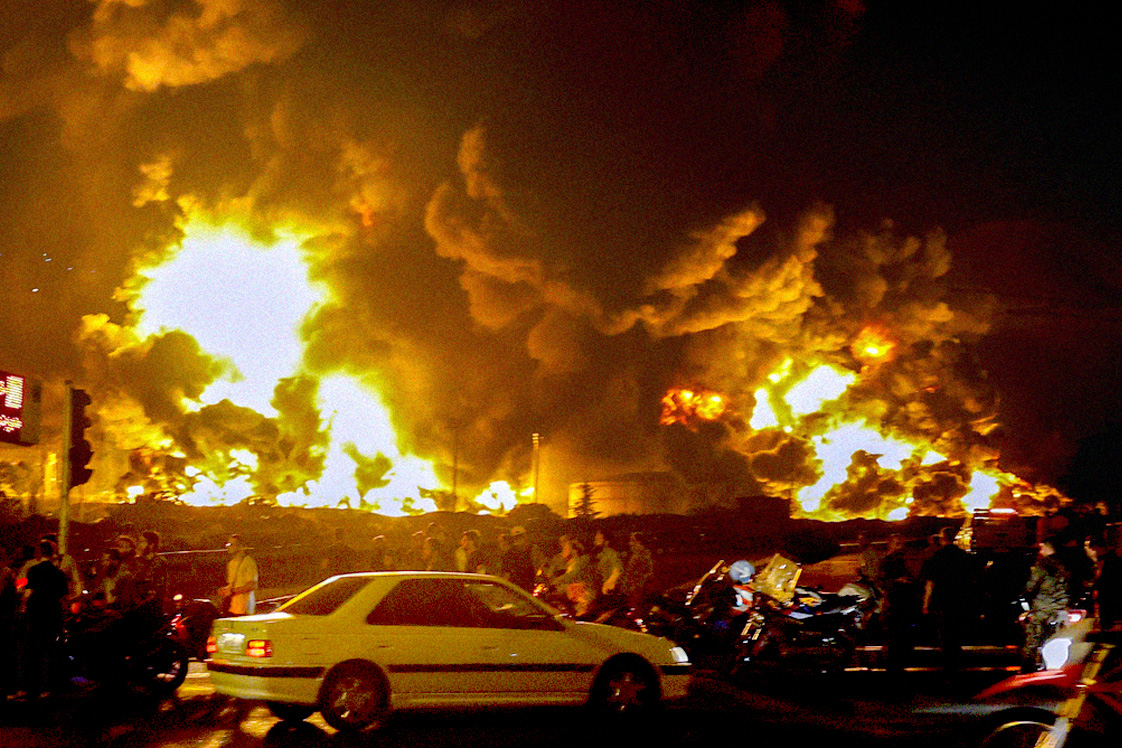
Since 2018, splits have regularly opened up in the regime between fundamentalist and ‘moderate’ factions as they face crises over every single political policy. In foreign policy, their dilemmas include whether to make humiliating concessions to US imperialism in order to get sanction relief, or whether to deepen ties with China, which buys oil at extreme discounts and is unwilling to provide defensive weapons. Domestically, they debate whether to privatise the state sector or maintain the corrupt status quo, while, like rabid dogs, they constantly blame each other.
The 12 Day War temporarily papered over the cracks and rallied the masses behind the national flag. Increasingly, the regime’s propaganda has taken on a secular nationalist tone rather than an Islamist one. And, indeed, national self-defence against imperialist aggression is the only banner under which the regime can rally some residual support. But given the debacle of Israeli infiltration, and the weakness shown by the regime in standing up to Zionism, even this is wearing thin.
This reliance on secular nationalism signifies that the old religious propaganda is now completely ineffectual. Women, for instance, regularly flout the law on mandatory wearing of the hijab. Since 2022, the regime has been split on this question, finally abandoning its enforcement as impossible without risking a mass backlash and potentially a broader social explosion amid accumulating class and social tensions.
Faced with the current protests, these divisions have emerged once more. The reaction of ‘moderate’ president Pezeshkian was calm. He limited himself to calling for restraint and dialogue. The Supreme Leader, on the other hand, rapidly intervened, insisting that the unrest be forcibly contained and that those challenging the order be put back in their place, signaling a swift turn toward repression. Meanwhile, the protesters have rejected the entire political establishment, signaling a clear break from both factions, whom they regard as being part of the same system of power.
The political crisis will only grow in intensity with the class struggle. Under these circumstances, some sections of the regime might even be tempted to attempt a palace coup to save themselves in order to open the country up to the West in exchange for some relief on sanctions. Such a thing could only have further dire and tragic consequences for the masses.
Death to all tyrants! Be it the Shah or Supreme Leader
The masses could’ve overthrown the regime multiple times since 2018 but a clear revolutionary alternative to unite the masses – above all, the youth and the working class – was lacking. Now, the students have correctly popularised the slogan, “Death to all tyrants! Be it the Shah or Supreme Leader!” They have learnt the lesson from 2022.
Meanwhile, the slogan “women, life, freedom,” has also become very uncommon even among students, as it has been tainted since being hijacked by the imperialists in 2022. This is not to say that women or their demands have been sidelined in the ongoing protests. As in 2022, women are often to be found in leading roles, and slogans about women’s liberation are common, especially among the students.
The western imperialists, especially Israel and the US along with their Iranian monarchist bootlickers, are already threatening the protests from abroad. On 2 January, Trump threatened military intervention: “If Iran [shoots] and violently kills peaceful protesters, then the U.S. would step in and rescue them”.
In a post on X, Mossad’s Farsi account stated: “Let’s come out to the streets together. The time has come. We are with you. Not just from afar and verbally. We are with you in the field as well.”
These criminals have nothing in common with the Iranian masses and only a tiny minority inside the country (along with the unhinged petty bourgeois diaspora) want anything to do with them.
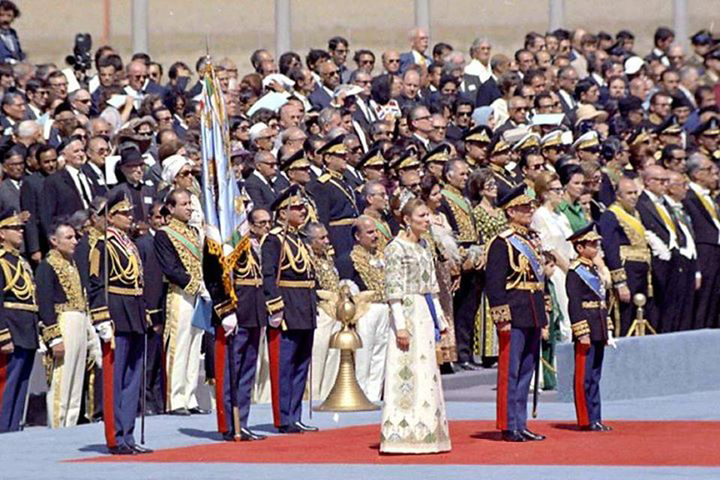
The liberal Israeli newspaper Haaretz itself exposed how the Iranian monarchists, led by the exiled prince Reza Pahlavi, are backed by the Israeli state. Now they are fabricating videos of monarchist slogans being chanted in Iran and spreading them on social media. Meanwhile, this vile propaganda is being spread by foreign Persian news outlets like Iran International and Radio Farda, with financing from the imperialists and the Iranian monarchist elite who left Iran with billions of dollars.
The level of misinformation is incomparably greater in this uprising than in previous ones. Instagram and X are full of monarchist-liberal propaganda to the point it is difficult to know what is real or fake news. This confusion has an effect on the Iranian masses.
This is nothing but ammunition for the propaganda of the Islamic Republic itself. It has no basis in reality. Individual monarchists have sometimes appeared at protests since 2018, but each time they would be sidelined, and at times even beaten up by fellow protesters – rightly! A few have even been identified as provocateurs of the regime. The Iranian masses remember the horror of the Shah’s regime. The Islamic Republic has only perfected their methods of repression and corruption.
This is partly at the root of the split between workers and the youth. The working class has been sympathetic to the multiple youth uprisings. They are wary of the imperialists, however, and uncertain where the overthrow of the Islamic Republic might lead. More than anyone, they understand the horrors of the Shah regime and the brutal history of western imperialism in the country: repression of workers and communists, exploitation, coups, and attempts to dismember Iran as a nation.
At the same time, everyone can see the crimes of western imperialists in the Middle East: the destruction of Iraq, Syria, the ongoing genocide in Palestine, and the general impoverishment of the region at the hands of subservient ruling classes and their western imperialist masters. It is true that these cannibals want to enslave Iran once again, to make the country suffer under their boot like the rest of the region.
This puts an enormous responsibility upon the revolutionary youth. It demands absolute independence from western imperialism. There can be no calls for aid from their institutions such as the United Nations and the European Union, not to mention Israel or the US. On the one hand, it is because these savages have nothing to offer the Iranian masses, but on the other it is because only by rejecting them clearly can the youth win over the working class.
Communists in the western imperialist countries have an important role to play. They must clearly say, “hands off Iran!” The overthrow of the Islamic Republic is the task of the Iranian working class alone. They must expose the hypocrisy of their own ruling class in propping up the monarchists in exile, including through the support they received through the imperialist bourgeois press.
Down with the Islamic Republic! For a socialist Iran!
It is unclear whether the current protests will persist. Students and pockets of youths across the country cannot overthrow the Islamic Republic. Isolated, it will end as a repeat of the 2022 uprising with the same brutal consequences.
The working class must participate en masse, for they have the power to bring society to its knees because of their role in production. Not a wheel turns, not a lightbulb shines without the permission of the working class. During the 1979 Iranian Revolution, it was precisely the general strike in 1978 which dealt the death blow to the Shah regime. It was the mass participation of workers on the streets that caused the paralysis of the security forces and began the process of their collapse.
These revolutionary traditions are very much alive. In the 2022 uprising, the youth instinctively called for general strike. But it is not enough to shout, ‘general strike’. A programme is needed to link up the overthrow of the Islamic Republic with the demands of the working class; showing that the overthrow of the regime will not be a farce that will replace one dictatorship with another.
Such a programme would incorporate the existing demands of the working class, including economic demands for a living wage and pensions, reversal of austerity measures, implementing workers’ control in the existing state sector, major public works to rebuild the country’s economy, and the expropriation of the banks and major companies to fund all this.
The political demands would include an end to all oppression; and equal rights under the law irrespective of gender, sexuality and ethnicity. To these demands we must also add the abolition of the police, the Basij and Revolutionary Guards’ paramilitary groups, along with the intelligence agencies; and amnesty to all political prisoners.
Regardless of the fate of the current protests, this is only the beginning. Every failed uprising, strike and mass movement since 2018 has strengthened the struggle against the Islamic Republic. On the basis of such a programme, the protests could be transformed into a real revolution, becoming a mass force in society uniting all the oppressed in the country and overthrow the regime.
But even with the overthrow of the Islamic Republic, none of the masses’ demands can be fulfilled without the abolition of Iranian capitalism. The Iranian working class and poor must seize power themselves, allowing no one else to wrest it from them, and build a socialist republic. The Iranian communists must already be building their forces, patiently explaining the necessity of a socialist revolution.

