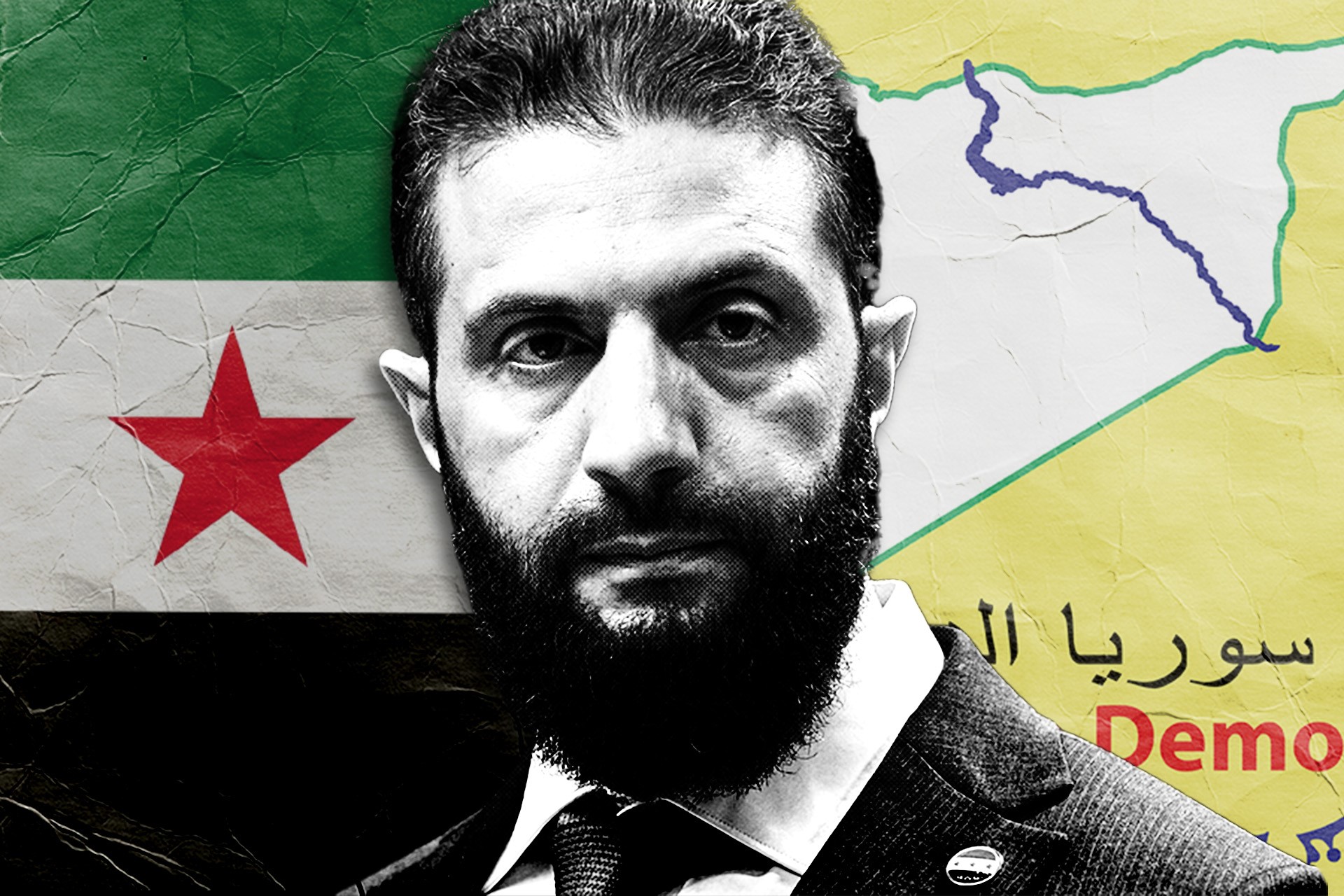
A massacre of Rojava and the Kurds is being prepared in Syria. The Islamist regime, headed by Ahmed al-Sharaa and backed by the West, has launched an offensive into the north-east of the country and has surrounded the historic Kurdish fortress-city of Kobane on the northern border with Turkey.
ISIS flags have been raised above Raqqa. Jihadist fighters have escaped from prison camps. Statues erected in memory of Kurdish fighters are being toppled. A nightmare reminiscent of the ISIS terror that swept Syria 10 years ago is being unleashed.
Having used the Kurds organised in the Syrian Defence Forces (SDF) as a pawn against Assad in the Syrian civil war, American imperialism under Donald Trump is now cynically abandoning them to their fate. At this juncture, it is crucial to explain how things ended up in this reactionary dead end and draw the lessons needed to advance the struggle for Kurdish freedom.
The West’s deceit
When Assad fell to Hayat-Tahrir al-Sham (HTS) at the end of 2024, the imperialists in the West were quick to assure the world that the new regime, headed by Abu Mohammad al-Jolani as he was then known, should be given the benefit of the doubt. The former al-Qaeda and ISIS commander was not only welcomed but paraded as a figurehead of Syrian democracy.
‘An enemy of an enemy must be a friend’, said the Europeans and Americans. They celebrated the end of Assad and spoke in lofty terms about the possibilities of a “free, stable, pluralistic, sovereign” Syria. Of course, this was all nonsense. With Assad – and therefore Russia and Iran – out of the picture, the real reason for their sweet talk was to position themselves to assert their own imperialist interests in a keystone country of the Middle East. As usual, this was all done behind the mask of ‘spreading democracy’.
But the insurgency that overthrew Assad was not based on anything resembling democracy or the desire for peace and stability in Syria, as the West was well aware. It was their intervention, funding, and arms in the Syrian civil war that led to the complete collapse of Syrian society, preparing the way for the insurgency of HTS. The only possible result, as we see today, was a renewed sectarian struggle for power in the vacuum left behind after the fall of Assad.
Al-Jolani and HTS swept to power under the wing of Turkish imperialism. In spite of a lot of empty talk by the jihadi ‘rebels’ about setting up an inclusive transitional government, al-Jolani has emerged as the sole ruler. He installed himself in all top government positions and appointed family members and his ex-ISIS allies to the remaining key posts.
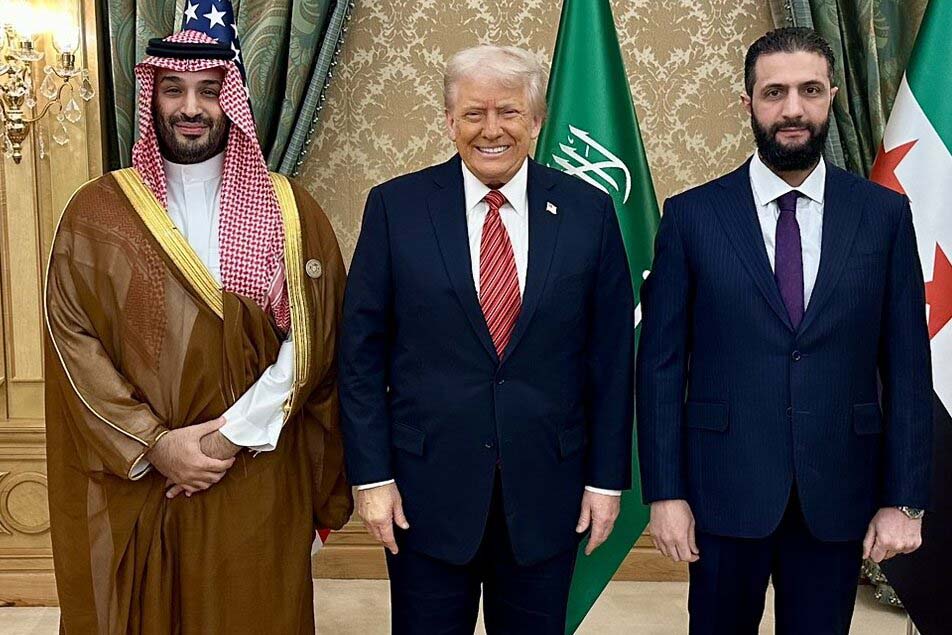
Instead of putting demands on HTS or cutting ties, the West simply persuaded Jolani to ditch his turban for a well-ironed politician’s suit, trim his beard and drop his former nom de guerre for the more moderate al-Sharaa. Sanctions were dropped and embassies reopened, while the carpet was rolled out for him at the UN General Assembly in September and later at the Oval Office.
But aside from optics, what has al-Sharaa actually done to Syria over the past year?
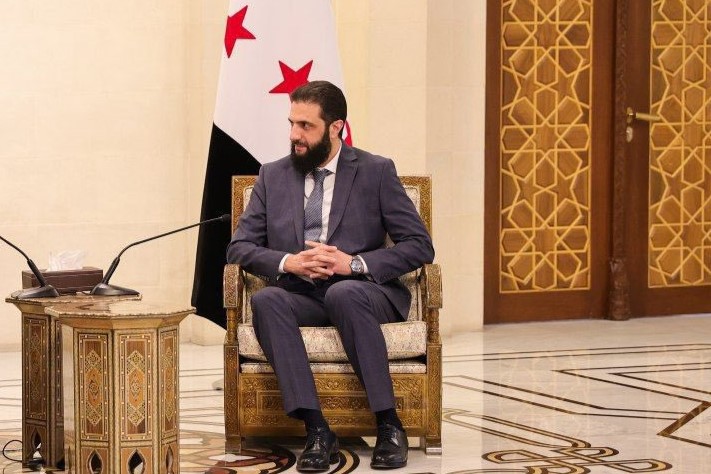
Far from extending an olive branch to his enemies, HTS have carried out multiple massacres against the ethnic minorities of Syria, first against the Alawites in March last year, followed by the Druze a few months later. The jihadist factions and other extremist groups that form the core of the new Syrian military have played a key role in carrying out these atrocities. They have slaughtered thousands of people. While al-Sharaa knows that he needs to pay lip service to a ‘united Syria’, he has done the exact opposite. His rule threatens to unravel Syria into horrifying sectarian violence.
The current offensive by the Syrian Armed Forces, alongside Arab tribal and clan militias, against the Kurdish-led SDF is the natural culmination of this process. The West installed and promoted a henchman who can serve their interests in the region. The price? Engulfing Syria in a new state of civil war and sacrificing the Kurds on the altar of imperialism.
Turkey’s role
The fall of the Assad regime in late 2024 can be traced back to Turkey, whose ties with HTS run deep. Turkey has long backed and financed HTS – which now constitutes one of Erdoğan’s central regional allies – because they provide them with an opportunity to advance their overall interests in the region.
One of these is Erdoğan’s ambitions for a new Ottoman Empire. He aims to expand Turkey’s economic control to the south by linking the country to the Persian Gulf through Iraq and the easternmost part of Syria. More important, however, is the prospect of having an arm extended into Damascus, which can fight the Kurds in Rojava. That is the grand prize.
Erdoğan sees the Kurds – many of whom live in Turkey – as a fifth column within Turkish society. Because of their national aspirations, they represent one of the main threats to his rule and his aim of establishing a ‘greater Turkey’. For him and al-Sharaa, even a formally independent Kurdish state in Rojava would undermine their goal of complete control over all the religions and ethnicities in the territory.
When HTS pounced on the weak Assad regime at the end of 2024 and installed a fundamentalist Islamist regime – entirely reliant on Turkey to consolidate state power – it was first and foremost an opportunity to crush and disarm the Kurds. Turkey has spent $1.8 trillion on this pursuit over the past 40 years.
With the Syrian army now waging an offensive in the Kurdish autonomous areas and driving out the SDF militias linked to the PKK, the Turkish and Syrian regimes have undoubtedly come closer to that goal. Not only have the SDF been forced east of the Euphrates River, but the prospect of the disintegration of the US-backed coalition seems more likely by the day. Already non-Kurdish SDF units are defecting to the Syrian regime.
Trump’s double cross
The actions of Donald Trump and US imperialism amidst these events highlight their crude cynicism, but they should not come as a surprise. It is no secret that US imperialism does not care much for loyalty in the pursuit of its interests around the world. Dropping the Kurds is but the latest cynical move in a long history of selling allies down the river when it becomes convenient.
According to the US administration, the need for the SDF, and by extension, US military presence in Syria, has “expired”. As Trump’s envoy to Turkey, Tom Barrack callously wrote in a statement on Syria, the situation has “fundamentally changed”, which means that the US “shifts the rationale for the US-SDF partnership”. In reality, they are saying that they are putting their faith in al-Sharaa to police ISIS, and that the Kurds simply have to accept America’s new sheriff in town. Whatever the human cost might be for the Kurds in both the short and long term is to be considered collateral damage.
In a moment of pure double-speak Barrack stated that the de facto dissolution of the SDF is not a kiss of death for the Kurds, but the “greatest opportunity”. This is while Kobane – the symbolic Kurdish city which held out against an ISIS encirclement in 2014 – is being surrounded once more, this time by HTS. Food, water, and electricity have been cut off by Syrian government forces. The city is in a state of siege, with thousands of men, women, and children on the brink of a humanitarian crisis.
As for the thousands of ISIS fighters held in prison by the SDF and US forces in northeastern Syria, US Central Command is opting to transfer them to Iraq. According to them, 150 prisoners were transported there this week, with the US planning to relocate more than 7,000 in total. But this is no simple matter. Reports are already circulating of ISIS fighters successfully escaping prison in the midst of the chaos, helped along by the advance of HTS and the militias loyal to them.
Having used Kurdish fighters as the backbone of the SDF to fight ISIS – a Frankenstein’s monster of American imperialism’s own creation – they now deem them a sacrificial lamb, shifting their support to, you guessed it… a former leading member of ISIS in the form of al-Sharaa! You (almost) couldn’t make it up…
For al-Sharaa this is all good, as a strengthening of jihadist control in the north-east only serves to bolster his base and strengthen his grip over the state.
Trump’s move has to be seen in the light of the recent National Security Document, which makes it clear that the Middle East is no longer the primary concern for US imperialism. As the document states, “the days in which the Middle East dominated American foreign policy in both long-term planning and day-to-day execution are thankfully over”.
But any American retrenchment to its own hemisphere is not going to bring peace to the peoples of the region. On the contrary, if the US chooses to pull out of Syria as Trump has advocated, they will simply leave behind the conditions for further chaos.
The US loosening their grip on the situation is clearly being recognised by players in the region who want to fill any partial vacuum, exploiting the sectarian divisions fostered by US intervention in the first place, to their own ends. This is the case for Turkey, but also Israel, which has been pursuing a more independent imperialist role in the region.
Since the fall of Assad, Netanyahu has consistently reminded al-Sharaa (and behind him, Turkey, which it sees as a rival for dominance of the Middle East) that any attempt to consolidate power will be met with military intervention. Israel has acted with its usual impunity to keep Syria in a state of weakness and foment every possible sectarian division. It has expanded its occupation of Syrian territory and bombed the country, including the military headquarters in Damascus, under the guise of ‘protecting’ the Druze.
The Kurdish resistance
There can be no question that the prospects for the Kurds are extremely dire. But that is not just because of the coming to power of HTS and the US’s betrayal.
Politically, the leadership of the Kurds, in the form of the PKK, has fought the Kurdish struggle on a purely national basis and posed the question of finding military allies as simply a tactical one. It was this that led them into the alliance with US imperialism during the Syrian civil war, a move that we warned against at the time. Today, it is shown to have been fatal.
The same approach was repeated in the spring, when the imprisoned PKK leader Abdullah Öcalan announced that the PKK would dissolve itself and lay down its arms. This is not the place to delve into an analysis of the political shortcomings and evolution of the PKK, but suffice to say that Öcalan’s show of faith in Erdoğan, in the belief that he would allow the Kurds to pursue their aims through ‘democratic’ means, is now proving to have been a disastrous move.
Al-Sharaa’s message to the Kurds is unequivocal: ‘Disband and ‘integrate’ into my army under my command, or face an assault.’ The approach of SDF leader Mazloum Abdi – also known as Mazloum Kobani – has in effect been to capitulate, resorting to appeals to foreign powers.
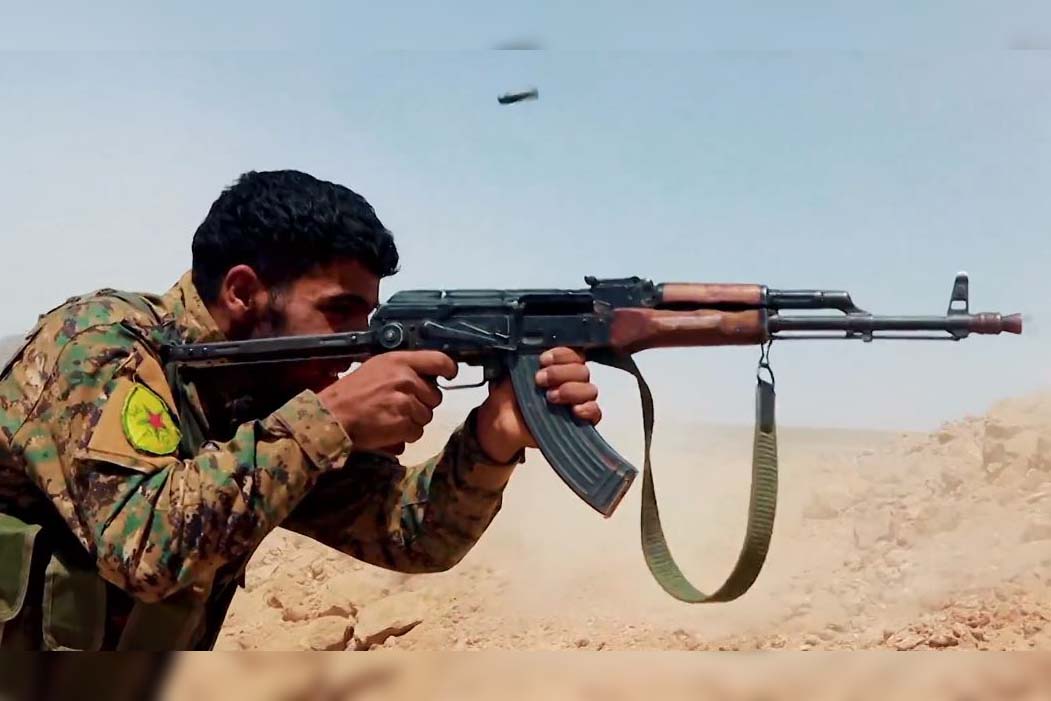
Abdi has consistently stated that “anyone who can help support our rights” can help ‘defend’ the Kurds. This also goes for Israel, of whom Abdi has said assistance would be “welcomed” and “appreciated”. One only has to look at how Israel has crushed the Palestinian people for 80 years to see that that would be a critical mistake.
Israel does not care in the slightest about the Kurds, and would turn on them at a moment’s notice. More importantly, what effect does Abdi’s appeasement of the most reactionary western imperialists have on the Arab and non-Kurdish workers and poor across the region? In effect, it is telling them that the Kurds side with the enemy class – who have wrought destruction in Syria, Iraq, Lebanon and Palestine – before their class brothers and sisters of different faiths and ethnicities. This is a fatal mistake that would only marginalise the Kurdish struggle in the region.
This unprincipled strategy is leading to a de facto surrender, as the ceasefire and integration agreement, agreed to by Abdi and published by the Syrian Government, shows. In it, almost all of the control of the Kurdish Autonomous Administration is reversed – a death warrant for Rojava.
The many thousands of Kurdish workers and soldiers in the YPG will not accept surrender in the face of an HTS offensive. But the fate of Rojava can ultimately only be secured by placing the struggle on a class-independent basis, dropping any illusions that a peaceful settlement of the Kurdish question can be found by striking deals with either American, Israeli or Turkish imperialism.
The need for a fightback
While Erdoğan and al-Sharaa may be rubbing their hands, history shows that the Kurds will not simply march to the slaughter. Already, protests are erupting across the region and among the Kurdish diaspora across the world. But what is needed is not collaboration and appeasement of Turkey and HTS – whose aim it has always been to drive the Kurds into the ground – or indeed the imperialists, but the placing of the struggle on a revolutionary class basis.
The current situation is wholly a product of imperialism. There can be no peace in the Middle East, for the Kurds or any oppressed group, as long as the capitalist classes of the world and the region hold power. HTS is showing the world that any sort of democratic state with autonomy and equal rights for the Kurds – not to mention the idea of separation and a Kurdish state – will never be on the table as long as they hold power.
The only way out of this reactionary morass is to change course by acknowledging that the fight for a Kurdish homeland cannot be solved on the basis of a national-military struggle supported by imperialist so-called ‘friends’. A revolutionary struggle to overthrow Erdoğan and the Islamists in Syria is the only way out. On the basis of a united revolutionary struggle of both Kurdish and non-Kurdish masses, their weak regimes would begin to feel the ground tremble under their feet.
There is the potential for such a revolutionary struggle not just in Syria and Turkey, but across the whole region. To advance this aim, it requires a complete break with imperialism and class collaborationism, which is once again proving to be the gravediggers of the Kurdish cause.

