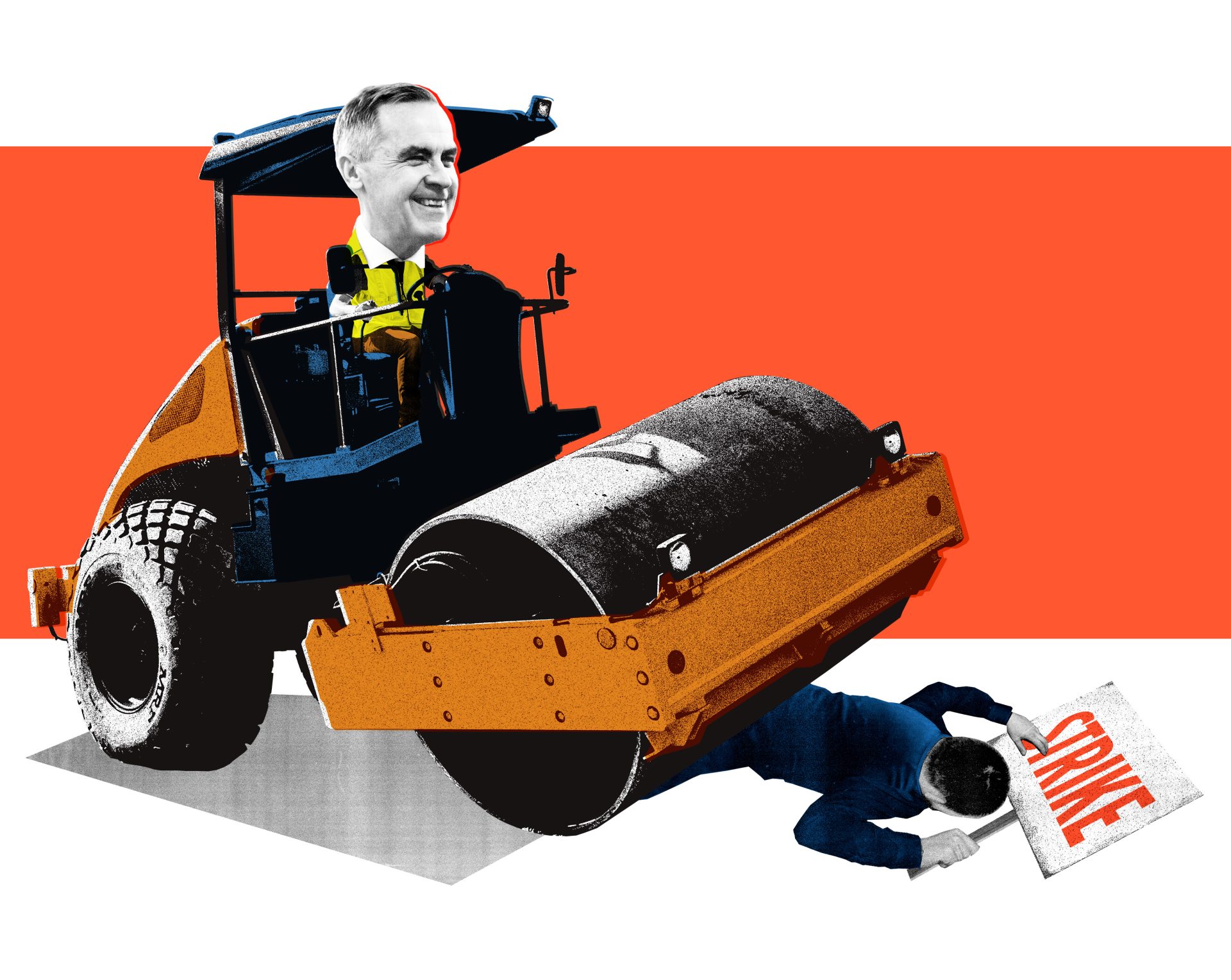
For generations, the Canadian labour movement was a formidable force, conquering rights and winning many benefits for working-class people. Maternity leave, public health care, pensions, and the eight-hour workday stand as monuments to its power.
But today, the economic foundation upon which the labour movement was built is collapsing. The result is a one-sided class war where the gains of the past are being taken away and the very tools of worker defence—collective bargaining and the right to strike—are being systematically dismantled.
The new era of protectionism and economic dislocation is accelerating this process. The trade war with America puts hundreds of thousands of jobs at risk. And in response to the trade war, the Carney government, like many of its provincial counterparts, has pivoted to a policy of “internal devaluation”—austerity, public-sector layoffs, and deep cuts to social spending.
Faced with this onslaught, the labour movement has been unable to mount a serious challenge. The question hangs heavy in the air: what is to be done?
The cracking social contract
The system that governs modern labour relations was born out of the economic upswing following World War II. Faced with a militant and discontented working class, the ruling class granted legal concessions, recognizing trade unions and creating the collective bargaining system. This was the legal framework for what became known as the “social contract”: a system where in exchange for industrial peace, workers won improvements in wages, pensions, and social programs.
But this system was only possible on the back of the unprecedented post-war boom. The boom allowed the capitalists some breathing space to throw some crumbs to the workers in order to prevent revolution. But today, the heady days of five- to six-per cent annual economic growth in the 1950s and 1960s are a distant memory. Every decade since, growth rates have trended downwards, reflecting the decay of the capitalist system.
This decline has been most felt in the relentless wage erosion which has become a fundamental feature of every recent labour dispute. Soaring inflation and the crushing housing crisis are eroding living standards at an unprecedented rate, making any below-inflation wage increase a pay cut in all but name.
The gap between what workers need to survive and what the bosses have been willing and able to give has become an unbridgeable canyon. Employers and governments are no longer able to grant concessions, and have gone on the offensive.
The result has been decades of slow-burn attrition: wage freezes, two-tier contracts, the erosion of benefits, and the relentless casualization of work. The unionization rate has fallen from a high of 37 per cent in 1981 to just 30 per cent today.
For decades, workers have been told to tighten their belts, be reasonable, and accept subpar contracts for the sake of competitiveness or fiscal responsibility. But workers could only tolerate this situation for so long. The accumulated pressure of years of concessions and eroding living standards demands an outlet.
After decades of relative quiet, the Canadian working class is moving onto the battlefield. 2023 saw the most days lost to strikes since 1986. Indicative of the situation, unions that have not gone on strike in a generation—federal public servants, Vancouver port workers, Alberta teachers and Quebec nurses—have all taken up the fight.
But the ruling class could not tolerate the economy being paralyzed. Union rights have been under attack, first with back-to-work legislation and more recently with Section 107 of the Labour Code. Provincial governments have passed a series of anti-union laws, attacking union financing and collective bargaining as a whole using the notwithstanding clause.
The middle ground has evaporated and the social contract is cracking at the seams. In Marxist terms, what we are witnessing is the deteriorating economic base of society clashing violently with the superstructure in the form of the legal framework of labour relations.
Sitting on a volcano
While labour rights and welfare reforms were a step forward for the working class, dialectically speaking, these victories paved the way for the degeneration of the trade union movement. As Trotsky describes in a text titled Trade Unions in the Epoch of Imperialist Decay, the common characteristic of trade union organizations is their “drawing closely to and growing together with the state power.”
In essence this is what the collective bargaining system represents. The trade union movement became institutionalized. Unions won legal recognition but sacrificed their right to strike while in contract. In addition, union representatives, instead of mobilizing their members, spend most of their time handling minor grievances between the employer and the employees—basically turning themselves into low-level functionaries of the capitalist state, charged with diffusing class anger.
Instead of leading the struggle, labour leaders cling to the past, not realizing that the period of relative class peace is long gone. They constantly appeal for the employers to “bargain in good faith” and to abide by the old labour law and rights which they violate left, right and centre.
Unable to see beyond the capitalist system, labour leaders are forced to accept what capitalism has to offer in this period of crisis: falling living standards. We have seen, time and time again, trade union leaders selling bad deals to their members arguing, “I know this is bad but this is the best possible deal.” This is why two-tier contracts, defined-contribution pension plans, and contracts with wage erosion and other concessions have become commonplace.
Worse than this, when rank-and-file members take initiatives to fight back, these very leaders spend much of their time policing their own members.
As an example, when the postal workers went on strike last fall, it was obvious that the Trudeau government was preparing to use Section 107 to take away the right to strike. Rank-and-file posties were expecting this, as their right to strike was taken away in 2018 and 2011. When the government invoked Section 107, workers in Saskatoon, Burnaby and Edmonton all voted to defy the back-to-work order. Local leaders in Scarborough and Vancouver equally stood for defiance. Some locals in the Maritimes even refused to return to work for a few hours the morning the order came into effect.
But this desire to defend the right to strike was smothered by the Canadian Union of Postal Workers (CUPW) executive. They even intervened to stop ILWU-affiliated workers from participating in a cross-picket of a processing plant in Vancouver—scandalously demonstrating how much they were trying to keep a lid on things.
Rank-and-file postal workers have moved mountains to defend their jobs, even reinitiating strike action this year, with many rank-and-file workers cross-picketing Purolator plants. But the CUPW leadership de-escalated the strike with no discussion about the future of the struggle, and at the time of writing, are moving to accept a deal in which 30,000 jobs will be cut.
The result is that Canada Post is being dismantled and the CUPW with its heroic traditions is being smashed, without a finger being lifted from the wider labour movement.
This displays exactly what was described by Trotsky. Writing on the situation facing the reformist trade union leaders, he explained that they become transformed into “political police before the eyes of the working class.”
The class anger in our society bubbles beneath the surface, just like hot magma within a volcano. Atop this volcano sit the labour leaders, remnants of past eruptions forming a hardened crust. Conditioned by decades of relative class peace, they block the way of future eruptions.
But even the most stubborn crust cannot hold back the pressure forever.
The dam breaks
With the labour leaders not able to hold back the anger, strikes have become more commonplace. This has forced the government to increasingly violate the right to strike, first with traditional back-to-work legislation and then with Section 107 of the Labour Code.
But all this has done is massively upped the ante. Employers have little interest in negotiating when they know that the government will intervene in their favour. The workers are left with a stark choice: defy the law or accept defeat.
In response to back-to-work orders, the labour leaders have generally obeyed them, then tried to take the legal route to challenge them. While they claim that they are going to “fight against this,” in practice, choosing the legal route has meant accepting defeat. These challenges take years and even when they have won in court, as with the postal workers union in 2016, the battle has already been lost in the real world. And court victories have done nothing to stop the right to strike from being violated in the future.
But no law can hold back the wheels of history. It was inevitable that at some point, some union was going to defy the law.
The first to breach the dam were the CUPE education workers in Ontario, in the fall of 2022. In that struggle, Premier Doug Ford imposed back-to-work legislation. He also used the notwithstanding clause to violate collective bargaining altogether, imposing a contract with below-inflation wage increases on some of the lowest-paid unionized workers in the country.
This caused such a huge uproar among the workers and the wider labour movement that the Ontario School Board Council of Unions (OSBCU) called for the law to be defied. The Ontario Federation of Labour (OFL) also threatened to shut down the entire province with a general strike. The result was that the law was withdrawn and no worker was punished.
Fearing this precedent that was set, governments everywhere then refrained from using back-to-work legislation for three years.
But after the ramp-up in strike activity in 2023, the ruling class demanded that the government do something. In 2024, Trudeau found the answer in Section 107 of the Labour Code and used it to end seven different strikes that year.
Then, in Aug. 2025, the Air Canada flight attendants defied a Section 107 back-to-work order from the Carney government. Citing the Ontario education workers as their inspiration they justified this stating, “When laws protect billion-dollar profits over workers, defiance is necessary.” The order proved to be meaningless and neither the union or the workers were punished.
These two examples demonstrated that the law means nothing when confronted by the power of the working class.
The need for a socialist perspective
But paradoxically, even when the workers have defeated back-to-work orders, they have not ended up with a good contract.
In the case of the Ontario education workers, the union leaders had argued that with mass inflation, anything less than a $3.25/hour wage increase was a wage cut. But after they successfully defied the law, the union leadership did a complete 180 and ended up recommending a $1/hour wage increase, calling it a “break-through agreement.”
Knowing full well that there was widespread opposition, the union leaders delayed voting and organized a series of Zoom meetings where they scaremongered the workers into voting for the deal. There was no space for workers to talk to each other, to organize opposition or challenge the leadership. In the end, the workers reluctantly voted 73 per cent in favour of the deal.
Increasingly, we have seen bad deals being recommended by labour leaders and ranks either barely accepting them or rejecting these deals altogether. This was the case in 2022 in British Columbia with the B.C. General Employees Union, where the ranks narrowly accepted a bad deal at just 53.5 per cent. The Quebec nurses in 2024 rejected a deal recommended by their leaders by 61 per cent.
A similar situation happened with the Air Canada flight attendants in August 2025. There too, even though the workers had defeated the Section 107 back-to-work order and had undeniable wind in their sails, the union leaders conspired to ram a rotten deal down the throats of their own members. They even scandalously quashed union democracy, depriving their members of any genuine decision making. In protest, the workers voted 99.5 per cent against the proposed deal.
But why do union leaders do this?
It all comes down to the outlook of the trade union leaders, who long ago ceased to fight for socialism and therefore are forced to accept the limits of capitalism.
During the 2022 Ontario education workers’ strike a reporter at a press conference asked, “What do you expect members to do? Aren’t you, as part of the bargaining team, supposed to bring forward the best possible deal that you think is best for workers?”
Laura Walton, president of the OSBCU, replied,
“I think the key word there, Carolyn, is possible. And when you are being told by the government that there is no possible way that they are going to improve then you have to do the right thing as a leader, and bring it forth for the workers to use their voice.”
Here, Walton tacitly admitted that she accepted the limitations imposed on the negotiations by capitalism. In conditions of a generalized capitalist crisis, this is a recipe for defeat. If we only accept what is “possible” under capitalism, we will be forced to accept mass layoffs, wage erosion and cuts to benefits.
Another example happened this October, with the strike of Ontario college support staff.
After years of underfunding, colleges and universities have huge holes in their budgets. No longer able to rely on international students as cash cows, colleges in Ontario have cut nearly 10,000 staff and eliminated 600 programs. While the union fought for no staff reductions or college closures for three years, the employers’ council bluntly stated that this was impossible for them to accept. The result was the union agreed to a deal with small wage increases for jobs that probably won’t exist much longer.
Similarly, in the situation with Canada Post, the union leaders have accepted the logic of management and the government and thus tacitly accepted that there will be tens of thousands of jobs lost.
Unable to see beyond capitalism, union leaders are forced to accept its logic.
The fact is that there is more than enough wealth in society, it is just in the hands of the billionaires who are raking it in. As the crisis has deepened, they have pillaged the state and governments have become increasingly indebted. Everywhere we look, privatization creeps in and funding is shifted to the private sector.
But a socialist does not accept this logic at all. If capitalism is failing, instead of bailing them out and bankrupting the state, we should expropriate the capitalists. But this means looking beyond the narrow confines of the trade union struggle and towards society as a whole. Only a socialist program can do that.
The blind alley of class collaboration
The situation with many private-sector unions is frankly even worse. While in the public sector the workers are not directly submitted to the market, private-sector workers bear the full brunt of various market fluctuations. This means that a socialist perspective is even more pertinent for private-sector unions.
Without this, Unifor, the largest private-sector union, has joined hands with the bosses in an attempt to ingratiate themselves to the capitalists. Flavio Volpe, president of the Automotive Parts Manufacturers’ Association, referring to his relationship with Unifor president Lana Payne says that “there is no daylight between Lana and I.”
Connected to this, the Unifor leaders support Carney on his economic Council on Canada–U.S. Relations. They even fail to oppose the massive increase in military spending, seemingly out of the vain hope for jobs. They have gone so far as to feature Conservative Premier Doug Ford as a speaker at a rally of Stellantis workers in Brampton. LiUNA, which represents 70,000 private-sector workers in Ontario, is also a firm backer of Ford.
The entire justification for this class-collaborationist strategy is based on a mistaken belief that if we are nice to the capitalists, they will graciously provide jobs for us. But the history of this approach does not have a good track record. All of the attempts of Unifor, and the Canadian Auto Workers before them, to collaborate with the auto manufacturers has not worked to save jobs. All this strategy does is prove to the capitalists that the union is not a threat to them. But in the class struggle, weakness invites aggression. This approach has contributed to the bleeding of hundreds of thousands of manufacturing jobs.
Today, the trade war is wreaking havoc on Canadian manufacturing. In this context, the approach of unions like Unifor is a gift to the capitalists who can shut down operations and lay off thousands with the knowledge that the union leaders are not going to do anything. This class collaborationist approach has not stopped the Crown Royal closure or the Stellantis and GM closures. And now Algoma is laying off 1,000 workers.
What is needed is not to cozy up to the capitalists and Liberal and Conservative politicians, but for unions like Unifor to mobilize their 315,000 members to take matters into their own hands.
Already, workers have taken initiatives in this direction. For example, on April 2 in Windsor, workers at Titan Tool and Die blockaded the plant to stop the company from taking tools and dies across the border to Michigan.
And last month, Mike Van Boekel, president of Unifor Local 88 at the GM Cami plant in Ingersoll, said, “If they try to remove even one single thing from the plant, we are ready to take over.” What these examples show is that the workers organically yearn to take militant action to fight against the bosses to save their jobs.
This movement should be encouraged and organized. If the private-sector unions are going to play a role other than labour management for the capitalists, they must mobilize their members to fight against the bosses and accept no layoffs or other concessions. The only way to do this is with a socialist program.
The socialist program is that any company which prioritizes its profits over the livelihoods of workers by laying people off or shutting down a plant should have that plant occupied by the workers. The workers, who are the ones who actually know how to run the plant, can take it over and run it under workers’ control, demanding that the plant be nationalized, with no compensation to the parasitical bosses who have received billions in government subsidies. This is the only program that can seriously challenge the attacks on workers.
As Trotsky explains, “In the epoch of imperialist decay the trade unions can be really independent only to the extent that they are conscious of being, in action, the organs of proletarian revolution.”
Whither the general strike?
Confronted with this generalized assault on social programs, wages, benefits and trade union rights, the idea of organizing a general strike has become popular. Trade union leaders like Sara Nelson and Shawn Fain in the United States have popularized this idea, with Fain calling for a general strike to be organized on May 1, 2028.
In Canada, following the OFL’s general strike threat in 2022, far from being pie in the sky, the idea of organizing a general strike has increasingly become seen as a practical way of fighting back against the assault on trade union rights. As Hamilton District Labour Council president Anthony Marco recently put it, “Province wide and nationwide general strikes cannot remain historical reference points or hypothetical threats, they are becoming necessary instruments of democratic defence.”
This has even been raised in the NDP leadership race. When Canadian Labour Congress President Bea Bruske asked NDP leadership candidate Avi Lewis to describe the future of the labour movement in one word during an October forum, he said: “Can’t do it. It’s two. General. Strike.” More recently, Magali Picard, president of the FTQ (the largest trade union federation in Quebec), made shockwaves when she has suggested that they will be organizing a “social strike” (“grève sociale”) on May 1, 2026 to fight back against a series of anti-union laws the Legault government has introduced.
This is a sign of the times and proof that many workers want a strategy that actually confronts the capitalists. If you think about it, it is quite exceptional that the idea of all of the workers going on strike to paralyze the entire capitalist system is being talked about positively all over the labour movement.
But the popularity of a general strike should be no surprise. The constant violation of the right to strike turns any economic strike into a political strike. It also threatens to broaden out the strike from a localized struggle to a struggle pertaining to the rights of the entire working class. An injury to one is an injury to all.
But talking about a general strike and actually organizing one are two very different things.
So far, with no other options, labour leaders have simply threatened a general strike. While the OFL forced Doug Ford to back off with the mere threat, there was no guarantee that this would always work. At some point the threat would need to be backed up, otherwise all of the talk would just be a bluff.
This is precisely what happened at the end of October with the Alberta teachers’ strike.
For over three weeks, the teachers fought a valiant battle against the government of Premier Danielle Smith. Public opinion was on the side of the teachers, and, on Oct. 23, over 30,000 people demonstrated in Edmonton—the largest demonstration in the history of the province.
But Smith announced she would put an end to the strike with back-to-work legislation on Monday, Oct. 27.
In response, Gil McGowan, the president of the Alberta Federation of Labour, referencing the example of the Ontario education workers in 2022, threatened a general strike. Correctly, he explained: “They can’t arrest 450,000 workers. There isn’t room in our jails.” He added, “There isn’t resources in our legal system to process arrests and fines.” A Leger poll conducted at the time showed that a majority of people in Alberta supported a general strike.
But when push came to shove, the union leaders choked. The Alberta Teachers’ Association ended the strike, saying they would challenge the law in the courts. This would be funny if it wasn’t so tragic, as Smith used the notwithstanding clause to pass this law—which means that it is protected from legal challenges.
McGowan called a press conference a couple of days after the back-to-work legislation passed where he said he would be willing to launch a “general strike if necessary.” But nothing was done.
If the violation of the right to strike and collective bargaining is not a “necessary” reason to call a general strike—God knows what is. In response to this fiasco, Alberta’s finance minister jokingly referred to it as “a plan to make a plan.”
The lesson is clear. All of the talk about a general strike cannot be just talk. It needs to be followed up with action, otherwise the ruling class will continue to violate trade union rights. The right to strike and trade union recognition can only be defended by workers exercising their power.
And that is what a general strike ultimately is. A general strike poses the question: who runs society? Only by threatening their power can we beat back the attacks of the ruling class and win improvements for workers.
Renew the labour movement
Governments, both federal and provincial, are preparing an all-out assault on the labour movement. In the federal budget the government says they will seek to “adjust the collective bargaining dispute resolution framework” and that public sector compensation “must align with Canadian labour market trends” and the government’s own fiscal position. Already, Alberta has attacked union rights making a portion of union dues optional. Legault is proposing to do something similar in Quebec. The Quebec government has also given themselves their own version of Section 107 with Bill 14, giving them the ability to violate the right to strike on a whim.
The reason they are doing this is clear. The ruling class needs to jettison the conquests of the past to make Canada competitive on the world market. The early retirement letters Carney is sending to 70,000 federal employees are just the beginning of a massive program of austerity measures touching every aspect of life. With the huge ramp-up in military spending and the massive amounts of money needed to reorient the economy, this is inevitable. They must weaken the unions so that they are not as able to stage a resistance to this onslaught.
But faced with this, the leaders of the labour movement drag their feet, trying to find a way to represent their members without disturbing the system. Defenders of this nonconfrontational approach argue it will allow workers to make real gains. But the ironic thing is that this method is precisely what has led the movement to not win any real gains for its members. All we end up with is counter-reforms.
The truth is that only by the working class exercising its colossal power and threatening the capitalists’ right to rule can even the most modest advances be made. The defeat of back-to-work legislation by the Ontario education workers and Section 107 by the Air Canada flight attendants demonstrated this.
We need a leadership that will organize a broad-based movement to unleash the power of the working class. And in order to do that, we need a complete revolution in the trade unions.
There is a process of awakening occurring deep within the ranks of the working class. Hundreds of thousands of people are beginning to think critically about their lives, their workplace, their employer, their trade union leaders, etc. Many have started to question capitalism and have come to the conclusion that their current leaders are lacking.
To these people—to this initial layer of working class militants looking to renew the trade union movement—the Revolutionary Communist Party is your party. It is the goal of the RCP to unite revolutionary workers in every single union in this country together into a cohesive unit. We aim to train militants in the lessons from the great class battles of the past and the great Marxist ideas that inspired them. We aim to revive the movement with communist ideas. By building our forces, at a certain point we will be able to fight for a revolutionary leadership of the movement.
With such leadership, we would be capable of not simply pushing back against the attacks of the ruling class, but leading the workers to wrest power away from the billionaires and end the attacks for good.

