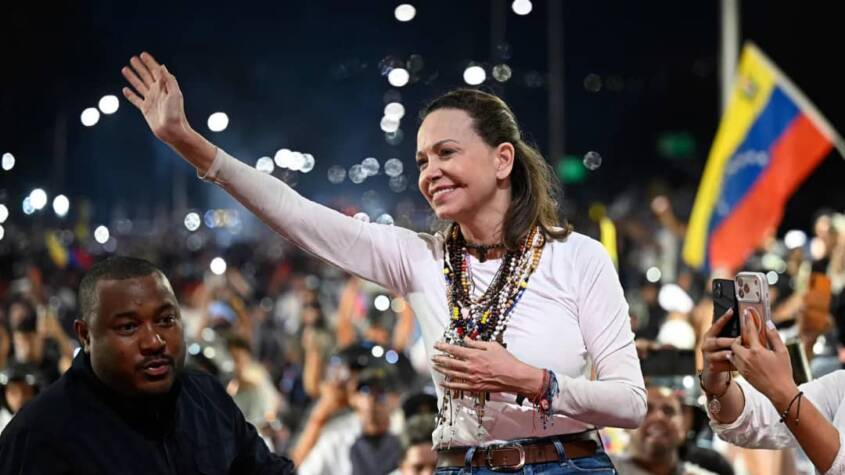
The circus that is Venezuelan right-wing politics has kicked off a new act. With a terse “I’m here. With you,” posted on X, María Corina Machado announced her return to Venezuela.
A record of coup-mongering and servility
María Corina Machado’s record dates back to April 2002, when she played an active role in the coup d’état against President Hugo Chávez. The coup plotters sought to repeal the Constitution, dissolve the branches of government, and impose a dictatorship.
Since then, her career has been marked by constant incitement to foreign interference and destabilization. In 2002, she founded Súmate, an organization presented as a defender of electoral rights but linked to the destabilization campaign against the Bolivarian Revolution. In 2003, she led the campaign to collect signatures to trigger the recall referendum against Chávez.
In 2012, Machado founded her party, Vente Venezuela, and in the years that followed, she participated in the insurrectionary offensives of 2014 and 2017. Since 2019, she has openly advocated for foreign military intervention against Venezuela through the Inter-American Treaty of Reciprocal Assistance.
Machado assumed that following the U.S. military intervention, Washington would immediately install her in the Miraflores Palace. Her years-long insistence on this matter makes her politically complicit in the criminal U.S. attack of Jan. 3—an imperialist action that ultimately paved the way for colonial domination of Venezuela and a “pragmatic” power pact between the White House and the Venezuelan government, headed by Delcy Rodríguez.
Machado’s return was not an individual feat, but rather an operation authorized and overseen by U.S. imperialism.
What Machado represents
Machado enjoys popular support today. However, this is not the result of the “failure of communism,” but rather of the profound decline in the consciousness of the Venezuelan working class after more than a decade of imperialist sanctions, structural crisis, and Maduro’s counterrevolution. It is no small matter that Maduro and his henchmen—who today collaborate with Washington—dismantled nearly all the economic and democratic gains of recent decades.
Inflation, falling wages, and collapsing public services, including daily power outages of eight to 12 hours in interior cities worsened by El Niño, have pushed working people into dire hardship. Under U.S. colonial tutelage over the country, these problems, far from being resolved, continue to worsen. And this is nothing new; imperialism’s goal was never to rebuild the country. Since the beginning, its goal has been to control its oil and mineral resources, project its new national security doctrine, drive “non-hemispheric” competitors—such as China and Russia—out of its sphere of influence, and intimidate regional governments into submission.
A growing sense of unrest, desperate for an outlet, is palpable on the streets of Venezuela. Trump’s constant declarations that “the spoils go to the victor,” as the recently signed ruinous oil agreement begins to take effect, are revealing the true nature of the imperialist plan to a growing number of Venezuelans.
The truly catastrophic conditions in Venezuela have allowed Machado, in the span of a decade, to transform from a “radical snob”—with no support among the working class and the masses—into a symbol of false hope for millions desperately seeking a way out.
But that hope is bound to fade, because what Machado represents is not an alternative for the exploited, but the most complete expression of the interests of the rich. Her program calls for the privatization of the oil industry and public services, the elimination of subsidies and labour gains, the flexibilization of the labor market, privately funded pensions, and massive cuts to public spending. In practice, this is a plan to govern in the interests of big capital and imperialism, shifting the cost of the crisis onto the shoulders of the poor.
The right wing—whether in its populist form or any of its other guises, anywhere in the world—has no solution whatsoever to the crisis of capitalism. For this reason, the broad support Machado currently enjoys will, sooner or later, turn into deep contempt on the part of workers in both the city and the countryside. Her platform, if put into practice, will be met with rejection and resistance from the majority of working people.
Electoral manoeuvers
If Washington allowed Machado’s return, it was not because of her ongoing tantrums, but rather due to the upcoming midterm elections in the United States. Trump’s approval rating among Latino voters in Florida has fallen from 58 per cent at the start of his term to 36 per cent, according to Equis Research. In their quest to curry favor with Florida’s Latino vote, Trump and Rubio are trying to project the idea that the transition in Venezuela is moving forward.
The problem is that this is a short-term calculation that could lead to further instability. For the Americans, economic recovery and the creation of favorable conditions for the extraction of Venezuelan resources are fundamental—even more so than bringing about a change in government and holding presidential elections, which is precisely Machado’s main demand. Both Rubio and other U.S. officials have made it clear that, as long as there is no economic and institutional stability, there will be no elections in Venezuela.
Machado’s presence in Venezuela is a variable that is difficult to control. Her belligerent rhetoric and the desperation of the masses—which she will try to manipulate to her advantage—make her a source of instability even for those who have used her.
Marco Rubio himself hinted at this when he warned Machado and her supporters, one day after her return, that “you’re not going to achieve democracy by protesting in the streets,” making it clear that the White House will not tolerate its pawn upsetting the apple cart.
Although the United States has full control over Venezuela, it is clear that the collaboration of the civilian-military leadership has not come without demands: among them, keeping Machado sidelined. Otherwise, there is no explanation for why Washington kept her on the sidelines for so many months, despite her uncontrollable whining. It is not in imperialism’s interest to provoke a conflict with the Venezuelan regime that would cause it to lose control of the situation and force it to intervene more decisively.
Although Machado will surely try to tone down her rhetoric, she will not stop pressing for immediate presidential elections, stirring up a hornet’s nest that Washington prefers to keep under control.
The farce of dialogue
The “national dialogue” process has unfolded over three rounds of talks. So far, measures have been agreed upon regarding freedom of expression, the unblocking of digital media, the release of oppositionists from prison, and the renewal of the Supreme Court of Justice (TSJ).
Despite the false pretense of institutional legitimacy that representatives of the PSUV (governing party) and the right wing are attempting to lend to the negotiations, ultimately this is a dialogue between two subservient factions ready to carry out Washington’s dictates. The so-called “national dialogue” is a farce that conceals the absence of sovereignty and self-determination of Venezuela.
The way out of the historic precipice on which Venezuela now stands lies neither in “Madurism without Maduro” nor in Machado’s pro-imperialist right wing. It lies in the class independence of the workers, in the rebuilding of their organizations, and in their ability to exert pressure on society in defense of their interests

