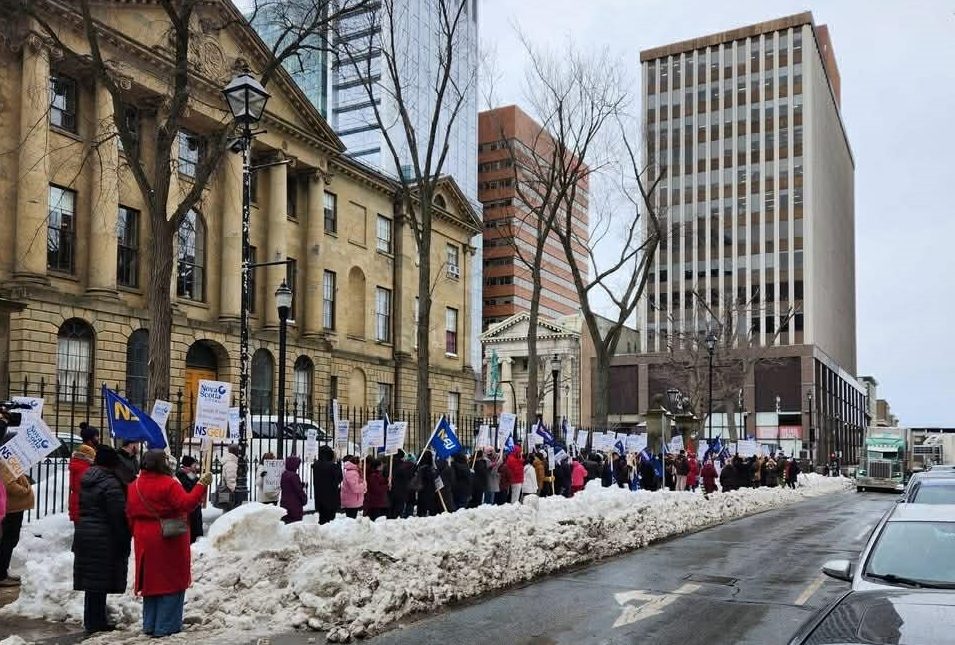
On Feb. 23, the government of Nova Scotia tabled the 2026-27 budget. Under the slogan of “Defending Nova Scotia”, the government announced $304.9 million in cuts. This is part of the government’s “Multi-Year Fiscal Stability Plan” which will see them cut $622.3 million, $756.8 million and $914.3 million in the next following three years.
The big-ticket items which are victims of these cuts are a $130 million reduction in grants, largely targeted at community programs and education. The civil service will be reduced by 20 per cent and the public sector 12 per cent over the next four years.
This abrupt shift in policy by the Tim Houston government has shocked many people. Nearly 1,000 jobs will be initially lost and thousands more are on the chopping block. The education cuts pour fuel on the fire of a student movement which is mobilizing for strike action on the week of March 15-21.
When Houston was elected, he promised he would run deficits to “fix healthcare.” But huge deficits year after year are unsustainable and sooner or later, something had to give. Faced with a record deficit of $1.9 billion, Houston is now offloading the cost of the debt onto workers and students in Nova Scotia.
But even with these cuts, the deficit is only being brought down to $1.233 billion. And even with the huge projected cuts over the next few years, the public debt-to-GDP ratio is still projected to rise to nearly 50 per cent by 2030.
Of particular note are the cuts to post-secondary education. With this budget comes $27 million in cuts to university funding, and as stated previously the $130 million in cuts to grants include education. For many, these grants are the only way to access education.
On top of that, these cuts pose an existential threat to higher education. Just last year, Dalhousie posted a $20 million deficit. The story is the same for higher education across the country.
The ultimate cause of the crisis in post-secondary education has been the historic lack of direct public funding. As the funding was either cut or not keeping pace, many universities and colleges took to gouging international students with exorbitant fees. But as the federal government has cut the amount of student visas, universities are forced to either close, or offload costs onto students and workers. We are seeing the latter in this budget, but even closures are not ruled out in the future. Next door in New Brunswick, the government has openly floated the idea of closing institutions.
This expresses the deep crisis that the capitalist system is in. In Canada we tend to think that good education will always be available—at least on paper. After all, Canada has some of the highest rates of post-secondary education in the world. But this is being dismantled before our eyes.
The only thing that has the potential to stop these cuts is a mass movement of workers and youth. And the students have the perfect opportunity to get such a movement started. Last year, the CFS-NS voted to hold a province-wide student strike for lower tuition among other things. That strike is set to take place this March 15-21. The cuts coming just a few weeks before the strike pours fuel on the fire. A successful strike could set an example for students elsewhere in the country.
But this budget is a direct attack not only on students but the working class as a whole. The students have a fantastic opportunity to begin this struggle against Houston and in doing so, inspire a broader struggle of the labour movement—the only force that has the power to stop these attacks.

