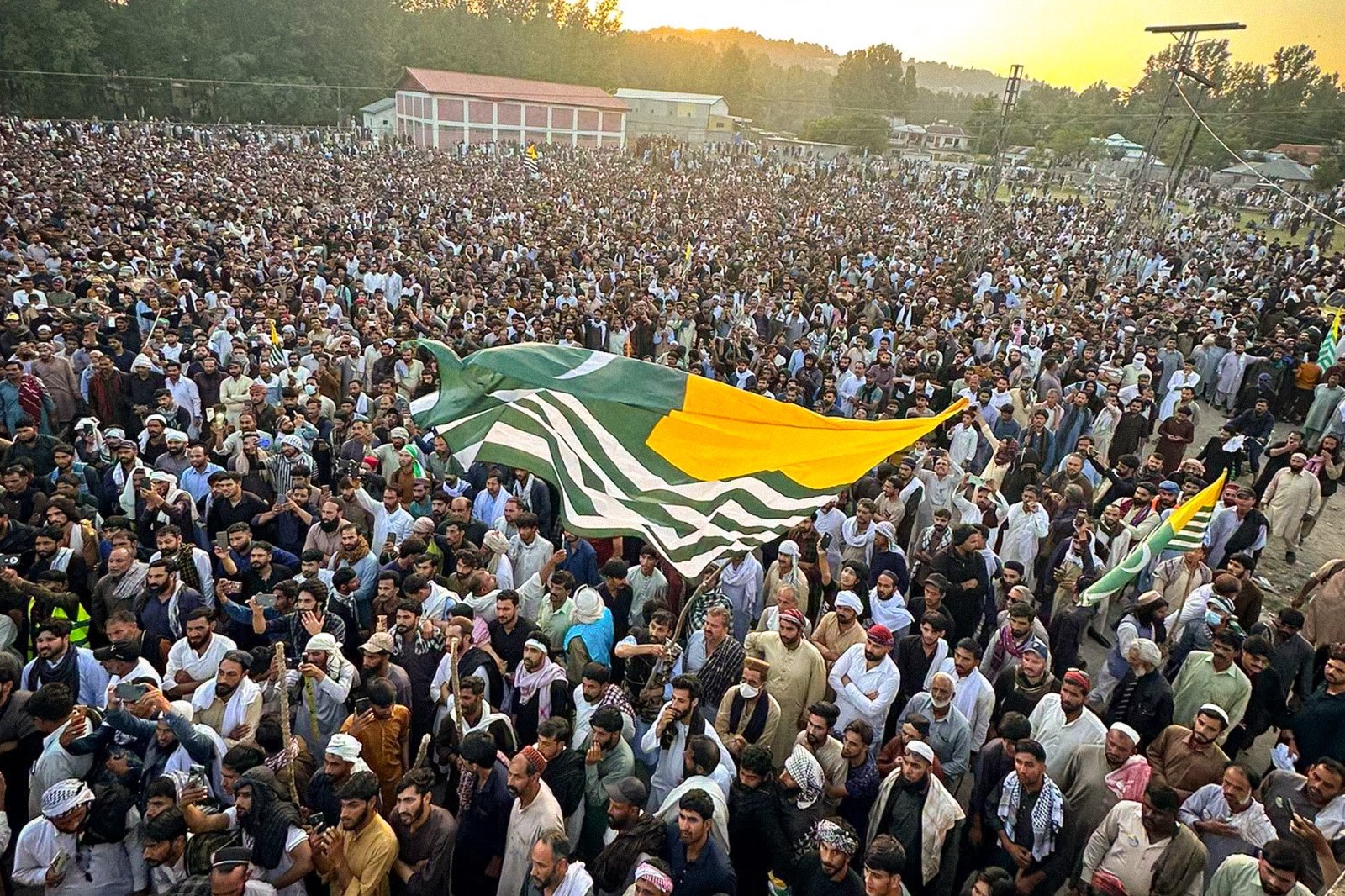
Hundreds of thousands of people in Pakistan-administered Kashmir, usually referred to as Azad Kashmir, are writing a new chapter in history through their courage and heroism as the Pakistani state unleashes some of the most brutal state repression we’ve seen in the recent period.
The Awami Action Committee (AAC) in Azad Kashmir is leading a historic long march towards Muzaffarabad to press for their demands. In the last three years, these demands had been accepted by the governments of Azad Kashmir and Pakistan following previous long marches. They have not yet been implemented however.
This time, the state authorities are hell-bent on crushing this mass movement through mass killings and brutal repression, and have crossed all limits of brutality by the measure of recent decades.
This long march was set to start from different parts of Azad Kashmir on 9 June, and reach Muzaffarabad after passing through various cities. But the state authorities unleashed terror on 5 June, when one of the central leaders of the movement, Sardar Umar Nazir, was shot by police at a checkpost near Rawlakot. He miraculously escaped this assasination attempt, the bullet even bruising his ear, while a long-standing activist who was driving his car, Shahzeb Habib, was killed.
Earlier that day, the government had labelled the AAC a terrorist organisation and had banned it. Meanwhile, the government also announced elections, despite the fact that earlier they had promised that the electoral reforms suggested by the AAC would be carried out before the elections. This was never fulfilled.
On the night of 6 June, when thousands of people gathered to attend the funeral of Shahzeb Habib, in Rawlakot, paramilitary forces such as the Rangers, Punjab Constabulary and Frontier Constabulary, coming from Pakistan, indiscriminately opened fire on the gathering, killing dozens.
According to the new norms set by the Pakistani state, the dead bodies from the mass killings were confiscated by the authorities and are dumped at undisclosed locations. Some reports suggest that more than 100 people were killed on this day. A curfew was subsequently imposed on Rawlakot, and anyone who broke it was shot by the security forces.
The long march
Despite all of this brutality, the long march started as scheduled on 9 June, and caravans from different parts of Azad Kashmir began travelling to Rawlakot. Every caravan had to fight battles against the security forces in which dozens of people were again killed.
In Kotli, at least six people were killed when security forces opened fire on a gathering. When people took the injured to the hospital, security forces followed them and opened fire inside the hospital, where more people were killed and injured including a woman. At several other places, similar incidents took place. In the end, however, tens of thousands of people reached the outskirts of Rawlakot.
The leadership of the AAC announced the start of a sit-in at Darek, a place on the outskirt of Rawlakot, and demanded that the state authorities withdraw all their forces and all measures against the AAC, vowing not to bow down and to continue their struggle if the state refused.
The sit-in has continued to today, and the battles between the protestors and the state authorities have continued on a daily basis.
All activity in Azad Kashmir has come to a grinding halt since 9 June. There is no traffic on the roads, and all shops and offices are closed. A complete strike has been observed continuously for almost one month now. The state authorities have tried every means to break this strike and have threatened the shopkeepers with dire consequences if they refuse to open their shops, especially in Muzaffarabad. Nevertheless, they have failed miserably.
The protestors also closed all the entry points into Azad Kashmir from Pakistan, which the state has been unable to reopen. They have thus imposed their own blockade on these points. All supplies of basic necessities, like food items, medicines and other essentials, have been blocked by the state.
The Pakistani state is trying to break the strike through a blockade of the whole four-million-strong population of the region. But the protestors are defiant and ready to fight this repression, which resembles the methods used by Israel against Gaza.
The Pakistani state has also unleashed a poisonous campaign in the national media. Every politician and media personality is speaking day in and day out against his mass movement. The AAC is being called a terrorist organisation funded by India. Everyday there are fake reports about new evidence that has been found linking it with the Indian state.
This movement, which has the overwhelming support of the people of Azad Kashmir, is being labelled a conspiracy against Pakistan. The state has announced bounties of Rs. 10 million for the four central leaders of the movement.
But despite all these frantic efforts, support for the movement is growing and has reached unprecedented levels. The most remarkable indication has been the participation of women in their thousands, which has helped to turn the tide in a difficult period for the movement.
From 14 June onwards, protests of women and children started in different cities were held, and thousands of women reached the main sit-in at Darek outside of Rawlakot. The speeches by women activists were the most militant in which women openly talked about sacrificing their lives for this movement and expressed their willingness to fight the state brutality.
This movement also enjoys the overwhelming support of the Kashmiri diaspora across the world, with two mass protests held in London outside of the Pakistani embassy. Many trade unionists, MPs and other activists of Kashmiri origin have supported this movement and have called upon the Pakistani state to end this brutality and to accept the demands of the movement.
But despite all this, the Pakistani state along with its stooges in the government of Azad Kashmir are still carrying out brutal assaults on the protestors. Every other day there are reports of battles in which activists are killed.
The central leader of the AAC, Shaukat Nawaz Mir from Muzaffarabad, was also arrested last week as he was secretly travelling to Rawlakot to extend his solidarity. Since then, his whereabouts have remained unknown, and the state has not yet produced him in court. After his arrest, protests were held in various cities in Azad Kashmir, and the central leadership called for mass protests and sit-ins on 5 July, which were met with a historic response.
5 July protests
The state authorities tried to crush the protests on 5 July and to break the movement. In the late hours of the night on 3 July, the state attempted a huge assault against the main sit-in in Darek. A few thousand security personnel marched alongside dozens of armoured cars from Rawlakot city to the area of the sit-in, in order to attack it and to kill all those present.
This was prevented by the tactics of the activists, who erected obstacles by felling trees in their way. The attackers had to return unsuccessful, but on their way back they fired their weapons in the air for more than an hour.
Remarkably, in response, the people who were sleeping in the surrounding area ran towards the sit-in when they heard gunfire in order to fight against the security forces’ onslaught.
This is a clear sign of the commitment of the roughly 100,000 people who have been involved in these sit-ins for almost one month. They are not terrified by heavy gunfire. Rather, they are willing to fight the enemy head on.
This whole incident gave the movement a new lease of life, and on 5 July hundreds of thousands of people came out for protests and sit-ins across Azad Kashmir. There were many battles with the security forces in almost every city. Dozens more protestors have died.
According to one report, an infant was shot and killed in his mother’s arms during a protest. One longstanding activist was killed in Mirpur, while in Muzaffarabad there was also heavy fighting with the security forces.
The speeches at the main sit-in in Darek – where more than 150,000 were present – were the most radical of the last month and everyone present vowed to fight this battle till the end. Comrade Hina Zain, from the Inqalabi Communist Party (RCP) Kashmir also addressed the gathering, and said that the working class of Pakistan and the world supports this movement, and that we should move forward towards victory, which will be a victory for workers everywhere.
The leadership of the AAC again gave the government three days to meet their demands, and announced that they will present their next steps on 9 July.
Which way forward?
This movement has reached a decisive point for the classes that face each other as enemies on either side of the battle lines. The Pakistani state has used every measure and every trick in the book to crush this movement, but so far it has failed to do so.
They have used political propaganda and parliamentary measures on the part of the rotten political parties against the movement, but have failed on all occasions. These political parties can’t even hold a meeting of a few hundred people anywhere in Azad Kashmir, and yet they are in power and are preparing to be returned to the same parliament after the sham elections scheduled for 27 July. Some politicians, including a former prime minister, have been beaten by the crowds when they tried to enter their own constituency.
The bankruptcy of the judiciary, the bureaucracy and all other institutions has been fully exposed. Everyone can see that they are open enemies of the people of Kashmir.
Pakistan has always championed itself as the defender of the rights of the Kashmiri people, and has accused the Indian state of oppressing the people of Indian-occupied Kashmir. Now, the hypocrisy of all the talk about ‘solidarity’ with their Kashmiri brothers and sisters coming from the Pakistani state has been exposed to everyone. This has been one of the main ideological pillars of the Pakistani state for the last seven decades.
But now, in Azad Kashmir, the Pakistani state is carrying out atrocities similar to those which the Indian state has been carrying out in the part they have occupied for the last seven decades.
The Indian state used pellet guns to attack the protestors in Srinagar and other cities in 2019, when Modi’s tyrannous government revoked the special status of Kashmir from the Indian constitution. Last month, the Pakistani state also used pellet guns in Ralwakot against protestors. Earlier, Pakistan had protested at international forums against the use of pellet guns by the Indian state.
Many activists and political leaders in Indian-occupied Kashmir, who had been labelled pro-Pakistan, have also protested against the brutality of the Pakistani state. This shows that Pakistani state authorities are fighting a battle for their survival and that they believe that another victory achieved by the movement would be detrimental to the authority of the state.
The AAC must take power
On the other hand, the movement has now grown from a mass movement for basic rights to a movement which has the potential to take power into its own hands.
In fact, should the leadership of the AAC march towards Rawlakot city at the head of hundreds of thousands of people, and wage a fierce battle with thousands of security forces to take the city back under their control, the situation would change dramatically. The people across Azad Kashmir are actually pushing the leadership towards this course, to move forward, to take over Rawlakot and then march towards Muzaffarabad.
The leadership of the AAC is reluctant to do this, because it fears that many lives will be lost in such a fight. They are pleading with the authorities for a peaceful solution through negotiations. But the situation has reached a point of no return. If the movement is defeated at this point, the state authorities will unleash hell. They will kill hundreds of activists and arrest thousands on charges of terrorism.
Already, on a daily basis the houses of many activists are being raided and bulldozed. The women in these homes are being humiliated in the course of these operations. Every day, the authorities are making new threats. The media campaign grows more poisonous. Solidarity activity across Pakistan and on social media is met with brute force, and some activists have been arrested or threatened simply for holding small solidarity protests.
In this situation, the only route available is to move forward: enter Rawlakot city and fight the impending battle to take it over. The sit-in can’t continue for an indefinite period and the leadership can’t simply make calls for mass protests and sit-ins forever. The reluctance of the leadership in this matter could be fatal for the movement, with dire consequences not only for the working class in Azad Kashmir but across Pakistan.
On the other hand, if the leadership puts out the call to enter Rawlakot city and take it from the security forces sent from Pakistan, it will receive tremendous support and hundreds of thousands – including women and children – will come out to fight alongside them.
A victory in this decisive battle would transform the whole situation and the question of power would arise. At this moment the AAC leadership must announce itself the new government and march towards Muzaffarabad to take power into its own hands. In reality, the leadership already has the power to form the government, but it has not announced it.
Once the leadership announces its intention to take power, it should also announce all the measures it is fighting for, including free healthcare, education for all, and an end to the luxury lifestyle of the government officials and politicians living at public expense. It must also announce employment for all and universal pensions.
These measures would draw massive support from the working class of Pakistan. The new government would enjoy overwhelming support. The new government should also denounce the imperialist powers and their institutions. This includes the UN and other ‘human rights’ organisations across the world. Instead, they should call for solidarity from the working class internationally.
They should invite union representatives from different countries to announce their support for this movement, starting with workers from across Pakistan. Ultimately, the final victory of the movement is only possible if the capitalist system is overthrown by a socialist revolution, not only in Azad Kashmir but across the whole subcontinent, including Pakistan and India.
A socialist federation must be established, which would not only end the national oppression of Kashmiris once and for all, but would also liberate tens of millions of people in this whole region from misery, poverty and endless wars and bloodshed.
All these actions are completely possible in this situation. Everyone in Azad Kashmir can feel it in their very veins, with every drop of blood. But these bold and radical measures need a leadership which has broad vision and revolutionary determination.
We have seen the mass movements of recent years across the whole region – in Sri Lanka, in Bangladesh, in Nepal. In each, hated governments were toppled as mass movements erupted, seeking a radical solution to the masses’ problems. But in none of these instances were the people able to organise themselves and take power into their own hands. As a result, these changes in government haven’t brought any relief for the people. But in Azad Kashmir there is this possibility – in the coming days we will see if it can become a reality.
Comrades of the RCP are intervening in this movement and are taking this message to the people. They are among those facing the brutality of the state, and are involved in organising logistics and other activities in the movement. Our women comrades have played a key role in mobilising women and in fighting conservative elements for this purpose. In the coming days, our comrades are prepared to perform any revolutionary duty and sacrifice demanded of them to secure the victory of the movement.
We appeal to all comrades of the RCI and workers of the world to support this movement and condemn the brutality of the Pakistani state.
An injury to one is an injury to all!
Forward to victory in Azad Kashmir!
Workers of the world, unite!

