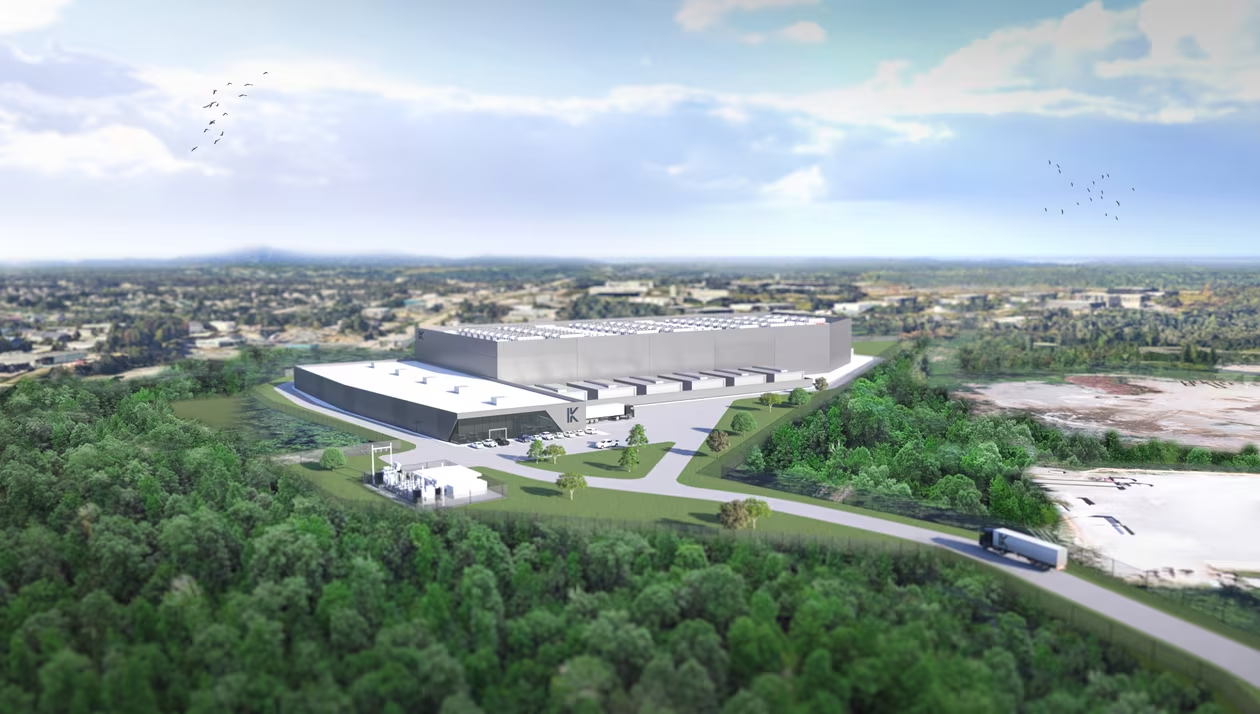
In early July, the city of Sherbrooke, Quebec, voted in favor of a preliminary agreement with Keel Infrastructure for a new AI data centre. Very little information has been made available about the $1.8 billion project. Residents concerned about the project’s impact launched a petition that gathered more than 5,000 signatures in one week.
Residents suffer while Keel makes a profit
The petition, launched on July 23, expresses concern about a “rise in electricity costs for nearby residents,” “environmental impact,” a possible decline in water quality, and noise pollution.
These are all consequences that have already been observed with this type of project. Data centres dedicated to AI are known to be particularly energy-intensive—more so than ordinary data centres. This means they tend to put a strain on the power grid. To prevent outages during periods of peak electricity demand, they often have to rely on natural gas or diesel generators, which are very noisy and emit air pollution. In addition, to prevent the processors from overheating, they can require large quantities of water.
In the United States, affected communities have already begun filing class-action lawsuits in response to these problems. Residents of Southaven, Mississippi, are suing Elon Musk’s Space X over noise issues caused by a massive data centre. The company is also being sued for violations of air quality regulations.
The concerns of many Sherbrooke residents about the construction of a data centre in their community are all the more legitimate given the ways in which major tech companies are using artificial intelligence. They use it to destroy jobs, facilitate surveillance, and wage war—all while raking in astronomical profits. When we consider that AI is used, for example, by Palantir’s Gotham software—a technological tool that facilitates the genocide in Gaza and ICE’s roundups of migrants in the United States—there are good reasons to wonder what purpose the data centre being built right in one’s back yard will serve.
In fact, this isn’t the first time residents have opposed a project by Keel Infrastructure (formerly Bitfarms) in Sherbrooke. In 2018, Bitfarms built three cryptocurrency mining centres, promising there would be no noise pollution.
After two years of noise complaints, it was a grassroots campaign that forced the facility to relocate. Shareholders are primarily concerned with their profits; without this campaign, the facility would still be a nuisance for the neighborhood.
The community should decide
The petition calls for a public meeting and a comprehensive environmental impact study. Public pressure has already forced Keel Infrastructure to hold a public meeting in mid-October. This is a first victory for the grassroots movement.
In response to the concerns raised, the company also stated that the centre would not lead to an increase in electricity consumption, as the power would simply be reallocated from the 96-megawatt power allocation the company currently uses for cryptocurrency mining. Furthermore, it promised that the cooling system would be a closed-loop system, which uses less water.
This momentum must be used to take the movement to the next stage and keep up the pressure. Once the petition is submitted to City Hall, a rally inviting everyone who signed it should be planned. This would send a strong message to the city council, while providing an opportunity to organize the community.
However, we cannot stop at simply calling for a public meeting and a study. Companies and politicians are experts at making promises while crossing their fingers behind their backs. The slogan should be: no data centre without democratic control by workers and the local community.
A committee composed of elected representatives of the community and workers from surrounding industries should be formed to serve as a decision-making body for the project, in order to ensure that mitigation measures are implemented and that the project is not used for harmful purposes such as war or surveillance. This democratic oversight should include full access to all available information, including information that is currently classified.
This is the only way to monitor the project’s impacts and avoid false promises. If the company is not willing to be transparent and give the community a say, it means there is nothing good to expect from this data centre and that it must be opposed.
Expropriate the tech bros!
The profound social transformations brought about by the development of AI are a perfect example of the central problem of the capitalist system: while we formally have a democracy on the political level, the economy is under the dictatorial control of banks, multinational corporations, and billionaires.
While AI is a powerful technology that has the potential to massively improve humanity’s living conditions, in the hands of capitalists it only serves to enrich a handful of “tech bros” while causing unemployment, impoverishing culture, facilitating repression, and destroying the environment.
To truly put this technology to work for our needs, we need a movement that is united beyond local efforts and that aims to uproot the problem at its source: capitalism.

