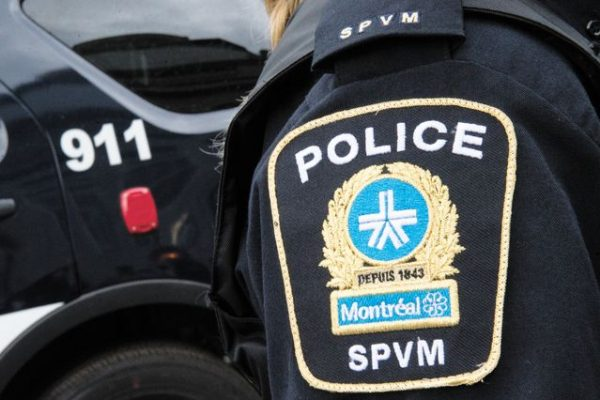
On Friday, June 12, in an unprecedented move, Montreal police (SPVM) officials announced the dismantling of an entire night patrol unit: two officers were suspended, and 14 other members of the 39th Precinct in Montréal-Nord were reassigned.
The limited information that has been released is damning: the officers allegedly encouraged and coordinated with one another to racially profile Black and Arab people. They went so far as to collect locks of hair from their targets—dreadlocks—as if they were war trophies.
SPVM Director Fady Dagher says he is “very surprised.” It’s just a few bad apples, an isolated case, something “unprecedented.” But no one is fooled. In reality, what the SPVM has been forced to disclose is merely the tip of a hideous iceberg.
Nothing new
What this appalling barbarity reveals is neither new nor surprising: the police force is a deeply racist institution.
The case of Fredy Villanueva, a young man shot and killed by police in 2008, is still fresh in people’s minds. His murder sparked a riot that put a spotlight on Montréal-Nord and the glaring poverty there. It is precisely to prevent a repeat of this kind of uprising that the SPVM is trying to downplay the current situation and is calling for calm.
But police racism is alive and well, a conclusion reached by several independent reports. An initial report in 2019 revealed that Indigenous people, Black people, and Arabs are disproportionately targeted by arbitrary stops. The SPVM chief at the time admitted to being “shocked” and promised “concrete and swift action”, but denied any possibility of systemic racism.
Another independent report published by the SPVM itself in 2023 showed once again that Indigenous people are six times more likely to be stopped than white people, with the figure being 3.5 for Black people and 2.5 for Arabs.
That same year, Fady Dagher was appointed director of the SPVM. An immigrant himself, he asserted that the fight against racism was for him “not an issue, but a cause.” His appointment was clearly intended to polish the police force’s image. The shocking revelations from the weekend show that racism is deeply entrenched, despite a cosmetic change at the top.
The police cannot be reformed
The fact that 16 police officers were racist enough that their colleagues reported them means that many “less severe” examples are widespread. Dagher himself said he expects a “tsunami” of denunciations.
In light of these repugnant revelations, a large portion of the political establishment—from the Quebec Liberal Party to Québec solidaire—has rallied behind the demand for an independent public inquiry.
However, as we have just explained, independent studies have already been conducted and even published by the SPVM itself, yet nothing has changed. At best, another investigation will merely add to what is already very well documented.
The mayor of Montreal also claims she wants to accelerate the rollout of body cameras. One wonders what difference that will really make, since the police officers in Montréal-Nord reportedly filmed themselves committing their despicable acts.
Similarly, officers can “forget” to turn the cameras on, as we’ve seen in Toronto since their implementation in the early 2020s. They are even permitted to do so under certain circumstances. We can be certain that officers will “forget” to turn on their cameras during all sorts of incriminating interventions. We cannot have any confidence in the “solutions” proposed by the establishment, which do not address the impunity enjoyed by the police in general.
In an interview, Fady Dagher spoke of getting “to the root of the problem.” These fine words are doomed to failure, because that root runs deep into the very foundations of the capitalist system.
You can’t have capitalism without racism
The violence, racism, and all the corruption that characterize the police are a reflection of the system that police officers protect and serve.
This system, capitalism, is the domination of society by a minority of parasitic exploiters—the Epsteins of this world—who hoard all of society’s wealth while the majority of workers must fight for crumbs. But such gross inequalities could not be sustained without pitting sections of this majority against one another. Racism and other reactionary ideologies play this role. As Malcolm X said: “There is no capitalism without racism.”
Oppressed groups serve as scapegoats for the system’s failures—housing, crime, the collapse of public services, and so on. Instead of blaming the capitalist class for our miseries, we are told to look to immigrants, Indigenous people, or others. And the higher rates of poverty among Black, Arab, and Indigenous people reinforce racist prejudices, which in turn reinforce their poverty and exploitation.
In such a rotten society, the institutions that defend the capitalist system will inevitably become tainted by all the prejudices of that society. In this regard, the SPVM is no different from the RCMP, the police in Repentigny, Longueuil, or anywhere else.
To put an end to the scourge of police brutality and racism once and for all, we must therefore overthrow the capitalism that generates and spreads them. We must expropriate these parasites who are getting rich off our backs. This will free up the resources needed to provide adequate housing, jobs, and services in all neighborhoods. Workers will no longer be competing just to survive, and thus prejudices will lose their foundation and begin to fade until they become nothing more than a bad memory.
We need to unite the workers in a struggle to overthrow this system; we need nothing short of a revolution. As Malcolm X also said: “We are not outnumbered. We are out-organized.” Uniting the workers in the fight for socialist revolution is the task to which the RCP is dedicated.

