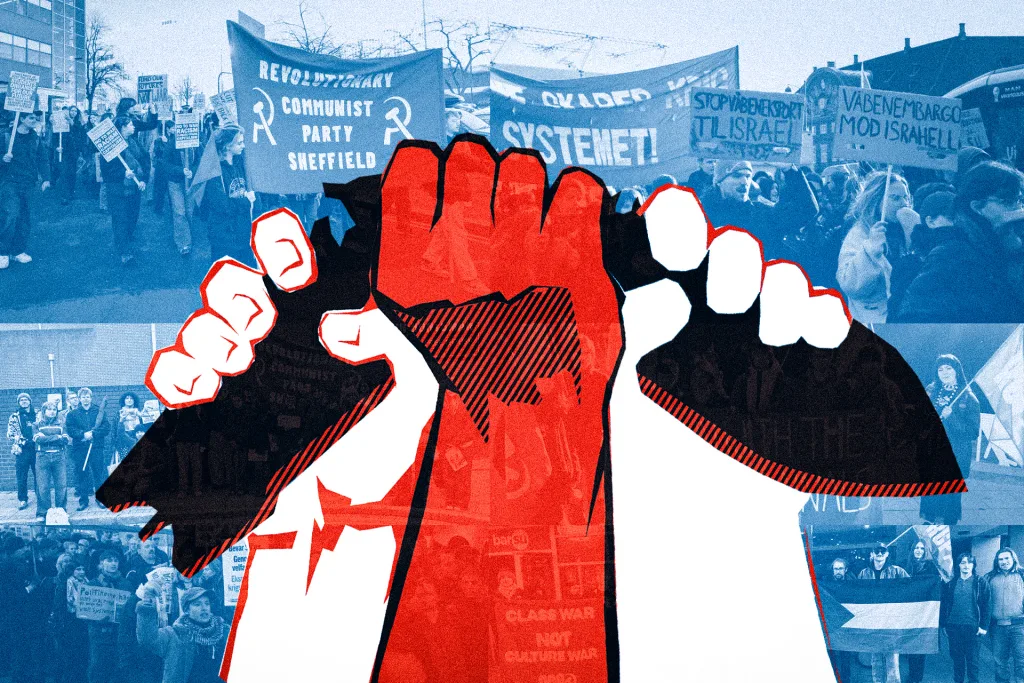
We’ve received reports from revolutionary communists in countries across Europe who participated energetically in the Nov. 20 November “youth strike” against militarism. We are now in touch with hundreds more young people who are interested in getting organized.
In different ways, the reports bring out two patterns.
On the one hand, in many countries an advanced layer of youth did turn out, and there the ideas of communism met with a natural and enthusiastic response.
On the other hand, there was undeniably a general lack of leadership able to connect the fight against militarism to the general mood of discontent. The small groups that called the “youth strike” lacked the forces to give a lead on their own account, whereas the trade unions in general sat on their hands, leading to a patchy response.
By far the biggest turnout was in Italy, where the CGIL called a general strike on the same day—but even here, we find that the trade union bureaucracy played a miserable role, having signed a deal with the bosses they had called the strike against a week before the strike even took place!
Yet despite this fact, the movement highlighted a seething mood developing, especially in the schools.
In Switzerland, there was also a big response in many places, with the school students themselves giving a lead. In Lausanne, the movement of the school students drew in the public sector workers, whose union called a teachers’ strike in the city on the same day.
Elsewhere, even with our small forces, we were able to mobilize dozens or hundreds, to lead rallies, and to gain a big echo with our ideas. This shows what potential exists.
For the revolutionary communists, our interventions on Nov. 20 were a success all along the line. Our real task begins in its aftermath: to bring the hundreds of militants we’re now in contact with into the ranks of the RCI, to build the revolutionary leadership that the workers and youth lack but sorely require in this period.
Italy
Nov. 20 saw an excellent mobilization of hundreds of thousands of young people and workers, despite the harmful role played by the CGIL bureaucracy—the main union organising the strike.
Not only did the union leaders do nothing to prepare for the strike, but they signed a rotten deal with the very bosses they were claiming to mobilize against a week before the strike even took place! Many would ask, what is the point of a strike after a sell-out deal? And yet, despite this, the mood among the youth was excellent!
The movement has clearly put the need to fight against this system on the agenda for a very broad layer of young people, especially high school students—and consciousness will develop along these same lines among workers as well.
In less than two months, we have recruited 119 comrades, bringing us to 800 members on the eve of the strike!
As the Partito Comunista Rivoluzionario, we intervened on Friday with over 400 comrades across 35 cities, and in many of which we had blocs that drew in dozens of youth and workers.
Our comrades delivered speeches against the government’s policies, the right wing, and the system as a whole—they boldly called for a struggle for a communist future. This caught the attention of many of those who had taken to the streets.
In a vivid embodiment of the unity of students and workers, a bloc of around 150 young people in Milan linked up with UPS workers, who were buoyed by their recent union victory.
The image of the hammer and sickle flying atop the statue of Garibaldi went viral on social media. By the end of the day we had sold over 140 papers, around thirty people asked to join the party, and two of them officially joined our ranks on the spot.
In Modena as well, our bloc drew in several metalworkers who stressed the need for unity between students and workers in the fight against the government.
Two demonstrations were called in Naples, and we intervened in both with a bloc of about 70 comrades and sympathisers. We sold 70 copies of our paper, and got the contact details of 11 people interested in joining us. In Rome, we attracted the most militant layers of the protest to our bloc—in the capital, we have now surpassed 100 comrades and are marching forward at a brisk pace.
We were also present in Genoa and Bologna. In the latter, our comrades did important work in bringing out their coworkers to join the strike. In Alessandria and Pisa, our comrades—all of whom are under 25—organized their second-ever contingent for a demonstration, and their critique of the opportunism of the trade union bureaucracy resonated with the crowd.
There were also plenty of successful interventions in the South of the country, in Messina, Bar, Lecce, Cosenza, and Cagliari.
We ended the day with over 850 papers sold, five new comrades recruited, and the details of over 150 people who are interested in joining us. There is a tremendous sense of momentum around the party.
On this basis, starting from the day of mobilization on Nov. 25, we have set ourselves the goal of reaching 1,000 revolutionary communists under the banner of the PCR in the period to come.
Switzerland
Clearly inspired by the Red Autumn of mass movements across Europe, the youth strike in Switzerland really cut through this Autumn’s calm in the class struggle. Despite the hysteria and lies of the bourgeois media about the violence of rioting youths, around 40,000 young people took to the streets across nine cities.
By far the biggest and most radical demonstration was in Lausanne. There, the school students had organized and prepared for weeks in advance, and the union of the public service called for a teachers’ strike in solidarity. The local government was forced to give schools the day off, and all ten schools spent it discussing and preparing slogans for the demonstration in the evening.
The turnout was amazing: in a city of 150,000, around 25,000 people rallied on the streets. Many of them were school students, but there were also many young workers.
The mood was very radical: many songs and slogans were taken up from France: against the police and the government of the rich, for revolution and class struggle.
However, the leadership of the movement wasn’t prepared to show a way forward for these youths. They simply dissolved after the official demo ended. But hundreds wanted to go further! Without a clear lead, they simply started to chant revolutionary songs or even tried to start another demonstration.
In all the demonstrations, three things were obvious:
- Hundreds and even thousands of young people are entering the struggle and looking for organization.
- They are reaching radical conclusions much more quickly than in past movements, like the climate strike. Everyone we spoke to had a huge list of problems—war, imperialism, climate, housing, jobs, education, etc.—they wanted to fight against. Anti-capitalism was mainstream. Most of them were open to communism. Some were already communist.
- In spite of the potential for a revolutionary student movement, there is a void of leadership that could lead this movement forward.
We are doing our best to step into that vacuum. In each demonstration, we made ourselves as visible and bold as possible with our communist banner and program.
We were present with 150 comrades in seven cities. In Zurich, Bern, Lausanne, and Basel, we organized bold communist blocs fronted by banners that read: “Down with the warmongers and capitalists! Organise the Gen Z revolution!” These slogans and our enthusiasm attracted dozens more youths to join us.
The thirst for ideas and strategy was apparent. In total, we sold around 200 copies of our newspaper in both German and French, as well as Marxist classics like State and Revolution and The Communist Manifesto. We met more than 60 new people interested in joining the party. Five of them agreed to join straight away!
And all this was while half of the party was organizing our three-day French-language communist school in Geneva. With 177 participants, it was our biggest school in French Switzerland ever. Many of them had come directly from the youth strike.
Britain
On Friday, Nov. 20, in total, thousands of students, young people, and trade unionists assembled on university campuses and in city centres across Britain, as part of the international youth strike against militarism.
In many of these mobilizations, the Revolutionary Communist Students (RCS) played a leading role: helping to build for student walkouts through stalls and lecture shout-outs; and providing revolutionary speeches and chants on the day.
The RCS intervened in demonstrations and rallies across London (Imperial, KCL, SOAS, Ravensbourne, and UCL) as well as in Bath, Birmingham, Bristol, Cambridge, Cardiff, Edinburgh, Glasgow, Hull, Lancaster, Leeds, Liverpool, Manchester, Newcastle, Nottingham, Portsmouth, Preston, Sheffield, Southampton, Warwick, York, and more.
Notably, the rally in Manchester was one of the largest in the country, with around 1,000 gathering in St. Peter’s Square. RCS comrades energized the crowd with chants like, “There is only one solution, Britain needs a revolution,” “Andy Burnham you can’t hide, we charge you with genocide,” and “Tout le monde déteste la police,” inspired by the ongoing struggle in France.
In London, two separate national rallies took place in Westminster, gathering over 1,000 attendees—a mix of trade unionists, left-wing activists, and young people.
At Parliament Square, far-right provocateurs and “auditors”—including the notorious grifter “Young Bob”—were out in (relative) force, trying to goad protestors with their racist bile about how the “riots” in Europe are being spread by immigrants.
After being given carte blanche by the Metropolitan Police to go around causing trouble, these reactionaries were soon chased off by ordinary young people—just as they have been in cities and campuses across the country in recent weeks.
The Nov. 20 mobilization was a promising start, giving students and activists something to build upon in the struggle against Burnham’s government of austerity and war.
Evidently, some of the local rallies and demos were a bit underprepared and leaderless, and therefore had a relatively low turnout. This is hardly unexpected, given the aloofness of the trade union and student union leaders to the day of action, and the general weakness of the left in Britain.
Where this has been the case, Revolutionary Communist Students were quick to take the initiative, putting across a bold, anti-capitalist perspective on the tasks ahead.
In central London, for example, communists at UCL, KCL, and SOAS took the lead in organizing a rally in Bloomsbury, which around 100 students attended.
RCP spokesperson Fiona Lali gave a speech, where she pointed out that “capitalism today offers nothing but austerity, nothing but cuts, climate change, genocide, and war.”
But, as Fiona explained, young people across the world are refusing to support “their own” imperialist governments, and are beginning to connect all of the problems around them to the need to struggle against the system.
In Cardiff, meanwhile, the rally drew the attention of ITV News, who interviewed our comrade Roo. “Our government continues to spend more and more money on militarisation,” they told ITV, “and we’re saying that our education and NHS is crumbling… we want to fight for a system which supports the interests of the workers, not the interests of the rich.”
On the back of such interventions, dozens of students and young people across the country have expressed an interest in joining our ranks. In Manchester alone, 30 people expressed an interest in joining the RCP.
One of the main things to take away from the mobilization is that many ordinary students and passers-by were supportive of the youth strike and its aims. They are greatly inspired by the struggles unfolding across Europe.
The mood out there is one of fury at the ruling class for destroying our futures; anger at the system, which offers us nothing but war and misery; and a burning desire for radical change. As one student asked the comrades in Sheffield, “A-to-B protests are fine, boycotts are fine, but what’s next?”
Austria
Demonstrations against militarism took place in several cities of Austria—Linz, Graz, Salzburg, and Innsbruck. The largest one in Vienna mobilized 3,000 people, while several hundred participated in Graz, Innsbruck and Linz.
The demonstration in Vienna, as in the other cities, was a broad left-wing mobilization of a kind that had not been seen for a long time. There were no restrictions on banners, the sale of publications or other political activities. In this sense, the international situation had a positive impact on the movement. This was particularly encouraging, as there was an open atmosphere for debating political ideas—exactly what is needed to agree on a way forward.
The Revolutionary Communist Party (RKP) mobilized a large bloc of around 100 comrades and supporters. We also led a youth bloc, made up of activists from the school strike against the hijab ban, who had been invited to take the lead in the demonstration. One of our young comrades spoke at the rally, while several comrades were interviewed and featured by various media outlets.
The presence of a fresh, largely unorganized layer of participants gave the demonstration a different character from the usual routine marches. A sizable bloc of dissident teachers took part, expressing their opposition to the hijab ban. The atmosphere was very open to radical ideas, and selling literature and newspapers was straightforward. In total, we sold around 140 newspapers during the day, and our stocks of classic Marxist literature sold out.
A group of comrades from Innsbruck also crossed the border into Bozen/Bolzano to participate in the Italian general strike, where they made a bilingual intervention.
We were able to establish numerous new contacts. For example, one comrade spent several hours during and after the demonstration talking to a group of school friends from different schools. They now want to start a Communist Manifesto reading circle with her! A further 22 contacts were recorded at the information table in Vienna alone.
The attempt to organize a morning strike, however, proved premature and poorly organized. A demonstration scheduled for 10 a.m. was advertised as a “second action”. Only a few left-wing sects actually mobilized around it, and around 400 people turned up.
While refusing to organize a campaign against the government, the socialist student faction nevertheless lent its credibility to this so-called strike without doing any actual work to build it. This approach serves to disorientate and demoralize the movement. We have had similar experiences during the struggle against the hijab ban.
During the opening rally, a small group of sectarian activists attempted to block the university just as the speeches were due to begin. The police responded brutally, using batons and pepper spray. Some of our comrades were also affected, but fortunately everyone is fine. When the demonstration eventually got underway, protesters were kettled and 60 people were arrested. The remainder of the demonstration was dispersed near a Christmas market.
This ultimately proved to be a missed opportunity to advance the demand for an all-out strike across the education sector—the task we had set ourselves.
Tomorrow, assemblies of university employees will take place at universities across Austria. We are observing an emerging radical mood, as recently announced cuts could result in 10 per cent of all university employees losing their jobs in the coming period.
Our comrades at the universities have primarily focused on publicizing, supporting and organizing solidarity with this emerging class conflict within the institutions.
In a situation marked by austerity, racism and warmongering, class struggle is undoubtedly back on the agenda. It will take time for the working class, and particularly the youth, to draw all the necessary conclusions. But the RKP is already successfully reaching out to, providing political direction for and organizing the most advanced layers.
Denmark
In Denmark, demonstrations on Nov. 20 took place across the four largest cities. Over a thousand students and young people participated.
The mood was very radical. Chants against imperialism and for revolution were common. School students showed up with banners denouncing the government’s plans for militarization, connecting it with the latest cuts to education.
The communists had a big impact on the strike. In all of the demonstrations, the forces of the RKP were by far the biggest. We were met with enthusiastic support from the students, who showed much interest in our paper. Many of them were keen to join.
At the largest protest, in Copenhagen, which drew in around 500 students, we intervened with about 50 comrades. Our speeches attracted a huge amount of attention, and our bold approach of asking people directly to join paid off. By the end of the day, seven people had joined on the spot, and another 20 had signed up to come to meetings. Except for May Day, we have never before recruited so many communists on the same day.
One of these recruits told us that he has a dozen declared communist friends. Another told us that they are setting up a communist group in their sixth-form.
In the run-up to the school strike, our comrades collaborated with other organizations in order to play an active role in its planning and mobilization. In many places, brand new comrades took the initiative to bring out their classmates with speeches in front of their schools, lecture shout-outs and flyering campaigns.
All of this was successful because, as we have been saying for a long time, the youth is being radicalized quickly. The push for militarization is only accelerating that.
Our aim now is to recruit the 36 other contacts we made on the day in order to prepare for the next wave of protests in Denmark!
Spain
On Nov. 20, thousands of young students and teachers took to the streets in various cities across the Spanish State. Fourteen comrades took part in Madrid in a very bold manner, making valuable contacts and chanting revolutionary slogans.
Here, the call to action did not resonate as much as in other European countries, mainly because of the organizers’ lack of outreach efforts. This was a wasted opportunity, because young people have been actively fighting for their future for months!
On Nov. 11, young people played a leading role in the demonstrations for the general strike. Furthermore, the day of action coincided with the anniversary of the dictator Franco’s death—a day that always sees anti-fascist demonstrations. Meanwhile, there was another mobilization by teachers from Madrid who have been on an indefinite strike for over a month!
All young people realize that cuts to public education and healthcare will continue, while military spending increases. Fifteen military projects totalling €10 billion have been approved for 2027.
Enough is enough! The comrades from Organización Comunista Revolucionaria (OCR) will continue to fight, and we encourage all young revolutionaries to join the communists!
Sweden
On Nov. 20, around 1,500 people demonstrated in six Swedish cities—Stockholm (700), Gothenburg (200), Lund (450), Uppsala (100), Umeå (70) and Luleå. Our comrades intervened in all of them except Luleå.
Despite not drawing massive crowds, the participation of young people still stood out in contrast to other small demonstrations we have seen throughout the year, which were dominated by older activists and sects unable to mobilize any broad support.
Evidently, many students have followed the events occurring elsewhere in Europe and see the need for a similar struggle in Sweden. Even with sparse mobilization, they took to the streets with their friends and classmates and outnumbered the “regulars.” This shows how much potential there is for revolutionary organizing among school students in Sweden. It’s up to us to act on it.
In many cities, we stood out as the only group to put forward a boldly and openly communist alternative. This drew the attention of some of the most radical young people there. Around 60 comrades took part in our interventions. We made 19 new contacts, and several people signed up for our national school, Communism & Revolution, where we’ll discuss how to prepare for the Swedish revolution.
Netherlands
The Youth Strike in the Netherlands drew in thousands of students across the country. Protests against conscription and militarization are particularly pertinent here.
On top of austerity and a “freedom contribution”—a tax to pay for remilitarization—the government now wants to introduce an obligatory questionnaire and medical exam for young students as a step towards partial conscription. Meanwhile, the intelligence agencies are to be allowed to collect data about potential conscripts, including trade union and political party membership and sexual orientation!
A recent poll showed 60 per cent of Dutch youth support these protests, while a further 80 per cent between the ages of 18-24 oppose conscription. That’s in spite of constant propaganda in favour of militarization and conscription in mainstream media.
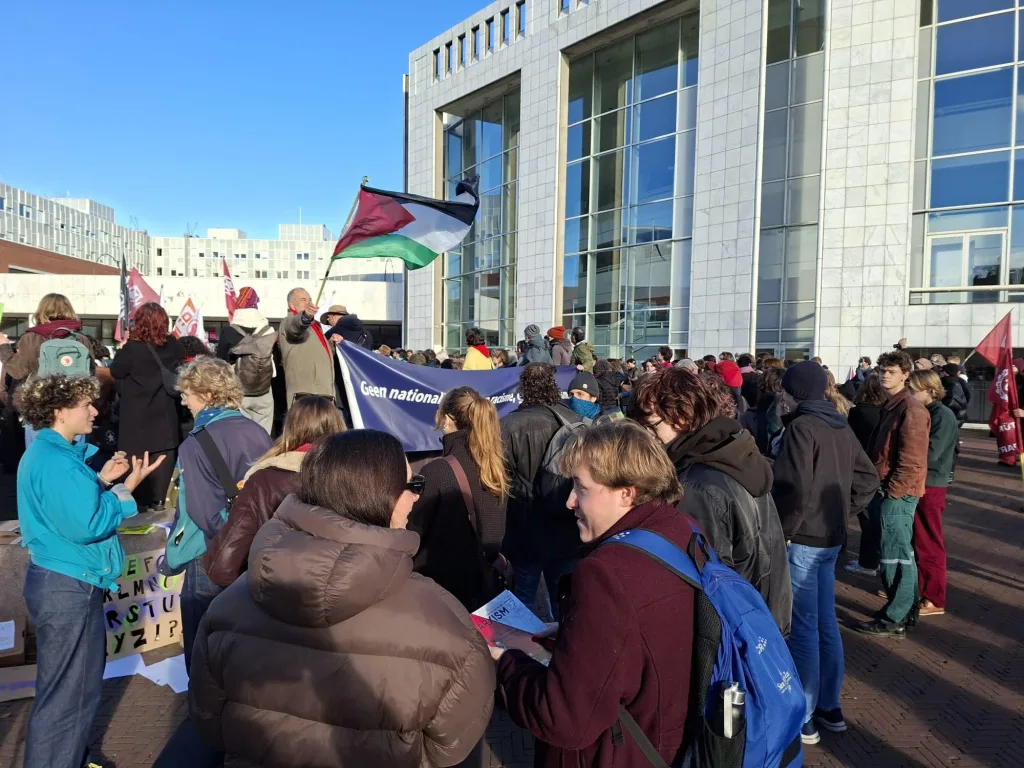
Dutch communists intervened at the protest in Amsterdam, which brought out a few hundred students. Protestors denounced the drive towards conscription and militarism with slogans like “Not a cent, not a body for militarization” and “a-anti-anticapitalista” and radical speeches by protesters as young as 14.
We met with a broad acceptance of communist ideas among this layer of students and youth. We sold five papers and one In Defence of Marxism magazine, and got the contact details of several students. At the end of the protest, there was an explicit call for everyone to get organized.
The youth in the Netherlands are hungry for new ideas and militant organization. The revolt against the crisis of Dutch capitalism might not have reached the level of Germany, France or Italy yet—but it is on the same trajectory as the rest of Europe.
Poland
What we see now in Germany is a picture of Poland’s future.
Legal measures are being introduced now to allow conscription and to shut down methods of avoiding it. Every sphere of life is being militarized. The remnants of industry are being reorganized as “dual use”—for civilian and military purposes. Meanwhile, the army visits university campuses to push its war propaganda
That is why we took the lead in organizing a demonstration on Nov. 20. We reached out to left-wing youth organizations in early October to co-organize it as a starting point for further mobilization against conscription and militarism.
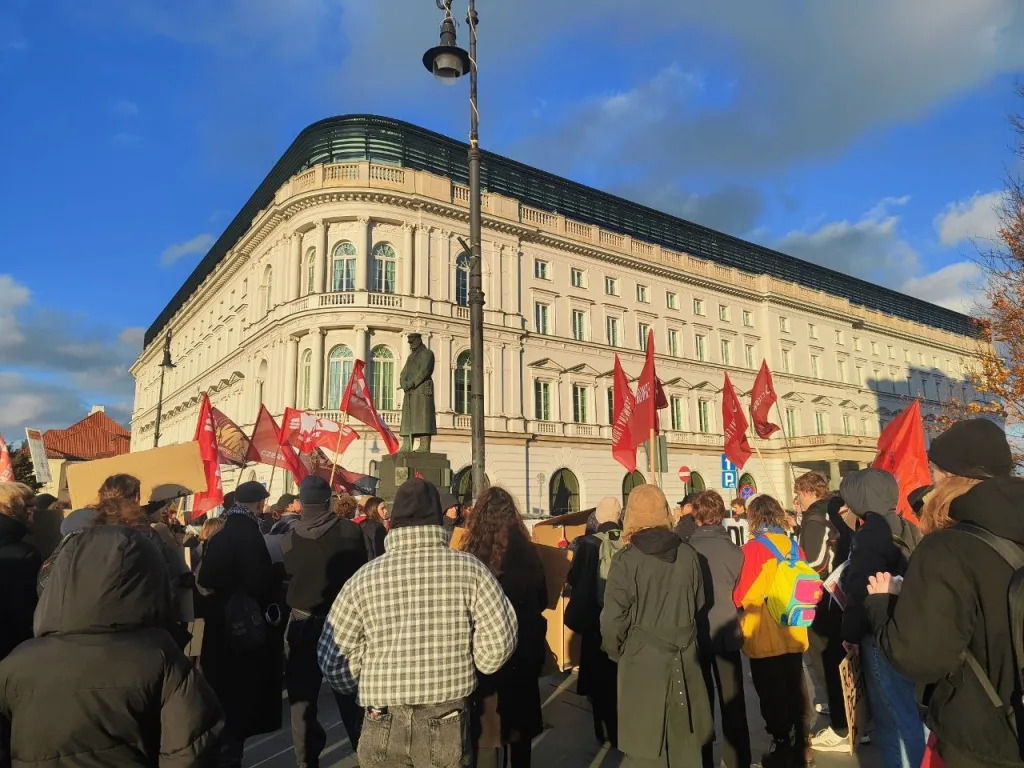
The demonstration was a modest size, but we managed to recruit new communists to the organization, gave speeches and interviews, and took part in the discussion as one of the leading and most organized forces.
In spite of its size, the protest caught the attention of the crazed capitalist media. These “respectable” outlets are claiming we are paid by Russia or naive pacifists who cannot understand that NATO alone can save us from inevitable destruction.
We are not pacifists. We are all in for class war. As we chanted last Friday and will continue to do so in the coming months: “No war between nations, no peace between classes!”

