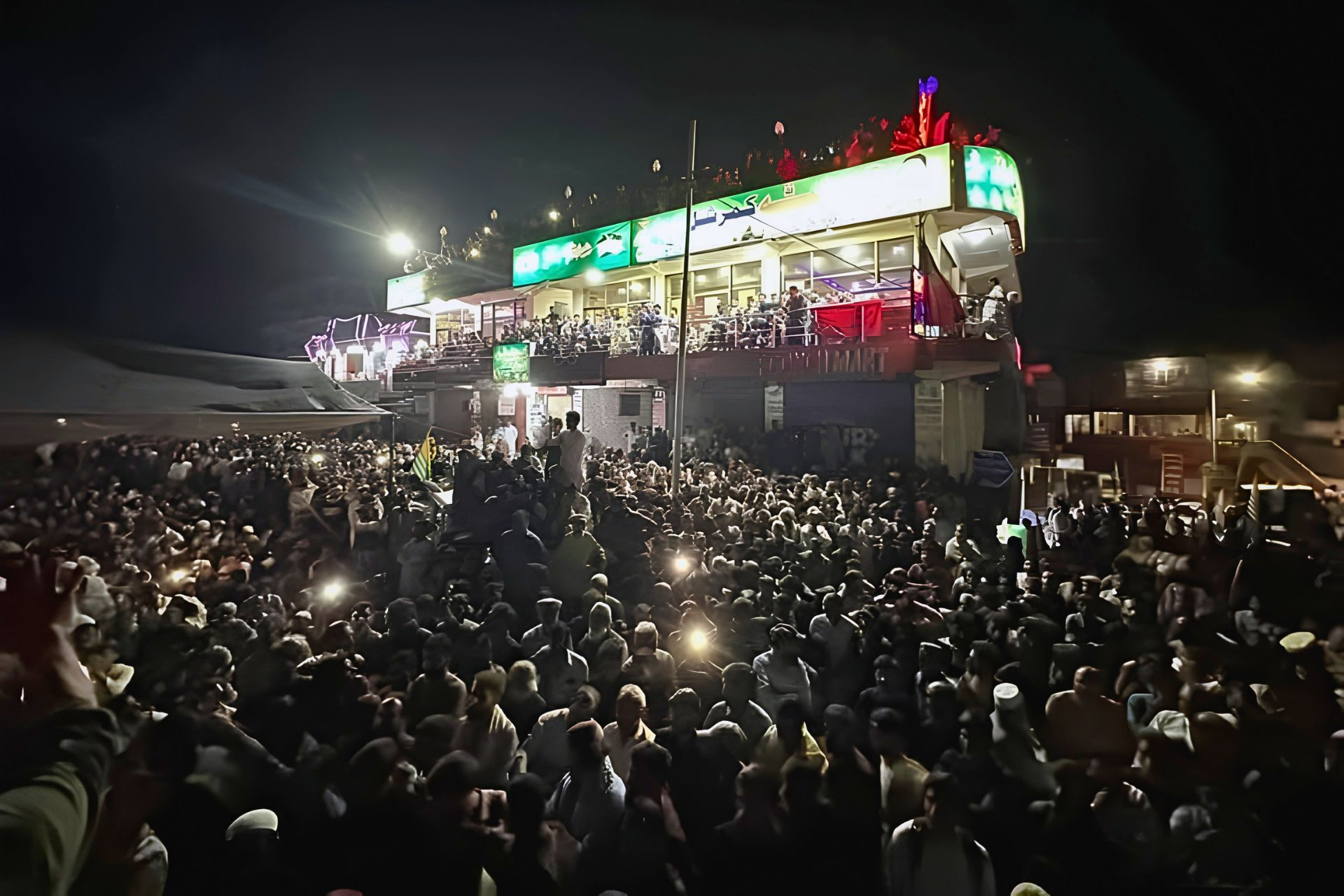
On the night of Friday 5 June, one of the central leaders of the Awami Action Committee (AAC) in Azad Kashmir, Sardar Umar Nazir, was attacked in an assasination attempt near Rawlakot. He narrowly escaped as the bullet hit his ear, while an AAC activist, Shahzeb Habib, was martyred.
Earlier that day, the government of Azad Kashmir, on the dictates of the Pakistani state, announced a ban on the AAC and all its activities, declaring it a terrorist organisation which is spreading anarchy. The government also shut down internet services, and may potentially extend this to phone services.
After the assasination attempt, hundreds of people immediately reached the CMH hospital in Rawlakot and started protesting against the state repression. The protest continued until the next day, and other protests against state repression have erupted in cities across Azad Kashmir. In response, police and paramilitary forces have abducted more than 70 activists in different cities. This further enraged the masses, and in some places, people freed the abducted activists from police custody, while raising slogans against state repression.
In an audio message the next day, Umar Nazir appealed to the masses to remain calm in the face of provocations by the state, aimed at drowning this movement of millions of people in violence and bloodshed. He instead called for peaceful protests. He also accused the Pakistani state of orchestrating the assassination attempt on him, through the paramilitary forces sent from Pakistan a few days earlier, which include personnel from the Rangers, Punjab constabulary, and the Frontier constabulary.
In the previous long marches held in the last three years, these paramilitary forces have killed more than ten activists and have injured many more. In the last long march, when local police refused to open fire on the protesters, these paramilitary forces killed some local policemen in retaliation.
Umar Nazir also pointed the finger of blame at the ISI (Inter-Services Intelligence) and the other secret services in Pakistan, which are controlled by the army and which have their own parallel security apparatus for crushing mass movements. He demanded that all those people involved in this crime should be exposed and brought to justice.
Later on in the day on 6 June, all entry points to Azad Kashmir from Pakistan were blocked by the people, and there were powerful strikes in many cities including in Rawlakot. The AAC leadership has announced the protests will continue until all their demands are met.
9 June long march to Muzaffarabad
AAC-Kashmir has announced a long march towards the capital city of Muzaffarabad, starting from 9 June, to press for the fulfillment of its charter of demands. Despite three previous long marches, and several promises by the government, this has still not been completely fulfilled.
Preparations for the long march had been in full swing for several weeks, and it had become evident that this would be the biggest one yet. More than a million people will participate and press for their demands, with a sit-in in front of the parliament in Muzaffarabad.
Local committees in all parts of Azad Kashmir had been holding preparatory meetings in which fiery speeches and revolutionary slogans reflected the defiant mood of the people. The revolutionary slogans at these meetings were mostly led by the Halla Bol team of the comrades from the RCP in Kashmir, led by comrade Umer Riaz. These slogans electrified the whole atmosphere. A rebellious mood was expressed at meetings of hundreds of activists.
The AAC had previously won huge victories, including a more than 90 percent reduction in the price of electricity, and a more than 50 percent reduction in the price of wheat flour. The AAC has also demanded an end to the luxury lifestyle of bureaucrats and politicians on public money, as well as free healthcare and education for every citizen. They are also demanding either guaranteed employment or else an unemployment allowance for all.
One of the major demands of the AAC for this long march has been to remove the twelve seats in the assembly reserved for refugees who migrated to areas in Pakistan at the time of and subsequent to partition in 1947. The AAC believes that the current generation of these refugees have now become citizens of Pakistan and can express their voting rights there, whereas in the Azad Kashmir assembly, these seats are a major source of corruption and the planting of the puppets of the Pakistani ruling class through fraudulent elections.
In fact, the rottenness and obsolescence of the whole assembly in Muzaffarbad has been exposed by this mass movement, which the state authorities have declared is acting as a parallel authority. The AAC has a democratic structure in which elected representatives make all the decisions, from the local villages and towns to the district and central level.
The core committee of 31 members, also called the Joint AAC, consists of three representatives from each of the ten districts and one central coordinator. It is true that the AAC is developing as a parallel force to the departments of the state, including the district administration and even the police in some places.
The reason is quite simple. The state institutions are corrupt and rotten to the core, and people place no hopes in any of them. In fact, these institutions are a source of constant humiliation and repression for the common people, while for the ruling elite these intuitions are a source of protection and glory.
In the last three years, the AAC has spread to far-off areas, and in preparation for this long march many new AACs were formed in new areas, as more people continue to join with enthusiasm and revolutionary zeal.
The AAC has also exposed the rottenness of all the parties on the political horizon, which are important tools that the ruling class uses to control the masses. All these political parties have the same agenda of loot and corruption, and of following the dictates of the ruling class.
That is why, when an alternative platform was offered, people embraced it wholeheartedly and rejected all the parties. For the last three years, the leaderships of all these parties have buried their personal differences when it comes to the looting and plundering of resources, and have jointly attacked the AAC. Nevertheless, at every occasion the people have rejected them.
This conflict between the AAC on one side and all the political parties in Azad Kashmir on the other side has now come to a show down as this long march is planned on the eve of the general elections. Just one day before the assasination attempt against Umar Nazir, the election schedule was announced, and it was declared that the process would begin on 9 June, with polling to be held on 27 July.
This announcement clearly showed that the government has completely rejected the demands of AAC for electoral reforms, for which various negotiations had been held between the two parties. This then means that two parallel forces now exist in Azad Kashmir: on one side the AAC, which has the mass support of a huge majority of the population, expressed many times through long marches and general strikes; and on the other there are political parties including the ruling PPP, PML(N), PTI, JI, MC and others, who have lost all mass support across the board.
On several occasions, we’ve seen how they have failed to attract people to their rallies and meetings. Despite frantic efforts, all their efforts were met with big failures. But despite these failures, the state authorities want to impose these rotten parties once again on the whole population through a farce of an election, after which a new government will be imposed and declared to be representative of the people of Azad Kashmir. But this is becoming increasingly difficult for the state authorities. A showdown has begun.
On the part of the AAC, it has not declared itself a political party nor has it announced any political manifesto, as there are activists from various political backgrounds involved in this movement. In the beginning, when the debate about elections started opening a few months ago, the AAC hadn’t announced any position on them, but events have pushed it towards a position where it has to arrive at a clear standoff with the state on this question.
The AAC asked its activists not to participate in any activity related to these elections and anyone participating in the elections cannot participate in the activity of AAC. They declared that they will consider participating in the elections once their demands are met, including those that concern electoral reforms. They also announced a long march, starting on 9 June, when this electoral process was supposed to begin. This is a clear confrontation with the state, which wants to impose this farce of elections on the people while AAC is exposing the rottenness of the process, which will once again bring one of the corrupt political parties to power as a puppet of the ruling class, with no support among the masses.
This stand off is developing into a situation of dual power in which the AAC has the support of an overwhelming majority of the population and could take over the power but is not consciously moving towards doing so. On the other hand, the rotten state structure and the government have lost all support and legitimacy in the eyes of the masses. The state authorities are using every means to hang on to power and to crush the movement at all cost.
The attempted assasination of Umar Nazir is a clear sign that they will not hesitate in order to achieve their goal. Furthermore, a poisonous campaign has been unleashed in the Pakistani media against the AAC. All the top journalists, ministers and other corrupt politicians are spitting poison at this mass movement. They are declaring it to be a conspiracy sponsored by India and are calling these peaceful activists terrorists. The real terrorists and enemies of the people are these corrupt ministers and media personalities, who are using every trick and lie to sabotage this movement.
The Inqalabi Communist Party (RCP) in Kashmir has been actively participating in this movement from the first day. In fact, the comrades of the RCP built the first AAC in the small town of Khaigala near Rawlakot, from which it spread to other towns and districts.
On Friday 5 June, a preparatory meeting was held successfully in Khaigala in which comrades of the RCP played a leading role. Umar Nazir also addressed this meeting. Leading comrade of the RCP, Yasir Irshad, who has addressed AAC meetings almost on a daily basis in the past month, was one of the main speakers.
Umar Nazir was attacked by the police while returning from the meeting. This meeting expressed the defiant mood of the participants and their determination to win all the demands from this long march. There was also discussion on the question of taking power and the role of the bourgeois state. In fact, these discussions have been carried by the comrades of the RCP into every meeting of the AAC for the past year, and this debate has developed among wide layers of activists.
The RCP in Pakistan is taking the enthusiasm and energy of this movement to various cities across the country and is organising meetings to discuss the lessons of this movement and how the workers and students of Pakistan can support it.
The way forward, however, must be a joint struggle of the people against the repressive Pakistani state and its imperialist masters. In its essence, it is a struggle to overthrow capitalism, which is the basis of this state and of all the problems faced by the masses. The RCP is building its forces to overthrow this system. One of our comrades, Ehsan Ali, who is imprisoned in Gilgit, in fact launched the first AAC in Gilgit in 2014 and led a mass movement there towards victory. This movement later spread to Kashmir through the comrades of the RCP.
It is quite possible that in the coming period, this movement in Kashmir will spread to all parts of Pakistan. Just as the rivers descending from the mountains of Gilgit-Baltistan and Kashmir fertilise the lands of Pakistan, so this mass movement can spread to these regions and develop into a mass revolutionary force that will fight a final battle against the ruling class of this country and overthrow capitalism through a socialist revolution.
The RCP is working towards its goal and is determined to face all difficulties in our way.
Long live the AAC in Kashmir! Forward to victory!
Fight against the repression of the Pakistani state in Kashmir!
Arrest those involved in the assasination attempt on Umar Nazir!
Release all the arrested activists of the AAC!
Death to capitalism!
Long live communism!
Workers of the world, unite!

