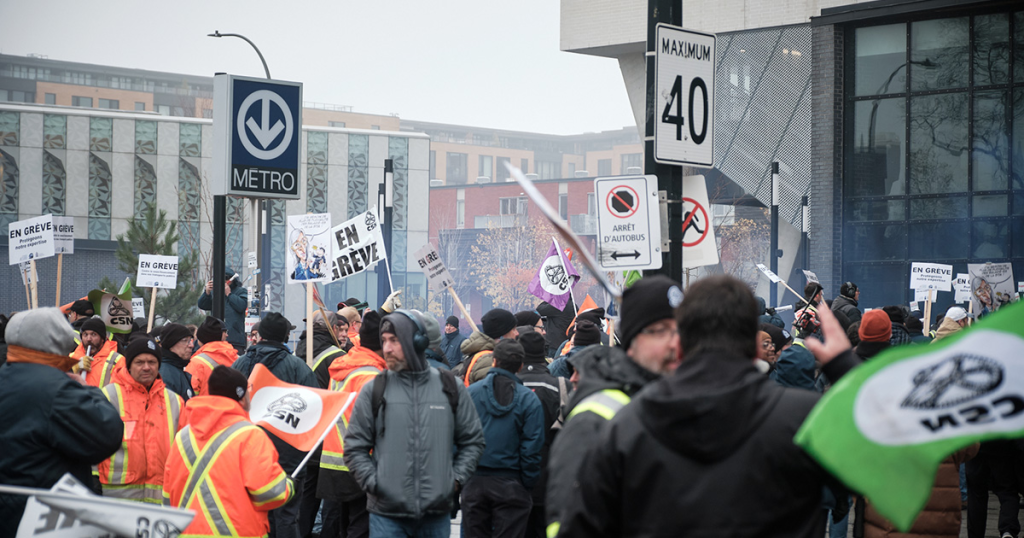
Bill 3, introduced by the CAQ, represents a significant attack on the Quebec labour movement. Under the guise of promoting democracy and accountability in union finances, it actually represents a scandalous meddling by the bosses in how workers manage their organizations. However, it raises an important question: should unions have a political role, or stick to “economic” struggles?
What is Bill 3?
Bill 3 will require union dues to be divided into “core” and “ optional” dues. These “optional” dues are those that pay for legal challenges, advertising campaigns, and any participation in social movements, “including those of a political nature.” Expenditures using optional dues will require additional votes at general assemblies.
The government’s stated reason is “to improve governance, democracy, and transparency in unions.”
In practical terms, optional dues will mean that each union local will decide on a case-by-case basis whether to contribute to a particular political expense of its union federation. The ability of union federations to participate in social struggles and issues that go beyond the immediate scope of collective bargaining will therefore be limited.
In addition, the bill will also create transparency and disclosure requirements for union finances.
Union leaders have denounced the administrative burden that such obligations will place on small union locals with limited resources. In fact, this is certainly one of the hidden objectives of this law: it will make unionization less attractive in small workplaces.
The CSN also notes that it already publishes its financial statements on the web—in greater detail than the government!
Furthermore, far from giving members greater control over their union’s finances, this is likely to make unions even more bureaucratic, by increasing the burden of the administrative apparatus.
Far from promoting democracy in unions, the law will instead discourage member participation even further by adding administrative formalities to general assemblies, making them even more tedious and depoliticized.
Bourgeois democracy, bosses’ dictatorship
The hypocrisy of the CAQ and supporters of this legislation is staggering.
The party that claims to teach lessons in “democracy” is the same party that would lose all its seats if elections were held tomorrow. The same party that presumes to lecture unions on “transparency” is incapable of explaining how it managed to spend $1 billion on a website with the SAAQclic scandal.
The political expenditures of the bourgeoisie, however, are not subject to votes in general assemblies. The wealthy spend lavishly and without transparency to buy the political class. Corruption scandals, whether they involve “sponsorships”, “brown envelopes” and revolving doors, “$200 ministers” or more recently “vote-for-cash”, keep happening.
Even such direct corruption is often unnecessary for the bourgeoisie: they only need to make a phone call to their “old buddies” or visit their golf club to get the ear of ministers, judges, and senior officials.
Bosses also don’t need to pay for political advertising campaigns in major newspapers to promote their interests: they own the major newspapers. The columnists at the Journal de Montréal know very well who is buttering their toast.
We can safely bet that there will never be a law requiring transparency in the finances of the Quebec Construction Association, nor imposing conditions on the “political” spending of the Business Council.
The business, political, and journalism circles are like a stinking swamp where incestuous relationships flourish—not everyone always agrees, but when it really matters, they all defend the same class interests. It’s a small club, and workers aren’t invited.
In reality, the “democracy” we live in is more like a “dictatorship” of the capitalists. It’s a law as reliable as gravity: no matter which party is in power, they will always ensure that the interests of the bosses are protected. The only choice workers have is to decide which clique of bosses’ lackeys will take power.
The very reason for the existence of unions is that workers must come together and organize collectively in order to stand up to employers who control the government and the media. Bill 3 aims to weaken this tool of workers’ self-defense.
Economic or political role?
An underlying argument made by supporters of Bill 3 is that the role of unions is purely economic. “The core mission of a union is training, representation, and negotiation. Anything peripheral to that becomes optional,” explained Labour Minister Jean Boulet.
This argument does not stand up to scrutiny.
Just last month, the CAQ threatened to force striking Montreal public transit employees back to work. In recent years, at the federal and provincial levels, governments have intervened on the side of employers to break strikes by postal workers, flight attendants, dockworkers, railway workers, construction workers, etc. This is not to mention cases of threats of intervention to break a strike, as in the case of the Quebec City public transit strike this summer.
The CAQ cannot claim that economic struggles are solely a matter for unions and employers when it systematically intervenes to break workers’ strikes, and has even just passed a law, Bill 14, to make it easier to break strikes. It is the government itself that proves that workers’ economic struggles are political in nature.
Similarly, it is clear that unions are involved in all aspects of political life. Currently, the government is pursuing austerity measures that are cutting jobs and damaging workers’ conditions.
For example, the CAQ cannot seriously claim that austerity does not concern the Montreal public transit workers’ unions, when it was the chronic underfunding of public transportation that pushed them to go on strike.
Similarly, the Santé Québec reform, which has led to significant administrative restructuring, has had a considerable impact on nurses’ working conditions.
More generally, it is the working class as a whole that pays and suffers the consequences of budget cuts.
The same goes for the issue of freedom of religion: it is an open secret that the spark that prompted the CAQ to adopt Bill 3 was the legal challenge to Bill 21 (the so-called “law on secularism”, which discriminates against religious minorities) by the FAE teachers’ union. Rumor has it that this angered the CAQ bigwigs. But it makes no sense to argue that it is not part of a teachers’ union’s role to defend its religious members against discrimination.
The division between political and economic struggles is entirely artificial. Workers’ struggles constantly come up against a political wall, and their economic conditions are constantly affected by political decisions. The reason for this is quite simple: as said earlier, the government serves the interests of the bosses.
A popular bill?
According to a Léger poll, 40 per cent of Quebecers support this reform of the labour union system, while only 16 per cent oppose it. This is not surprising. The same poll reveals that 54 per cent of those surveyed have an unfavorable opinion of labor unions.
Faced with negative opinions about unions, the usual response from union leaders is to complain about the negative image of unions portrayed by the media.
It is certainly true that right-wing columnists make a living out of scandals in the unions and seize every opportunity to attack them. For example, Quebecor media made a big deal out of a boozy evening enjoyed by FTQ-Construction leaders at their members’ expense, with $30 glasses of whiskey and $80 steaks.
During her appearance on Tout le monde en parle (Quebec’s biggest talk-show), FTQ president Magali Picard dismissed these criticisms out of hand. “Where there’s man, there’s mischief,” she said.
Indeed, we cannot expect unions to be pure—all institutions under capitalism are affected by a certain degree of corruption, careerism, and crookedness. Eighty-dollar steaks are a minor offence compared to what goes on behind the scenes in banks and government departments.
However, this does not explain anything. If these attacks resonate so strongly, even among union members themselves, it is because they contain an element of truth.
Above all, union members would be less likely to raise an eyebrow at the $30 glasses of scotch for union leaders if those leaders were truly fighting for their members.
But anyone who has been a union member has seen with their own eyes how disconnected union leaders are from their members. Unions, born out of the class struggles of the past, are now run by conservative bureaucrats whose lofty salaries and working conditions (per diem, company car, a working week that ends at noon on Friday, etc.) bear no relation to the reality of their members’ lives.
Bill 3 aims to weaken workers’ political mobilization. But it must be recognized that union leaders themselves often act as a barrier to political struggles.
For example, union leaders refused to challenge back-to-work legislation, limiting themselves to legal challenges in court that led nowhere. In the spring, when the CAQ announced drastic cuts to education, union leaders claimed that this struggle concerned parents and confined themselves to supporting it from a distance. Bill 14 was passed last May, came into effect on Nov. 30, and until the day before (!), no mobilization against it had yet taken place.
Often, union members learn about calls to action from the media rather than through their internal channels. As for general assemblies, they are often a routine and bureaucratic exercise that seems designed to discourage rank-and-file participation.
While workers’ living conditions are deteriorating, the bureaucracies at the top, with their comfortable careers, do not want to rock the boat too much.
In a revealing moment, Magali Picard, also on Tout le monde en parle, lamented that “in Quebec, we were the champions of social dialogue.” Indeed, union leaders had become accustomed to conciliation with management at a time when the latter could afford to “sit down” and “chat” with union leaders—and buy “social peace” through concessions.
But those days are gone, and union leaders have yet to wake up to this reality. The ruling class is waging a one-sided war against workers, and union leaders are allowing their members to be trampled on, constantly accepting cuts in working conditions and wages.
They are therefore rightly seen by their members as out of touch. It is no surprise, then, that many workers wonder what the point is of paying dues if it is just to send bureaucrats to Dubai to socialize with the elite at the COP, as Magali Picard did in 2023—in the middle of public sector negotiations.
Incidentally, it is quite telling that while the CAQ is launching two attacks on unions—one, Bill 14, which jeopardizes the democratic right to strike, and another, Bill 3, which jeopardizes union finances—it is the latter that is provoking a strong reaction from union leaders.
Warning shot
This law should serve as a warning to union leaders. It is only part of a widespread offensive against unions and against the working class in general.
We are entering an era in which all the gains made by the working class will be called into question. This bill, by attacking the Rand formula (the automatic deduction of union dues), a pillar of the industrial relations system established after World War II, shows that nothing is sacred to capitalists anymore. Everything is at risk.
All of this strongly highlights the political role of trade unions. We need union leaders that understand this.
Quebec unions have traditionally adopted a policy of “political neutrality” (which amounted to tacit support for the Parti Québécois). Today, this neutrality is untenable. Employers, for their part, have their representatives in parliament. As Marx said, the modern government is a committee for managing the common affairs of the bourgeoisie.
Bosses have their parties, and workers need theirs. The urgency of building a workers’ party is greater than ever.
The unions, as the largest workers’ organizations, have the resources to build such a party. Based on a class-based, socialist program offering solutions to the urgent problems of workers, such a party would be capable of defeating the bosses and capitalist austerity. The Revolutionary Communist Party will continue to defend this perspective, both inside and outside the unions.

