This article is the editorial for issue #25 of Communist Revolution. Subscribe here or order a copy of the new issue in our store.
The life of monopolistic capitalism in our time is a chain of crises. Each crisis is a catastrophe. The need of salvation from these partial catastrophes by means of tariff walls, inflation, increase of government spending and debts lays the ground for additional, deeper and more widespread crises. The struggle for markets, for raw material, for colonies makes military catastrophes unavoidable. All in all, they prepare revolutionary catastrophes. Truly, it is not easy to agree with Sombart that aging capitalism becomes increasingly ‘calm, sedate and reasonable.’ It would be more apt to say that it is losing its last vestiges of reason.
So wrote Trotsky in 1939, a few months before the outbreak of World War II. From those years of chaos and madness emerged a new world order, dominated by the American empire. Today, as this world order crumbles before our eyes, these remarks once again apply perfectly to the times. As then, it seems that capitalism “is losing its last vestiges of reason.”
The catastrophe resulting from the war waged by the United States and Israel against Iran was entirely predictable. Months beforehand, experts had described, with varying degrees of accuracy, the scenario the world now finds itself in: the closure of the Strait of Hormuz triggering a major energy crisis, the political strengthening of the Iranian regime, the resilience of Iran’s military capabilities, and so on.
But in the words of Ted Grant, a man standing on the edge of a precipice does not reason. Reason does not guide the American ruling class.
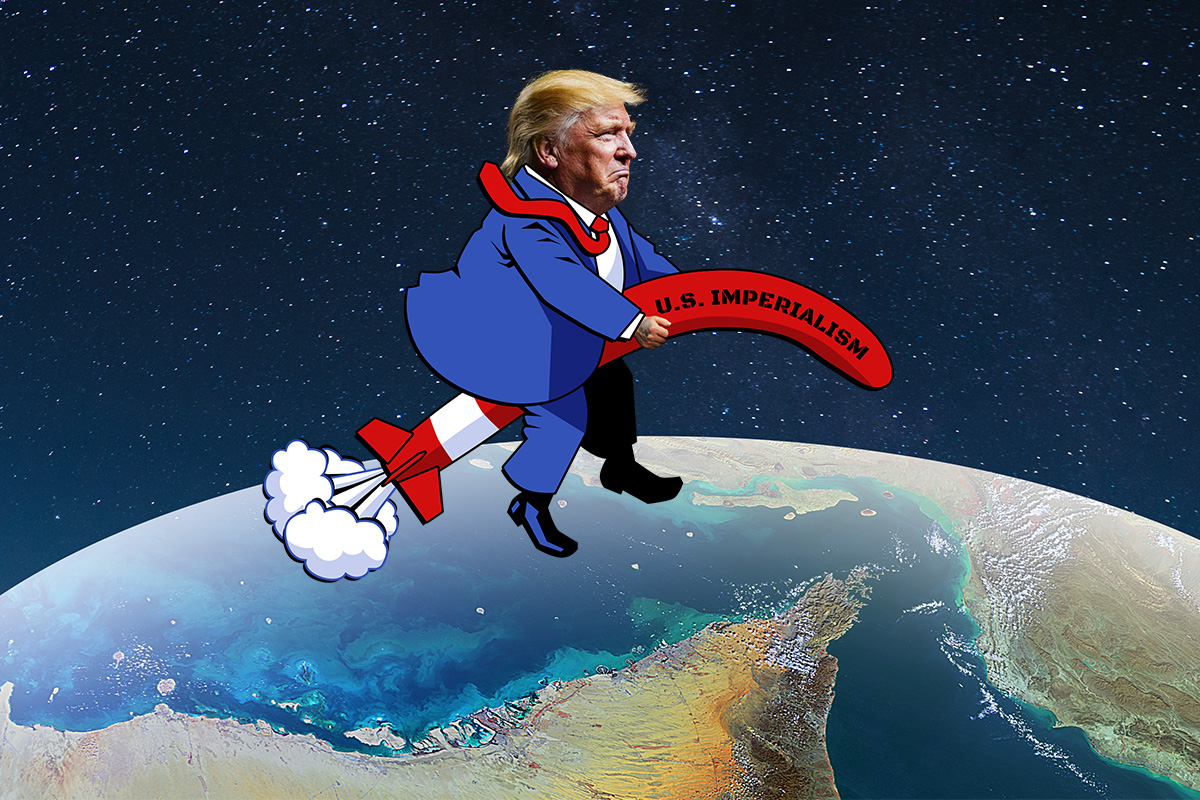
Trump’s promise to “Make America Great Again” represented an attempt to save the empire from its decline through forceful means. Trump believed that this decline was the result of the weakness of the political representatives of the American ruling class. America’s humiliations in Iraq, Afghanistan, and Ukraine, the industrial and technological ground lost (or at least the narrowing of the gap) relative to China—all of this, Trump believed, was the fault of the politicians at the helm of the empire. If only a strongman were to take the helm of the empire, he could turn it around—so Trump thought.
Many people believed it—not only his supporters, but also, ironically, many on the left. Indeed, from the perspective of certain left-wing groups, we have entered a reactionary period with Trump’s return. But this amounts to accepting, from the opposite side of the political spectrum, the same premise that drives the MAGA thesis: all that was needed to revive the American empire—the most reactionary force on the planet—was a strongman, and Trump is that strongman.
But the U.S. adventure in Iran is exposing the utter fallacy of this idea. The man who promised a quick victory—and who was elected on the promise of ending endless wars—is now unable to extricate himself from a disastrous war without conceding a strategic victory to Iran. The empire’s weakness is laid bare for all to see, and the so-called strongman is powerless to do anything about it.
Trump is less the Führer conqueror and more of a furious blunderer. The war is turning into a complete humiliation for American imperialism and for Trump personally. The Lego-style videos released by Iran, which mock Trump and the “Epstein regime” and have been viewed by billions of people, only rub salt in the wound.
One can sense Trump’s panic and frustration. His public statements are even more incoherent than usual. His angry outbursts on social media against former MAGA supporters who have abandoned him and are speaking out against the war (such as Tucker Carlson, Joe Rogan, and others) carry a note of bitterness and despair. Far from forming a strong, confident MAGA movement, Trump’s base is reeling and splintering.
Trump is like a man trapped in quicksand, flailing desperately and sinking all the faster. He thought he could restore the empire by force, but instead he is accelerating its decline.
In reality, this decline is inevitable, and it began long before Trump. Whether he kicks up a fuss or stays calm, he won’t be able to change a thing. The decline is not the result of the political leadership at the helm of American imperialism, but a product of the economic system upon which this empire is built.
Lenin described imperialism as the reign of monopolies, and the United States is the land of economic giants par excellence. Huge banks, tech giants, and other multinationals act like parasites, weighing down and feeding off the living body of society. They siphon off a massive proportion of national output in the form of profits, corruption, government handouts, etc.—staggering sums that serve to pamper a layer of greedy, idle profiteers rather than to develop the country’s productivity, educate its people and keep them healthy, build infrastructure, and so on. Such a cannibalistic system is bound to collapse sooner or later.
The global capitalist system is sinking deeper into crisis, and the American empire, as the nerve center of global capitalism, rises and falls with that system.
Overproduction, inflation, unemployment, public debt—every measure taken by the ruling class since the Great Recession of 2008 has only served to destabilize yet another aspect of the economy, and “lays the ground for additional, deeper and more widespread crises,” to return to Trotsky’s quote. War against Iran risks being the spark that sets the powder keg ablaze.
Many people have been demoralized by recent events. One can sympathize with that feeling when one looks at the horrors unleashed upon the world. Genocide in Palestine, the kidnapping of Maduro, the blockade of Cuba: at first glance, it seemed that U.S. imperialism was pushing forward with its reactionary agenda unopposed.
But this renewed strength of the empire was merely a temporary reprieve. Now, the United States’ humiliation in Iran sends a message to the entire world that the empire is weaker than it appears. The colossus has feet of clay. In capitals around the world, ruling classes are reevaluating their relationship with the United States. There is blood in the water.
The working class would do well to grasp the significance of the moment. Those in power are not as powerful as they seem. The capitalists—the so-called “Epstein class”—preside over a senile system. They are merely a minority, and they are hated. And through their actions, they are paving the way for “revolutionary catastrophes.” It is up to us to prepare for them.

