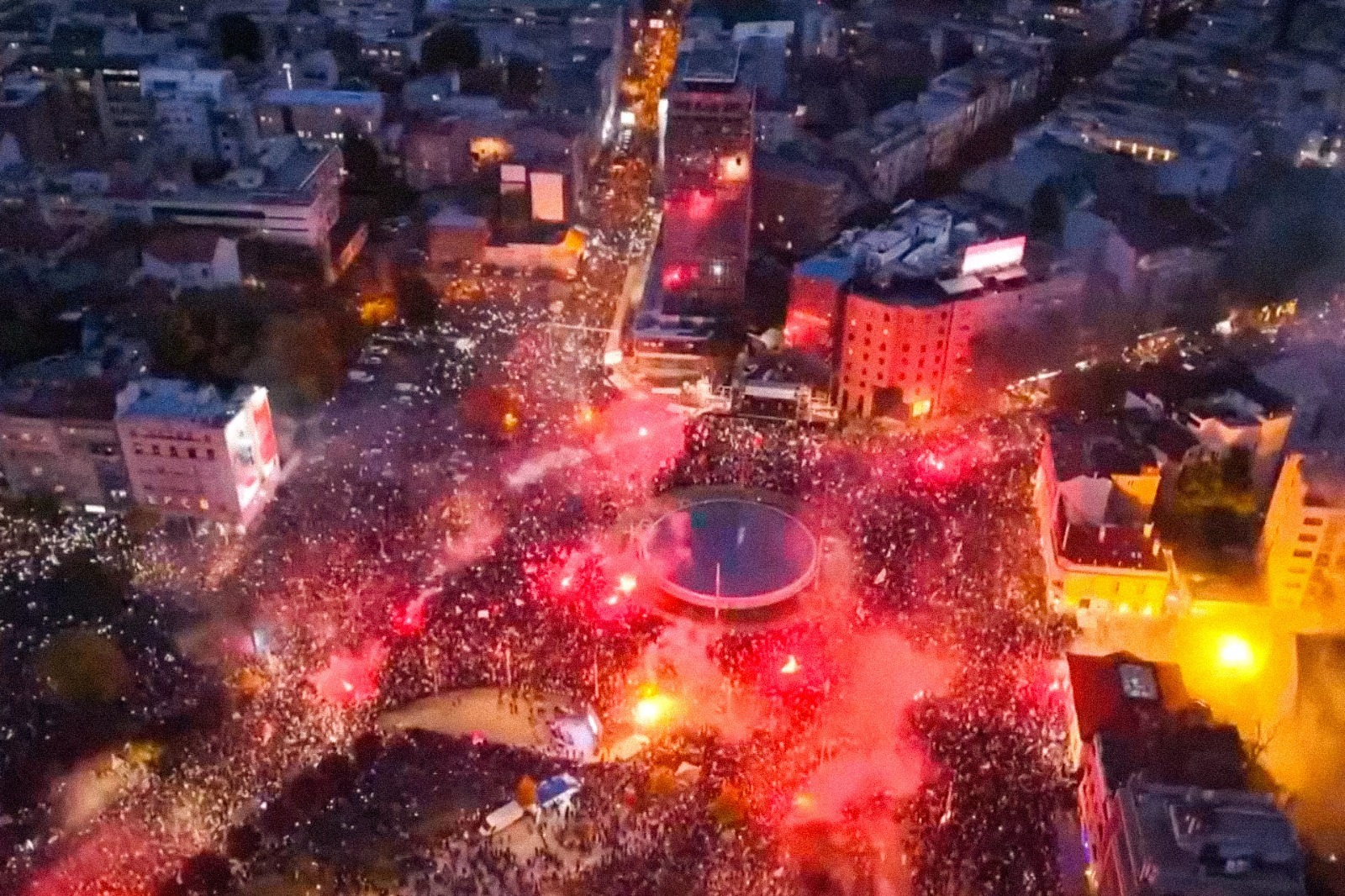
The 25 October election marks a qualitative change in Serbia, a political earthquake feeding into the shockwaves reverberating throughout the Balkans.
The student-appointed list ‘Student list – Students Are Winning’ (SL) triumphed with a staggering 52.7 percent of the votes (conquering 141 seats), while the ruling party, Aleksandar Vučić’s SNS, scored just 39.2 percent (103 seats), in what can be described as a referendum against the regime. Voter turnout hit 70 percent.
This was not just a mere election, but the culmination of a prolonged mass movement defying the power of Vučić’s entrenched regime, which had embedded itself in every root and branch of the Serbian state and society over 14 years in power.
Jubilant scenes saw hundreds of thousands erupting in collective celebration across the country immediately after Vučić had acknowledged defeat. These celebrations tell the story of a long and bitter struggle led by the Serbian youth for over two years with broad mass support, defying slander, provocations, vilification, intimidation, state repression and direct violence by the SNS’s hired thugs. Tens of thousands continued to celebrate the next day.
However, despite the euphoric mood, a significant section of the movement correctly understands that, whilst Vučić’s defeat represents an important first step, the regime is far from being destroyed. Instinctively, they are striving to take advantage of the momentum the mass movement has gained to strike decisive blows against the regime and its hated props.
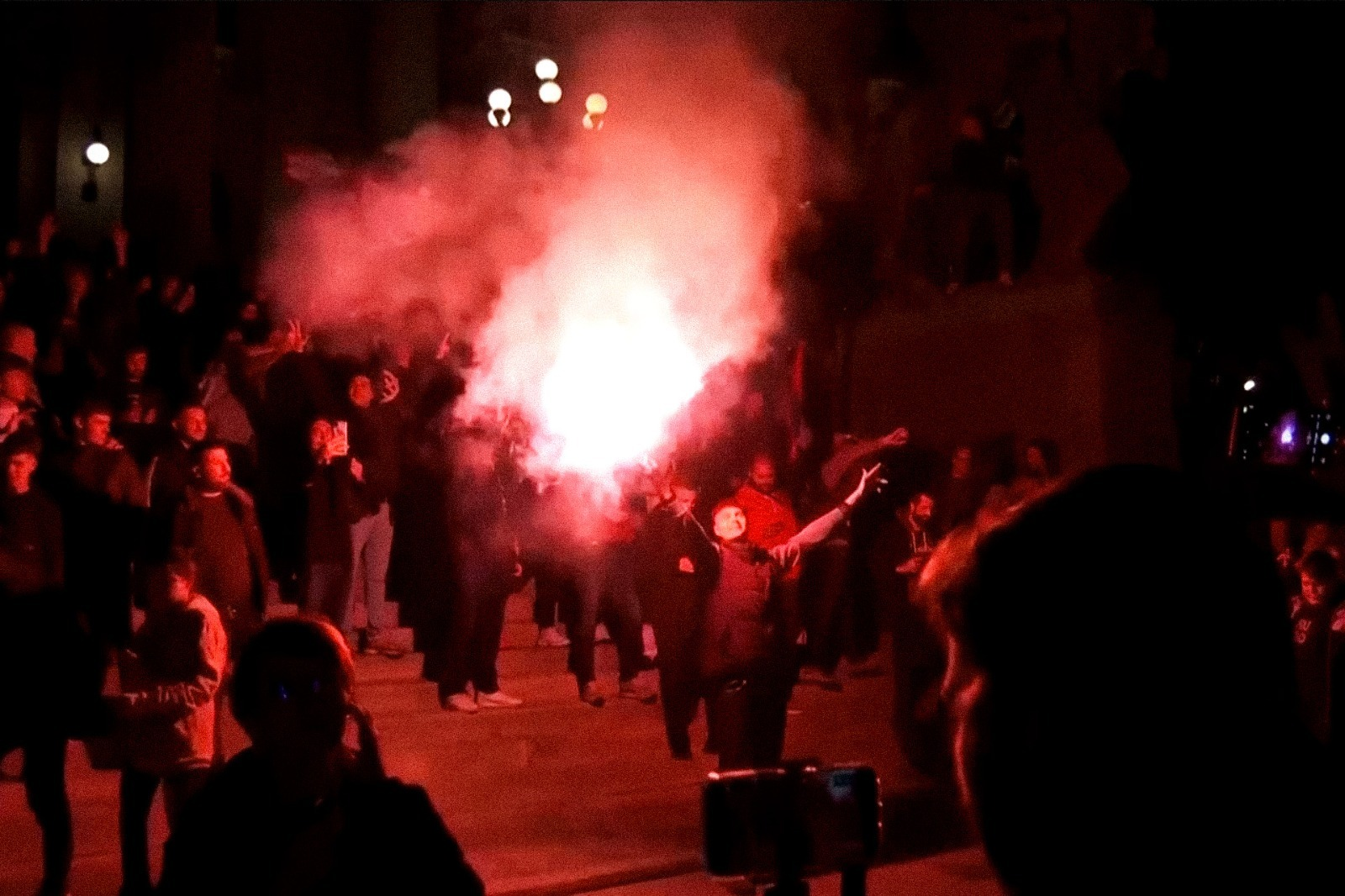
The most striking example of this revolutionary mood, on the very election night, was the mass action clearing out ‘Ćaciland’. This camp had been held for over a year right in the centre of Belgrade by regime loyalists, armed thugs, crooks and assorted provocateurs, and had been the source of endless provocations and attacks, protected by heavily armoured anti-riot police.
Thousands headed straight towards Ćaciland with the intention of wiping out the camp. They were joined by a growing number of people as the news started to spread. Any attempt at a direct intervention by the riot police would have been overwhelmed, resulting in more oil being thrown on the fire. Instead, they stood down and retreated.
On the following day, protesters stormed the Belgrade offices of the infamous pro-government broadcaster Informer, interrupting its live broadcast and confronting its editor-in-chief.
Vučić claims that this was an attack on ‘free speech’, but it represented a healthy reaction from the movement against the ‘freedom’ allowed to a few entitled and protected goons to slander and fabricate fake news – a ‘right’ that they have abused for years with total impunity to support an increasingly desperate, rotten political regime.
The Independent Association of Journalists of Serbia said in a statement that it would submit an application to have Informer TV’s broadcasting licence revoked, citing systematic violations of the law and programme obligations. This struggle applies to all mass media to one degree or another, starting with the pro-Vučić Pink private media group, but also the state-owned RTS.
‘Vučić ode’ – ‘Vučić Is Gone’
What is the meaning of these events? A section of the movement correctly realises that the electoral defeat of the SNS does not mean that the regime has been uprooted. Its power base is shaken, but it must be destroyed by revolutionary means. Any complacency on this point means allowing the reactionary forces time to regroup, entrench themselves in defensive positions and regain the initiative at the first opportunity. They can rely on the deep network of support they still have from the darkest recesses of Serbian society and the state.
What has been happening in Serbia around this election is not ‘normal business’ – it is closer to a revolutionary upheaval.
This hasn’t been a fair election, even by the twisted standards that define ‘fair’ elections in advanced capitalist societies. There too, the rules of bourgeois democracy are nevertheless bent in favour of the ruling class, and all mass media is controlled by the capitalists. Everyone with eyes can see how, for example in Germany or France, the ‘law’ is bent to allow extremely unpopular governments to stick to power for years, regardless of massive opposition. At the same time, they pass reactionary legislation, like criminalising protest and the class struggle, and recklessly lean on state repression against widespread revolt.
But elections and the normal running of society are still carried out according to certain rules.
In Serbia, extremely unfavourable conditions were imposed on the Student List’s ability to contest elections, let alone to win them. They could be won only by means of an overwhelmingly powerful mass mobilisation.
So, why did Vučić decide to call for these elections? He probably thought he could take advantage of the two-year-long fatigue accumulated by the mobilised youth and the masses supporting them. His call for a snap election left just over a month for the movement to organise and carry out the election campaign, with almost no access to the mass media.
On the other hand, there had been meticulous preparation by the SNS election machine, based on a consolidated mix of corruption, threats and blackmail. Vučić was hoping he could pull this off, but he catastrophically miscalculated the real mood in society. His bet backfired.
The mass movement was galvanised as soon as it became clear that there was an opportunity to deal a decisive blow to the regime. As the date of the election approached, it became increasingly visible that Vučić’s base of support was becoming demoralised, while the mass movement was gaining strength as it pushed back provocation after provocation.
However, the result left no room for doubt.
Mass mobilisation
The SL election campaign mobilised student-led caravans to reach every village and town in the country. While mainstream media, including RTS (the state-owned broadcaster), almost completely ignored the Student List throughout the campaign, tens of thousands of supporters of the SL went out to listen to the concerns of ordinary people, knocking on every door.
An important part of the SL programme is the struggle against corruption, which resonates with the mass of the youth and the working class. They have seen firsthand the rise of thieves, looters, and crooks, who have become wealthy and powerful under the regimes that followed the breakup of Yugoslavia, and the increasing inequality that has resulted. This is something that must be reversed.
Their programme also poses the question of drastically increasing the resources for education, healthcare (a doctor in every village), and social housing, as well as raising the minimum wage, among other things.
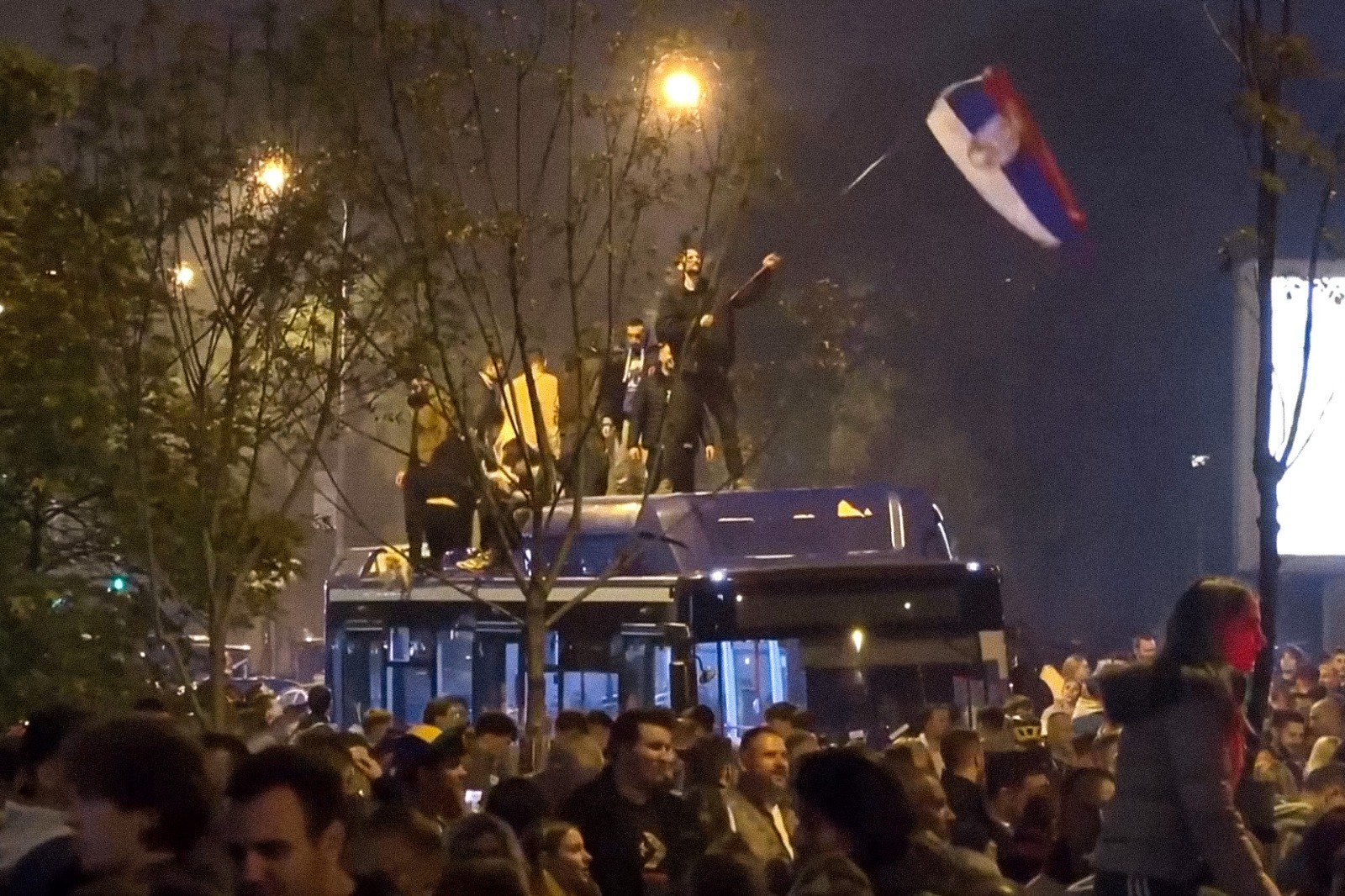
It is clear that the mobilisation of the masses against the regime was key to achieving the election victory – and its significance goes beyond the staggering result. This show of strength was also instrumental in hammering home the fact that any attempt not to recognise the result would have been met with a revolutionary upsurge.
The mobilisation for the election rally on Friday 23 October, which saw 150,000 fill the streets and squares of central Belgrade, was comparable in size and energy to the monster demonstration on 15 March 2025, which brought hundreds of thousands onto the streets. 23 October was a true display of mass defiance, which has been a constant element in all the mobilisations over the past two years. On the other side, Vučić addressed a few hundred supporters in a sports hall, making the contrast even more graphic.
Mass action also took centre stage on election night itself. On Sunday evening, tens of thousands mobilised to push back against possible attempts to steal the election. This massive mobilisation was clearly the key factor forcing Vučić to concede defeat so early and abandon any plans the regime may have had to lean on the heavy buildup of riot police and loyalists around Ćaciland.
Despite serious threats, tens of thousands took to the streets, despite the calls by the lead candidate of the Student List, Ilija Srdanović, to stay at home. As pointed out, mass action successfully cleared Ćaciland – the riot police were presented with the alternative between stepping back or provoking a mass revolutionary response.
The SL leadership has made repeated appeals for calm and for the masses to demobilise during and after the election. Without a clear revolutionary strategy, it is inevitable that the attempt to uproot the power base of the regime will be undermined.
However, the experience of the fact that once the masses are mobilised, there is nothing that can stop them will stay in the consciousness of those who have lived through these events. Should there be any serious threat to the sweeping change that is demanded and expected by the new government, these lessons will once again come to the fore.
What now?
It is our duty as communists to pose the question: what now?
As we pointed out, the SL election campaign could not have been waged, let alone won, without mass mobilisation. The student plenums – established in December 2024 – and the local mass assemblies (zborovi) – which erupted in the spring of 2025 – were emptied out over the past year because of fatigue as the mobilisations stalled. The election campaign revitalised and galvanised mass organisation in election action committees and other forms of self organisation. This is the source of the power and momentum of the present movement.
Faced with that, Vučić has had no alternative left but to retreat. But what is Vučić’s strategy now? What are the challenges posed in the transitional period between the election and a new government headed by the SL? When we come to that, what scenario will be facing the new government?
One thing can be said. It is likely that the transition could be dragged out by the SNS as long as they possibly can stretch it. By the rules, it could take up to 90 days, giving time to the reactionary forces to reorganise, bearing in mind that all the officials that were supporting Vučić’s regime are still in place at all levels of the state apparatus: police, secret services, army, judiciary, ministries and the public administration. Vučić’s camp is stunned, but they can fall back, entrenching their forces. The same crooks that have built their position and privileges supporting Vučić can use this time to hide their tracks, reposition themselves and attempt to impose conditions on the new government or work out an agenda of economic dislocation and sabotage – or both.
When forming the government and even before that, it is possible that the SL will be subject to enormous pressure from within the state apparatus, reinforced by imperialist pressure, especially from the European Union and the US. They will push for the SL to water down its programme, ‘be realistic’, and so on.
Their aim at first will be to tie the new SL government’s hands to respecting the sacred compatibilities of capitalism, above all, foreign investors. Von der Leyen and company will give their ‘friendly’ advice, promising EU integration. They have already demanded that Serbia adopt sanctions against Russia, a condition that would impose an extremely heavy toll on Serbia’s economy – and which the SL leaders are politely declining.
This may not become the decisive point of contention. However, at some point, should the SL government refuse to comply with EU demands and fall into line, the EU will show their teeth and change its tune.
We must be clear. The ‘civilised’ European powers are no friends of the Serbian people. They have supported Vučić throughout, and have no interest whatsoever in supporting an SL government that is carrying out significant reforms at a time when almost all European governments are inflicting damaging cuts to social spending while splashing money on rearmament and militarism. The whole of Europe is on fire as a consequence of this policy.
They will not tolerate substantial reforms being carried out in Serbia. They will attempt everything in their power to effectively prevent the SL government from carrying out their programme.
If one has any doubt, it should be enough to have a cursory look at the vicious role played by the so-called Troika (European Commission, IMF, and European Central Bank) in strangling the revolutionary upsurge of the Greek people, and the attempt by the Syriza government in Greece in 2015 to stop austerity and carry out modest reforms.
But a SL government won’t just have to face resistance from Brussels or Washington. We can add that it will be facing sabotage and resistance from the very heart of the Serbian state: the bureaucracy, the judiciary, and the security forces.
The question of the struggle against corruption, which is central, is posed by the SL leadership in purely legalistic terms. It connects with the idea that, in most cases, extreme wealth has been accumulated in criminal ways, by looting, corruption, and exploiting privileged positions in the state after the breakup of Yugoslavia.
However, we must be clear on this. The SL puts forward the dangerous illusion that a struggle against corruption can be carried out by a reformed Serbian state, when the state is precisely at the centre of this and has allowed the looting to continue for decades. This includes the judiciary, the security services, and the police.
Corruption is rampant in all capitalist countries, but has an even more structural role in a country like Serbia. It is an integral part of the system and cannot be fought by a state connected by one thousand threads – formal and informal – to the ruling class. Only an alternative power, based on the workers and youth of Serbia, can carry out such a struggle.
Carry the struggle to its conclusion!
So, what can a SL government do to carry out the radical transformation of Serbian society that is expected by the mass movement that swept it to office?
We have to bear in mind that reactionary powers appear to be strong as far as they can base themselves on the inertia of bourgeois society. If they were all-powerful, and it depended on them, Vučić would still be in place. The revolutionary mobilisation of the youth, the working class and the broader Serbian masses is the only force that can provide the power needed for a SL government to carry out its programme.
It is inevitable that the coming period will be defined by a contradiction. On one hand, there is a general confidence among the masses towards the SL government, based on the idea that the election victory has given legitimate power to the leaders of the SL to carry out their programme. Many in the movement are convinced that the SL should be granted time to deliver on that. On the other hand, sections of the movement will take direct action to accelerate the process of change. We will see surging mass action whenever the reactionary forces attempt to raise their head and threaten the process.
It is vital that in this process the zborovi and the plenums are revitalised, strengthened and consolidated, and that they sink roots into the mass of the working class, workplace by workplace. The election campaign showed that it is possible for the movement to reach every house, every worker, pensioner and young person in every corner of the country, and convince them to vote. The capillary organisation of the movement must be reaching all workplaces.
Only by strengthening the organs of alternative power can the radical transformation of society that is necessary be supported, defended, and carried out.
As communists, we are determined to carry out this struggle to its final conclusion.

