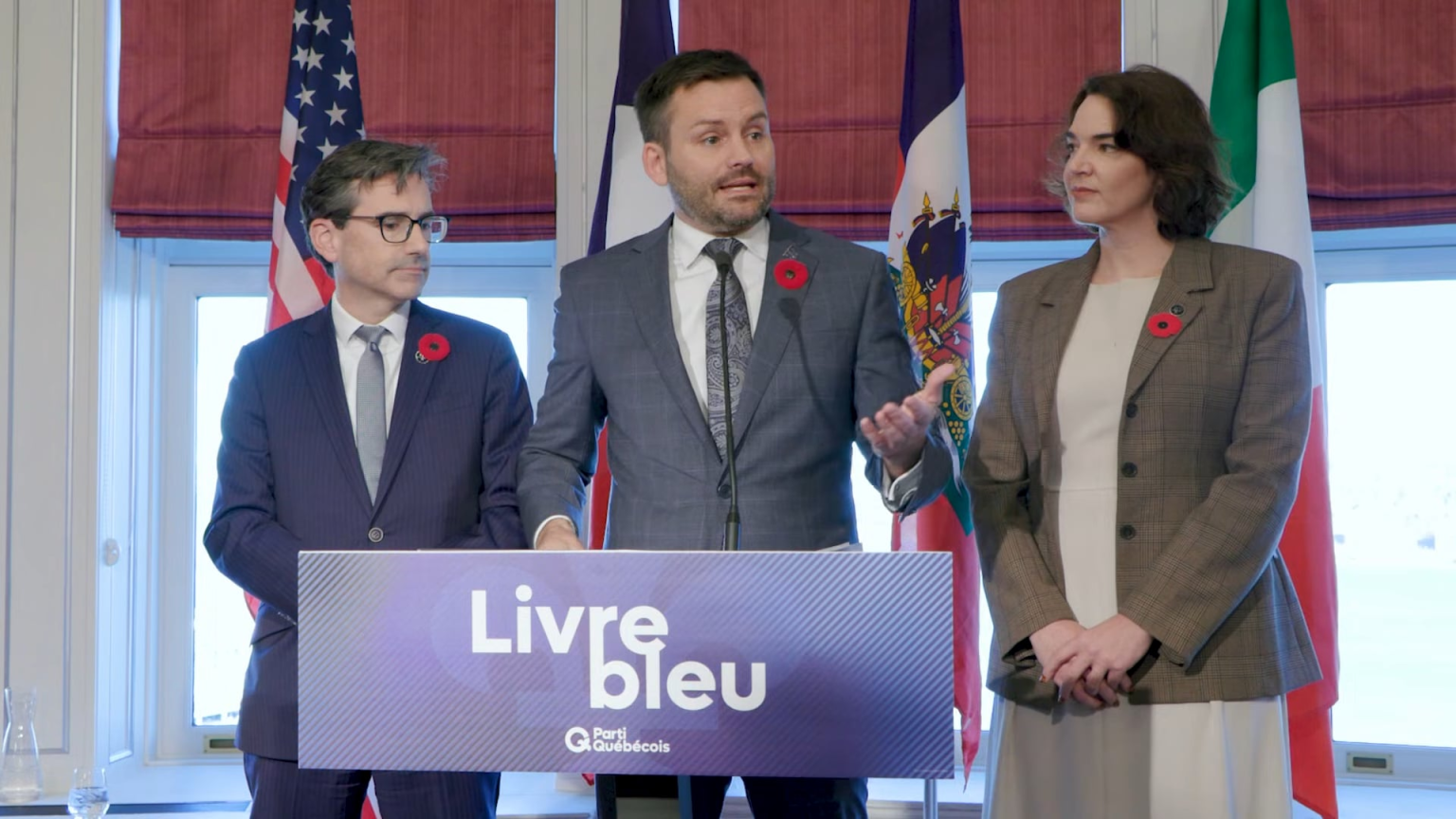
The Parti Québécois’ groveling to the U.S.
There was a time when the national liberation movement in Quebec was synonymous with opposition to Anglo-Canadian imperialism, but also to American imperialism. When Quebec’s national liberation meant taking power back from the powerful.
But there is no denying that the “sovereignty” of the PQ and its leader, Paul Saint-Pierre Plamondon (PSPP), has nothing to do with any of this.
Loyalty to the United States
Last November, PSPP stated that an independent Quebec should align itself with U.S. policies: “Our loyalty begins with the rest of Canada and the United States, which are our natural partners.”
Our “loyalty” to Canada and the United States? Is this really a sovereigntist speaking?
The party has also remained virtually silent on the invasion of Venezuela and the kidnapping of its president by the United States. They have limited themselves to platitudes, vaguely calling for “a peaceful solution that respects international law.” Yet it should be easy for a sovereigntist party to denounce such a flagrant violation of sovereignty.
Then, in response to Carney’s trade agreement with China, PSPP criticized him, saying that he was forming an “alliance” with a “totalitarian communist regime.”
PSPP justifies its complacency toward American imperialism by asserting that “there is no scenario in which our Quebec companies will cease doing business with our main partner, which is the United States.”
There is no denying that the Canadian economy, including Quebec’s economy, is objectively dependent on the U.S. market. To give just one example, 67 per cent of Quebec’s lumber production is exported to the United States. Even with tariffs, the United States remains Quebec’s largest trading partner by far.
Thus, beyond lofty principles about democracy in China, the PQ is motivated by economic considerations. As PQ MNA Pascal Paradis said, “Strengthening cooperation between Canada and China could reasonably be interpreted by the United States as a threat to its own security, with all that that implies.”
So, while Carney’s approach to the Trump monster is a futile attempt to seek allies, the Parti Québécois’ approach is to lie down on the ground, protect their head, and hope that the monster leaves us alone. It’s a case of picking your poison.
But we must be clear about the consequences that PSPP’s approach would entail.
Trump is openly threatening to destroy a number of Canadian industries, such as lumber and automotive, and wants to open up the Canadian market to a range of American products. How far will the logic of appeasing him go? Agreeing to hand over industries to the Americans, even if it means massive job losses (which have already begun)? Relaxing the supply management system that protects Quebec’s dairy sector?
Furthermore, at its convention in late January, the Parti Québécois promised that if Quebec became independent, the PQ would increase military spending in order to meet the NATO target required by Trump. Contrary to the $3.5 billion earmarked for defense in the PQ’s proposed “budget of year one” of an independent Quebec, such a newly independent country would actually have to spend at least $8 billion more, according to more recent estimates. And that would only be to reach the threshold of two per cent of GDP, while Trump and NATO now demand five per cent!
Where will these billions for arms manufacturers come from? The party does not dare say, but it would necessarily mean austerity for workers, similar to what we are seeing in Europe, and in Carney’s first federal budget.
Cynical lies about international politics, militarism, austerity, job losses, all to kiss up to the United States. That is PSPP’s plan for Quebec. With sovereignty like this, who needs national oppression?
A true national liberation
Many pro-independence activists must raise their eyebrows when the leader of the PQ talks about “loyalty” to the United States. That is certainly not what they have in mind when they talk about national liberation.
Ultimately, this approach is the product of the PQ’s narrow nationalist vision. As iconic Quebec labour leader Michel Chartrand said, there is a fundamental difference between nationalism and true national liberation. Nationalism is content to seek “what is best” for its nation in today’s world; it does not question the economic system, especially not beyond its borders.
Furthermore, nationalism presents “the nation” as an abstract whole, when in reality it is divided into classes. When nationalist politicians like PSPP say they are fighting for their nation, they are really fighting for the interests of their nation’s bourgeoisie. He said so himself in an interview: “I work for Quebec businesses.”
Canada and Quebec (whether independent or not) find themselves in an impossible situation. The idea of an alliance of medium-sized powers carving out a piece of sovereignty for themselves is particularly utopian for Canada and Quebec. They certainly cannot change geography, nor decisively reverse decades of deep economic integration with the United States.
This means, to quote Carney’s Davos speech, “the performance of sovereignty while accepting subordination” to the United States. It also means putting up with the worst manifestations of American imperialism instead of fighting them, and tough luck to the workers and poor people who suffer. In this imperialist system, their lives and livelihoods are chump change.
But this is not inevitable. Why do powers such as the United States use economic integration as a weapon? It is not just a question of geography. It is because we live in a world dominated by major capitalist powers that seek to maximize their profits, including by crushing other nations. This is the main obstacle to true national liberation.
The only way for workers to take control of their destiny is to fight to overthrow the capitalist system. By nationalizing the major levers of the economy and establishing a rational production plan with genuine democratic control, we would no longer be at the mercy of a small elite that speaks in the name of the “nation” but only has its own interests at heart. Instead of appeasing U.S. imperialism and cynically covering up its crimes, we would be able to call on workers south of the border to also overthrow their ruling class. This is the path to true national liberation.

