
The US-Israeli war on Iran and the subsequent closure of the Strait of Hormuz have created a crisis in the world economy and further exposed the fault lines between US imperialism and its Russian and Chinese competitors.
[Originally published at communistusa.org]
Closing the Strait and threatening other commercial routes, like the nearby Red Sea and Suez Canal, is having grave ramifications on the world economy, which was already on thin ice. Energy is essential to all industrial production, and the oil and natural-gas shock caused by the imperialist slaughter threatens to push the entire world into a deep economic slump.
‘World’s most vital waterway for energy’
The Strait of Hormuz is a 103-mile long passageway that narrows to 21 nautical miles. Iran controls over 250 miles of the northern coastline around the narrowest point, and 300 miles of coastline in the Gulf of Oman, which feeds directly into the Strait from the Arabian Sea.
The shipping lane is an indispensable node of world commerce. Prior to the war, 20 million barrels of oil a day flowed through this crucial artery, which the Financial Times called “the world’s most vital waterway for energy markets.” In addition to a fifth of the world’s oil and gas, a third of all fertilizer and countless other commodities passed through it daily.
Military analysts have dubbed the Strait “the gauntlet.” Any ship that passes through will be at the mercy of Iranian missiles, drones, torpedoes, submarines, and mines. In order to neutralize the threat, an invading force would not only have to capture the entire length of the coastline, but hold it against a military and population that would fiercely resist the invading forces.
Risk premiums on shipping insurance in London have leaped fivefold making passage not only potentially deadly, but more importantly for vessel owners, impossibly expensive. In reality, Iran has not “closed” the Strait. Select ships from countries not engaged in attacking Iran are being allowed through, and ships with ties to the imperialist attackers simply cannot afford insurance. The ball is in the imperialists’ court.
Oil crisis
Not only has Iran prevented all non-Iranian fossil fuels from leaving the Persian Gulf, it has struck production facilities in Saudi Arabia, Qatar, Bahrain, Iraq, Kuwait, and the UAE, which are all complicit in the war. In short, Iran has succeeded not only in disrupting the world energy market, but also in destroying energy production and export capacity in the Gulf States.
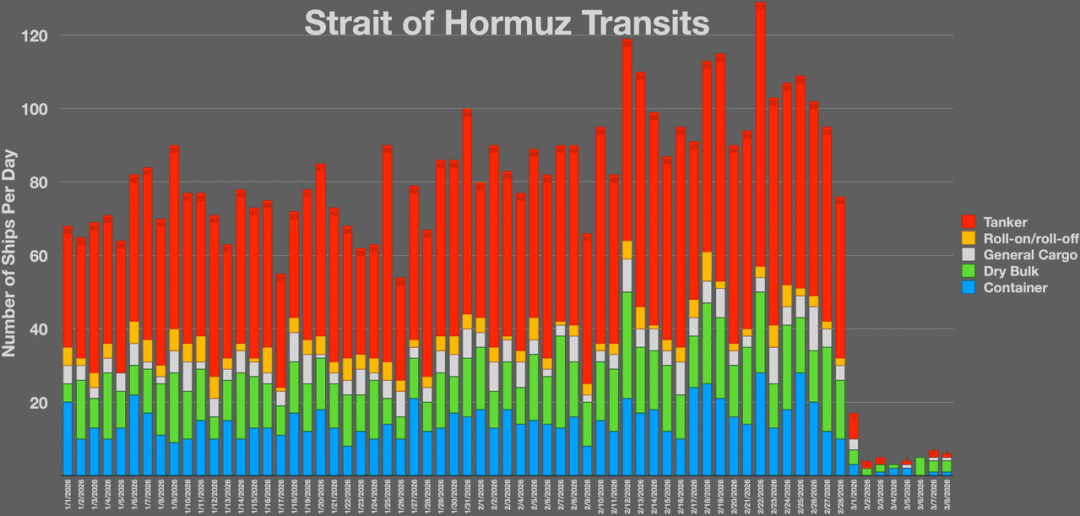
At least three large energy producers in the Gulf have declared force majeure, a clause in contracts allowing one party to suspend its obligations due to uncontrollable circumstances. As Bloomberg News reported: “It took just days for the Iran war to hobble oil fields, refineries and gas plants across the Persian Gulf, but it could take years to restore their full potential as the conflict drags on.”
The International Energy Agency (IEA) declared this “the largest supply disruption in the history of the global oil market,” bigger than the 1973 and 1979 oil crises combined. The 1973 crisis pushed the price of oil 300% above pre-crisis levels. At that time, less than 10% of the world’s supply was cut off by Gulf producers. Today 20% is affected. The price of Brent crude leaped about 60% in the war’s first four weeks. It will climb even higher as the war drags on.
Scrambling to control the market mania, the IEA—which includes the US—committed to releasing 400 million barrels from the strategic reserves of its member states. It’s the largest-ever release of reserves, more than double the previous record in 2022 at the beginning of the imperialist proxy war in Ukraine.
Significant as this may sound, strategic reserves can’t plug the gap. There are technical limitations to how quickly this oil can be delivered to the market. Besides that, 400 million barrels represents less than three weeks’ worth of what usually passes through the Strait.
The US imperialists launched this war in part to weaken China by cutting it off from Iranian energy. But their maneuver is backfiring. Despite consuming 90% of Iran’s oil exports before the war, China is weathering the storm. The Chinese ruling class—foreseeing the US imperialist assaults on Venezuela and Iran—stockpiled oil to supplement their own diverse domestic energy sources. At the same time, most of the vessels Iran has allowed to pass through the Strait of Hormuz are tankers transporting millions of barrels of oil to China.
Not only have the American imperialists failed to weaken China, but they’ve also strengthened Russia. The shortfall in the world market has forced the US to drop its sanctions on Russian oil. Russia can now export oil at market price, meaning a significant windfall—estimated at an extra $150 million a day. As a result, the Financial Times dubbed Russia “the biggest winner from the conflict in the Middle East.”
Desperate to hold prices down, the US has even lifted sanctions on Iranian oil. For decades, the American imperialists used economic sanctions to bully any government that failed to fall into line. The lifting of sanctions on Russia and Iran are a stark admission of US imperialism’s growing weakness relative to China and Russia.
Millions at risk of hunger
Energy is the most important commodity to the functioning of production and commerce. When its price soars, the prices of all other goods and services rise too. But it is not the only commodity held up by the closure of the Strait.
Before the war, a third of the world’s nitrogen and phosphate fertilizer passed through the crucial waterway. A 30% drop in the fertilizer supply means farmers will be forced to sow fewer crops at higher costs. Similar to the oil market, the world fertilizer market is closely integrated. When the price of fertilizer jumps in one part of the world, it affects even those who purchase fertilizer produced outside the Middle East.
These costs will inevitably be passed onto the working class, who will feel the sting at the grocery store checkout. The World Food Program estimates, “An extra 45 million are projected to be pushed into acute hunger because of rises in food, oil, and shipping costs, pushing the global tally above its current record level of 319 million.”
AI bubble
AI is another sector of the world economy being undermined by the war. The Gulf states produce a tenth of the world’s aluminum and about half its supply of helium, sulfur, and bromine, crucial components for chip manufacturing.
An AI crisis is looming, compounded by the rising cost of powering data centers and manufacturing. Look at South Korea, which imports around 70% of its energy from the Gulf. Their stock market experienced the largest crash since 2008, clearing out $500 billion in market value in the first week of the war. Semiconductor chipmakers Samsung and SK Hynix, major providers for Nvidia, made up 40% of the whole market. Both saw their stock value slashed by more than 20%.
Taiwan, whose Taiwanese Semiconductor Manufacturing Company produces 60% of all semiconductors and 90% of the most advanced chips, is in a similar position. The lack of energy threatens to disrupt production. According to analysts at The Carnegie Endowment for International Peace, “The AI boom has driven up chip prices to historic highs,” resulting in a “shortage in the industry even before the Hormuz traffic stalled.”
The Gulf states themselves have become an epicenter of global AI infrastructure. Cheap energy and land made them ideal for building AI data centers. In recent years, 61 data centers have been built in Saudi Arabia and 57 in the UAE.
As the war drags on, they will be forced to pull back on AI-related investments at home and abroad. Last year, during a visit from Trump, the Gulf states pledged to invest $3 trillion in US tech and energy firms. Within just a week of war, a Gulf state official told Reuters that “Three of the big four economies in the [Gulf] are all assessing future and current investments.” With Chinese capitalists surging ahead in the global AI race, a blow this size could spark a devastating crisis in the US market.
The US-Israeli war against Iran is an accident expressing the necessity of the breakdown in the US-led world order. Chinese and Russian imperialism will emerge strengthened from this conflict, as nations once beholden to US imperialism look elsewhere for military alliances and trade relationships.
Trump and US imperialism will lose this war, but the biggest loser will be the working class, who will be forced to pay for the mounting crisis. The only solution to the war and anarchy endemic to capitalism is for workers of the world to unite and take the economy into their own hands under a rational, socialist plan.

