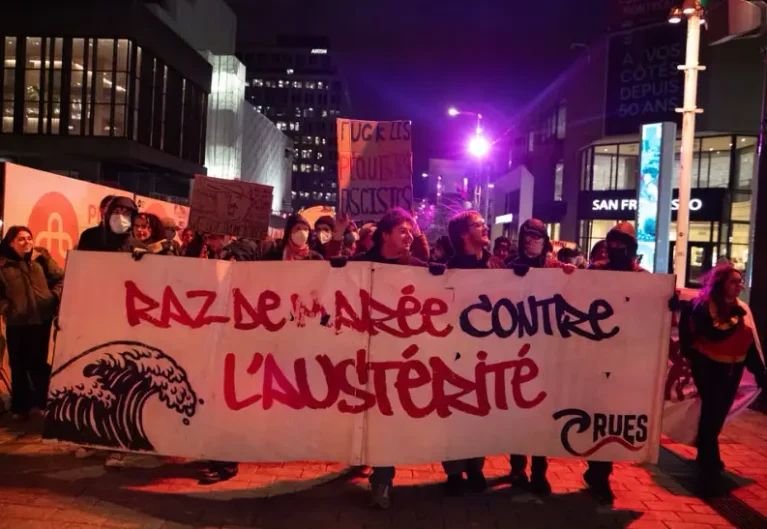
From Nov. 9–13, 100,000 students went on strike across Quebec. Spearheaded by the CRUES student federation, the strike week had two key demands: more generous and accessible student financial assistance, and increased funding for postsecondary education.
As the CRUES now prepares to vote on whether to launch an unlimited general strike this winter, it is worth taking stock of this inspiring week. If the student movement draws the necessary lessons, it could very well spark a youth revolt like those we are seeing in Europe. This is not only possible, but necessary.
Montreal police goes on a rampage
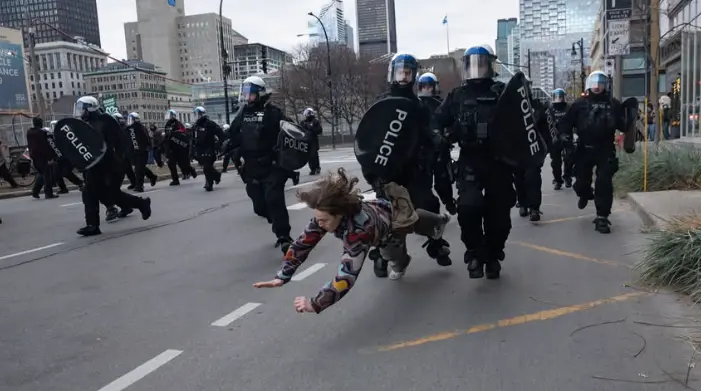
The first major takeaway from the week was undoubtedly the intensity of the police repression that students faced throughout. During blockades at Cégep Saint-Laurent and Collège Ahuntsic, officers intervened to expel students by force—many of them minors.
It was on Friday, however, during the major closing demonstration in downtown Montreal, that the so-called forces of law and order unleashed the greatest chaos. Faced with a festive demonstration of more than 5,000 people, hordes of riot police thugs fired tear gas into the crowd, then charged protesters, hitting them with boots, batons and shields to the throat, while spraying them with pepper spray.
Despite the SPVM’s (Montreal police) lies claiming that no one was hurt, at least 15 protesters were injured, according to the CRUES, and several had to be hospitalized. Broken ribs, fractured noses, people passing out from tear gas: this was a level of police violence against a demonstration rarely seen since the student movements of 2012–15. It was a clear sign that the police intended to crush the student mobilization before it could get off the ground.
In the immediate aftermath of the demonstration, the ruling class’s mouthpieces did everything they could to portray the protesters as the real troublemakers. La Presse immediately singled out the tiny number of vandals. On QUB Radio, they gave the floor to the president of the Montreal Police Brotherhood, who had the gall to praise the police as having acted “by the book.”
At the highest levels of government, the only comment came from Elsie Lefebvre and Guy Lapointe Jr., the Parti Québécois ministers of higher education and public security, respectively. In a joint statement, they condemned “acts of vandalism and destruction.” Not a word, however, about the rabid dogs of the riot police. It is worth noting that the PQ has not said a single word about the strike movement since.
Only Quebec’s left party, Québec solidaire, questioned the police brutality—and it would be difficult to imagine a more timid statement than theirs. The party did not even dare condemn the SPVM’s thuggish behaviour. Instead, they called on the City of Montreal to “shed full light on what justified such police repression”!
For months now, the SPVM has been sinking deeper into a cesspool of scandals. It started with the disbanding of an entire team of 16 officers for egregiously racist behaviour, including collecting dreadlocks as trophies. Then there was the case of the police officer who deleted evidence of domestic abuse directly from a victim’s phone. Then, most recently, the SPVM has been under fire again after a policeman filmed himself urinating on a homeless man. In this context, any “justification” they could come up with would ring hollow.
Whatever excuses are offered, it is becoming increasingly clear to many people that the police as an institution is rotten to the core. And yet Québec solidaire argues that “the role of the police is to defuse tensions and intervene proportionately.”
Nothing could be further from the truth. To protect and serve… the interests of the rich and powerful: that is the essential role of the police. And the rich and powerful have no desire for a movement like the ones in Europe to break out here. It should come as no surprise that the police recruit bigoted and violent thugs to carry out their dirty work. The violence unleashed on the student movement on Nov. 13 is yet more proof of this.
Where is the student movement headed?
There is potential on every campus to recreate the magnificent mobilizations we have seen in Europe and revive the best methods of the massive 2012 province-wide student strike. Nearly one in two students in Quebec has experienced food insecurity. They face prohibitively expensive housing, enormous student debts and unpaid internships, leading many down the path of poverty. The fact that the entire education system around them is crumbling makes their living conditions even more unbearable. Many are ready to fight.
The number of students who went on strike is significant proof of this potential. Historically “moderate” student federations, such as the FECQ and the UEQ, were pushed into joining the mobilization. Even graduate students at HEC Montréal business school went on strike—that’s saying something!
Yet, despite this massive momentum behind the strike votes, there is a stumbling block in the student movement: on most campuses, picket lines and activities mobilized only a small fraction of the student body. Why is this the case, and how can it be overcome?
There is no denying that the leaderships of the FECQ and UEQ joined the CRUES initiative late and reluctantly. Moreover, their approach to the PQ boils down to giving it the benefit of the doubt, while the UEQ has already stated that it rejects any recourse to an unlimited general strike “for the time being.”
We saw another example of the negative role these leaders are playing yesterday, when the UEQ proudly announced that it had met with the Minister of Higher Education, complete with a photo op. The student association claims they “discussed” tuition fees, student financial assistance and paid internships with the minister. This betrays the UEQ’s naïvely conciliatory outlook: as if simply explaining the issues to the minister would be enough to change her mind. This approach will get us nowhere and can only lull students into a false sense of hope.

Let’s be clear: the only way to win significant gains is to force the government’s hand. The new finance minister, Nicolas Marceau, is the same man who unfroze tuition fees and introduced annual fee indexation in 2013, thereby betraying the 2012 student movement that had brought the PQ to power. The PQ is planning to slash the government budget—not to increase funding in education. This means that, to extract even the smallest concession from them, we will have to apply force through mass mobilizations. The half-hearted approach of these student leaders is the main factor holding back the escalation of the mobilization.
Sectarianism
On the other hand, many rank-and-file members within these federations support an unlimited general strike. Without the tens of thousands of students they represent, the strike could hardly be general. But a significant section of the movement’s left wing, rather than helping these students challenge their leadership’s hesitation by involving them in joint actions, cuts itself off from them in a sectarian fashion.
As we explained in a recent article, the CRUES adopted a “mandate of distrust” towards the FECQ and UEQ. Asked about this, a member of the CRUES Executive Council told an RCP activist that this was because they were “strikebreaking federations.” We must of course be wary of the conservative, careerist bureaucrats at the head of student unions. However, among a section of CRUES activists, this attitude goes beyond distrust of the bureaucracy and has turned into a cliquish mentality, accompanied by widespread mockery and hostility towards anyone outside their circle.
While it is important to openly denounce any conciliatory policies pursued by the FECQ/UEQ leaderships, we must remember that they represent hundreds of thousands of students who could be won over to the idea of an unlimited general strike. These students must be patiently convinced through arguments, not relentlessly denounced in a way that risks driving them into the arms of the conciliators.
Anyone who has so much as dipped a toe into the student movement can undoubtedly think of examples of this sectarianism. There is a poisoned atmosphere, full of inside jokes, gossip and petty attacks against anyone who isn’t part of the “in crowd.” One need only take a look at the many meme pages associated with the student movement to see the prevailing atmosphere. Some particularly idiotic memes even receive likes from the official pages of student associations affiliated with the CRUES.

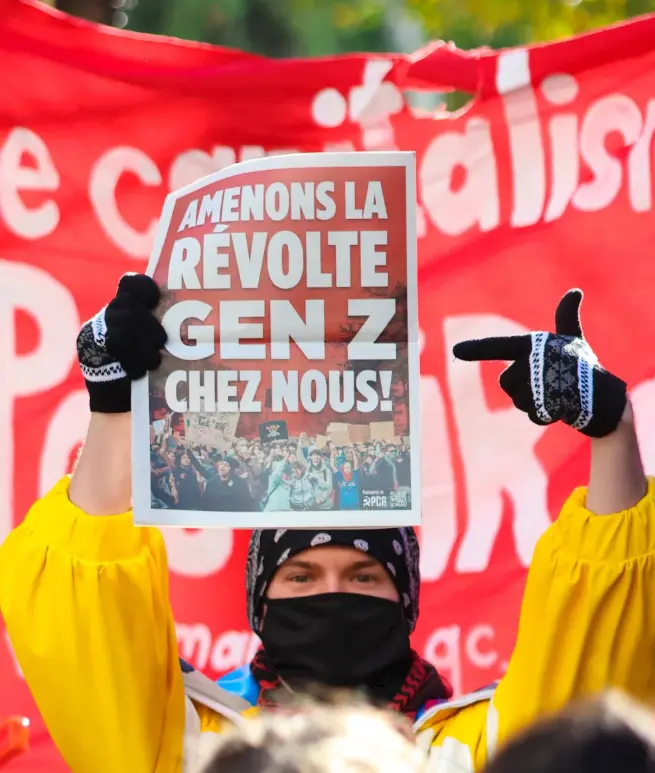
As an aside, the RCP faces this same attitude on campuses, where our activists are subjected to bizarre slander. On every campus where we have members, we have spoken out to explain the need for a mass movement on the scale of 2012 and to bring the Gen Z revolution to Quebec. At a general assembly at UQAM, when two of our comrades took the floor to put forward these views, they were heckled by a few hooligans shouting: “Everyone hates the RCP!” At a rather sparsely attended picket line at Cégep Maisonneuve, the student association executive sent masked activists to try to intimidate us into leaving. In both cases, most students were baffled by this behaviour, and many came over to express their support.
Anyone who genuinely wants the movement to win must denounce this kind of sectarian attitude. Debating within the movement is one thing: it is necessary to clarify ideas and arrive at the best strategies and tactics. But an atmosphere of gossip, unhinged denunciations and slander has nothing to do with debate. It only sows division and demoralization. It can only undermine the movement, without strengthening it in the slightest. The movement is stronger when it includes as many people and groups as possible, united behind a common objective. Those who put their personal hostility towards this or that group or party—whether QS, the RCP or anyone else—ahead of the interests of the movement as a whole are only harming it.
It is essential for the left wing of the student movement to rid itself of this sectarianism, win the support of rank-and-file members of the federations, and unite all forces in favour of an unlimited general strike. That should be the ABC for anyone who genuinely intends to build a united movement against austerity.
Organizing the unlimited general strike
The November strike also showed that there is no substitute for the preparatory work of persuading and educating the mass of students.
At Cégep du Vieux Montréal, which has the reputation of being a stronghold of radicalism, the strike was rejected by a majority in an online referendum. But a handful of activists then set out to blockade the college. With no demands and organized in secret, this initiative was doomed to remain isolated, leaving many students bewildered. Such an action can only give the impression that a “radical” minority is trying to impose its will against the democratic will of the majority, thereby strengthening the hand of students opposed to the strike.
Blockades are, of course, necessary. Strikes are too. But the success of these methods depends on the active participation of a mass of students. This requires sustained efforts to convince as many people as possible, through extensive open mobilization backed up by concrete arguments. The broadest and most open democracy is essential to give as many students as possible a sense of belonging to the movement and the desire to get involved.
That being said, a strike involving 100,000 students and culminating in a demonstration of 5,000 people is a good starting point. But for the movement to grow and mobilize more people on the ground, a broad campaign of political education and mobilization will be necessary, like the one that led to the great student strike of 2012.
On every campus, we must work tirelessly to convince students on a mass scale. Building a broad movement in favour of an unlimited general strike is possible if all the forces supporting it begin preparing now, openly and across Quebec: constantly recruiting new activists; speaking in classrooms; distributing newspapers, pamphlets and leaflets to explain the political case for the strike; intervening in student assemblies; organizing demonstrations; and so on. Needless to say, the comrades of the RCP will do their part in such a movement.
The PQ is preparing devastating attacks on our education system, with the support of all the parties of the bosses in the National Assembly. The ruling class will mobilize all its resources—police, media, courts, college and university administrations—to ram its austerity down our throats.
This is no time for division and infighting. Everyone who supports the strike must be brought into the movement without delay. If we undertake serious preparations for an unlimited general strike, Quebec could experience its own “Red Winter.” It is the role of the left wing of the student movement to seize this historic opportunity as soon as possible and build a broad movement capable of putting an end to austerity once and for all.

