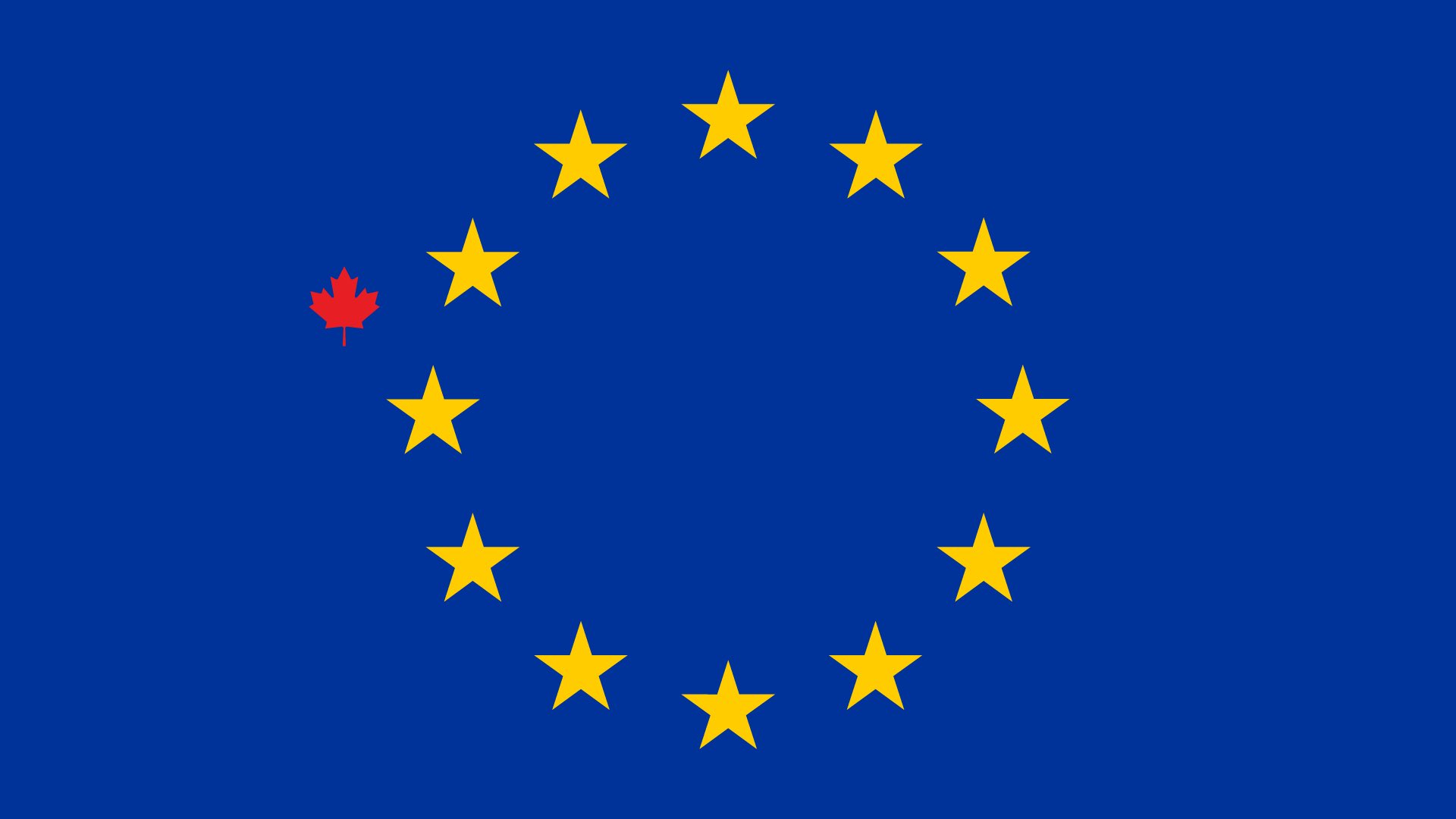
Mark Carney could hardly contain his glee. On his recent visit to the European Parliament in Strasbourg, France, European Commission President Ursula Von Der Leyen spoke of her ambition to make Canada an “associate member” of the EU—a designation which hadn’t existed until that moment.
The Canadian Prime Minister, who was addressed affectionately as “dear Mark,” sat and listened as EU parliamentarians touted the hypothetical benefits of deeper Canada-EU integration, from a revival of advanced manufacturing to a bolstering of the alliance’s military power. One German parliamentarian—eager to demonstrate his wide knowledge of Canada and to prove he had a sense of humour—spoke of his admiration of maple syrup and the Canadian T.V. program Heated Rivalry. To his dismay, no one seemed to laugh.
Back in Canada, the response from people was one of confusion. Von Der Leyen’s mention of Canada’s “association” with the EU—a relationship which no one has yet defined—was the first time anyone had heard of such a proposal. Carney’s Liberals were not elected on a promise to join the EU, and no mention of it was ever made in any public forum in Canada. Instead, Canadians learned of Carney’s plans from a woman from Brussels who even the most politically astute observer would struggle to identify in a lineup.
Without a thorough explanation, the public has been left to decipher for itself what exactly Carney and his new European pals are cooking up.
Why now?
Not mentioned during the meeting’s proceedings was Donald Trump—though he was certainly the cause of Carney’s visit and the meeting’s intended target audience. While Carney denied it, the proposed marriage between Canada and the EU can only be understood as designed to provide notice to the U.S. president that a new bloc was emerging—one that could rival U.S. power and place checks on its ambitions in their own backyards.
On the surface, Carney could not be more relieved. The U.S. has demanded exacting concessions from Canada as part of their ongoing trade negotiations, something which Canada’s much smaller economy is unable to resist indefinitely. His political reputation, as well as the stability of Canadian capitalism, is on the line.
In anticipation of these difficulties, Carney has been quietly courting European politicians to deepen the bloc’s ties with Canada as a way of gaining leverage over the U.S. In early 2026, Canada joined the Security Action for Europe (SAFE)—a military purchase agreement between European countries (and now Canada). Later this year, Canada joined the Eurovision Song Contest—a move that proved more baffling than symbolic. Canada’s designation as an “associate member” of the E.U. is just the latest and most ambitious step in this direction.
In his January 2026 Davos speech, Carney spoke of building an “alliance of middle powers” as the only means of offering pushback to the U.S. and other large powers. The moves to deepen Canada’s ties with Europe are his attempt at putting his theory into practice.
In his own speech to the EU parliament, Carney spoke of the potential in combining Canada’s natural resource wealth with the cutting-edge manufacturing offered by Europe. His hope was to inspire his listeners back home that he had found a solution to Canada’s economic woes, as well as to convince the man in the White House that he was not a man to be toyed with.
But theory doesn’t always translate into practice—and a careful look at Carney’s promises suggest he is almost certain to fail on both counts.
The trouble with Europe
The first problem is with Europe itself. Carney and Von Der Leyen made great efforts in their speeches to paint Europe as an economic superpower with a strong unity of purpose between its members.
In reality, Europe today is far cry from the force it presented in generations past. In the mid-1950s, Europe made up some 25 per cent of global GDP. By 2000, that figure had slipped to 20 per cent, and then dropped further to 13 per cent in 2026. In recent years, deindustrialization has ravaged even the wealthiest European countries—including the first-ever closure of a Volkswagen plant in Germany in 2025. The debt load of countries like France make Canada look spendthrift by comparison—resulting in one round of austerity after another.
Carney’s efforts are not the first time that a Canadian government has tried to rebalance trade away from the U.S. and towards Europe. Diefenbaker tried it in the 1950s. Trudeau Sr. had another go with his “Third Option” proposal in the 1970s. Both attempts failed. Carney wants to try yet again—but at a time when Europe’s economy is far smaller than it was for his predecessors.
The EU’s member states have also never been more disunited. In recent national elections, euro-sceptic parties like the AfD in Germany have been winning an increasing share of the vote, threatening to functionally tear the EU apart at the seams. Joint production of military hardware has been stalled as different groups of national capitalists spar over the division of the proceeds. It is difficult to imagine how Canada could meaningfully unite with Europe when it already has so much trouble uniting with itself.
Another problem is geography. Carney has suggested that a deeper relationship with Europe would mean a boost in exports for Canadian resources and a reduction on its reliance on the U.S. market. However, Europe is an ocean away from Canada, meaning that exports will incur prohibitively expensive transit costs even if major export terminals to Europe existed—which they do not. This presents a major problem when Europe already has cheaper access to major oil and gas production in places like Norway, North Africa, the Caucasus and the Middle East. These factors partly explain why Justin Trudeau turned down Germany’s request in 2022 for LNG shipments from Canada—stating at the time that “there was no business case” for it.
Further, Canada already has virtually tariff-free access to Europe as a result of CETA—its decade-long free trade agreement with the EU. Despite this, Canada’s share of exports to the EU has remained mostly stable, growing to only 5.5 per cent of the total in 2025, versus 4.4 per cent in 2017. Meanwhile, 70 per cent of Canada’s exports are destined for the U.S.—virtually unavoidable when the country is right next door. Labelling Canada an “associate member” of the EU doesn’t change where countries sit on the map.
The final problem is political. No one has yet defined what an “associate member” of the EU is, or how it would tangibly change Canada’s already-close relationship with Europe. However, any serious changes to Canada’s status would likely require approval by all 27 EU member states—a tall ask considering that 10 countries, including France and Italy, have yet to even ratify CETA.
Moreover, even if Canada were approved as a member, it would pose the possibility of Canada then being subjected to certain EU regulations and institutions—but without a vote in EU forums. In that scenario, Canada would simply be substituting indirect influence by the U.S. (although this would certainly continue to exist) for direct influence and control by the large European powers. Hardly the display of “sovereignty” that Carney presents it as.
Most importantly, any serious change to Canada’s relationship with the EU would almost certainly invite the wrath of the U.S. administration. Trump has already slammed Von Der Leyen’s plans for Canada as a “hostile act,” threatening to impose “very serious tariffs” on the EU should it go through. Carney’s potential gains from an association with the EU are minimal and even then uncertain—but the mighty retribution from Washington is all but guaranteed.
Nowhere to run
From day one, Mark Carney has staked his strategy of taming the U.S. on forging alliances with other middle powers—and none more so than Europe. In addition, his government has promised to usher Canada into a new era of prosperity as a result of his achievements abroad.
These yet-to-be delivered promises have kept Carney’s approval rating high despite attacks on workers and unpopular decisions at home. Canadians wait with bated breath for their prime minister to deliver—and deliver big.
But big promises if left undelivered produce big disappointment. Carney’s gambit for a Canada-EU alliance amounts to far less than he makes it seem in his over-the-top speeches. Moreover, insofar as Canada does deepen its ties with Europe, it means hitching the country’s wagon to a rag-tag grouping of declining powers an ocean away and with little to offer its people.
The EU offers no solace for Carney—however much praise he receives in Europe’s centres of powers. Canada’s unavoidable reliance on the U.S., as well as its much weaker position in relation to its neighbour, will sooner or later need to be accepted by Ottawa—with all of the concessions to Trump that flow from it. The mythos enveloping Carney will disappear just as quickly as it was produced—leaving nothing but the naked reality of a future marked by austerity, poverty and unemployment. The class struggle will follow in its stead with a renewed ferocity.

