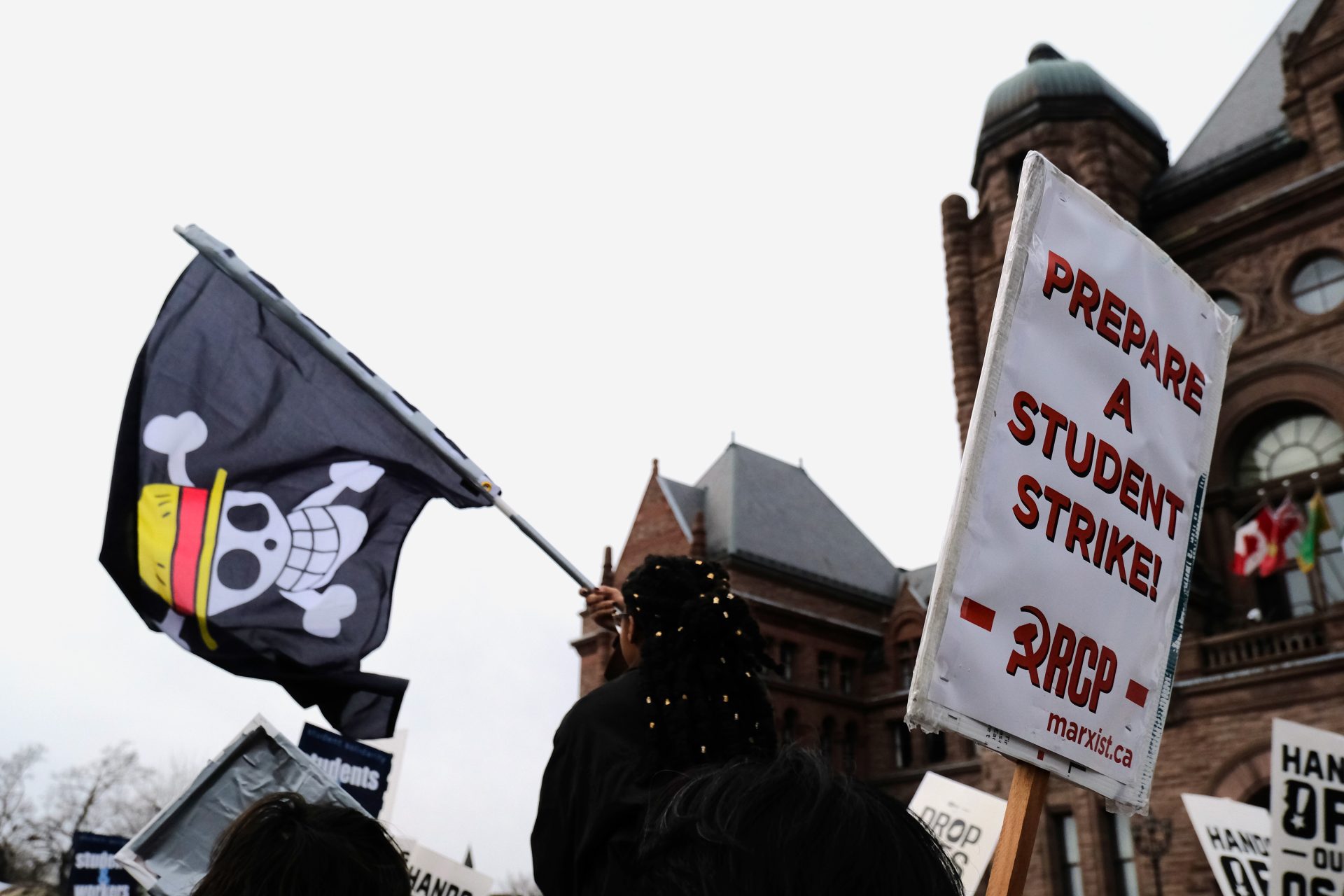
Nearly seven weeks have passed since Doug Ford’s announcement of dramatic cuts to Ontario’s OSAP program—a program designed to help students pay their tuition.
The response from students since then has been nothing short of historic. On March 4, thousands of postsecondary students from across Ontario gathered at Queen’s Park at the call of the Canadian Federation of Students-Ontario (CFS-O) to voice their anger at the politicians sitting inside. This was easily one of the largest protests of postsecondary students in Ontario in recent memory—and a sign of things to come.
On March 11, thousands of high school students staged walkouts at their schools, also in protest of OSAP cuts. Organizers estimate that some 120 schools participated in the walkout, a figure made more remarkable when one considers that high schoolers have no student unions and very little resources with which to organize. In most cases, it only took a few Instagram posts to draw a few dozen or even a few hundred students into the streets.
The most notable feature of this movement has been the growing popularity of the idea of a student strike. In the past, this demand was put forward almost exclusively by small groups on the left, including our own. But even this has started to change.
Strike efforts in Ontario
In the weeks after Ford’s announcement, the Waterloo Undergraduate Student Association (WUSA), which is not affiliated to the CFS-O, conducted a vote for a one-day strike to be held on March 4. On the day, some 1,000 students left their classes and joined a lively march on campus. This seemed to be the best result of any campus that held a walkout on March 4—and by a significant margin.
On March 13, some 900 students at McMaster University in Hamilton gathered for a general assembly to vote for their student union to adopt a “strike policy”—a first considering that Ontario has no traditions of mass student assemblies, especially in relation to strikes. The vote resulted in a near-unanimous adoption of the strike policy. This was yet another important advance.
Of course, the exact definition of a “strike” and the way to conduct it can vary wildly depending on who’s raising it. However, what the word’s growing popularity represents is students’ feeling that this movement must somehow be different from those of the past in order to have some effect—and not only different, but bigger and more combative.
Moreover, in places like Waterloo and Hamilton, students have adopted some of the tactics of the Quebec 2012 Student Strike—including mass general assemblies and strike mandates—in an attempt to recreate its results as best they can.
The actions taken in Waterloo and Hamilton are pioneering in nature and should be commended. Of course, the work of pioneers is often beset by small mistakes and limitations. The WUSA seemed to have no plan for how to escalate the movement beyond March 4, while McMaster strike activists missed an opportunity to call for an immediate action to build momentum for a strike at their historic GA.
But the immediate results speak for themselves—the idea of a strike gets students out. The objective of the wider movement’s leadership should not be to nit pick their faults, but to broadcast their successes, absorb the lessons from this or that misstep, and to help give the movement a broader and more polished scope on the lines they’ve laid out.
On this basis, the prospect of a sustained strike involving multiple campuses and enjoying popular support from students can become a real possibility. The current movement has every chance of evolving into something mightier that can pose a serious challenge to Ford. The anger and desire to fight are there.
But is the movement’s leadership there?
The position of the CFS-O leadership
The CFS-O is the largest student federation in Ontario, representing some 350,000 students at multiple campuses. It alone has the resources and authority to conduct a student strike at a large scale. The stance of its leadership is therefore of vital importance for students interested in escalating the movement.
In 2019, the national CFS adopted a policy to “develop a comprehensive Ontario Students’ Strike Plan” in response to OSAP cuts at the time—though this decision was not widely broadcast to students. If asked today, most CFS-O executives would say that they support the idea of a student strike in principle.
However, in practice, the CFS-O leaders have repeatedly poured cold water on the idea of a strike.
In a recent appearance on Blueprints for Disruption, a left-wing podcast, a number of top CFS-O executives were asked for their opinion on the idea of a student strike. No one disagreed with the idea.
However, rather than explain how to make a strike possible, the interviewees focused instead on why a strike was not possible—or at least, not anytime soon. This included the idea that a strike could pose risks for international students, that a strike would fail without the participation of workers, and that local unions are not ready for strike action.
The massive student strike that took place in Quebec in 2012 was spoken of with admiration. However, the only lesson that seemed to be taken was that the Quebec strike “took years to build”—the suggestion being that a strike in Ontario is off of the table for the foreseeable future. The efforts to build a strike in Waterloo and Hamilton, remarkably, were not spoken of at all.
The interviewees spoke further about the need to build students’ fighting capacity before rushing headlong into a strike—a proposal no sensible person could disagree with. However, the plan for building that capacity was not mentioned, beyond doing what they’re already doing.
These points were presented as being realistic and not “defeatist.” However, it is hard to imagine how any student hoping to build a strike would leave the discussion not feeling both directionless and deflated.
Compare this with the recent TV interview given by Owen Skeen, a CFS national executive involved with the recent student strike in Nova Scotia. Skeen also highlighted how Quebec 2012 took time to prepare. However, his proposals for doing so included educating students on the need for a movement like Quebec 2012, as well as launching limited strike actions as a way to build momentum—concrete ideas which were put into practice by the union leaders in Nova Scotia. Indeed, this approach is far closer to how Quebec 2012 was actually built than that put forward by the CFS-O.
Of course, the Nova Scotia strike was nowhere near the scale of Quebec 2012, and it too probably had its miststeps—as it is to be expected whenever students try something bold and new. Lessons will need to be learned.
But Quebec 2012 also had to start somewhere. Whatever the immediate outcome, hundreds of students in Nova Scotia have been lifted to their feet, gained real experience in the living movement, and have been equipped with an ambitious objective for the future. This is how every great movement is built—not with a focus on what students and workers can’t do, but a focus on what they can do, with its leaders continually trying to raise the bar.
Sadly, this is not the approach being taken by the leaders of CFS-O—and without a course correct, consequences will follow.
The CFS-O approach applied
How has the CFS-O’s approach played out in practice?
In the wake of the March 4 protest, the CFS-O announced its next day of action for March 24. Their plan was to hold another protest at Queen’s Park—the same as on March 4, but hopefully larger.
The RCP argued at the time that it would be a mistake for March 24 to be treated as a repeat of March 4. The danger of repeating the same tactic again, with no perspective for escalating the movement further, would be that students would fail to see the point of ditching class and making the trek to Queen’s Park. Momentum would be lost.
Instead, we pointed to the strike at Waterloo, and encouraged the CFS-O to try and repeat their example at as many campuses as possible on March 24. This would help give students greater ownership over the movement (since they would be voting on the action), create a feeling that the movement meant business, and help establish a tradition. If even only partly successful, it would help lift students’ fighting capacity and help pave the way for even larger actions down the road.
However, while our proposals were met with enthusiasm by thousands of students, the CFS-O maintained its course.
What was the result? On March 24, the protest at Queen’s Park had a markedly lower attendance than that on March 4—perhaps half as many. Attendees noted a deflated mood when compared with the first protest. The WUSA at Waterloo actually had to cancel its bus for students to Queen’s Park due to low ticket sales—despite drawing out 1,000 students to strike just a few weeks before. But when the movement isn’t escalating, but actually de-escalating, who could blame them?
Even if they had attended, the students wouldn’t have missed much. The CFS-O leaders at the protest presented no clear plans for the movement’s next steps—not even another protest. The CFS-O has led students into a blind alley, at least for now.
This outcome was far from a foregone conclusion. The examples set by Waterloo and Hamilton offered a clear and realistic example for where to take the movement next and what students responded to. However, no efforts were made to follow their lead and build upon them. In fact, no efforts were made to even inform students what was happening at these campuses.
The CFS-O leaders have spurned strike action by arguing for the need to “build capacity” and educate students first. No one disagrees on the need for these steps. But how do increasingly smaller protests build confidence in students to fight? How does keeping mum on the need for a strike and the real efforts of students to build one help to educate?
In truth, these conservative methods do nothing to enhance students’ fighting capacity and understanding of what needs to be done—in fact, they degrade it.
This is not over
But that doesn’t mean this movement has drawn its last breath. Even in the short term, new explosions and a revival of the movement can not be discounted.
The severity of Ford’s cuts mean that students in Ontario are still angry as ever. The campuses are a pressure cooker, and will remain so for the foreseeable future. The high schools are no different—and those students will soon be in university. In time, that pressure will find an opening that can be widened and through which it can escape. Either that, or it will blast a hole through the surface obstructing it.
The bungling of the CFS-O leadership is a major obstacle on the path to resist Ford’s cuts. However, there is no shortage of creativity or a desire to fight by students, as the last few weeks show. The popularity of strikes and other militant actions will continue to grow, helped along by examples at individual campuses and in other provinces. The actions of pro-strike groups like the RCP can also play an important role, in part by highlighting these examples and others from history.
Eventually, these two opposing forces will enter into conflict—either forcing the student union leaders into action, or by replacing them with those who will. It is not a question of if, but when.

