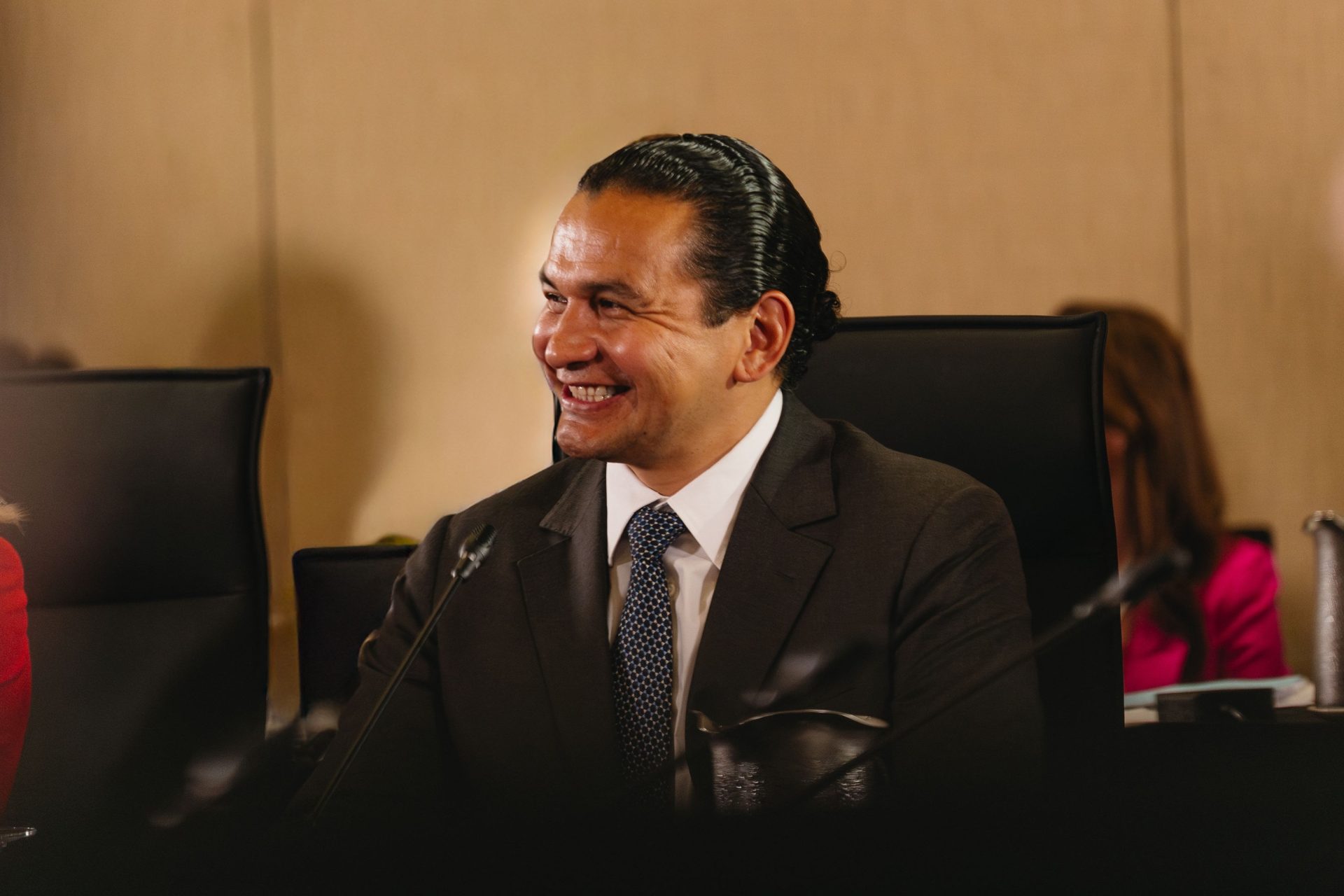
Wab Kinew, Manitoba’s “left-populist” NDP premier, recently shocked his supporters when he forced striking medical lab workers back to work.
Since he was elected in 2023, Kinew has built a reputation for standing up against the establishment. He criticized Mark Carney’s support for the U.S. war on Iran, and called the operation “a distraction from the Epstein files.” He cancelled plans for a data centre in Île des Chênes when Manitobans petitioned against it. When Carney voiced support for a sand mining operation in eastern Manitoba that could damage drinking water, Kinew pushed back, saying, “I work for the people of eastern Manitoba, not for the Davos crowd.” His approach has been successful—Kinew is far and away the most popular premier in Canada, with an approval rating of 63 per cent as of September, 15 points higher than the runner up.
However, Kinew’s progressive image ran into a serious obstacle in early September as his government joined the ranks of other strike-breaking premiers like Danielle Smith and Doug Ford. Workers at Dynacare, a private medical testing company, had been working for six months without a contract at pay rates 20-30 per cent lower than workers in public labs. They walked off the job on Sept. 8, only for the Manitoba Labour Board to order them back to work at the request of the NDP government.
Responding to blow back over this, deputy premier, Uzoma Asagwara justified the violation of the right to strike: “We respect and revere [workers’] rights. We also know that it is fundamentally important to make sure that Manitobans have access to the health services that they need.”
This is actually not the only time that Kinew has taken the side of Manitoba’s ruling class. Despite Manitoban Indigenous communities’ opposition to new pipelines and the NDP’s own “Path to Net Zero” plan to phase out fossil fuels, Kinew has welcomed construction of an east-west oil pipeline, and expressed interest in it ending at the Port of Churchill. He joined Carney’s attempts to woo “the Davos crowd” at the Canada Investment Summit, offering tax breaks in exchange for private investment in the Port of Churchill and vowing to triple critical mineral production.
For all his populist rhetoric, Kinew is a reformist who accepts the limits of capitalism. Betraying striking workers is the inevitable result.
Kinew made some very revealing comments as to his political philosophy after Avi Lewis won national leadership of the NDP. He explained that he differed from Lewis, who had a “very aggressive approach to class consciousness.” Instead, Kinew said, “My approach is that the one per cent has been very lucky. Why don’t [they] join us in stepping up and contributing [their] fair share?” In other words, the interests of workers and bosses are not inherently antagonistic, and the workers can reasonably turn to the ruling class as collaborators rather than exploiters. In fact, the ruling class of Manitoba didn’t get their wealth by “luck” as Kinew suggests, but by exploiting the labour of Manitoban workers. The interests of the one per cent and the working class cannot be reconciled—as this strike demonstrates.
When asked about shutting down the strike, Kinew offered the following explanation: “Yeah, Dynacare sucks… Dynacare should give these workers a raise. Dynacare is making a mess of the situation… At the same time, nobody should be trying to use people’s health care as leverage.” In other words, “I don’t like what they’re doing, but I have no other choice.” In this respect, he is correct: any government that accepts the laws of private property and private profit will eventually be forced to bend the knee to the ruling class, and will suppress strikes and trample on workers’ rights while claiming that “they had no choice”.
In reality, Kinew’s government did have a choice, and he knows it: nationalize Dynacare. Kinew addressed the suggestion directly, before ruling it out as too expensive to buy out the company. A real socialist would have put workers’ livelihoods and right to health care before private profits and expropriated Dynacare without compensation. He would have explained that a company that leeches off of the public healthcare system and underpays workers does not get to demand compensation. Instead, Kinew has accepted the capitalists’ right to profit.
This is one of Wab Kinew’s first open betrayals, and unless he breaks with the ruling class, it will not be the last. It is our task to fight for a workers’ government that will take essential services out of the hands of profiteers and build a fully-funded, functional healthcare service that works for workers and patients alike.

