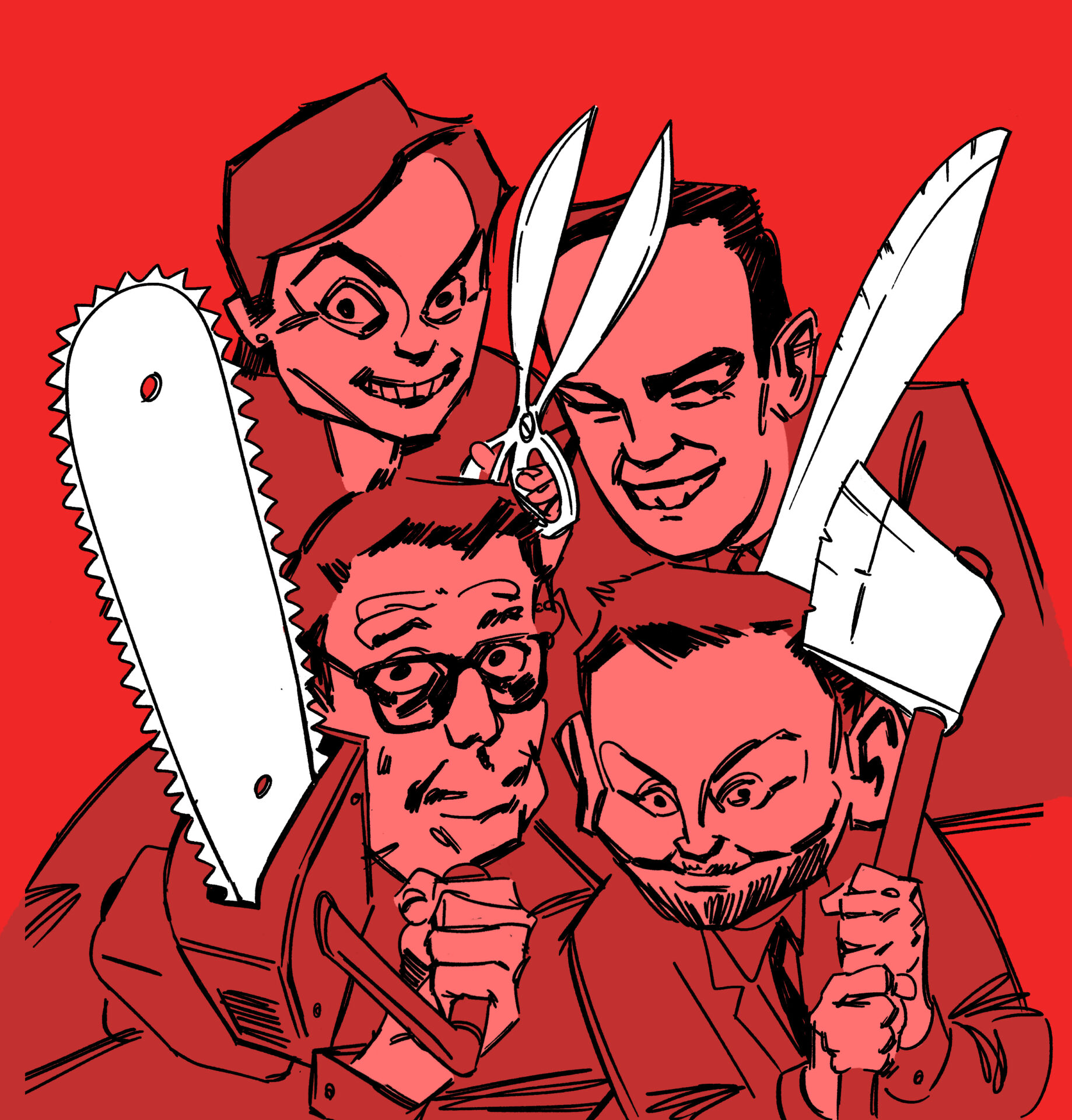
The campaign for Quebec’s Oct. 5 elections is giving us an unprecedented spectacle: from the very beginning, the debate has been an exercise in one-upmanship around budget cuts—with Radio-Canada even headlining one of its articles “Scalpel or Chainsaw”!
Every party except Québec solidaire is promising to drastically reduce government spending and eliminate public-sector jobs. All are promising austerity without calling it by its name.
After bleeding healthcare and education dry, Christine Fréchette’s CAQ is promising to eliminate 11,000 civil-service jobs. Charles Milliard’s Liberals: 12,000 jobs over five years. Éric Duhaime’s Conservatives: 20,000 jobs over five years, along with a gargantuan $47 billion cut in government spending.
The Parti Québécois, which is all but guaranteed to take power on Oct. 5, is planning a 2.5 per cent reduction in public-sector wage spending, without providing any details—the equivalent of 16,000 jobs. They promise to limit spending growth to 1.9 per cent per year, the lowest growth in 30 years.
While promising cuts, the leaders of these parties are also all reassuring workers that they have nothing to worry about, the quality of public services will somehow not be affected.
Let’s be clear: that’s a barefaced lie. It is absolutely impossible for cuts of this magnitude not to affect services.
Of course, no one would be popular if they announced cuts to public services in the middle of an election campaign. That is why all these parties avoid using the A-word. But austerity is indeed coming.
A huge, inefficient machine
Even though the bourgeois parties are concealing their real intentions in this election, the fact remains that announcing cuts has never been a recipe for political success. What we are witnessing is truly unprecedented.
While QS, the only party that wants to increase government spending in order to improve public services, is stagnating at the bottom of the polls, the parties competing for power are campaigning on measures that, historically, would have amounted to political suicide. How can we explain this scenario?
This phenomenon reflects the depth of the crisis of the “Quebec model” of a strong welfare state.
Public services are crumbling. People have had enough of hospital waiting lists and schools falling into disrepair.
Chronic underfunding is undoubtedly to blame. Yet year after year, the only measures taken to supposedly improve services have been administrative reorganizations: school governance reform, the creation of new healthcare administrative structures followed by their abolition, centralization, decentralization, then recentralization. Each time, under the pretext of simplifying bureaucracy, they create even more bureaucracy. Meanwhile, underfunding continues.
The result is a loss of confidence in the government and public services. And today, cynically, the ruling class is exploiting this widespread frustration—which it has itself orchestrated by continually cutting services and tinkering with the bureaucracy—to justify further cuts.
Meanwhile, at every stage, the same parties that sabotage public services and impose austerity spend taxpayers’ money as if it was infinite. Cost-overrun scandals such as SAAQclic and the ridiculous explosion in IT costs at Santé Québec, the ill-fated bets on projects such as Northvolt and Lion Electric, and the scandals surrounding the awarding of construction contracts (the Charbonneau Commission) do nothing to reassure workers that their taxes are being spent wisely.
And the more the state cuts services, the more it outsources work to the private sector: consultants, agencies, subcontractors, IT companies, and so on. For every dollar invested in our services, another goes to line the pockets of a myriad of parasitic intermediaries. The recent SAAQclic and SIFA fiascos at Santé Québec revolve around enormous contracts awarded to the same company, LGS, a subsidiary of the multinational IBM. Another example: during the pandemic, the Quebec government, like the Canadian government and many others around the world, entrusted the (botched) management of the crisis to the extremely wealthy consulting firm McKinsey.
For many workers today, the state is nothing more than a massive bureaucratic machine that keeps growing while the quality of the services it provides continually deteriorates. Faced with such a broken machine, workers are understandably asking themselves: “Why keep throwing our money out the window?”
It is therefore unsurprising that in January a Léger poll indicated that a majority of Quebecers support cuts to the state bureaucracy. More recently, a study by the Université de Sherbrooke found that nearly two-thirds of the population would prefer a reduction in public services rather than a tax increase to make up the deficit.
Thus, the more the parties of the bourgeois establishment demonstrate their incompetence and corruption, and the more they cut public services, the more arguments they find to justify further cuts and outsourcing contracts to the private sector. As we wrote at the time of the Couillard government’s healthcare reform, they “sabotage in order to privatize.”
For a new model
The ruin of the welfare state is not simply the product of administrative incompetence or a mere lack of funding: it is a direct symptom of the capitalist class’s control over the state.
In reality, the “Quebec model” is a historical anomaly. Our ruling class did not create the welfare state willingly, but under pressure from the struggles of the past. Through the intense struggles of the 1960s and 1970s, workers wrested concessions from the capitalist state in the form of public services.
At the time, the capitalist class had enough room to maneuver to grant these concessions to workers. The postwar boom had ushered in a period of unprecedented prosperity, with high growth rates and low government debt. The labour movement was highly organized, and the bourgeoisie preferred to buy social peace, especially since it could afford to do so.
But the ruling class never intended these concessions to be anything more than temporary. Since the 1980s, it has sought to dismantle the welfare state. This has become all the more urgent in recent years, as the Quebec state has become heavily indebted and the economy has slowed to a crawl.
The solution, therefore, is not to return to the past, to a welfare state that was never more than a historical anomaly. The conditions that made the welfare state possible have disappeared.
And even if it were possible to set aside the public-debt crisis and simply replenish government coffers by taxing the rich more heavily, as QS proposes, the problem goes deeper. It is because the bosses are in control of society and, by extension, of the state that we are suffering through this disaster. Driven by profit, the capitalist class has no interest in improving public services or preventing public money from being funneled into private pockets. Quite the opposite.
The problem is the very nature of the state itself—a state designed, built, controlled, and captured by bosses, banks, big corporations, major landlords and other parasites. We need a genuinely new model of society, in which workers are in control of the economy and build a government in their own image.
This new model will guarantee democratic management by workers, and collective resources will be used to meet the real needs of the population, rather than the imperatives of private profit. By driving out private profiteers and capitalist bureaucracy, we will put an end to the waste and inefficiency that drain our services.
The crisis of the Quebec model is a clear demonstration of capitalism’s inability to meet our needs. Only the struggle for a socialist society will allow us to escape this dead end.

