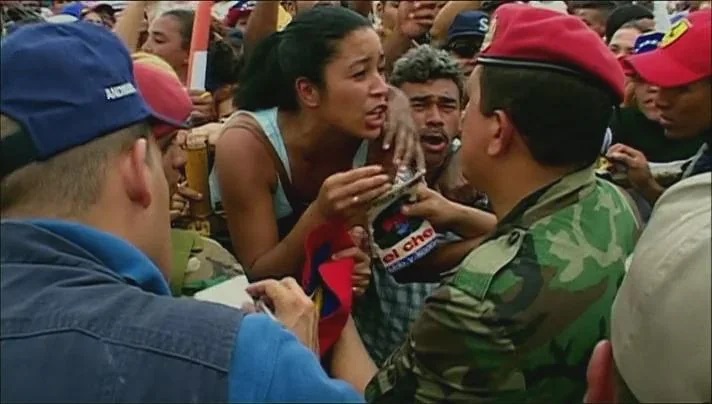
On the evening of April 11, 2002, within the walls of the besieged Miraflores Palace, cameras captured in real time the Bolivarian government’s shocked reactions to the coup d’état raging outside. For over a year, Irish filmmakers Kim Bartley and Donnacha Ó Briain had been accompanying Hugo Chávez everywhere he went in order to document the first achievements of his term in office. Their proximity to the Venezuelan president proved so privileged that they now found themselves in the eye of a counterrevolutionary storm, where few cameramen could claim to have ever focused their lens.
Rare—if not non-existent—are works that narrate so closely the unfolding of a coup and, above all, its defeat at the hands of the masses. If only for the exceptional images that emerge from such an opportunity, The Revolution Will Not Be Televised is a must-watch. But the film is far from being limited to this single dramatic sequence.
At the end of the shoot, up to 200 hours of footage were made available to the editor! The directors, in the wake of this project originally intended to paint a portrait of an unusual politician, found themselves witnessing the unfolding of a revolution. Chávez appears not as a mere eccentric character, but as a leader who channels both the demands of workers and poor farmers and the wrath of the oligarchy. Chávez is the center of attention, but the rising tide of class struggle courses through the entire film. The initial framing, too narrow, cannot help but burst open.
So the oppressed masses, as they enter the stage of history, also take over the screen. The crowds overflow. Women from the barrios, the poor neighborhoods on the outskirts of Caracas, talk about the positive impact that the 1998 victory has had on their lives. We even witness a surreal visit to the secretariat where thousands of letters addressed to the president are stored, a mountain of scraps of paper on which workers and poor people from all over the country scribble their hopes, advice, requests, and thanks, a symbol of the titanic popular support Chávez enjoys.
At the same time, the filmmakers show the contempt that the mainstream media and the residents of Caracas’ affluent neighborhoods have for the millions of “worthless people”—according to one wealthy woman they interviewed—who are participating in this revolution. An editorialist raves about the so-called “Freudian sexual spell” that Castro is said to have cast on the government. A journalist recounts how his superiors ordered him to manipulate public opinion against the Chavistas. In short, the entire establishment is united in its attacks.
And despite immense pressure from the establishment, upon hearing the news of their leader’s capture, the masses flood the streets. Bartley and Ó Briain, cameras in hand, capture this indescribable moment when the power of mass mobilization defeats the usurpers. One cannot help but get goosebumps from these scenes. Nowhere else but in The Revolution Will Not Be Televised will you witness so directly the extraordinary process that is a revolution, the tension it catalyzes, and the hopes it unleashes. This breathtaking film is the cinematic testament to the Bolivarian revolution.

