War. Economic crisis. A widespread feeling that the world is standing on the edge of a great catastrophe. Meanwhile, the rich sit pretty. Many of them seem completely oblivious to what’s developing around them.
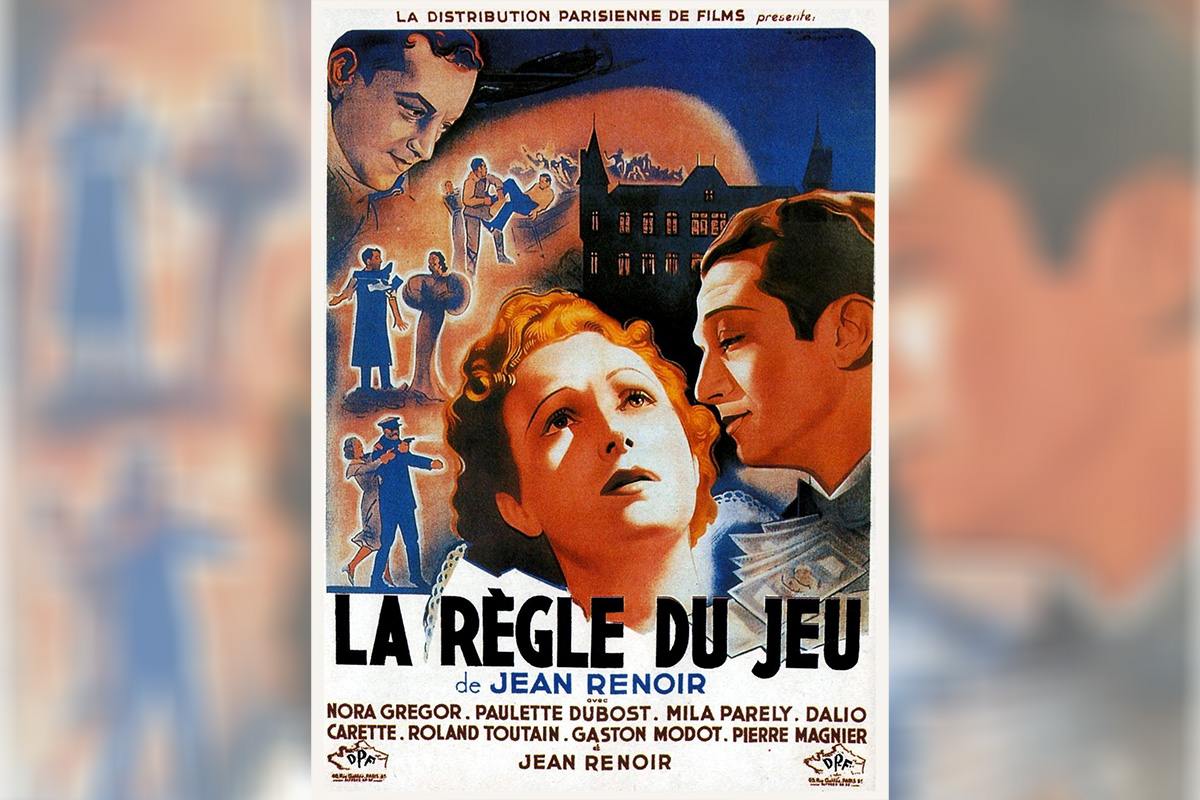
These conditions, which mirror the world today, were the conditions of France in the 1930s, as it straddled the Great Depression and World War II. It’s this world that Jean Renoir depicted in his film The Rules of the Game. And because he captured the mood of the time so well, it still feels incredibly fresh today.
The film depicts a group of rich socialites out on a country retreat. They spend their days hunting, drinking, and cheating on one another (almost every character sleeps with another’s spouse).
Meanwhile, just over the vineyards, a world war is brewing. Less than a year after the film’s release, France would be invaded by Nazi Germany and placed under a fascist regime. Yet, the characters all seem entirely unaware. Hardly anyone has anything to say that’s not about themselves or one of their affairs.
The French upper class is depicted as ignorant, gluttonous, and morally and spiritually empty. There is no main character. Instead, the film is driven by a large ensemble cast. This brings the focus away from any individual and towards the ruling class as a whole. As Renoir explained: “The conception I had from the beginning was of a film representing a society, a group. I wanted to depict a class.”
Renoir was better equipped to make this film than most. Son of the great painter Pierre-Auguste Renoir, he grew up in French high society and knew exactly what frivolousness took place in these social circles. He knew the topic so well that, according to him, he shot the film without a finished script. “In reality, I had this subject so much inside me, so profoundly within me, that I had written only the entrances and movements, to avoid mistakes about them.”
The camera work is extremely complex for the time. The film is primarily shot through wide depths of field and long takes. The camera moves constantly, flipping around characters and sweeping through vast chateau interiors.
The cinematography and editing give the film a very pleasant rhythm, while providing a means to expose the low moral standing of these characters in clever ways. We see characters betray one another literally behind each others’ backs.
This visual style only breaks during a scene where the cast goes on a hunt. At this point, the pace of the film completely shifts. The long takes are replaced by rapid cuts of pheasants and rabbits getting shot. Their deaths are shown in incredible detail. Rabbits get thrown into somersaults by speeding bullets and we watch as their limbs stretch fully out as the result of death spasms. A brisk day in the country is replaced with a war.
On one hand, this scene serves as a grim anticipation of the carnage that was about to consume Europe. On the other hand, it reveals the complete moral callousness of the rich. At one point, one character asks another if she even enjoys hunting. She shrugs her shoulders in reply.
The Rules of the Game is a rare sort of film. It’s incredibly funny and entertaining, as well as technically marvelous, while also offering insightful criticism of the world we live in. As Renoir himself said:
“In no way was it my intention to make a controversial film. It was not at all my intention to shock the bourgeoisie. I just wanted to make a movie, even a pleasant movie, but a pleasant movie that would at the same time function as a critique of a society I considered rotten to the core and which I still consider rotten to the core. Because this society continues in its rottenness and is leading us towards some fine little catastrophe.”

