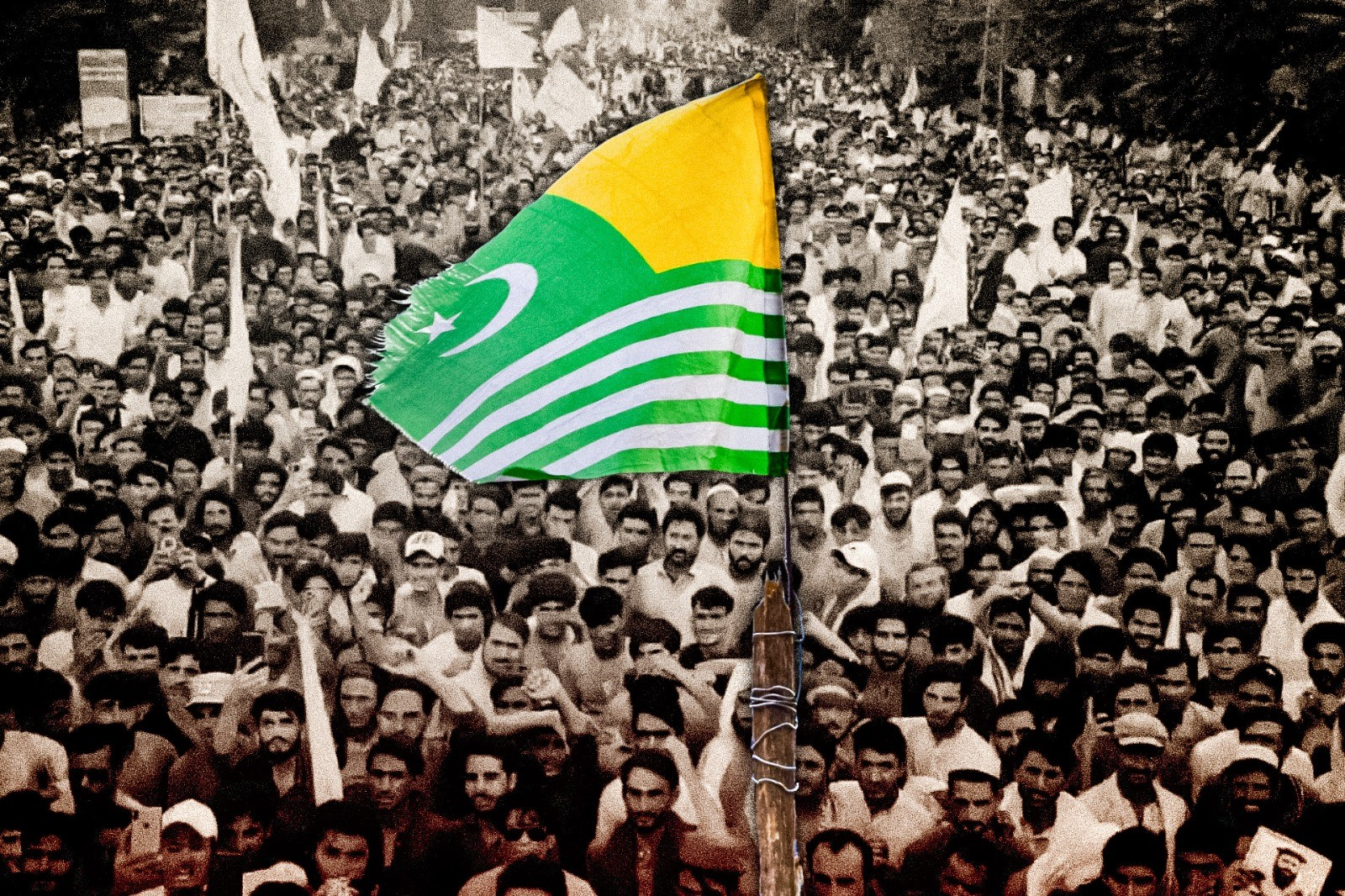
The situation in Pakistan-occupied Kashmir is on a knife edge. The mass movement, which was forged over the last three years and which has now reached revolutionary proportions, is on the move. As it has grown in size, so have its demands. By such actions, it has thrown down the gauntlet to the Kashmiri authorities and the Pakistan government.
Initially, the demands centred around the restoration of subsidies on wheat and electricity, but they have now embraced other social questions, such as jobs and democratic rights. With youth unemployment double the national average, young people have been at the forefront of the struggle, along with women, who have been the most determined fighters.
The central government, in its turn, has made clear its intention to crush the movement in blood, using the full force of the state against the protesters. As a result, over 100 have been killed in sporadic clashes, the highest level of fatal casualties seen in decades.
The ruling class understands that the mass upheavals in so-called ‘Azad’ (‘Free’) Kashmir are a continuation of the mass revolutionary unrest that swept through Bangladesh, Sri Lanka, and Nepal over the past two years. Such revolutionary mass outbursts have given them sleepless nights.
The movement in Kashmir once again reignited in early June of this year, with mass protests, demonstrations, and strikes, which have paralysed the whole region. Roadblocks have been set up by protesters to prevent government armed reinforcements. These represent elements of dual power that have arisen.
“Pakistan’s government is facing a serious test of its authority,” wrote the Financial Times recently.
The mass movement has been led by the Joint Awami Action Committee (JAAC), which has been labelled a ‘terrorist organisation’ by the Pakistani state. This has resulted in a crackdown and the arrest of many activists in an attempt to quell the growing unrest.
The demonstrators have been subjected to increased repression by the authorities, desperate to keep a lid on the situation. Police and paramilitary Rangers have stepped up their brutal repression, firing indiscriminately into crowds of unarmed protesters, resulting in many deaths and thousands of injuries.
The authorities then cut off the internet and phone communications to isolate the protests. But this too has failed to quell the movement.
In response, the Long March on the region’s capital Muzaffarabad, announced by the JAAC leaders, gathered pace from different towns and areas, aiming to congregate on the outskirts of Rawalakot, a staging post for a march on the capital itself. As tens of thousands gathered, the next step was to enter Rawalakot, but the path to the town was blocked by occupying security forces.
There was a great deal of hesitation and procrastination about entering Rawalakot, given the bloodshed and the presence of state forces. This caution was especially evident from the leadership. But the mounting pressure from below, especially from the militant women, forced the leadership to announce a march on the town. On entering, they established a bridgehead of resistance so as to push out the security forces.
However, the Rangers were determined to use force to hold their ground, indiscriminately killing and injuring a number of protesters. Other towns from other areas of Kashmir were also on the move, but were also attacked by police and state forces.
Awami Action Committees
The first Awami Action Committees were established on the initiative of our Pakistani comrades of the Inqalabi Communist Party (RCP). The initiative and the call by the Marxists corresponded precisely to the needs of the movement for an organisational expression. Committees therefore spread far beyond the towns and villages where the Marxists were present, and culminated in 2023 in the joining up of these committees into the Joint Awami Action Committee in the autumn of that year.
Two years later, in late 2025, its campaign of shutdowns and strikes paralysed the region in support of a 38-point charter of demands. Under pressure, the authorities were thrown into a state of panic and accepted the main proposals, with promises to address all the demands within six months.
This was clearly a ploy to dissipate the mass movement and reestablish their control, all the better to prepare for any future clashes.
It was precisely this betrayal by the authorities, in which they refused to implement any of the agreed demands, which led to the current situation.
In response, the JAAC announced a series of marches to press their demands. This call to mobilise was taken up energetically by the oppressed masses in a magnificent display of courage. Likewise, our comrades of the RCP carried out their duty in explaining the way forward at each stage.
Unfortunately, despite initiating the formation of committees, given our small size we were unable to lead the movement, although we have had growing influence in the Rawalakot action committee. However, nature, as we know, abhors a vacuum.
As a result, the leadership of the JAAC fell into the hands, not of determined revolutionaries, but of accidental elements, lawyers, traders, and other petty-bourgeois layers. Unfortunately, these layers had no clear perspective for the movement. When our comrades initially raised political issues, they were told by these leaders not to rock the boat, that politics should be kept out of the movement in order to ‘preserve its unity’.
We have been met with such arguments many times from such people. The cry of ‘unity’ is used as an excuse to gag the movement and an attempt to stultify discussion. Above all, it is a measure to silence revolutionary ideas, which they view as a challenge to their authority. But our comrades, who have helped build this movement from the beginning, cannot be silenced.
Our comrades therefore advanced the idea that the Action Committees should go beyond simply squeezing concessions from the authorities – which the latter always renege on – and for the masses to take power themselves as the only real way forward.
The situation among the masses in ‘Azad’ Kashmir is desperate. The region is based largely on agriculture, horticulture, tourism, and traditional crafts, and is one of the poorest regions of Pakistan. Although there is practically no industrial proletariat, the oppressed masses have a burning feeling of deprivation. They are therefore seeking a way out, whatever the cost.
What workers there are in the region are primarily focused around hydropower. ‘Azad’ Jammu and Kashmir currently produces around 2,300MW of electricity, primarily from the Mangla Dam Raising Project and the Neelum-Jhelum Hydroelectric Project. There are several large public and private projects underway, largely backed by Chinese loans, that will expand output further. Power generated in the region is then fed into Pakistan’s national grid, whilst local consumption only accounts for around 400MW – the fact that most of the power produced in the region goes to Pakistan has made hydropower a focal point for debates and protests regarding regional utility pricing.
Lenin dealt with how to proceed in such conditions at the Second Congress of the Communist International in 1920, when he spoke about the tasks of the national and colonial question. In the revolutionary struggle, it was necessary, he said, for communists in the colonial and former colonial countries to establish direct links with the oppressed layers. In this struggle, it was their duty to “conduct propaganda in favour of peasants’ soviets or of working people’s soviets.”
Having successfully established such action committees, the next step is to furnish a programme that charts the way forward, starting with basic economic and social demands and linking them to the question of power. It is clear to everyone that the mass movement in Kashmir has been transformed into a revolutionary movement, going way beyond the initial demands. Every day that passes, the more the masses can feel their power.
Once again, it was Lenin in 1905 who recognised the newly-formed Soviet of Workers’ Deputies as the real authority in the country, and called upon it to take power as the legitimate “revolutionary provisional government”. This was despite the fact that the Bolsheviks were in a minority. In fact they had originally adopted a sectarian approach to the St Petersburg Soviet, which Lenin was forced to correct. Trotsky, who was elected president of the soviet, came to the same conclusion as Lenin.
The carrot and the stick
Fearing the hot breath of the movement, the Pakistan authorities slandered the JAAC as a ‘terrorist organisation’, falsely accusing it of being funded by India. This led to the banning of the organisation and the arrest of a host of leaders and activists. But this action only caused the movement to become even more defiant and to grow even larger.
The regime is worried that the instability in Kashmir will spread further afield. In fact, in many ways, Kashmir is a microcosm of Pakistan itself, gripped by growing instability and anger in many parts of the country, from the Punjab to Baluchistan and Khyber Pakhtunkhwa. Most suffer from extreme poverty and hunger, which is getting worse, as the economy crumbles under the pressure of the Iran war and the dictates of the IMF.
The Pakistani government is increasingly discredited in the eyes of the masses and the country is sitting on a powder keg.
In an attempt to cut across the movement, the Pakistan government called staggered elections to the Legislative Assembly in ‘Azad’ Kashmir. But the Kashmiri masses understood that these elections were clearly rigged, with their ‘reserved seats’, to guarantee a government favourable to Islamabad.
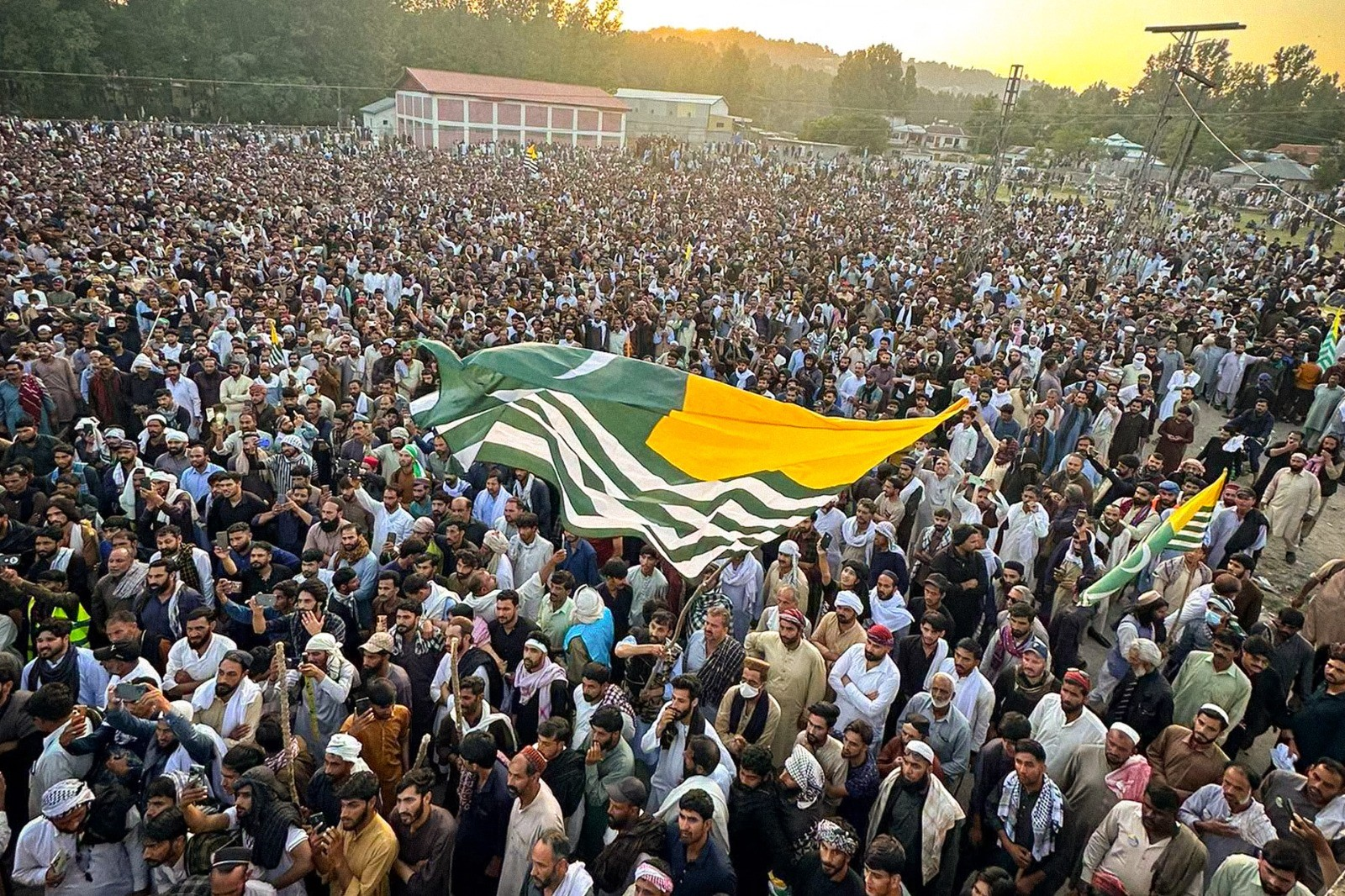
Such elections taking place under these conditions are a farce. They were correctly boycotted by the masses. All the old corrupt political parties were taking part in the hope of getting their hands on the spoils of office. But this only reinforced their lack of legitimacy in the eyes of the masses. While polling stations were almost empty on account of the boycott, winners were announced with tens of thousands of fake ‘votes’.
However, as expected, the Pakistan authorities have been using the carrot as well as the stick. They have been busy attempting to split the Action Committee through back channel discussions between themselves and JAAC leaders to agree on some kind of solution. Lawyers and NGO activists have been trying to mediate between both sides. Before the latest bloodletting on 28 July, JAAC leader Umar Nazir Kashmiri was involved in these negotiations. But the state repression has cut across this for the time being.
The leaders of the Action Committee have hesitated and dragged their feet at every turn, only to be pushed forward under the pressure of the mass movement. It is clear that the present leadership would like to find a peaceful compromise to resolve the crisis. They are like a man who desperately wants to dismount a hungry tiger, but without being eaten.
But the movement is at the crossroads. The masses are aroused and are eager for battle. Any retreat by the movement would be seen as a sign of weakness. And weakness invites aggression.
Our comrades have consistently argued that the Long March should aim to take over the capital and sweep out the old corrupt administration and establish a popular revolutionary government. This is clearly the overwhelming desire of the masses. However, this means challenging not only the regional authorities, but the Pakistani state itself. This is, of course, a very serious step.
Except for brief intervals, the military have always dominated Pakistan. The top generals will be discussing what to do. They will have reached the conclusion that the only thing to do will be to teach the masses a lesson by crushing the movement in blood. That has always been their way.
The shooting of demonstrators by the police and Rangers is only a foretaste. It indicates how far they are prepared to go to suppress the movement. However, the masses are on the move. They show no fear. They have boldly confronted the security forces.
Under these circumstances, the leadership, instead of trying to persuade the Pakistan authorities that they represent a ‘peaceful movement’, which is dismissed by Islamabad, must be prepared to take steps to defend itself.
As in all great revolutionary movements, when confronted with state violence, it is necessary to resort to self-defence. This means acquiring arms by whatever means. If this was done, the police and Rangers would run away soon enough. They are brave when shooting unarmed men, women, and children, but not so brave when they are met with armed resistance.
The struggle for power is, of course, a very serious question. Unfortunately, it seems the JAAC leaders lack the necessary will. They are timid compared to the radicalism of the masses and lack any real perspective of taking power. But taking power is the only road to success.
If we are to be honest, what is lacking in the situation is a revolutionary leadership and party. That was the case in Bangladesh, Sri Lanka, and Nepal. In these cases, the revolutionary masses were on the move, but the leadership was more than willing to compromise, and it was this that led to their eventual defeat.
The energy of the masses was needlessly dissipated and squandered. Power was literally in their hands. The repressive forces of the state were swept aside. But the leaders sought compromise and were satisfied simply with a change of faces at the top. The opportunity was let slip and the opportunity to take power was lost. This is a crucial lesson for Kashmir.
For socialist revolution across the subcontinent!
In such a mass movement, there is no question of standing on the sidelines, like the armchair sects. Our comrades are doing their duty. At each stage, their task is to tell the truth and clearly explain the way forward, as they are doing. In Kashmir, the burning national question is bound up with the social question. There cannot be national liberation without social liberation. And national emancipation cannot be achieved while the ruling elites remain in power in Islamabad and Delhi.
Without doubt, the taking of power in Kashmir by the masses would provoke the intervention of the Pakistan army, and the Indian army, in an attempt to crush the revolutionary movement. We have no illusions on that score. The only way this could be confronted is to make a class appeal to the ranks of the army, the ordinary soldiers, many of whom are Kashmiris, who would be open to revolutionary agitation.
The imperialists sent in 21 foreign armies of intervention to crush the Bolshevik Revolution. Despite the supremacy of the imperialists, they were defeated by the class appeals to the troops by the Soviet government and the solidarity of the workers in the West.
The revolution in Kashmir has to have an internationalist perspective. Having taken power, the call must go out to the toiling masses of Pakistan to follow their example and put an end to the miseries of landlordism and capitalism. The Pakistani masses are in ferment, burdened by rising prices, fuel and transport costs, imposed by the demands of the IMF. They would respond if a real lead was given.
Likewise in India, there exists widespread dissatisfaction with the regime, as the mushrooming of the Cockroach Party demonstrated. It was a symptom of the real explosive situation within the country. Again, a revolutionary appeal to the Indian mass would meet with a ready response. There has never been a better time.
In other words, the fate of Kashmir and its national liberation is directly tied to the socialist revolution throughout the Indian subcontinent.
That is why our comrades are also taking urgent steps to build the RCP in Kashmir, as Lenin urged the party cadres to do in 1905, even amidst the revolutionary turmoil of that year.
However, if the JAAC makes a deal with the Pakistan authorities to call off the movement for some future concessions, this will be a trap. The clique in Islamabad will simply use this, as before, to hoodwink the movement. Once the masses are demobilised with false promises, the Pakistani state will strike with an iron fist to crush the movement. They will want revenge. They will not allow the mass movement to rise again if they can help it.
Therefore, we must warn of the extremely serious situation that has arisen. The road of compromise under these conditions will be one of defeat and further bloodshed. The only road to victory will be the taking of power by the masses in Kashmir and spreading the revolution, like wildfire, throughout the whole of the Indian subcontinent. In this perspective is contained the stark fate of the masses of Kashmir.

