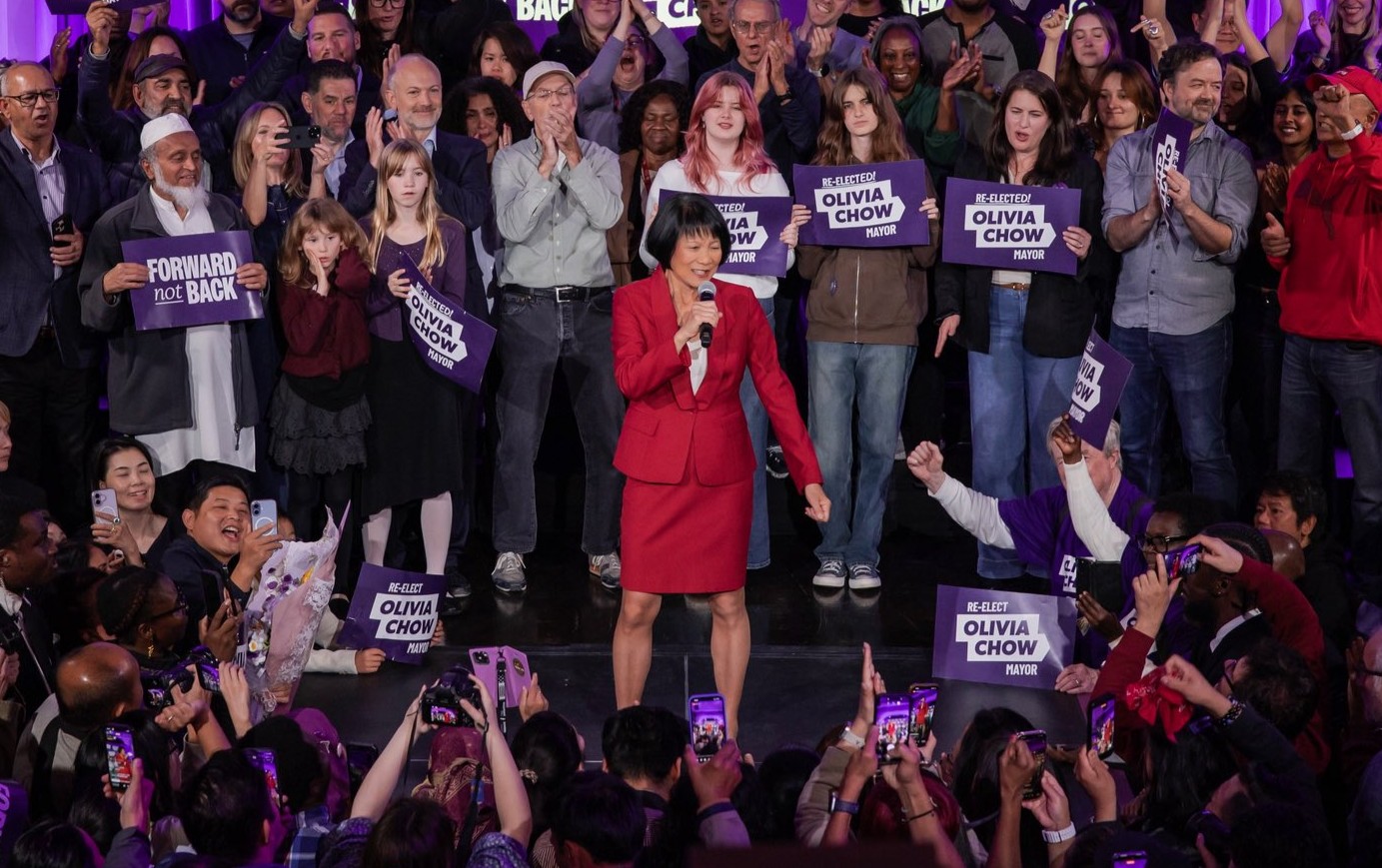
Toronto’s municipal election has ended with a comfortable victory for incumbent Olivia Chow. Challenger Brad Bradford, who shot up in the polls out of nowhere, seemed to pose a serious challenge. But at the last second, Chow pulled ahead, winning 54 per cent to Brandford’s 41 per cent.
Many people perceived this as a race between “right-wing conservative” Brad Bradford versus the more “progressive” Olivia Chow. For example, Bloomberg published an article on the election with the title “Billionaire-Endorsed Rival Threatens Progressive Toronto Mayor’s Hold on Power”.
It seems like fear of a Bradford mayorship galvanized support for Chow right before voting. In particular, there were worries that he would privatize Toronto’s water services, a prospect which was heavily exaggerated by the Chow camp in a desperate bid to keep her popularity up.
However, when we compare their platforms it becomes difficult to notice any difference between these two on any important question.
For example, Brad Bradford (also known by his ridiculous legal name, Bradford Bradford) was seen as the “tough on crime” candidate. He promised to raise police funding, and his supporters were more likely to cite crime as a top issue.
But Chow’s position on police funding is practically identical. Bradford promised to hire a net total of 1,000 cops over the next four years, after taking retirements into account. Chow’s current plan will hire 1,800 cops over the next five years. While taking into account projected turn-over, Bradford’s plan would have only hired 191 more cops over a slightly shortened timeframe.
There’s also Bradford’s Zionism. Groups like the Palestinian Youth Movement have rightfully highlighted and condemned his full-throated support for the Israeli state and hateful attitude towards the pro-Palestine movement.
But Chow’s record on this question is also terrible. She’s spent years as mayor attacking and defaming Palestinian protesters. Shortly after Oct. 7, she defamed a pro-Palestine rally as an “unsanctioned” “terrorist” rally. She backed the “bubble zone” by-law that placed broad restrictions on the right to protest. And she’s a solid supporter of Project Resolute, a police operation that’s been terrorizing Palestine activists.
The only somewhat substantial point of difference was on property taxes. In her first two years as mayor, Chow raised residential taxes 9.5 and 6.9 per cent. These are flat taxes that disproportionately affect working-class home owners.
Bradford promised to freeze property taxes. But considering that property taxes are one of the few ways the city has to raise money, and that the city already has a $1 billion shortfall in its budget, this could only ever be a temporary measure. Rob Ford made and abandoned the same promise while he was mayor.
Also, Chow has already promised to keep property taxes “at or around” inflation, which is not too different from Bradford’s proposal.
There’s very little here that would help or inspire anyone. Some commentators noted that the election was characterized by a “lack of big ideas.”
This is despite the fact that working-class Torontonians face an immediate crisis. In many ways, this city has become a nightmare for ordinary people. It’s the second most expensive city with the highest income inequality in Canada, with the 18th highest rental prices in the world.
Everyone feels the pressure. Eighty-one per cent of Torontians doubt that a young person can start a good life in the city. Fifty-four per cent of people have seriously considered leaving the city in the past year. Sixty per cent agree that city hall needs a major change in direction.
Bradford’s surprise popularity is a partial reflection of this growing discontent. No incumbent mayor has lost an election since Toronto amalgamated. John Tory won by over 40 points in 2018 and 2022. So the fact that Chow could have lost to a candidate who only got one per cent of the vote in the previous election is quite significant, and shows that a layer of people in the city are looking for an outlet to their anger.
But no candidate can improve things significantly if they respect the sanctity of the billionaires’ private property, which they all do. There is only so much money that can be raised through general property taxes, which moreover hit ordinary people. Consequently, every candidate ends up proposing almost identical programs.
Just look at who endorsed who. Olivia Chow, the “progressive” candidate, received a tacit endorsement from Conservative Premier Doug Ford, while Bradford, the nominally more conservative candidate, received a flurry of endorsements from Liberal members of parliament. These cross-party endorsements are acceptable because all of these politicians are part of one big club, all upholding the same fundamental interests.
Now we’re in for four more years of the same-old. Nothing significant has improved under the first four years of Chow, and there’s no reason to expect much to be different over her next term.
But there’s no reason why things have to be this way. Toronto is a very rich city. It’s the 13th wealthiest city in the world. It’s home to 200 people who control $100 million in wealth, and 18 billionaires.
Despite the housing crisis, there are plenty of unused units. Vacancy rates in the GTA have reached a five-year high. In many cases, housing prices are being kept artificially high through shady deals and market manipulation.
Toronto is a city with enormous wealth and potential that’s currently being squandered by our local capitalists. A candidate who points this out and promises a bold, left-wing program could become extremely popular.
In cities like Vancouver, we’ve seen the election of socialist councilors who promise to fund social services by placing the burden on the ultra-wealthy with things like a mansion tax and an empty homes tax. This shows that another approach is possible. There would be a healthy appetite for a campaign like this in Toronto, and the election of a socialist municipal government in Canada’s biggest city would be a welcome step-forward.
But left-wing city councillors and mayors, whether in Vancouver or Toronto, inevitably run up against the barriers of private property. Even progressive taxation has its limits under capitalism. Only if we are prepared to go all the way and mobilize the working class to challenge the right of the billionaires to own the means of production can we find a way out of this blind alley.

