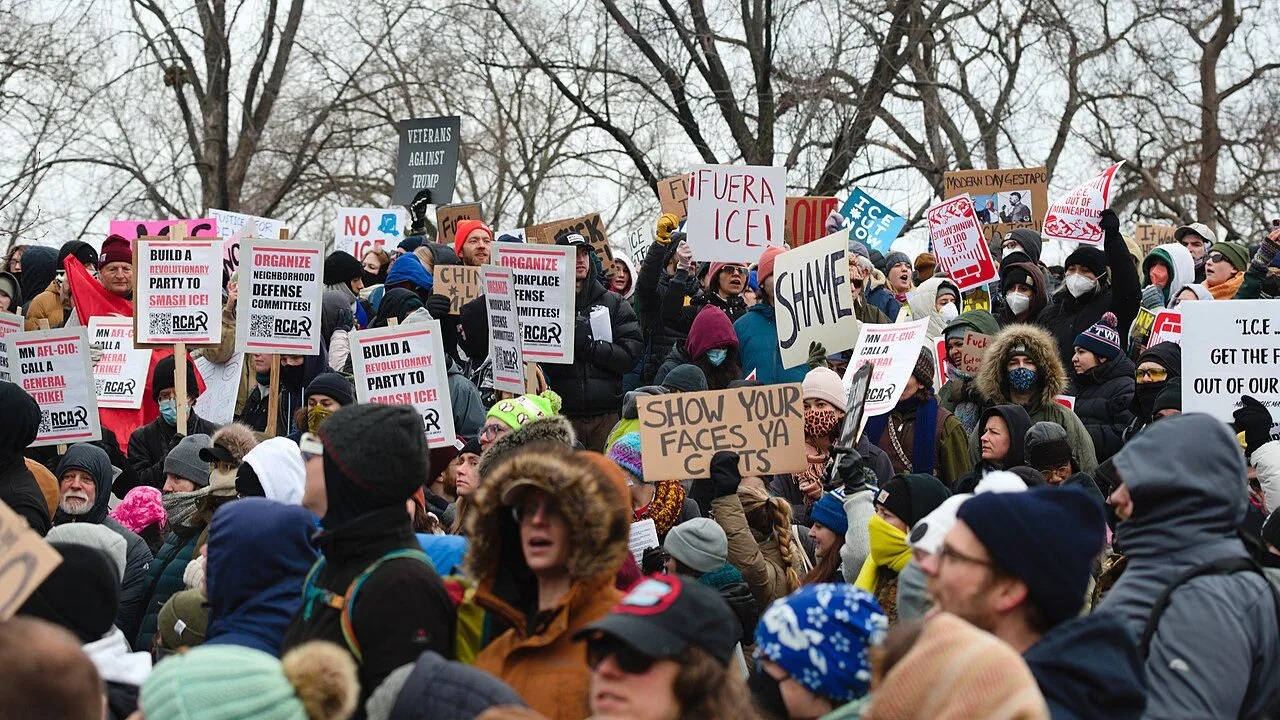
Two weeks since ICE agents in Minneapolis murdered protester Renee Good, the movement that erupted in response to her killing continues to gain momentum. In the epicenter of 2020’s George Floyd uprising, protesters have clashed with police and ICE thugs. Ordinary workers are organizing and strategizing to safeguard their neighbors and coworkers, and the idea of a citywide general strike has seized the imagination of a growing layer of the population. This speaks volumes about the mood of class rage permeating US society as the “war on terror” is turned directly against US citizens.
[Originally published at communistusa.org]
A spark ignites a fire
Let’s recap the events of the past two weeks. At the beginning of the month, the Trump administration deployed 2,000 ICE agents to Minnesota to clamp down on foreign-born workers in an attempt to distract from the Epstein files and his failing economic agenda. On January 7, ICE agent Jonathan Ross shot Renee Good point blank as she attempted to drive away from ICE agents surrounding her car. This was nothing less than an extrajudicial killing by the capitalist state.
While the Trump administration immediately branded Good as a left-wing “terrorist” who “weaponized” her car to run over an ICE agent, copious video evidence and eyewitness accounts made it abundantly clear that she was, in fact, murdered in cold blood.
Ordinary workers and young people across the US watched the videos in horror, rage, and disbelief. Immediately after the killing, protests and vigils took place all over the Minneapolis–St. Paul metropolitan area, with solidarity protests springing up across the US.
Trump administration hardliners have cheered on the ICE brutality. Trump even threatened yet again to invoke the Insurrection Act—but has since backtracked. The more sober representatives of the American bourgeoisie watched events play out with grave concern. In an interview with Minneapolis Police Chief Brian O’Hara, The New York Times asked: “When you found out that there was a shooting involving an ICE agent, what was your first thought?” O’Hara’s response said it all: “I mean—I’m having a hard time describing it. I just thought, fuck, this is it. You know? This is potentially 2020 all over again.”
O’Hara’s anxieties about 2020 are well founded from the point of view of the ruling class. That year, racist police terror perpetrated by his department served as the catalyst for the largest mass movement in American history. And as subsequent events have made clear, there is no lack of combustible material waiting to be ignited in Twin Cities—and nationwide.
“I felt like we had nothing to lose anymore”
Immigrant rights activist networks have been reinvigorated by Trump’s high-profile campaign of deportations. Given the brazen murder of an American citizen, some might have expected anti-ICE activists to lay low for fear of more reprisals. In fact, the opposite happened. The killing of Renee Good did not cow the movement, but rather significantly emboldened tens of thousands of ordinary Minnesotans, determined to intensify the fight to defend their city against ICE terror.
As The New York Times reported on January 14:
Anti-ICE tactics by volunteers and so-called patrollers who track and follow immigration agents in caravans have only intensified in the Twin Cities in the last week, despite Ms. Good’s death, activists and officials said in interviews … Group chats on WhatsApp have proliferated, as neighbors watched for signs of immigration agents and rushed outside to confront them.
Ashley Lopez, who works in education and lives in the city of West St. Paul, has become active in anti-ICE neighborhood groups only in the week since Ms. Good’s death.
“Because of what happened to Renee, I felt like we had nothing to lose anymore,” said Ms. Lopez, who has joined patrols that blow whistles and set off their own car alarms if they see ICE agents. “Why should she be the only one who put herself in danger?”
Another New York Times article from January 17 details the situation in Minneapolis:
Fear and fury can explode on any street corner during this charged time in Minneapolis, any time, any place the muscle of the federal government meets the rage of the citizens who reject its tactics.
Thousands of people attended a march last Saturday to mourn Renee Good, the woman an ICE agent had shot and killed days earlier. There have been school walkouts, daily protests outside the federal building where agents take detainees, four-person protests on frigid street corners and an hourslong demonstration after an ICE agent shot a man in the leg while attempting to detain him on Wednesday night.
But the city’s defiance toward the thousands of federal agents surging into Minneapolis also looks like this: local people using their cars, whistles, phones and local networks to monitor and confront the agents wherever they can, sticking close to them to complicate their efforts, like cornerbacks guarding wide receivers.
These scenes are remarkable for their defiance and for the utter contempt shown towards ICE by ordinary Minnesotans. Even after these federal thugs showed their willingness to harass, detain, and murder foreign- and native-born workers alike, people in Minneapolis–St Paul have continued to alert their neighbors of the presence of ICE, track and tail their vehicles, throw snowballs, and curse at ICE agents while they attempt to round up their coworkers.
A broader layer of workers and young people have mobilized in daily demonstrations and rallies since January 7. So far, the largest demonstration took place on January 10, when tens of thousands protested in the frigid Minnesota weather. Twin Cities comrades of the RCA reported the following:
When we arrived, we were struck by the scale and energy of the protest. It was estimated that tens of thousands were in attendance—possibly upwards of 100,000 according to some activists. For hours on end the crowd chanted “Fuck ICE!” People were angry with the Democrats, who have proven that they won’t fight ICE. 30–40 comrades and contacts joined us, carrying newspapers, leaflets, and signs with slogans like “MN AFL-CIO: Call a General Strike” and “Build a Revolutionary Party to Smash ICE.” Comrades asked protestors what was needed to get ICE out of Minneapolis. Many said this protest was a start—but not enough.
Since Trump was reelected, there has been constant chatter in the demoralized liberal media about the alleged “shift to the right” of the US population. The Revolutionary Communists of America have rejected this impressionistic, short-sighted argument from day one. The eruption of anger in Minnesota shows clearly that, while a section of workers is still testing Trump’s program, a huge stratum of US society has already rejected him and been radicalized to the left.
Mass interest in the question of how to stop ICE
A significant feature of the movement in Minnesota is that wider layers of workers have been pushed into political action. It is not just the usual, smaller “activist layer” who are taking part in anti-ICE actions. People who, in “normal” times, are not particularly political have also been awakened to political life.
A comrade in Minneapolis sent the following report, showing the scale of involvement in the movement:
This evening three RCA comrades attended a community meeting at Whittier International Elementary School in southern Minneapolis.
We were not ready for the mass outpouring that ensued. People were flooding toward the school from all directions. By the beginning of the meeting the entire school was completely filled with standing room only in every large room. Over 1,000 people were in attendance. The Whittier Alliance Neighborhood Association, which had called the meeting, was visibly overwhelmed. They had a small speakers list including a city council member, a state rep, and a park board commissioner. With these speakers came the standard liberal moral appeals … A representative of the South MPLS Tenants Union voiced the need for in-person neighborhood committees organized in every block in the city … providing basically the only source of direction in the entire meeting.
Afterwards time was provided for residents to break out and “find their neighbors.” Our comrades used the opportunity to spread out into the meetings and talk with as many people as possible.
The comrades reported their impressions of the situation: 1) the movement seems to be picking up where the George Floyd uprising left off five years ago; 2) the momentum toward building neighborhood action committees is stronger than ever before; 3) there is growing enthusiasm for a statewide general strike on January 23; and 4) a section of people recognize that the current union leadership is acting as a barrier, but don’t know what to do about it.
Another comrade detailed the mood at the restaurant where he works:
I work in a small restaurant, and ICE terror is forcing my coworkers to strategize for our own safety. At work today, ICE vehicles were reported about 10 blocks away. One of my coworkers gave me a whistle. We locked all the doors except for the front, where a coworker stood on the lookout.
Everyone was on high alert, including the customers. Some shared information and strategized with us, and offered their assistance if anything happened. A coworker barricaded chairs. The owner of the restaurant threw a fit, but his “concerns”—for “business as usual”—were easily disregarded.
About a week later, one of the comrades who attended the 1,000-person mass meeting reported the following:
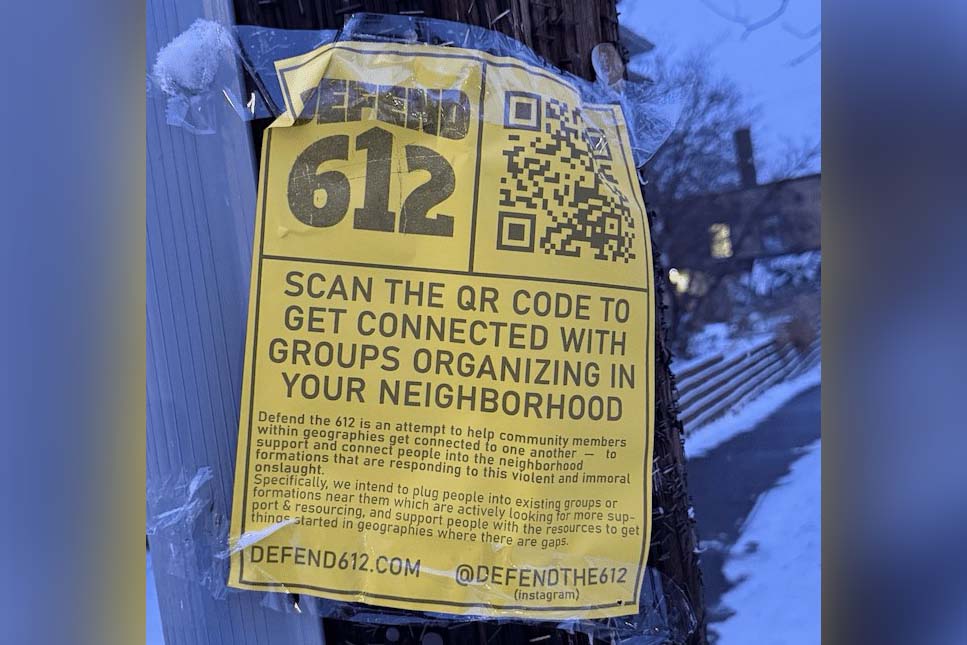
Events in Minneapolis have continued to escalate. Following the mass meeting last week, posters have been popping up around the neighborhood with links and QR codes to join “neighborhood formations.” A lot of the neighborhood defense groups have activist leadership or self-appointed captains.
The local community groups and activist groups have spearheaded the organizational elements of these formations. They are being visibly strained by the sheer number of people entering into this movement. There seems to be nearly a dozen Signal group chats set up for a lot of different neighborhoods across the city. The organizers have had to create duplicates because of the Signal’s size limitations. Just in my neighborhood there are already three “Rapid Response” (RR) group chats because the first two have reached the 1,000-person limit.
These RR chats have been the primary tool of these neighborhood formations and the main point of orientation thus far. These chats are used by people to report ICE sightings. Reports are made in the channel following a “SALUTE” format which includes information on: size, activity, location, uniforms, time, equipment/weapons. It is sort of like a digital whistle, but helps convey more information.
There are groups of people who have set up databases to check license plates and keep track of ICE vehicles in the state. There are groups of people ready to go out on patrol, and people are called on to respond to the presence of ICE wherever they can. There is a real visible division of labor forming within these chats. Rapid Response forms the core, but then there are branches off the neighborhood RR which include Information and Events, Strategy and Planning, Doorknocking and Canvasing patrols, mutual aid, and other needs of the movement.
The deep-seated desire to fight ICE, and the capacity for self-organization among thousands of Minnesotans is clear. However, the spontaneous neighborhood responses also suffer from a lack of regional coordination and centralized leadership. As the comrade reported:
Each activist group seems to be carving out their own part of this while playing to their strengths. No official citywide leadership has been formed. Nobody really knows where to look for a central authority within the movement—a large vulnerability which can lead to confusion and division. 50501 [a liberal anti-Trump activist group] seems to still have a large presence, but otherwise the Democrats cannot seem to play any serious role. Everyone I talk to hates them. Mass meetings seem to be occurring, but not regularly and not focused on broad discussion. Instead, the organizers typically talk to participants with information on the movement.
From what I can tell, there are some in-person meetings of various group chats, but usually centered around a particular goal such as distributing whistles, mutual aid, or going on patrols … When we get a chance to raise our ideas, they have a noticeable effect on average workers, many of whom have never heard such clear ideas and perspectives.
It is abundantly clear that the working class in Minnesota is striving toward organization. But as the comrades reported, “the whirlwind of information, organizations, and lines of communication have been overwhelming for a lot of people.”
In their discussions at the community meeting, the comrades emphasized the need to make these mass meetings regular, and to discuss the lessons of the other neighborhood committees to generalize them across the movement. The comrades also argued the need to elect a centralized citywide leadership, made up of delegates from each neighborhood committee. Lastly, comrades made the case to draw in the unions, to have union members form their own strike committees if necessary, and to build toward a city and statewide general strike to paralyze Minneapolis until ICE is forced out entirely. “These ideas were met with the utmost enthusiasm,” the comrades reported.
The Minneapolis–St. Paul RCA is doing everything possible to raise these ideas in the movement. But when a mass movement like this breaks out, it is necessary to have not only strength in ideas, but significant strength in numbers in order to put our program forward. This is yet another example of why we need to urgently build a revolutionary Marxist cadre party across the country.
January 23 day of action
Faced with all of this mass anger, labor unions across the state, as well as churches and NGOs, have called for a mass “day of action” on Friday, January 23, officially named the “ICE Out of Minnesota Day of Truth and Freedom.” There is also a call for “no school” for students and “no shopping” by the general population.
The Minneapolis Regional Labor Federation, AFL-CIO, endorsed the day of action in a January 16 press release. This is a very positive step forward, and a significant change in the context of the usually meek US labor leadership.
The RCA wholeheartedly endorses this action, and will be enthusiastically taking part in and building towards it.
Unfortunately, the union leaders have, so far, equivocated on the exact nature of the “day of action.” While many rank-and-file activists are casually referring to January 23 as a “general strike,” none of the unions have used this term or made a concerted effort to properly organize a generalized shut down of the economy. Instead, union leaders are calling on workers to take the day off, however they can, on their own time and their own dime. Workers are told that they should take sick leave, paid time off, or rearrange their work schedules so as to participate in a mass rally in downtown Minneapolis.
The union bureaucracy is afraid to violate their contracts by calling for strike action, fearing potential legal problems or more serious conflicts with the capitalists. But we should ask: If ICE is willing to break the law, how seriously should we take the legal “rules of the game” set up by the billionaires?
A bona fide general strike is exactly what is needed to drive ICE out of Minnesota. In addition to halting the operations of ICE, widespread strike action would put pressure on Trump to pull back his attack dogs. In a country that has not seen a general strike since the 1940s, a one-day general strike would be a historic and confidence-building experience. It would show the ruling class what to expect if they continue attacking workers and unions.
We applaud the courage and determination of the activist networks who are tracking ICE vehicles and recording deportations. Still, only the organized and mobilized strength of the working class can truly bring an end to ICE’s vicious campaign. It is the power of the working class that can lead to real victory, not the actions of small groups, however committed and self-sacrificing they may be. This is why the unions must mobilize for a general strike, whether or not it breaks contract stipulations.
With so little time to prepare, the January 23 day of action should be seen as the beginning of a well-coordinated campaign for an all-out general strike across Minnesota. Union stewards should be deployed for an agitational campaign to educate workers on the need for strike action, to prepare workers for a protracted, militant struggle. An all-out general strike would not only fight against ICE, but take up broader economic demands addressing the cost of living crisis, which would draw in even wider layers of the working class.
A successful strike requires serious organization—beginning with action committees in every workplace and neighborhood. These committees could elect delegates from across the metro area to meet in a Twin Cities-wide meeting. This would provide the organizational backbone for a real general strike—an elected and accountable body representing the workers of the entire region. Such a move would transform the situation and prepare the ground for successful battles in the near future.
As part of this campaign, the labor leaders must expose the reactionary scapegoating behind the entire ICE campaign. Foreign-born workers are not the cause of rising rents, unemployment and inadequate wages and healthcare benefits. In fact, 2025 was a year of net migration away from the US, and yet the economic crisis has only gotten worse. The problems facing workers are caused, not by immigrants, but by the billionaire parasites. To defeat them, we need maximum unity of all workers.
The movement must also be clear on the pernicious role of the Democratic Party. The “Democratic Farmer-Labor Party” is simply the Democratic Party in Minnesota, and has absolutely nothing to do with the interests of workers or farmers. While they may opportunistically pay lip service to the day of action, we can be sure they will move might and main to oppose militant workers’ strikes. We must also remember that their party is just as willing as Trump to deport immigrants—they just prefer to do it more quietly.
In short, to make January 23 a success, we must be clear about our goals. We’re not interested in merely letting off a little steam. We want to make actual the colossal potential power of the united working class through mass, collective action. There are two million wage and salary workers in the Minneapolis–St. Paul metropolitan area—compared to just around 2,000 deployed ICE agents.
By shutting down business as usual in a general strike, Minnesota workers can force ICE out of the state. Such a victory would inspire similar actions elsewhere across the country and spread like wildfire. It would begin to pose the question: who should get to decide how the country is run? The profit-hungry bosses and their repressive state apparatus? Or the workers who produce all the wealth of society?
What will it take to end ICE terror?
According to a recent YouGov poll, despite right-wing propaganda about immigrants “stealing jobs,” 46% of Americans—a plurality—support “abolishing” ICE. For 18–29 year olds, the figure is 54%. This shows the clear potential for working-class solidarity between native-born and foreign-born workers alike.
However, “abolishing” ICE as such would not stop the capitalist state from creating some other agency to carry out the same essential function. As long as capitalism remains—a system based on private property and the nation-state—the ruling class will maintain some form of immigration control, and will also cynically scapegoat immigrants to pit different sections of the working class against one another and drive down wages.
This is why the struggle to end terror against immigrant workers must be a struggle for world socialist revolution. By fighting for a nationalized planned economy and a socialist federation of the Americas, we can end the refugee crises, scapegoating, and artificial scarcity that are endemic to capitalism, and which form the basis for the cruelty suffered by immigrant workers.
Workers of all political leanings are fed up with years of stagnating living standards, meager job opportunities, and economic instability. In the same YouGov poll, when asked what the most important issue is, 24% said “inflation/prices,” 16% said “jobs and the economy,” and 10% said “healthcare,” for a total of 50% citing these universal class issues. The fourth-ranking issue was immigration, with only 8% highlighting it as the most important issue.
A mass revolutionary party, with a program emphasizing the class issues that affect all workers, could tap into this mood, breaking significant layers of the working class away from the pernicious influence of both Trump and the liberals, and reframing the polarization in US society along class lines.
Some may dismiss this perspective as unrealistic. But after studying the current situation in Minnesota, who can deny we’ve entered a new era of class struggle in the US?
Gone are the days of political and economic stability in this country. We are witnessing the beginnings of the working class striving toward self-organization and realizing its interests as a class. What is happening in Minnesota is a preview of struggles to come across the entire country. We must energetically intervene in this movement, build the party, and prepare for the struggles that lie ahead.
Workers and students across the Twin Cities: All out on January 23! No school, no shopping, no work!
Turn the January 23 day of action into the launching pad for an all-out general strike!
Elect action committees in every workplace and neighborhood to defend our coworkers and neighbors! Elect a citywide coordinating body to direct the movement!
No faith in the Democrats! Workers need our own party!
The labor movement must reject any military deployment in Minnesota!
Immediate and unconditional amnesty and full rights for undocumented workers and their families!
Join the RCA and fight to end ICE and the capitalist system once and for all!

