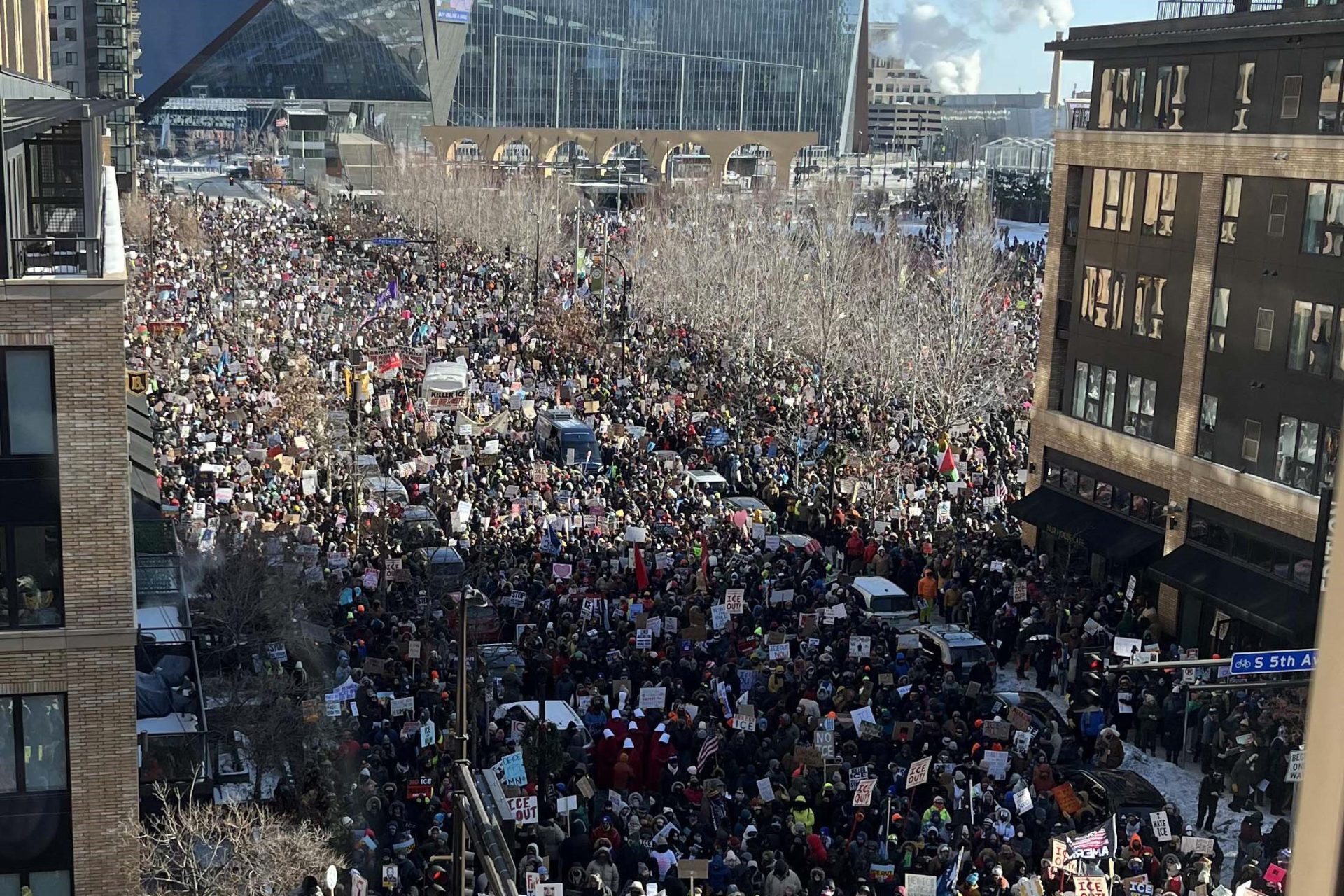
Minneapolis has yet again become the epicenter of the class struggle in the United States. The city that sparked the 2020 George Floyd uprising has seized the attention of class-conscious workers and youth across the country for three weeks—and at present, there’s no sign of things slowing down.
[Originally published at communistusa.org]
Ever since Trump deployed 3,000 ICE agents to the city at the beginning of the month, any semblance of stability and normality in the Twin Cities has been eroded. First, there was the killing of Renee Good on January 7. The subsequent daily protests and widespread civilian resistance against ICE culminated in the de facto general strike of January 23. One day later, Border Patrol riddled ICU nurse Alex Pretti with bullets—the second extrajudicial execution of an American citizen by federal agents this month.
Hundreds of thousands of ordinary Minnesotans feel that their city is under occupation by federal agents, and as the Democrats offer no real solution, ordinary people have been taking matters into their own hands.
It is hard to overstate the significance of what is unfolding in the Twin Cities. Communists must study these events closely, and draw the conclusions about what this means for the trajectory of US society and the class struggle in the second quarter of the 21st century. We have covered the initial killing of Renee Good and the mass resistance that developed in response in previous articles. Now we will pick up where we left off, on the eve of the January 23 “day of action.”
The 2026 Minnesota General Strike
The first thing to say is that January 23, 2026 will be remembered as a turning point in the history of the American class struggle.
Responding to a call by local unions and other organizations for a “day of action” to protest ICE terror, tens of thousands of Minnesotans braved –9° F (–23° C) weather in an energetic outpouring of mass political action. The result was a de facto citywide general strike, imposed from below.
This was the first time anything remotely close to this has happened in the US in 80 years, since the 1946 strike wave, which saw general strikes in Oakland, Rochester, and other cities.
Furthermore, this was essentially a political general strike. It was not an economic action over wages and benefits, but an overtly political act, aimed directly at the repressive apparatus of the national government. It was sparked in defense of workers unfairly targeted because they don’t possess a particular piece of paper, and to protest against the brazen killing of American citizens for the crime of exercising their constitutional rights. In it, the embryo of an emerging class consciousness can be clearly discerned.
The strike mushroomed organically despite the lack of a militant class-struggle leadership, thanks in no small part to the self-organization of the working class taking place in neighborhood meetings and Signal chats across the Twin Cities.
Even Greg Bovino, the arch-reactionary “commander-at-large” of US Border Patrol, was forced to acknowledge this reality. As he said at a January 20 press conference: “What we’ve seen that’s a bit different here [from immigration raids in other cities] is the organization of some of the groups. The groups are a bit better organized. They’ve got some excellent communications.” These “excellent communications” were on full display in the leadup to January 23.
Just imagine what could be accomplished if the unions actually mobilized their members and resources to build for an all-out shutdown! As we explained ahead of January 23:
With so little time to prepare, the January 23 day of action should be seen as the beginning of a well-coordinated campaign for an all-out general strike across Minnesota. Union stewards should be deployed for an agitational campaign to educate workers on the need for strike action, to prepare workers for a protracted, militant struggle. An all-out general strike would not only fight against ICE, but take up broader economic demands addressing the cost of living crisis, which would draw in even wider layers of the working class.
A successful strike requires serious organization—beginning with action committees in every workplace and neighborhood. These committees could elect delegates from across the metro area to meet in a Twin Cities-wide meeting. This would provide the organizational backbone for a real general strike—an elected and accountable body representing the workers of the entire region. Such a move would transform the situation and prepare the ground for successful battles in the near future.
“Like a wildfire”
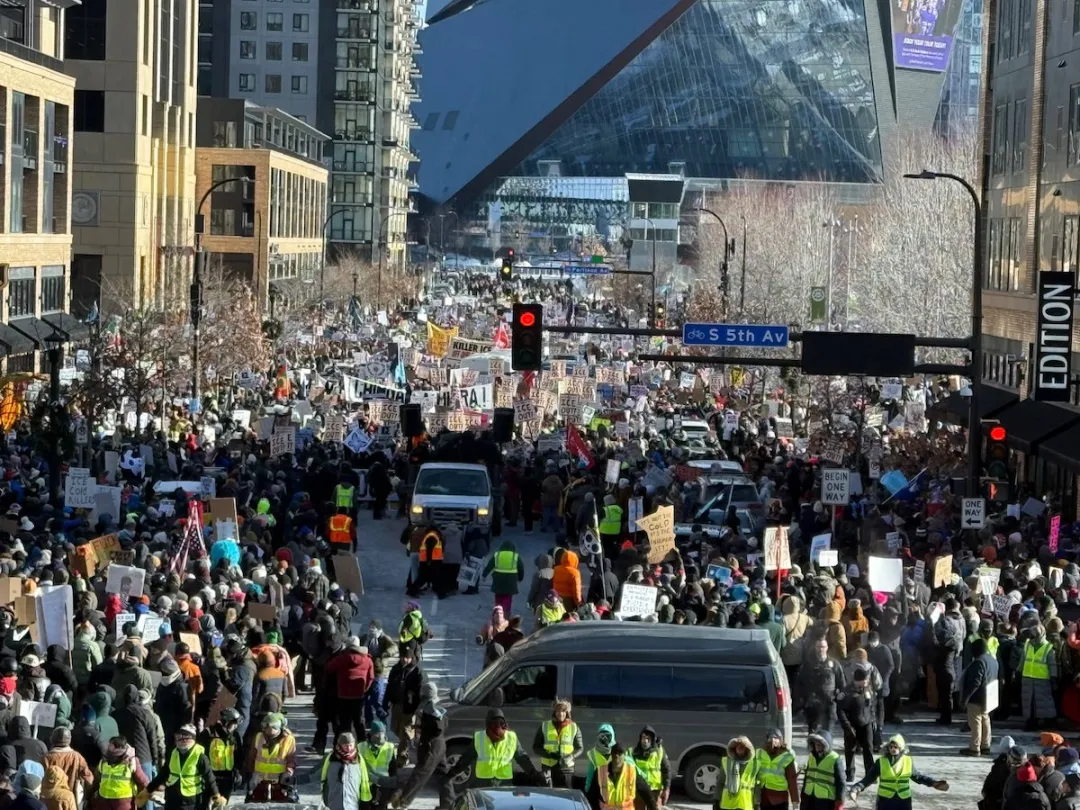
Under pressure from below, some unions, as well as NGOs and churches, called for the “day of truth and justice” to protest ICE terror on January 23. The Minneapolis regional AFL-CIO eventually endorsed it, followed by the statewide AFL-CIO organization.
This was a significant step forward for the labor movement, which the RCA enthusiastically supported. However, while they officially endorsed the day of action, the union leaders were ambiguous about its character. Afraid to violate anti-democratic laws like Taft-Hartley, which ban unions from engaging in solidarity strikes, they called for a demonstration, stopping conspicuously short of uttering the word “strike”—much less “general strike.”
However, rank-and-file activists and ordinary workers had other ideas. Enraged by the killing of Renee Good and the shameless violence ICE’s thugs have been inflicting on their neighbors and coworkers, tens of thousands of Minnesotans decided that enough was enough. Enthusiasm for a general strike percolated throughout workplaces and campuses. This occurred despite a near-total media blackout in the American press regarding the planned “economic blackout.”
By the morning of the day of action, it was evident that nothing could stop the momentum, and that something major was brewing in Minnesota that day. The New York Times reported:
Word of Friday’s strike and protests spread “like a wildfire” in the preceding days, said Jake Anderson, an executive board member with the St. Paul Federation of Educators, a union representing teachers and educational support professionals. Hundreds of businesses, mostly in Minneapolis and St. Paul, said they would close. On Friday, it seemed as though many followed through on that promise.
The same article continued later on:
For some leaders of local and state unions, the decision over whether to encourage their members to participate in the general strike was difficult, because it was not organized under state and federal strike laws, and was not considered an official “work stoppage day.” But the push for the boycott spread so widely that it became hard to ignore.
Work stoppage
The ensuing generalized work stoppage went far beyond the bounds of a normal mass demonstration. The unions may have raised the idea, but workers across the state took it and made it their own.
Nearly 800 small businesses closed their doors for the day, either due to genuine political solidarity with the anti-ICE movement, pressure from employees who wanted to participate, or a mixture of both.
At first, only a handful of small businesses had announced closures, but as the pressure to participate grew, dozens and then hundreds of small businesses followed like dominoes. The result was a cascade of small business closures. “Every shop I’ve ever been to in Minneapolis was closed,” said an RCA comrade who was born and raised in the Twin Cities. Institutions such as the Science Museum of MN, the MN Institute of Art, and the Guthrie Theater also closed.
The public school system and University of Minnesota announced closures, ostensibly due to the weather. But in a state that is accustomed to extreme cold temperatures, the inclement weather was merely a useful excuse to save face while giving in to the pressure of the tens of thousands of students who were enraged and politicized by recent events.
Minnesota’s largest employers, like Target, UnitedHealth Group, 3M, and Xcel Energy, did not close their doors for the day, and there were no indications of major work stoppages at any of these companies. However, thousands of workers at these kinds of workplaces still used paid time off or called in sick in order to join the mass demonstration.
RCA comrades on the ground in Minneapolis–St. Paul explained that, in general, managers at larger workplaces did not even try to prevent this from happening, given the momentum and the widespread enthusiasm for a successful day of action. In effect, workers forced the hands of their employers through mass collective action. And if it did not result in a total shutdown of the key levers of the local economy, it certainly constituted a generalized work stoppage, making a significant dent in the economic activity of the metro area that day.
Workers across the city strived instinctively to exert their power over the economy and shut down “business as usual” in Minnesota, despite no serious lead being given by the unions. This was also on display in the demonstration outside the Minneapolis airport earlier that morning, which ended with 100 people being arrested by police. While the demonstration did not succeed in shutting down the airport entirely, it was notably much larger than usual activist attempts to “shut down” transit lines, and it showed a healthy instinct towards the need to paralyze this key economic node.
By the afternoon, with the mass demonstration of over 50,000 people underway, even some mainstream bourgeois media outlets were starting to call it what it really was.
“Thousands march through downtown Minneapolis protesting against ICE as state workers hold general strike,” read a CBS headline.
“The Trump administration’s immigration crackdown and ICE surge in the Twin Cities drew large protests today. It was part of a general strike and walkout backed by labor leaders and faith groups,” reported PBS NewsHour that night.
Even The New York Times—the “paper of record”—updated their article to explain that the “protests on Friday were part of [a] general strike organized by residents, faith leaders, and labor unions.”
Local news channel Fox 9 Minneapolis–St. Paul gave its viewers a quick history lesson about the “last” general strike in Minnesota: the 1934 Teamsters Strike, during which Trotskyists led a two-month shut down of the city.
The US bourgeois media is not accustomed to even entertaining the idea of a general strike in this country. But as the strike unfolded, more and more journalists could find no other way to describe it.
Mass consciousness
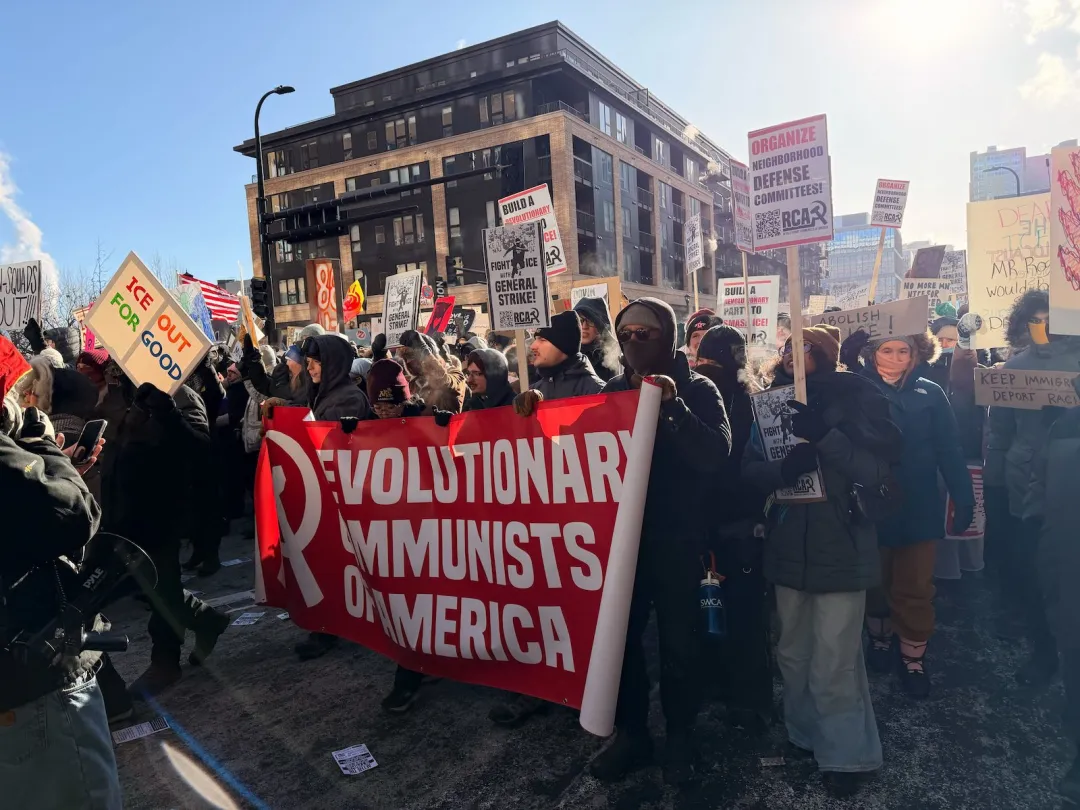
To be sure, as in any genuinely mass movement, there was considerable ideological heterogeneity among the participants, and not a small amount of political confusion. How could it be otherwise? Decades have passed since this country last saw well-led militant strikes, and the labor movement is just starting to wake up after a long period of slumber.
Many radicalized young people took part, but so did workers and small business owners who continue to have illusions in the Democratic Party. Liberal, pacifist, and religious slogans were present alongside more radical demands. As the Minneapolis–St. Paul RCA reported: “Of course, we encountered plenty of radical youth and workers, who marched with us. However, there were still many liberals who had ‘No Kings’–type signs, focused on insulting Trump and rallying behind local Democrats.”
As the comrades explained:
Not everyone in this movement wants to get rid of ICE (and all deportation enforcers) for good. A good chunk just want to see ICE temporarily stop committing open human rights violations in their state, and trust the Democrats to do this. That’s to be expected.
There were still many radicalized people in the crowd completely open to our perspective. Events are bringing people into political life, and they will have to see even more betrayals by the Democrats for their perspective to meaningfully change. What’s really significant is that many “average liberal” types are now much more open to engaging with communists than in the past, as many have already seen the treachery of the Democrats.
Probably a majority of participants in the general strike did not necessarily see themselves as workers striking against the capitalist class, but rather, as “Minnesotans” coming together to fight what they see as an occupation by federal immigration officers. But Marxists do not expect the working class to arrive at crystal-clear class clarity overnight. As Lenin explained, “Whoever expects a ‘pure’ social revolution will never live to see it. Such a person pays lip service to revolution without understanding what revolution is.”
The real movement of the working class contains all manner of confusions and contradictions, which the Marxists seek to resolve over time through active participation and patient explanation.
However, there is no denying that appetite comes with eating. The essential feature of the general strike was that tens of thousands of workers opted to exert their power over the economy in an attempt to drive federal law enforcement officers out of their city. The instinctive class sentiment that “we have to take matters into our own hands” found the most advanced expression we have seen in the recent history of the US class struggle. In other words, the laboring masses are beginning to realize that they can alter the course of events by exercising their ability to shut down the economy.
The murder of Alex Pretti
Morale was exceedingly high in the afterglow of January 23. But on Saturday morning, the mood took another sharp turn. Minnesotans were afforded just a few short hours to celebrate the successful day of action, before news of another ICE shooting spread on social media and local neighborhood Signal chats. ICE had committed yet another scandalous extrajudicial murder.
37-year-old Alex Pretti, a unionized ICU nurse at a Veterans Affairs hospital was killed for the crime of using his phone to film ICE agents in the Whittier neighborhood of Minneapolis. His last words were “Are you okay?” as he sought to help a woman who had been pepper sprayed by ICE, moments before he was tackled, forcibly held down and pummeled by a gang of six officers, and shot ten times.
As the news spread, Minnesotans spontaneously left their homes in droves to gather outside. The Department of Homeland Security brazenly lied to the public, stating before any investigation and against all evidence that Alex Pretti was a “domestic terrorist” intent on massacring law enforcement officers. Meanwhile, every new angle of video and each new detail that emerged about the victim only added fuel to the fire.
Governor Tim Walz mobilized the National Guard in anticipation of mass protests and riots. Some had hoped he was planning to disperse ICE with these forces, but it was clearly just a move to establish “order” on behalf of the ruling class in Minnesota.
A vigil was initially called at the scene of the killing, starting at 1:00 pm. However, in the hours that followed the shooting, Whittier became a kind of war zone. People set up makeshift barricades, as clashes took place between protestors, the riot police, and ICE. So much tear gas was deployed that MCAD, a college four blocks away, had to evacuate some dorms due to gas leaking in through the windows and vents, and the original vigil was canceled.
While this unfolded, calls for a national general strike began trending on X. When 50501 asked its Instagram followers how to move forward after Alex Pretti’s murder, the top response captured the mood: “A general nationwide strike and again while the iron is hot.”
Enthusiasm for an expanded general strike was just as well received on the ground, with spontaneous protests erupting across Minneapolis–St. Paul.
In another astonishing example of the mood on the ground—somewhat reminiscent of the famous scene in Tiananmen Square in 1989—an armored National Guard vehicle was stopped and surrounded by a crowd of unintimidated protestors.
Militant mood at a spontaneous vigil
Since the “official” vigil had been cancelled, several spontaneous group chats for planning vigils formed, as ordinary citizens took it upon themselves to hold vigils at parks in different parts of the city.
One comrade of the RCA, who played a leading role organizing the vigil for Alex Pretti in his neighborhood, sent in a very telling report.
As the plans were being put together, the comrade had asked in his local group chat, “Do we think we should use this as an opportunity to discuss as a community what the way forward is? We need mourning, but we need to also avenge the dead by kicking ICE out for good.”
“People enthusiastically agreed and then their question was who could start and guide the discussion,” the comrade explained. “I put my hat in the ring. I decided to connect the recent killings to Bloody Friday in 1934 and the general strike that followed it.”
At the comrade’s suggestion, the group sought help from neighbors and people in the group chat, assembling a team of six people who started posting hundreds of leaflets across the neighborhood, door knocking, and calling on everyone to spread the word. Other people shared the leaflet through Signal chats, Instagram, and Yik Yak.
300 people assembled for the vigil, which began with a eulogy for Alex Pretti and the distribution of whistles, before our comrade’s introduction about the way forward and the lessons of the 1934 Teamsters Strike. “A few minutes into my introduction, one attendee started heckling me saying that ‘this is just old stuff that doesn’t matter to the situation today,’” the comrade reported. “A couple other older people joined in on these grievances, but then received a large response from at least a dozen others who shouted that ‘history repeats itself,’ and that ‘we have to learn from history.’”
After the comrade opened the discussion, the floor was open to any other attendees who wanted to speak. As the comrades relate:
One worker spoke and explained he had grown up trusting the cops, trusting the state and politicians. He continued on, explaining that every single one of these institutions has proven they are against the people. He ended by saying that the only people we can trust is ourselves. This was received with cheers.
Summarizing the mood at the vigil, the comrade explained, “People saw ICE as a fascistic or dictatorial threat that we must absolutely crush with a mass movement and general strike. Many people were actively shaking off their fears and looking to enter into the mass movement for the first time.”
The molecular process of revolution
This vigil is just one of many examples of the mood in Minnesota at the present time, which is characterized by a politicization of all layers of society, in which political discussions are taking place everywhere.
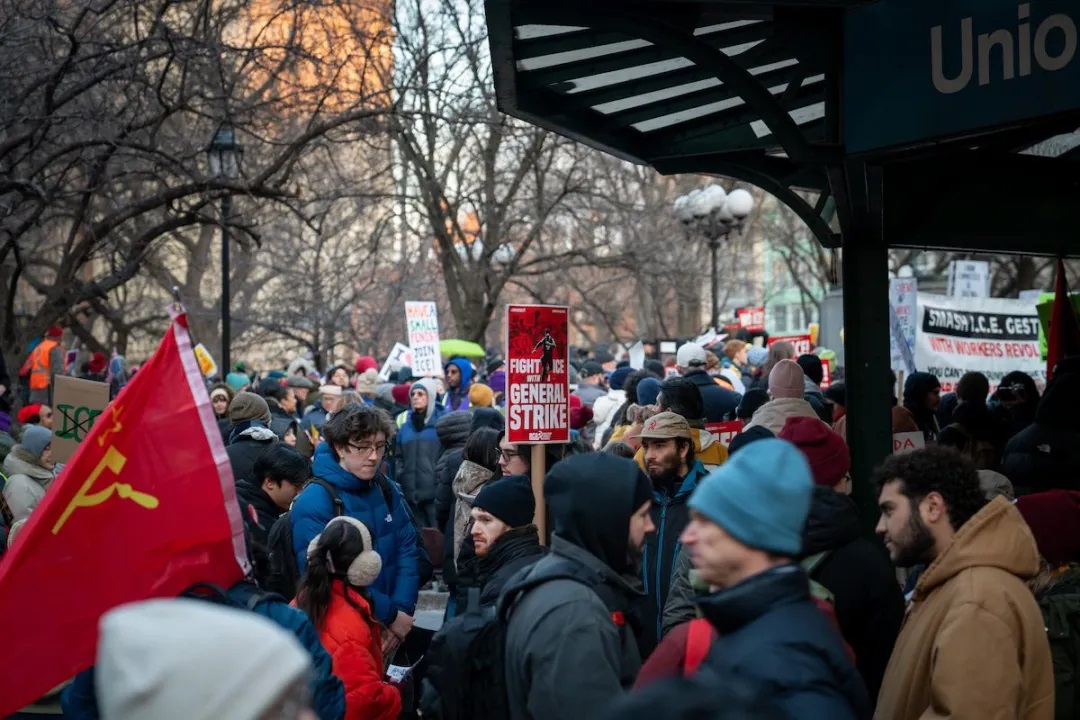
In “normal” times, only a small layer of the working class takes an active interest in politics, while the masses largely leave it to the professional politicians and other representatives of the ruling class to run society. But under the impact of great events, a much larger layer of society is compelled to take an interest in political life. This was reflected in an anecdotal report sent in by another comrade in Minnesota on Sunday night:
After a long day of political discussions with new recruits, I decided to treat myself with a meal at a local restaurant, around a mile away from where Alex Pretti was murdered.
As I finished paying my bill, I asked the waitress if they had plans for if ICE shows up, and the answer was, “yes!” She described the protocol that the employees and manager had come up with, as well as the security measures that they are preemptively taking.
I asked her if she had coordinated yet with the employees of the neighboring businesses, and her eyes went wide. She said that it was an amazing idea, and started brainstorming out loud about developing communication lines between all of the local establishments, so that the workers could all mobilize in the event that ICE shows up!
We discussed the conflicting interests of the workers and corporate owners on the issue of workplace safety, and ways that the movement could escalate with democratic city-wide leadership, and even link up with other cities! She happily grabbed our leaflets for herself and her coworkers.
This same mood was also captured in a January 25 article in The Atlantic by Robert F. Worth, which deserves to be quoted at length:
Behind the violence in Minneapolis—captured in so many chilling photographs in recent weeks—is a different reality: a meticulous urban choreography of civic protest. You could see traces of it in the identical whistles the protesters used, in their chants, in their tactics, in the way they followed ICE agents but never actually blocked them from detaining people. Thousands of Minnesotans have been trained over the past year as legal observers and have taken part in lengthy role-playing exercises where they rehearse scenes exactly like the one I witnessed. They patrol neighborhoods day and night on foot and stay connected on encrypted apps such as Signal, in networks that were first formed after the 2020 killing of George Floyd.
Again and again, I heard people say they were not protesters but protectors—of their communities, of their values, of the Constitution. Vice President Vance has decried the protests as “engineered chaos” produced by far-left activists working in tandem with local authorities. But the reality on the ground is both stranger and more interesting. The movement has grown much larger than the core of activists shown on TV newscasts, especially since the killing of Renee Good on January 7. And it lacks the sort of central direction that Vance and other administration officials seem to imagine.
At times, Minneapolis reminded me of what I saw during the Arab Spring in 2011, a series of street clashes between protesters and police that quickly swelled into a much larger struggle against autocracy. As in Cairo’s Tahrir Square, Minneapolis has seen a layered civic uprising where a vanguard of protesters has gained strength as many others who don’t share progressive convictions joined in feeling, if not always in person. I heard the same tones of outrage from parents, ministers, school teachers, and elderly residents of an affluent suburb. Some of the quarrels that divided Minneapolis city leaders only a few weeks ago, over policing or Gaza or the budget, have faded as people have come together to oppose ICE.
As he explains later in the article:
The participants I spoke with did not seem like typical protest types. One of them, a driver’s ed teacher who asked me to identify him only as Dave, told me, “I do not like confrontation at all, and that’s another reason that it’s weird I went to the training.” But in light of what is happening around him, he felt he needed what the trainers had to offer. His 14-year-old daughter, who attended the training with him, told me, “It was kind of overwhelming. But I don’t think it could be too much, because they’re just being realistic.”
The nonprofit groups that run these training sessions are not organizing or directing the anti-ICE protests taking place in the Twin Cities. No one is. This is a leaderless movement—like the Arab Spring protests—that has emerged in a spontaneous and hyperlocal way. The people who follow ICE convoys (they call themselves “commuters,” a verbal gesture that is part joke and part effort to elude government surveillance) have organized on a neighborhood basis, using Signal groups. The man who drove me to the ICE raids I witnessed—a lawyer, activist, and social-media figure named Will Stancil—had a cellphone fixed above the windshield of his car, and I could hear people tracking the location of the ICE convoy as it passed through their neighborhoods on a Signal audio chat. It was like being inside a police car that is getting updates by radio from a dispatcher.
You do not have to get tear-gassed to observe all of this self-organization; it is visible to anyone walking through Minneapolis. One bitterly cold morning, I approached a man standing across the street from an elementary school, a blue whistle around his neck. He told me his name was Daniel (he asked not to be identified further, because his wife is an immigrant) and that he stood watch every morning for an hour to make sure the kids got into school safely. Other local volunteers come by regularly to bring him coffee and baked goods, or to exchange news. These community watches take place outside schools throughout the Twin Cities, outside restaurants and day-care centers, outside any place where there are immigrants or people who might be mistaken for them.
“It’s kind of unorganized-organized,” Daniel said, when I asked how the school monitoring worked. “George Floyd connected everybody.”
The local networks that formed after Floyd’s killing were not just about fighting racism. During those febrile weeks in May and June of 2020, there were looters and provocateurs of all kinds on the streets, and so much anger had been directed at the police that they pulled back from parts of the city. Many neighborhoods began organizing local watches simply to defend themselves.
The capacity for self-organization, the rapid changes in consciousness, the class instinct coming to the fore, and the massive potential to escalate the movement even further are absolutely apparent. Hundreds of thousands of ordinary Minnesotans are searching for a way forward, hellbent on driving ICE out of their state. But there is also a major shortcoming: the lack of a clearly defined political leadership for the movement. What’s needed now is a serious mobilization for an all-out nationwide general strike to stop ICE. But without a revolutionary leadership rooted in every Twin Cities neighborhood and every other American metropolitan area, there is no organization able to give the necessary lead at this time.
As Lenin explained long ago, “It is too late to form the organization in times of explosion and outbursts; The party must be in a state of readiness to launch activity at a moment’s notice.” The comrades of the RCA in Minnesota are doing everything possible to put our ideas forward, but we don’t yet have the forces to gain a mass echo. This is why we must utilize this opportunity to urgently build the forces of revolutionary communism, in preparation for the even more momentous events of the not-too-distant future.
History in the making
It is fitting that, as momentum for a general strike was building up in the Twin Cities, representatives of the world’s ruling classes were gathering in Davos, acknowledging the end of the post–World War II world order.
The 80-year anomaly that began in 1945, in which both inter-imperialist tensions and the class struggle were softened for a time, is rapidly unraveling. Yes, as the liberal press bemoans, we are back to a world of open competition between the “great powers,” in which it is flatly acknowledged that “might makes right.” But we are also returning to the world of open, militant class struggle, of general strikes, and—sooner than most people think—revolutionary upheavals.
With anger mounting over his economic failures last month, not to mention his handling of the Epstein files, Trump evidently thought that shock-and-awe ICE tactics in Minneapolis might serve as a useful distraction. But given the class balance of forces and the anti-ICE rage that has built up in Minnesota and across the country, he is playing with fire, as each additional provocation by ICE risks sparking a nationwide social explosion. It’s therefore no surprise that at the time of writing, Trump appears to be backtracking, saying he had a “very good” call with Tim Walz to deescalate the situation.
Whether the movement escalates in the coming days or dies down for a period, we can confidently assert that this was not a mere flash in the pan. History wastes nothing. The scenes in Minneapolis–St. Paul show us the future of every American city. Without a revolutionary party, there are limits to how far the current movement can go, but the experience is nonetheless forging a new generation of class fighters, with immeasurable repercussions for the future. After a long period of slumber, the American working class is starting to flex its muscles and rediscover its class-struggle traditions. January 23 was only a dress rehearsal, a sign of far bigger things to come.

