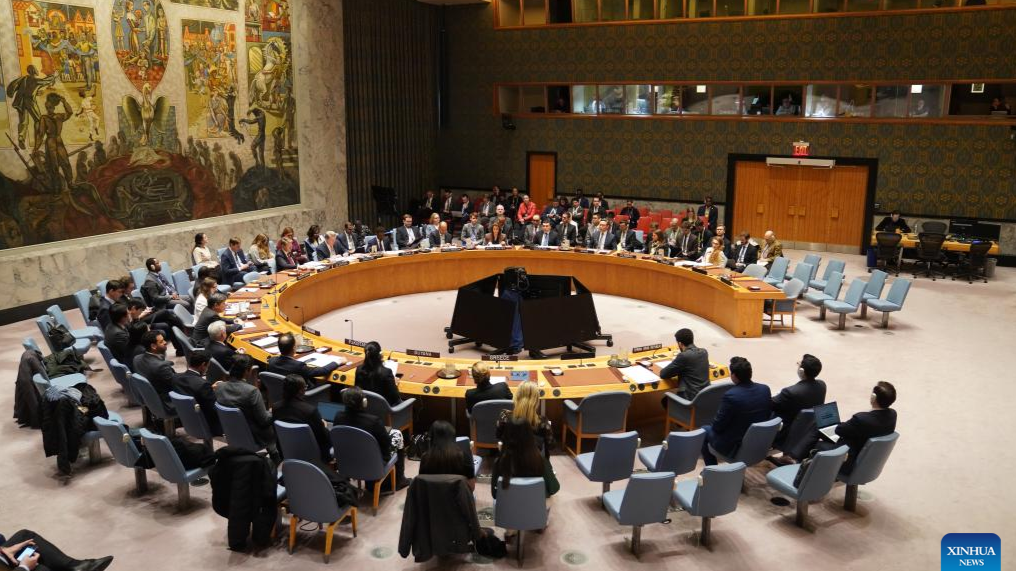
The term “rules-based international order” is on everyone’s lips these days. Liberal commentators have accused Trump of not respecting it, with his threats to annex Greenland.
Mark Carney, in his famous speech in Davos, announced the end of this “rules-based world order.” “We know the old order is not coming back. We shouldn’t mourn it,” he said.
On the left, some lament that international law is no longer respected and that the UN has been abandoned.
The NDP denounced the U.S. attack on Venezuela in these terms: “The U.S. attack on Venezuela is neither an act of self defence nor does it have UN Security Council authorization. It is therefore totally illegal and a breach of the UN covenants the U.S. has agreed to uphold as a Member State.”
Québec solidaire spokesperson Ruba Ghazal wrote on Twitter: “Trump’s military intervention is totally unacceptable and must be strongly condemned. It tramples on international law, which must be our compass to prevent us from sinking into the reign of arbitrariness and imperialism. It is not up to Trump’s United States, nor any other state, to intervene in a foreign country without first obtaining authorization from the UN.”
But as Carney admitted before the whole world, this “rules-based international order” was a “fiction”—a lie to mask the domination of the imperialists.
This becomes clear when we look at how this system of “rules” was established and how it has been used by the powerful throughout history. We should not mourn its demise, but use it to better fight to overthrow imperialism.
The myth of the UN
The term “rules-based international order” is generally used to refer to the world order established after the Second World War.
According to the myth put forward by the ideologues of the ruling class, this order was characterized by relative peace, free trade, disputes between nations settled by international law and diplomacy, and respect for the sovereignty of nations, all governed by international organizations and under the benevolent aegis of the United States and its NATO allies.
The institution that best represents this mythical world order is the UN. But if we take a closer look at the history of the UN, the myth shatters.
Far from being the result of some kind of concerted effort by nations, the UN project was essentially born within the U.S. State Department, at the beginning of World War II. At the time, the Roosevelt administration already foresaw that the United States would emerge from the war as the leading, if not the only, world power. The question of how to administer this hegemony was debated in intellectual circles close to the government.
The idea first emerged to establish a joint naval force with Great Britain to control the oceans and create an “American-British world order.” Roosevelt even considered completely disarming all countries other than the United States, Great Britain, and the U.S.S.R.
But the need to mask this domination became clear: “An imperialistic connotation may all too easily be given to the projected American-British policing of the seas,” warned the Council on Foreign Relations, responsible for advising the State Department. Thus was born the idea of concealing this domination within an international organization, inspired by the defunct League of Nations, but much more pliable to American dictates.
The UN Charter was essentially written by the United States and negotiated with the Soviet Union and the United Kingdom at the Dumbarton Oaks Conference in 1944. China—which, at the time, was still ruled by the U.S.-aligned bourgeois government of the Kuomintang—also participated, although the three major powers led the discussions.
The British and French, fearing that the grand principles serving as a fig leaf for the UN’s imperialist objectives would threaten their colonial empires, succeeded in ensuring that the UN Charter did not recognize the right of peoples to self-determination. A system of “mandates” was also established to legalize the United States’ capture of several Japanese islands.
The 1945 San Francisco conference, attended by 50 nations and which ultimately adopted the Charter, was essentially a rubber-stamping exercise for the decisions taken by the four major powers at Dumbarton Oaks. The U.S. ensured that it controlled the entire proceedings by having the FBI systematically spy on all delegates.
But the British and Americans wanted to ensure that they retained control over all important decisions. They did not want to repeat the failure of the UN’s predecessor, the League of Nations, which was an empty shell with no power. To maintain control, they established the Security Council, which made all the real decisions and in which they gave themselves veto power.
As the Marxist Ted Grant wrote at the time, “Britain and America… would have liked to be able to use this league as they did the last, as a breeding ground for anti-Soviet plots.” But the imperialists had no choice but to also grant the U.S.S.R., the real winner of the war, a seat and veto power on the Security Council. France and China, subordinate partners of the imperialists, also obtained their seats and veto power.
A Turkish delegate complained that this voting system was designed to “make lawful the projects of large powers” and was “ensuring them impunity.”
The General Assembly, meanwhile, has only advisory powers. In Roosevelt’s words, its sole purpose is to allow small countries to “blow off steam.” Or as Sumner Welles, one of the architects of the UN Charter, put it: “To be frank, what we required was a sop for the smaller states: some organization in which they could be represented and made to feel themselves participants.”
As expected, the United States emerged from World War II in a position of dominance. By far the largest economy on the planet, their factories and capital rebuilt war-torn Europe. They established military bases around the globe. Only the U.S.S.R. had the strength to stand up to them.
As the world divided into a capitalist camp and a Soviet camp, a series of institutions were created to ensure the stability of international trade, facilitate the plundering of poor countries, and curb the spread of the Soviet camp.
This led to the creation of the NATO military alliance and the Bretton Woods financial and trade architecture, which established the U.S. dollar as the currency of global trade. Second-tier imperialist powers such as Canada and the Europeans willingly joined this alliance in order to participate in the plunder.
Imperialism’s fig leaf
The UN is one of these institutions, serving as an instrument to legalize Western imperialist hegemony. Time and again, it has been used to legitimize the wars and aggression of Western imperialists.
One example is the partition plan for Palestine adopted by the UN Security Council in 1947 without the approval of the Palestinians, which essentially served as legal cover for the theft of half of their territory by the Israelis. Since then, Security Council resolutions on Palestine have been piling up, ignored when they do not suit Israel and enforced when they do—just think of the ceasefire between Israel and Hezbollah, which is really a one-sided ceasefire, with Israel continuing to bomb Lebanon on a regular basis.
We can also think of the Korean War, a war aimed at imposing a dictator aligned with the United States. This imperialist aggression was approved by the UN Security Council (the USSR was boycotting the Security Council at the time in protest against the exclusion of Maoist China), and was therefore a perfectly “legal” act under international law.
Later, it was a UN “peacekeeping” mission that participated in the coup against the Congo’s first democratically elected government in 1960, following its liberation from Belgian colonialism. UN forces helped the CIA and Belgian secret services kidnap and assassinate President Patrice Lumumba, one of the leading figures in the struggle for colonial liberation in Africa. We leave it to legal experts to judge whether the UN sanction legally justified the dismemberment of his body and its dissolution in acid.
More recently, there was also the UN “peacekeeping” mission in Haiti. In 2004, the United States organized a coup d’état, with strong Canadian participation, against the democratically elected government of Jean-Bertrand Aristide. Aristide had adopted widely popular policies that uplifted the poor, raised the minimum wage, protected local food production, etc. But these policies also went against French, Canadian and American business interests, like those of rice farmers and garment manufacturers. After years of pressure tactics, Aristide was kidnapped by U.S. special forces and replaced by a more compliant president. The United Nations Stabilization Mission in Haiti (MINUSTAH) was then launched to provide legal cover for the coup regime that replaced Aristide. These UN forces were then used to violently repress the left.
Votes at the UN also provide an opportunity for the major powers to exchange favors and buy the votes of poor countries. Resolutions 940 and 937 are examples of this. In 1994, the United States sought to establish a “peacekeeping” mission in Haiti to overthrow the military junta then in power, which had become a thorn in its side. In exchange for Russia’s abstention in the Security Council, they agreed to allow Russia to establish its own “peacekeeping” mission under the UN banner in Georgia, over which Russia was seeking to reestablish control. These peacekeepers were in fact entirely Russian and under Russian command. And to secure China’s abstention, the United States granted it loans through the World Bank as well as guarantees related to Taiwan.
Whose rules?
The post-war world order also established the modern form of international law through a series of treaties signed and ratified by most countries around the world, such as the 1961 Vienna Convention, which governs diplomatic relations, and the 1969 Vienna Convention, which governs the law of treaties.
But while international law is useful for structuring relations between states when those relations are relatively stable, it is ineffective in preventing the strong from dominating the weak. The reason is quite simple: there is no “neutral” arbiter who can judge and impose sanctions at the international level. Its application depends on the consent of both parties to a dispute. As Stephen Budiansky puts it, “international law is to law what professional wrestling is to wrestling.”
It is precisely when the strong attack the weak (and no one is stronger than the United States) that international law ceases to function. Thus, international law is useful to imperialist powers in giving an air of legitimacy to their decisions, but they simply throw it out the window when it becomes an obstacle to their interests. As Carney admitted in his speech, “international law applied with varying rigour depending on the identity of the accused or the victim.”
In reality, the international legal system developed since World War II has never been an obstacle to imperialist aggression. The “rules-based world order” established in the postwar period is one of domination by Western countries, led by the United States, which have used it to conquer markets, steal natural resources, and exploit cheap labor across the globe.
Trump’s ambitions to take over Greenland can hardly be described as exceptional. It is only the latest in a long list of coups, invasions, and other “violations of sovereignty” against states that have refused to bow to American dictates.
The difference is that this time, Trump did not even bother to hide American imperialism behind the hypocritical mask of international law.
And what shocks Western capitalist establishment politicians so much is not the imperialist nature of Trump’s actions—after all, these people had no problem with the genocide in Palestine, with Saudi Arabia’s aggression against Yemen, or with the kidnapping of Maduro. No, what is causing such outrage in European capitals and in Ottawa is the fact that this time, American imperialism is attacking another Western imperialist country, Denmark.
The rules of this “rules-based world order” were supposed to be the rules of the United States… and its NATO allies. Second-tier imperialists like Canada fell closely in line behind the United States in the postwar period, like scavengers gorging themselves on the leftovers left behind by the predator.
But as Marxists have been explaining for several years, the American Empire is in relative decline, and new powers, notably China, are emerging. The American imperialists can no longer afford to let the rest of NATO cling to their coattails. Thus they are breaking with the old arrangement with their Canadian and European lackeys.
Death to imperialism!
Lenin called the League of Nations a “thieves’ kitchen.” And when the UN was created, Ted Grant wrote: “This new thieves’ kitchen can solve secondary problems, but cannot solve a single one of the fundamental contradictions which face world capitalism and world imperialism.”
These contradictions have reached acute levels in our time. The old world order is dying, but imperialism is still very much alive. The world is ravaged by wars, while it is divided into spheres of influence, and each imperialist fights for a larger share of the pie.
Through its brazen actions, such as supporting genocide in Palestine and Trump’s open imperialist aggression, the ruling class is fueling widespread radicalization. It is no longer able to maintain the illusions of the past, forcing politicians like Carney to admit the harsh reality of capitalism, which is opening the eyes of millions of workers to the true nature of capitalism.
As communists, our role is not to spread illusions about the possibility of achieving peace through bourgeois institutions like the UN, but rather to expose them. We must seize these opportunities to reveal the nature of the system to everyone and rally more people to the struggle against capitalism, in order to put an end to this sick system that sows war and misery.

