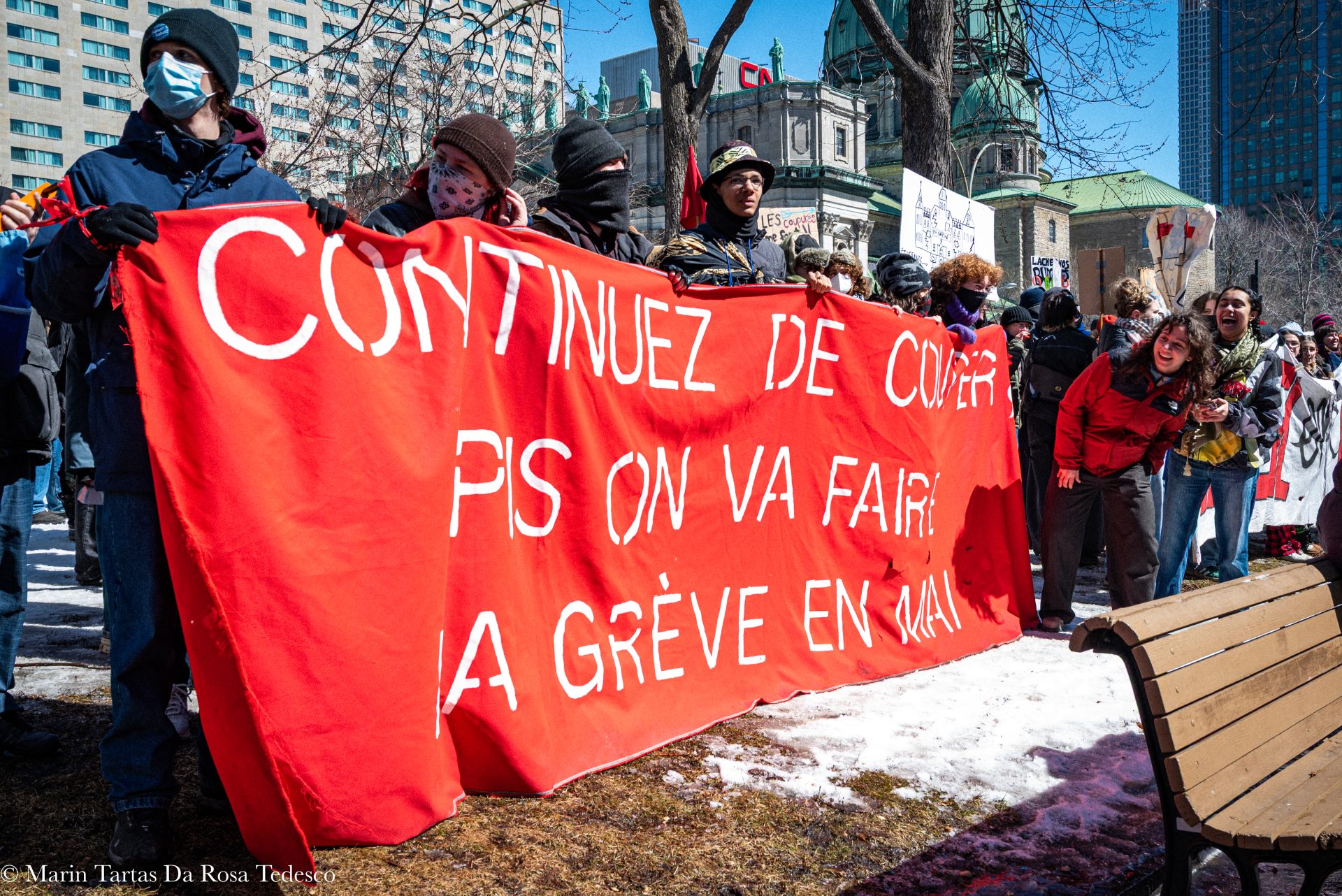
The working class in Quebec is suffering a surge of attacks. Living conditions are deteriorating, our public services are collapsing due to chronic underfunding and recurrent budget cuts, and even trade unions are being attacked.
This generalized despair has led to the collapse of the CAQ and the announced resignation of Premier François Legault at the start of the year.
But this onslaught is just beginning. With the exception of Québec solidaire, all parties in the National Assembly want to implement austerity measures. If they knowingly avoid saying the unpopular A-word, we shouldn’t allow ourselves to be fooled by this tip-toeing.
The Liberal Party, which wants to make Quebec an “entrepreneurial paradise,” proposes to reduce the tax burden on businesses and to “get public finances in order”. The Parti Québécois (PQ) talks about reducing the “bureaucracy” of the state and making public service “more efficient”. And the Conservative Party of Quebec (PCQ) plans to slash civil service and privatize a portion of social services.
In fact, these bourgeois parties meet the demands of employers. The recent cuts of the CAQ in health and education, as well as Law 14 and Bill 3 that attack the right to strike and the financing of unions—laws that these other parties also want to maintain—do not come out of nowhere.
Québécois capitalism, like Canadian capitalism in general, faces an existential crisis. Productivity is at a low point, public debt is rising sharply, and the trade war with the United States is causing losses of market share. In January alone, Quebec exports fell by 8.1 per cent.
In this context, the ruling class desperately needs to make Quebec attractive for investment and reduce debt. In almost eight years in power, the CAQ reduced the marginal corporate tax rate from 12.8 per cent to 7.9 per cent. But more is needed: cutting deeper into public services and attacking working conditions. And to do this, it needs to look at the unions. Whoever comes to power after the CAQ in the coming months will continue to implement this program.
In reality, we are only at the beginning of a great battle that the capitalist class is preparing against the working class.
And now?
In view of this scenario, how is the labour movement getting organized to combat such attacks?
In the fall, FTQ president Magali Picard said that “we are at war” and talked about organizing a “social strike” on May 1 against attacks on trade unions. On Nov. 29, a large demonstration was organized by the major trade union groups, in which more than 50,000 workers participated. These were very good steps in the right direction.
But since then, there has been radio silence in the trade union organizations.
However, there is no better time for the trade union movement to go on the offensive. No government in recent history has found itself as weakened as the CAQ currently is. In addition to Legault’s resignation, almost all ministers have announced that they are jumping ship. Only a few rats, like the hated former minister Bernard Drainville, who is now running to be leader, remain on board.
Despite this, union leaders seem to only have their eyes on the upcoming elections, hoping that the next government will not repeat the CAQ attacks. The CSN is currently lobbying other political parties. Its campaign “Take a stand for Quebec” aims, among other things, to “elect a government that spends less time strutting around with the bosses” and stresses the need to “get the support of other parties.” In the same perspective, Magali Picard also stated that in order to have the recent laws of the CAQ repealed, “The only opportunity we have is that we have elections in 10 months.” On March 30, representatives from the FTQ, CSN, CSQ, and FAE unions met with Charles Milliard, the new leader of the Liberal Party—the traditional party of the bosses of Quebec. Astonishing!

But we cannot believe that the PQ, the Liberals or the PCQ will do anything different from the CAQ. Attacks on the workers’ movement will continue, whether the union leaders want it or not. Nothing but a fierce struggle by the workers’ movement will push back against this government as well as the next one.
The demonstration in November showed the great potential for a general mobilization against austerity. This rally also provided a glimpse of the leadership role that unions can play in organizing the masses of workers in Quebec.
What we need is mobilization for a real general strike across the province. The slogan of a “social strike” cannot go unheeded.
Recently, a few local groups and unions took up this slogan to mobilize for May 1. But as the leaders of major union confederations twiddle their thumbs, what small groups can accomplish is limited. For a real movement towards a social strike to be built, the leadership role of trade unions is crucial.
A concrete mobilization plan should be developed by the main union groups, culminating in a first one-day strike and developing a timetable for action to intensify mobilization throughout the province. The immense resources of trade unions should be used to prepare a strike fund, coordinate an education campaign, organize mass meetings in all trade unions and sectors, etc.
Demonstrations such as the large one in November and the one planned for May 1 are good, but to be effective, they must be accompanied by a serious threat of strike action. They must represent a show of force accompanied by a threat of escalation. Without the threat of a strike hanging over them, the government knows that it has little to fear. The alternative for workers—to lie down and accept the current offensive—is not an option.
The government and the bosses would certainly seek to scare the workers, arguing that such a general strike is illegal, as it does not respect the periods and parameters of the right to strike provided for in collective agreements. But this argument doesn’t hold water: even during legal strikes, the government prohibits them. The CAQ has just passed a law, Law 14, which aims to allow the government to declare any strike illegal.
Revolutionary perspective
Trade union leaders generally see austerity as a political or ideological choice that governments make. In doing so, they believe that we can convince politicians to change their mind.
But attacks on the welfare state and on the living conditions of the working class are not a matter of choice. They are products of capitalism in crisis.
All over Canada, the picture is the same: capitalism can no longer afford to provide decent living conditions for the working majority.
Whether it’s the recent Doug Ford cuts in Ontario, the new Nova Scotia austerity budget, or the huge cuts in all departments of the federal government, the trend is widespread: governments must cut.
Ultimately, the only way to get out of this dead end is to lead the revolutionary fight against capitalism. This is why the working class needs its own party to wage the struggle against the capitalist class to the end.
This is what the Revolutionary Communist Party is fighting for.

