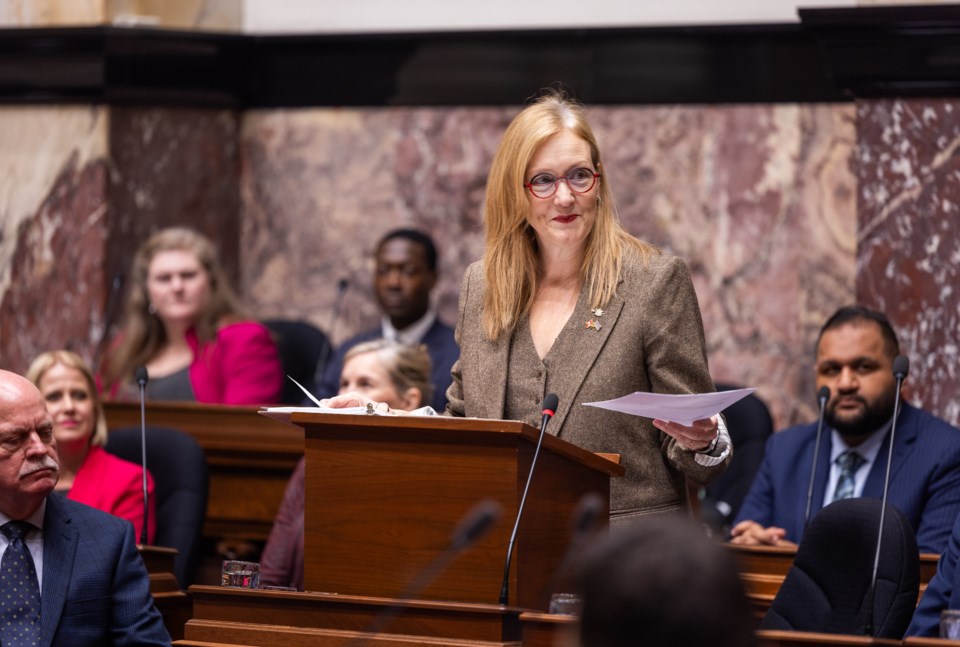
In the weeks leading up to the B.C. provincial budget announcement, Finance Minister Brenda Bailey made the prediction that she’d be the “least popular person in the province for a while.” The BC NDP is under considerable pressure from both sides of the class divide: to court capital investment they need to rein in the $154 billion debt; to keep their base they need to deal with the cost of living crisis facing B.C.’s workers.
“There are those who said we want deep cuts,” Bailey said, “[…] and there are those who say we want to keep making historic investments into important areas… the approach is to try to balance the two.” When the budget was finally revealed, it was the worst of both worlds. It burdens B.C.’s working class with cuts, while not going far enough to make the capitalists happy.
Brenda Bailey lamented that “Families are stretched by the rising cost of living,” but in her next breath she cynically compared the government to working families who had to “make careful decisions to keep their household finances in order.” It’s exactly those families that the BC NDP is offloading the crisis of capitalism onto.
The NDP’s first volley was the public sector hiring freeze and 15,000 public sector job cuts to education, healthcare, and CleanBC. The second was the increase to the tax rate for the lowest tax bracket, pulling $76 out of the pockets of 60 per cent of British Columbians every year. The budget also freezes the tax brackets to no longer account for inflation, effectively a hidden tax hike. This amounts to an extra nearly $1 billion in tax revenue over the next three years. This is clearly to make up lost revenue from the tax cuts handed out to mining, manufacturing, processing, film production, and shipbuilding.
But the budget didn’t stop there: it gouged post-secondary education, which is now on track to operate on a deficit for the first time in recent history, guaranteeing program and job cuts. It offered no funding increases to B.C.’s crumbling healthcare system, meaning, as the president of the B.C. Nurses’ Union put it, “when we look at the demands on the system, [this] translates to […] a cut.”
It also pumped the brakes on projects like the Burnaby hospital expansion, which was meant to alleviate some of the strain on the medical system; UVic student housing expansions, meant to help with the housing crisis; and numerous long-term care facilities for elderly British Columbians who are facing a housing crisis of their own.
In the balancing act the NDP is performing, it’s clear where the cuts are coming from. But the deficit is still set to grow by $13.3 billion this year, so where is this “historic investment” going? Towards showing that “B.C. is open for business” as Bailey put it! A record-breaking $750 million is going towards mining exploration this year alone, $400 million will be put towards courting federal and private investment into the province, and $40 million will go towards shortening permitting times for natural resource extraction. Even with all these handouts to corporations and tax cuts to numerous industries, Greater Vancouver Board of Trade president Bridgitte Anderson declared budget day “a very dark day”, giving this year’s budget a D—a whole letter grade worse than last year’s budget!
The budget did one thing for sure. As Marc Lee from the Canadian Centre for Policy Alternatives put it, “They definitely managed to piss off everybody.” For the capitalists, this budget didn’t cut deep enough. They demand more blood on the altar, more tax cuts for corporations, more social spending cuts, more job cuts. When it comes to reining in the deficit, they are no doubt eyeing the biggest line item in the budget: the $1.2 billion spent on public sector wages. For the working class, tax hikes and cuts to social programs hurt particularly badly in the midst of a growing cost of living crisis.
The BC NDP is caught between a rock and a hard place, and their most recent budget reflects the true crisis reformism faces. Bailey stated that this budget was making “careful choices now to avoid more difficult ones later.” But this budget solves nothing. B.C. is set to have the highest debt-to-GDP ratio in Canada. The amount of money going to interest payments is now more than the entire budget for the ministry responsible for poverty relief. Capitalism demands this deficit spending be reined in, so it’s guaranteed that more “difficult choices” are ahead, and it’s not a coincidence it’s never the capitalists that have to foot the bill.
As long as it works within the limits of capitalism, the NDP has no choice but to cater to the needs of the capitalists and betray the working class. Not only will this budget make the lives of B.C.’s working class worse, but it paves the way for a Conservative victory down the road—a party which rose from the dead two years ago as a result of the NDP tying itself to the capitalist status quo. The NDP has shown in practice the inevitable result of working within the system. If the left and the labour movement in B.C. are to defend themselves against these cuts, and the cuts that are sure to come in the future, we must turn the fight against capitalism itself.

