This draft document presents the political perspectives of the Revolutionary Communist Party for 2026, as adopted by its Central Committee at the end of March. We invite feedback on this document as we prepare for discussion at our upcoming Congress in May 2026.
“There are decades where nothing happens; and there are weeks where decades happen.”
This well-known quote from Lenin aptly captures the period we are living through. Compacted into a short period of time, a flood of shocking events has transpired, drastically upending the old world order.
After cracking at the seams, the U.S. led international order is now dead. The year 2026, which opened with the kidnapping of Maduro and Trump’s renewed threats to take over Greenland, put the last nail in the coffin. The death of the old world order is now an inescapable fact, as is now being openly admitted by world leaders.
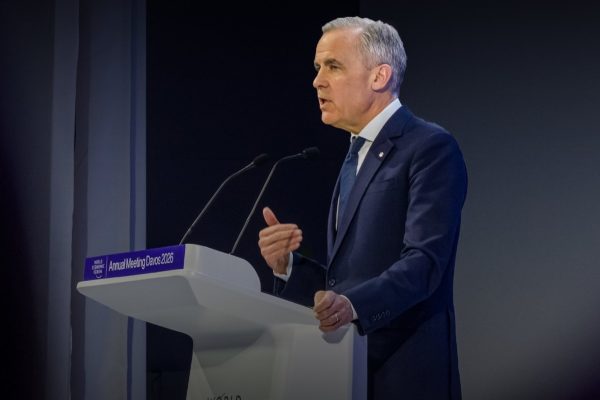
As Carney said in his speech at the World Economic Forum in Davos, “We know the old order is not coming back. We shouldn’t mourn it. Nostalgia is not a strategy.” The Munich Security Conference this year also echoed this, stating: “more than 80 years after construction began, the U.S.-led post-1945 international order is now under destruction.”
But what new order will take its place? And what place will Canada take in it?
Why we need perspectives
The tradition in our international is to always start significant meetings with a discussion on perspectives. This is because, without a firm grasp of the nature of the period we are passing through, any further discussion will inevitably lack a compass. Without perspectives, there is a tendency to fall back on an empiricist method—that is, merely reacting to events as they transpire with no general theoretical framework for making sense of them.
For many on the left, it is enough to simply oppose whatever they perceive as “bad”, whenever it arises. But for us, this is akin to a man trying to navigate the ocean without a map. He turns this way and that, reacting to the stormy waters as they batter his boat, zig-zagging with no perspective of how he is going to actually reach his destination. History has not looked kindly on these types of travellers.
An understanding of perspectives is especially important today. We are living through the most turbulent period the world has passed through in at least 80 years, or perhaps the history of the entire world. While in the past, crises would be localized to one part of the world, capitalism, by globalizing the world economy has globalized the crisis and thus globalized revolutionary developments.
It is therefore impossible to address Canadian perspectives without first laying bare the processes taking place internationally.
Redivision of the world
In 1916, Lenin wrote Imperialism, the Highest Stage of Capitalism. In this book he described how the great powers, driven by economic compulsion, divide up the world among themselves. Lenin also explains that the division of the world is not a static phenomenon. Instead, as new powers arise, a struggle for the redivision of the world is inevitable. This was the ultimate cause of the two world wars.
The result of the Second World War produced a situation which was very different from the first half of the 20th century. America, which was already a rising dynamic power, emerged relatively unscathed. The new power of Germany was smashed and the old powers of France and Britain severely weakened. America became the hegemonic imperialist power.
The world was redivided based on the new balance of power with the United States on one side and the Soviet bloc states on the other. Among the capitalist powers, the United States became the big dog who could force themselves on the other, lesser powers. They propped up other capitalist powers to counter the U.S.S.R.—which had emerged strengthened from the war. Multilateral organizations like the United Nations and the World Trade Organization were created to cement this new situation. This was the so-called “rules based international order.”
Due to this exceptional situation, protectionist trade barriers were brought down and world trade expanded tremendously. Multinational corporations established operations all over the world, and an international division of labour rationalized production, increasing efficiency of the global economy. In this way, the barrier to development represented by the nation state was partially overcome.
Canada, through its connection with America, benefited from this setup and became one of the main advanced economies in the world. On the back of the boom, and because the Soviet Union existed as an alternative to capitalism, the ruling class conceded many significant reforms and the so-called “middle class” was built. This created a regime of relative class peace for an entire historical period. This period has coloured all of the dominant ideas and trends in Canada.
But after the Soviet Union fell and China embarked on the path back to capitalism, seeds were planted which eventually upended the post war world order. Now we find ourselves once again faced with a struggle between the great powers for the redivision of the world.
The United States is no longer the world power, but one power forced to contend with the rising economic power of China and the military might of Russia. As Carney put it in his speech at the World Economic Forum at Davos, we face an “era of great power rivalry.”
The Donroe Doctrine
China has spectacularly developed, stealing trading partners out from under the nose of the United States. Russia has also flexed its muscles militarily, demonstrating in Ukraine that it is a force to be reckoned with.
“America First”, far from being simply the ravings of a single madman, is an attempt by a section of the U.S. ruling class to face up to the new world situation. In a sense, they are more clear-eyed than the old establishment politicians in the U.S., who refuse to accept that the global balance of powers has changed.
In order to shift their foreign policy, Trump has gone to war with the so-called “globalist” institutions in the United States. The Eurasia group, a renowned neoliberal consultancy group, said in a recent report that the U.S. is in the throes of a “political revolution” aimed at “unwinding its own global order.”
The Trumpist camp of politicians have abandoned the hypocritical window dressing historically used to justify the domination of American imperialism. Summing up their new philosophy, United States Homeland Security Advisor Stephen Miller explained that “we live in a world, in the real world […] that is governed by strength, that is governed by force, that is governed by power.”
He continued by stating that: “We’re a superpower. And under President Trump, we are going to conduct ourselves as a superpower.”
No more false pretenses to international law. No more feigned concerns for the sovereignty of nations. No more pretending to care about democracy.
In a sense, Trump has done us a favour. He has discarded the hypocritical ruse normally used to justify the actions of U.S. imperialism. In its place is the brutal and honest truth: he is fighting for the interests of American capitalism, above all else.
But what does this full-throated, mask-off imperialism actually mean?
The irony is that, in spite of this aggressive rhetoric, Trump and his acolytes admit that America is actually less of a superpower than it was in the past. It is no longer able to play the role of world police. Indeed, the U.S.’s National Security Strategy released last November states that the United States rejects “the ill-fated concept of global domination for itself.”
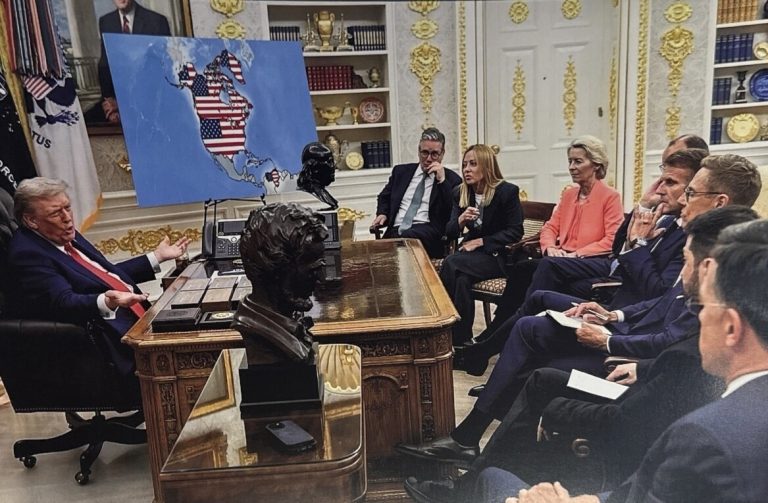
Instead, they will focus on their “core national interests” and restore “American preeminence in the Western Hemisphere.” To do so, they will seek to “deny non-Hemispheric competitors the ability to position forces or other threatening capabilities, or to own or control strategically vital assets, in our Hemisphere.”
We have already seen that this is not just bluster. Venezuela, which was a trading partner of Russia and China, has now been turned into a semi-colony of the United States. This move was not just about submitting Venezuela; it was done to send a message to the entire hemisphere. As Trump said at the time: “American dominance in the Western Hemisphere will never be questioned again.”
Trump has cut off Cuba from oil supplies, and it is rumoured that he may carry out some sort of military operation there, similar to what he did in Venezuela. The U.S. has forced the Panama government to seize two canal ports operated by a Hong Kong based company.
Trump has also renewed his threats to take over Greenland—which is a colony of Denmark, a NATO ally. While this has perplexed other NATO members, Trump was perfectly clear in his justification: “the problem is there’s not a thing that Denmark can do about it if Russia or China wants to occupy Greenland, but there’s everything we can do. You found that out last week with Venezuela.”
All of this is intended to push China (and to a lesser degree Russia) out of the Western Hemisphere. Chinese imports into the United States have unsurprisingly fallen to their lowest level since the early 2000s, and Trump is pressuring other countries in the continent to cut China out as well.
However, what Trump wants and what he can get are two very different things. U.S. imperialism, which for decades has been the unipolar imperialist power, is enmeshed in the economies and security apparatus of countries all over the world. It is not so simple to disentangle from this. There are also serious differences of opinions within the Republican party, with one wing still wanting to hold onto past glory.
The result is that while Trump was elected on ending “forever wars,” he has found it difficult to simply pull out everywhere. We see this with the war in Ukraine and the war on Iran.
This is therefore not a linear process where Trump will pull out of everywhere all at once. But one way or another, the United States will be forced to withdraw from many areas of the world for the simple reason that they can no longer afford—politically, economically or militarily—to hold onto them.
Canada’s place in ‘Fortress America’
For Canada, this qualitative shift in U.S. policy has dire consequences.
Under the postwar order, second-rate powers like Canada were able to play an outsized role. For example, Canada, which has a miniscule military, is incapable of seriously challenging anyone. It is also unlikely that Canada, on its own, would have the economic leverage to bring a weaker country to heel. But under the financial and security umbrella provided by America, Canada was able to develop a huge mining empire that spans all over Latin America, Africa, Asia and the Middle East.
But with the return of a Great Power struggle for the redivision of the world, Canada risks losing its privileged position and the economic benefits that came with it. In Carney’s speech at Davos, he claimed, “American hegemony, in particular, helped provide public goods: open sea lanes, a stable financial system, collective security and support for frameworks for resolving disputes”—at the expense of all countries except a few western countries involved in this imperialist racket.
Indeed, Carney’s comment that “if we’re not at the table, we’re on the menu,” obviously means that so-called “middle powers” like Canada, under the aegis of America, were able to feast on others. Their central complaint therefore is not that the United States is acting in violation of so-called “international law” but that they are abandoning the world setup which allowed countries like Canada to punch above their weight. As the Belgian Prime Minister acidly put it: “Being a happy vassal is one thing. Being a miserable slave is another.”
If we boil down the strategy of the U.S. government, there are two main elements. The first we have already laid out: restore American dominance in the Western Hemisphere. In this venture, the Canadian ruling class would be happy to participate as a junior partner. In fact, Canadian banking and mining companies have made a killing (quite literally) on the back of U.S. dominance in Latin America.
This was recently admitted by Scotiabank CEO Scott Thomson at a conference of bankers: “You’re moving all these governments from left to right, or centre-right, and then you’re seeing more U.S. influence, which plays very well to our Western Hemisphere strategy. There should be or could be some bumps along the way here […] but longer-term, this is a good thing for the Western Hemisphere, it’s a good thing for the U.S., it’s a good thing for the Bank of Nova Scotia.”
The Canadian ruling class is more than happy to continue their role as a junior partner to big brother plunderer. But this may not be so simple.
For starters, in this new world order, the Canadian ruling class is going to have to prove that they are a useful ally and not simply riding on the coattails of American military might as they have done in the past.
This is especially the case because of the importance of the Arctic, where Canada has thousands of kilometers of unprotected coastline. With the Northwest Passage waterways opening up due to ice melting, these areas could become important trade routes. The Arctic is becoming an important zone of imperialist rivalry, with the great powers vying to control it. Greenland is only a part of Trump’s Arctic strategy, and if Canada doesn’t significantly and rapidly increase its military capabilities in the Arctic, Trump will act on his own to secure the Arctic.
As the prestigious Expert Group on Canada-U.S. Relations recommends: “If Canada can prove it has the military and other capabilities to operate in the Arctic, it will be seen by the U.S. as both a deterrent against aggressive actions and an opportunity to work with its northern neighbour.”
Trump has already succeeded in pressuring the Canadian government to increase military spending to five per cent of GDP. In total, according to Carney, the military budget could rise to $159 billion by 2035—more than three times the entire federal government budget for healthcare.
The amount of money the Canadian government will need to spend to participate in “Fortress America” is simply eye watering and the social consequences of this will be far reaching. The peace dividend is over. Someone will have to pay for this increased military spending and it is plain to see that the capitalists will try to make the working class foot the bill.
Between a rock and a hard place
The other aspect of the Donroe Doctrine is that the United States will “prioritize commercial diplomacy, to strengthen our own economy and industries, using tariffs and reciprocal trade agreements as powerful tools.” They also “want other nations to see us as their partner of first choice, and we will (through various means) discourage their collaboration with others.”
The National Security Strategy document also states that “The goal is for our partner nations to build up their domestic economies.” But “America First” means that any Canadian industries in competition with American industries are in the line of fire.
Trump represents the distillation of capitalist interests. He purses these interests in a cold, calculated manner, without any scruples. When Carney visited the White House last fall, Trump explained that the economies of the two countries were in “natural conflict.” He went on, explaining that: “the problem is that they want a car company, and I want a car company, they want steel and we want steel. With other countries, they are very far away and there is no problem. We don’t like to compete because we hurt each other, it’s a natural business conflict, nothing wrong with it.”
This places the Canadian government in a very tough spot. The farsighted representatives of Canadian capitalism know that it cannot exist without American capitalism. Goldy Hyder, president of the Business Council of Canada has explained that they cannot change the “geography and math” of the situation, and therefore whatever Carney does, he should “do no harm” to the Canada-United States-Mexico Agreement (CUSMA) renegotiations taking place in July.
In this new doctrine, the United States does want allies. However, they want allies who will develop industries that will complement American industries, not compete with them. For example, there doesn’t seem to be a place for Canadian auto manufacturing within “Fortress America,” and Trump has made that patently clear.
Currently, 90 per cent of vehicles produced in Canada are sold in the United States with only seven per cent sold outside of the CUSMA trade zone. Canada’s entire auto manufacturing industry only exists because of its proximity to the U.S., and its privileged access to the U.S. market. As the Japanese ambassador Kanji Yamanouchi said, this is “the critical condition” for Japan’s investment in Canadian auto manufacturing. “Your GDP is one of the top ten countries—$2.5 trillion. But you know the size of the U.S. market? $30 trillion,” he explained.
While Carney is trying to pivot and “diversify trading partners,” the fact is that Canadian cars would not be competitive on the world market. As TD economist Andrew Foran explained, exporting elsewhere would force Canadian manufacturers to compete on an “intense and increasingly price-driven” market. Unsurprisingly, both South Korea and Germany have resisted pressure from the Canadian government to attach investment in car assembly plants to their bid to build 12 submarines for the Canadian Navy.
Carney’s deal with China contains the “expectation” that China will invest in Canadian auto manufacturing. But there is no guarantee this will happen, for the same reason other car manufacturers are pulling out—it’s only profitable if they have access to the U.S. market. Any significant development of Chinese car production or sales in Canada would also place Canada on a collision course with the United States, which doesn’t want Canada to be a “drop off port” for Chinese goods into the American market.
With three quarters of Canadian goods sold in the United States, Trump holds immense leverage to get what he wants. He has complained about Canadian laws in place to protect the dairy, softwood lumber, banking and aviation industries. But if the Canadian government were to relax these protections, entire Canadian industries would be in jeopardy.
The logic of the situation is that if Canadian producers want to sell their products to the American market, they will either have to pay a higher tariff and/or the Canadian government will have to relax protections meant to guard local industry. As U.S. trade representative Jamieson Greer recently explained: “If Canada wants to agree that we can have some level of higher tariff on them while they open up their markets to us on things like dairy and other things, that’s a helpful conversation.”
Hanging over all of this is the renegotiation of the CUSMA trade agreement. Due to the existence of this trade deal, Canada has the second lowest tariffs after Mexico. In fact, over 85 per cent of all Canadian goods exported into the United States are tariff free.
This has meant that Canada has so far largely been able to avoid the full effects of Trump’s protectionism. But everything points in the direction of the CUSMA trade deal being either significantly modified to the benefit of the Americans or scrapped altogether. If it does survive, it may limp on in a modified form, having to be renegotiated every year—which would give Trump the ability to demand more concessions every year.
Carney’s first attempt to ingratiate himself to Trump obviously failed. Each grovelling gesture or pathetic concession only led Trump to make further demands. Carney, in his Davos speech called this “the performance of sovereignty while accepting subordination.” Lenin described that within the imperialist world system, apart from the Great Powers and their colonies or semi-colonies, there also exist “small states” which are “formally independent, but in fact, are enmeshed in the net of financial and diplomatic dependence.” This is precisely the situation with Canada.
But does Carney have a choice?
His strategy to “diversify to hedge against uncertainty” will be extremely difficult. As the Council of Foreign Relations explained: “The deeper a country’s ties to the United States, the harder it is to hedge.” The economies of the U.S. and Canada are heavily integrated, the U.S. consumer market is the largest in the world and it’s right next door. Detangling from the U.S. economy will be a very painful procedure, and exporting to many smaller markets, if possible, will inevitably be much more costly.
Carney plans to “double non-U.S. exports over the next decade.” But what will Canada be exporting, and to whom? There is a crisis of overproduction everywhere, and the ruling class of each country is already struggling to find a market for their goods.
In a fracturing world, Canada simply doesn’t have the industrial base or the capital concentration to compete with the big powers. Canadian cars, aerospace, aluminum, steel, etc. all cannot hope to compete with Chinese or American industries. That places these industries on the path to destruction, with over 600,000 high wage, mostly unionized jobs on the chopping block.
Energy and critical minerals
With Canadian industry facing a dire situation, Carney has made harvesting critical minerals and oil and gas central to his economic plan.
The government has said that its aim is to transform Canada into the “world’s leading energy superpower.” According to energy minister Tim Hodgson, they want to increase exports of Liquified Natural Gas (LNG) from the current 14 million tonnes per annum to 100 million tonnes. Many countries, including countries like Japan, South Korea, China and India have all signaled that they want Canadian natural gas.
But this is easier said than done. Firstly, for this to take place, many new pipelines will need to be built and at great cost. For example, the first LNG pipeline which was forecast to cost $5 billion, ended up costing $40 billion—a 700 per cent increase!
So far, in spite of the Memorandum of Understanding on the building of a new oil pipeline, which Carney signed with Alberta premier Danielle Smith, no company has shown interest. After major projects such as the Keystone XL expansion (2021), Energy East (2017), and Northern Gateway (2016) were cancelled with billions of dollars in investment lost, companies aren’t exactly ecstatic to invest in another costly Canadian pipeline project that may never get built.
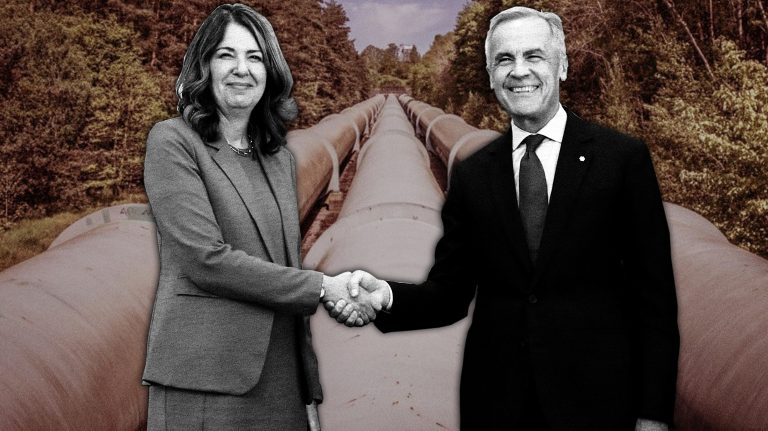
Therefore these pipelines require tons of government money. We saw this with the Transmountain pipeline. The only way that was even finished was because the government took over the project—effectively bailing out Kinder Morgan. On top of that, the project’s cost massively ballooned from a projected $5.4 billion to $34 billion when all was said and done. We may end up seeing a similar situation with future pipelines.
The other part of the government’s strategy is critical minerals. But there are even more problems with this.
China currently enjoys crushing dominance over the world’s critical mineral supplies which are essential for all modern technology and military equipment. As we saw last year, China is prepared to use their control of critical minerals as leverage in the trade war with America, which is dependent on Chinese minerals.
This means that America needs to drastically build its critical mineral mining and processing infrastructure. And Canada can be a key player in this, as it has significant untapped mineral supplies including significant deposits of lithium, cobalt, nickel, and graphite. Canada also has some of the largest deposits of tungsten and rare earth elements in the world.
Unsurprisingly, Carney has made developing critical minerals mining and infrastructure a top priority for his government. This is a part of an attempt by Canada to carve out a spot as a valuable partner to other Western imperialist countries, the U.S. being the most important.
As the Royal Bank of Canada explained: “For Canada, the race to develop and process these minerals is about much more than the mining sector; it underscores a new security paradigm to protect and enhance our economic and national interests in an evolving world order.”
Carney has made a lot of noise about the number of “good-paying jobs” these projects will create. In truth, the number of jobs created in extractive industries is generally lower than those in “value-added” industries, such as auto manufacturing. The best jobs tend to be in refining and processing—but they are usually few in number. And, as the Royal Bank of Canada explains, “Canada remains largely a ‘mine-and-ship’ jurisdiction when it comes to critical minerals.” The real beneficiaries of this will therefore be Canada’s resource barons, as well as those banks invested in them.
It will also not be easy developing critical mineral infrastructure. A recent report explained that this industry requires an extremely high capital investment compared with the relatively long payback period. This makes it a very risky investment. Thus why investors are not rushing to invest in critical mineral development.
Therefore, if Canada wants to get critical mineral infrastructure off the ground, it is going to take an incredible amount of state money, in one way, shape, or form. In an interview with The Globe and Mail, one mining specialist put it this way: “The model China uses currently is the model North America will need to adopt.”
In the words of Finance Minister François-Philippe Champagne: “If we left it entirely to the market, I’m not sure we would meet the moment.” Tim Hodgson, Minister of Energy and Natural resources put it this way “some of the rare earths processing facilities that are being talked about—unless they receive equity-like support, given the stranglehold that certain countries have on those markets, they’re unlikely to happen.”
And we are already seeing this. China is so far ahead and at any moment can flood the market, swamping out the fledgling critical minerals industry in Canada. To counter this, Carney has put in place minimum price floors. For example, Carney has guaranteed the Nouveau Monde graphite mine in Matawinie, Quebec that if the market price falls below a certain price, the government will pay the difference.
But if the Canadian government does this across the board, it will be extremely costly. Considering it took China hundreds of billions of dollars of investment over decades to get where they are at, it will take a long time, and be a massive cost to the taxpayer, to develop the critical minerals industry in Canada. So the story for minerals is the same as for oil and gas.
Sacrificed on the altar of profit
This push for more oil and gas as well as mineral extraction projects also places the government on a collision course with Indigenous opposition, as well as environmental regulations.
It is therefore unsurprising that Carney has been slashing environmental policies like there is no tomorrow. Bill C-5, fast tracked through parliament last summer, allows the federal government to bypass all sorts of regulations for projects deemed to be in the “national interest.” All manner of smaller climate policies and practices have also been abandoned.
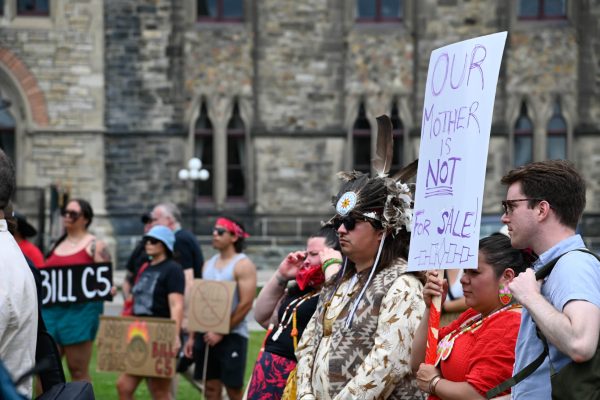
But for corporate Canada, this is not enough. As the Enbridge CEO put it last fall, unless the Liberals lift the tanker ban, which bans oil tankers on a large part of B.C.’s coast, no company will invest to build a “Pipeline to Nowhere.”
While the Alberta-Canada Memorandum of Understanding talks about making the “appropriate adjustment” to the tanker ban, Coastal First Nations have been clear, stating, “We will never tolerate any exemptions or carveouts, period.”
With approximately 600 separate Indigenous governments scattered across the country, this creates huge complications for any development project. For example, just last fall a B.C. court ruled that the province’s current mineral claim system is inconsistent with the United Nations Declarations on the Rights of Indigenous Peoples. This has led the Association for Mineral Exploration to claim that this “has cast confusion on business and reconciliation,” and they are challenging this in the Supreme Court.
Carney knows this, which is why he is pursuing a strategy of “economic partnership” with Indigenous groups. This cunning use of identity politics by the liberal establishment helps them to confuse and disorientate opposition to their projects, by giving them an “Indigenous” colouring. In this he is doing the same thing the Trudeau Liberals did before him: foster the development of an Indigenous bourgeoisie and then partner with them to build projects. As most Indigenous groups don’t have sufficient capital to be serious business partners, Carney is offering $10 billion in loans if they use this money to become partners in development projects. His Indigenous Advisory Council is filled with Indigenous business leaders who will no doubt help the government justify pipelines and mining projects to the Indigenous groups whose land these things will be built on.
While this is meant to pave over the contradiction between private property and Indigenous land rights, it will inevitably lead to increased tensions between Indigenous communities. For example, Carney has promised to fast track a liquified natural gas project co-owned by the Nisga’a First Nation. Yet this project is opposed by a whole number of surrounding Indigenous groups. The Lax Kw’alaams Band and Ketlakatla First Nation have filed legal challenges against it.
Carney’s approach will also lead to tensions inside Indigenous nations, as we saw with the Wetʼsuwetʼen opposition to the CGL pipeline construction in 2020. Even when most of the band councils have been bought off with “benefit agreements”, a militant opposition can still form and cause problems for the company and the government.
In the end, it all comes back to money. Companies, who are already wary of investing in these projects, won’t be too happy if they are forced to foot the bill to buy off Indigenous groups.
Sooner or later, there will be a showdown with Indigenous groups and the Liberals who have talked a lot about reconciliation will show that they care far more about capitalism than anything else.
The dead end of military Keynesianism
Carney is also betting on military spending to boost the economy. He claims that his “Defence Industrial Strategy” will generate $300 billion in investment and create 125,000 well-paying jobs.
The fact that a serious bourgeois economist like Carney is relying on military spending to drive the economy forward just shows how hopeless the situation is for them.
Theoretically, military industries can hire a great number of workers, as they did during the two world wars. But the first problem is that Canada doesn’t currently have a significant military industry. Historically, Canada has purchased between 70–75 per cent of its military equipment from the United States.
If the government wants to develop a military industry capable of employing 125,000 more people, this will take hundreds of billions of dollars worth of investment. We then encounter the same problem with auto manufacturing—the Canadian market is far too small for serious investors to consider building industrial production here. And while Carney wants to turn the defense sector into an “export powerhouse,” this would bring Canada into competition with other arms manufacturers, in particular America.
Then there is the general problem with relying on military spending to develop the economy. Arms expenditure produces neither capital goods (which would increase productivity) or consumer goods. A portion of the total economic product is thus siphoned out of the economy for a totally unproductive purpose, while the workers producing weapons still need to be paid wages. This actually increases demand while decreasing production, with inflation being the inevitable result. Therefore, while military spending can act as a stimulus in the short term, in the long run it will turn into its opposite and become a massive drag on the economy.
And this massive increase in military spending will have to come from somewhere. Provincial and federal deficits are already historically high, so there will be immense pressure to offload the cost through austerity measures. Healthcare and education spending, pension and Employment Insurance will all be on the chopping block.
Internal devaluation
Whichever way you look at it, the Canadian ruling class is staring down the barrel of a gun. Uncompetitive on the world market, investment has been flowing out of the Canadian economy. Over the past 20 years, the gap between foreign direct investment into Canada and Canadian investment in other countries has widened to over $1 trillion. And now their principal trading partner is attacking them.
The entire economy needs to be reorganized, but this will take an immense amount of investment. Private investors are tepid towards Canadian development projects and are waiting to see how serious Carney is about making it easy for them to profit.
So far, Carney has tried to attract capital by claiming that Canada is a “stable” environment. He is also appealing for Canadian investors to embark on a grand “nation-building” project. But this can only go so far. Despite Carney’s nationalist pleas, the so-called “Maple eight,” the largest Canadian public pension funds, have a total of $1.7 trillion invested abroad—about two-thirds of their total assets. Even Brookfield Asset Management, one of Canada’s biggest private-sector asset managers and the company that Carney was the CEO of before entering politics, has committed just seven per cent of its nearly $1.3 trillion worth of assets under management to Canadian investments. This is just another way of saying that the ruling class is betting against its own country!
If you drank the Canadian nationalist Kool-Aid, you would think that the great patriotic Canadian bourgeoisie would be heeding the call and investing in Canada. But the truth of the matter is that capital has no nation, and instead chooses whichever market will help it replicate itself the easiest and quickest.
And while Carney has a penchant for using the state to “catalyze investment” (or trying to), there are limits to this. In fact, all levels of government are incredibly indebted with total amalgamated government debt at a record $2.3 trillion—more than 100 per cent of GDP. And the accumulation of debt is accelerating as federal and provincial governments have shoveled billions into failing industries. The federal deficit has ballooned to $78.3 billion and the deficits in Quebec, Ontario and British Columbia are at $13.6 billion, $13.5 billion and $13.3 billion, respectively.
Unsurprisingly, all governments—regardless of the party in power—have passed budgets which, one way or another, offload the cost of the crisis onto the backs of working class people. The crisis is so stark that differences between the different political parties, whether it’s the Federal Liberals, the CAQ in Quebec, the BCNDP, or the Ontario Progressive Conservatives, have been reduced to almost nothing. Capitalism leaves no choice.
Carney faces an impossible situation. He drastically needs to jump-start the economy. Under capitalism, investment is the lifeblood of the economy. If you cannot attract capital to your market, jobs will be lost and there will be no money for social services. But this is becoming more difficult. As the Business Council explains: “jurisdictions around the world are competing harder than ever to entice investment.” Therefore, Carney will need to enact a deep “internal devaluation” throughout the country, that is, reducing the cost of labour and eliminating barriers that stand in the way of private investment.
Carney’s first budget, passed last fall, included significant corporate tax exemptions while laying off tens of thousands of federal government employees. But this is far too timid for the Canadian bourgeoisie, who are demanding more blood. The Business Council has complained that the changes implemented in the budget last fall are insufficient “baby steps” and “don’t provide enough of a long-term advantage.”
Carney, in his book Value(s), argues for a socially responsible version of capitalism. He is now learning that this is not possible. If he really wants to attract capital investment, he must make Canada competitive on capitalism’s terms, not his own.
The writing is on the wall: the old Canada is dead. The “middle class” built on the back of the post-war order is on the chopping block. Class collaboration as a governing strategy is dead. Liberal pretenses about protecting the environment are dead. And reconciliation with Indigenous peoples is dead.
Socialism or disaster
The depth of this crisis has created a dilemma on the left. The reformist establishment in the NDP and the trade unions, who normally set themselves the task of achieving “small gains,” have no answers to the biggest problems we face.
For example, during the federal election, the NDP abandoned their demand for an increase in the corporate tax rate and instead called for an “excess profit tax” which would only affect very large corporations. Unsurprisingly, this inspired no one.
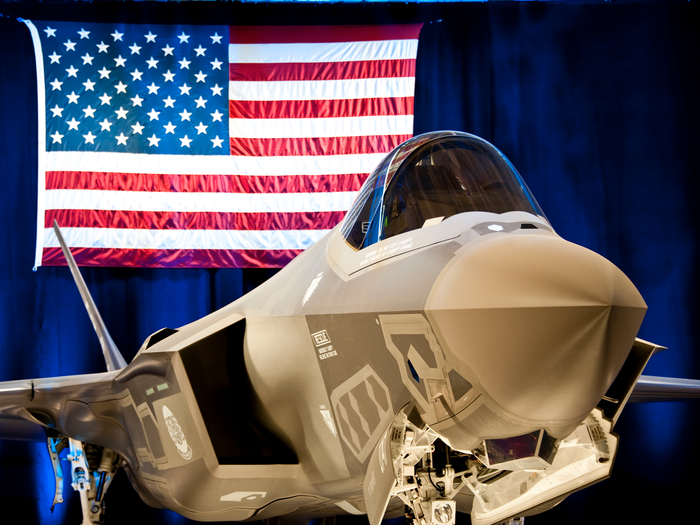
The NDP has also completely capitulated to Carney’s “Team Canada.” This has led to some absurd situations. For example, during the election, Carney promised to increase military spending to two per cent of GDP by 2030. Instead of opposing this militaristic war drive, the NDP promised to do the same—by 2032! More recently, the NDP’s criticism of the purchase of 88 new fighter jets—which they opposed in the past—is that the government should buy Swedish Gripen jets instead of American F-35s.
The situation with the unions is just as bad. The union leaders all support Carney’s economic plan. Unifor has even been holding rallies with Ontario Progressive Conservative premier Doug Ford.
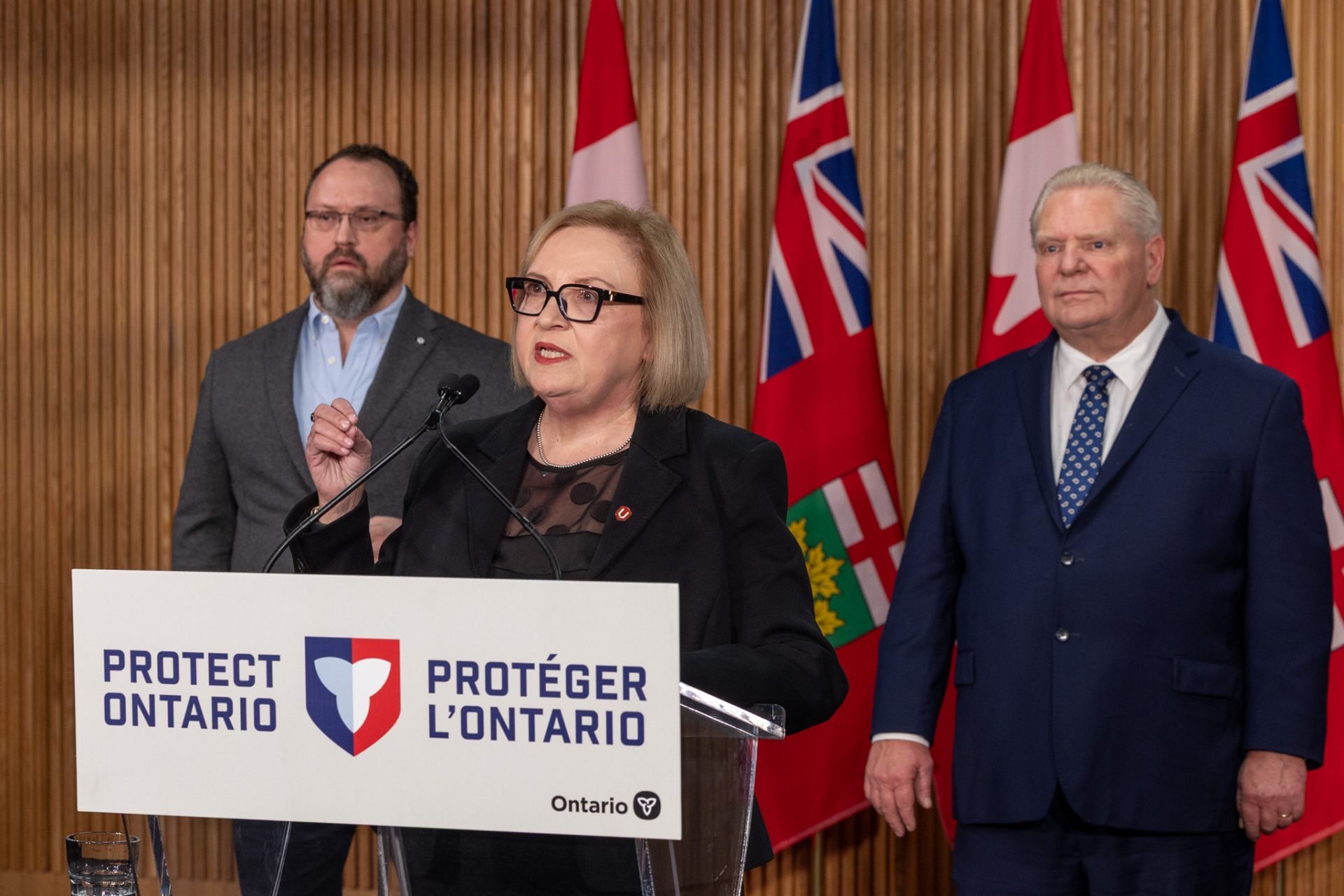
At best, the NDP and the union leaders have failed to criticize Carney’s corporate welfare plans. This crisis has thus exposed the gradualist, reformist, parliamentary outlook of the mainstream left and labour leaders and has made a revolutionary internationalist, socialist perspective more vital than ever. It is the mission of the Revolutionary Communist Party to bring these perspectives, idea and tactics into the movement, to stop the impending disaster.
The labour movement must accept zero cuts to social services or public sector jobs. The constant talk about cutting back “waste and bureaucracy” is frankly nonsense when this is being done to spend hundreds of billions on arms expenditure.
Even when union contracts do not technically contain losses, inflation eats away the living conditions of the workers. This is why the trade union movement must demand wages adjusted to inflation, and have all negotiated wage increases be on top of that. This is the only way to stop the bleeding.
With factory closures and mass layoffs on the order of the day, the position of the unions should be: no job losses allowed! In response to any company claiming that they must lay off workers or move operations, the union should demand its workers have the right to inspect the financial records of the company to guard against subterfuge. We say: open the books! Any factory which offloads the cost of the trade war onto the backs of the workers and the community should immediately be occupied and run under the control of the workers themselves.
Being squeezed between the great powers, the perspective of saving Canadian manufacturing under capitalism is entirely utopian. Therefore, we demand the manufacturing sector be nationalized, cutting out the narrow profit interests of the capitalists. Only this way could we develop a rational plan of production, connected with the steel and aluminum sector. Factories could be retooled to produce socially necessary infrastructure.
Major infrastructure like telecommunications, railways, and electricity—which were previously publicly owned but then privatized—should all be renationalized and integrated into a socialist plan of production. The parasites who bought their infrastructure from the state for a dime would no longer be able to gouge consumers. Canadian grocery monopolies, who have gouged consumers for too long, should also be nationalized and a network for publicly owned grocery stores, offering cheap groceries to workers.
Under capitalism, development projects, such as oil and gas or mining projects, will always be done to the detriment of indigenous people. Only with rational and democratic economic planning can economic development take place without the pressure of vulture private investors overhead, who demand cuts to environmental regulations and Indigenous rights.
With such a perspective, the labour movement could unite with Indigenous peoples to fight back against the corporate onslaught. Under a planned economy, Indigenous peoples would be guaranteed good jobs, resources and autonomy over their communities.
Most of the time, when the left puts forward demands, the common refrain is: “where will you get the money for that?” But this talking point falls apart when you look at the eye watering amounts of state funding being doled out to private companies and military contractors. Equally, the big Canadian banks, which leech wealth off of the real economy, have posted recorded profits of $19 billion just in the first quarter of 2026. But this is just the tip of the iceberg. Corporate profits hit an all time high in 2025 at $676 billion dollars!
A workers’ government, armed with a socialist program, would expropriate this wealth produced through the blood and sweat of workers, and use it for socially necessary purposes.
The rise of militarism is also a crucial question for the working class. As the world fractures, wars and conflicts are becoming more common. But imperialist rearmament will only make this situation worse. And as we have laid out here, military spending is no way to develop the economy and will lead to huge cuts to public spending.
This huge increase in military spending is just an attempt by the ruling class of Canada to demonstrate to Trump that they can be a reliable partner. We fight against the illusions in military production being sown by the private sector union leaders. This shortsighted vision will lead nowhere good—not for the workers of the world and not for the working class of Canada.
Instead, the labour movement must fight tooth and nail against this militarization drive. Against this militaristic war drive, the RCP, the Canadian section of the Revolutionary Communist International, fights for an international working class perspective. We cannot allow the bourgeoisie to pit workers of different countries against each other. Not in a trade war or a real war. We have no faith in our ruling class who always prioritize their profits over everything. This inevitably leads them to plunder other countries as well as attack workers at home.
Working class people have no interest in oppressing workers of other countries. We fight to build links with the workers of America, Mexico, China and the world to fight for a socialist transformation of society as the only way to end this madness.
Workers of the world unite!
Provincial fracturing
Perhaps the biggest challenge facing the Canadian ruling class is the prospect of the break up of the country, the possibility of which looms in the distance with possible independence referendums in Alberta and Quebec.
In response to the deep crisis in the oil reliant Alberta, right-wing politicians, using longstanding, genuine feelings of western alienation, have manipulated working class anger and directed it towards Ottawa.
When Danielle Smith took over the ruling United Conservative Party (UCP), she leaned further into this “East vs. West” discourse, blaming Ottawa for everything she possibly could. The result has been that a genuine separatist sentiment has sprouted up in Alberta, with a significant section of the population supporting Alberta becoming an independent state.
When Carney came into power he quickly moved to reassure politicians in Alberta that he would govern in a starkly different manner than Trudeau. He immediately cut the carbon tax and signed the above-mentioned Memorandum of Understanding with Smith on the building of a pipeline to the west coast. However it seems like this has not had the desired effect.
At the UCP convention last fall, Smith said, “I support a strong and sovereign Alberta within a united Canada. I know we may have a bit of a difference of opinion on that but I hope people today feel a lot more confident that Canada works than a couple of days ago.” She was met with boos. At that convention, separatist elements organized with the Alberta Prosperity Project managed to secure five of nine seats on the UCP’s governing board.
As Smith has relaxed the requirements it takes to hold a referendum, it seems certain that there will be a referendum on Alberta sovereignty sometime this fall.
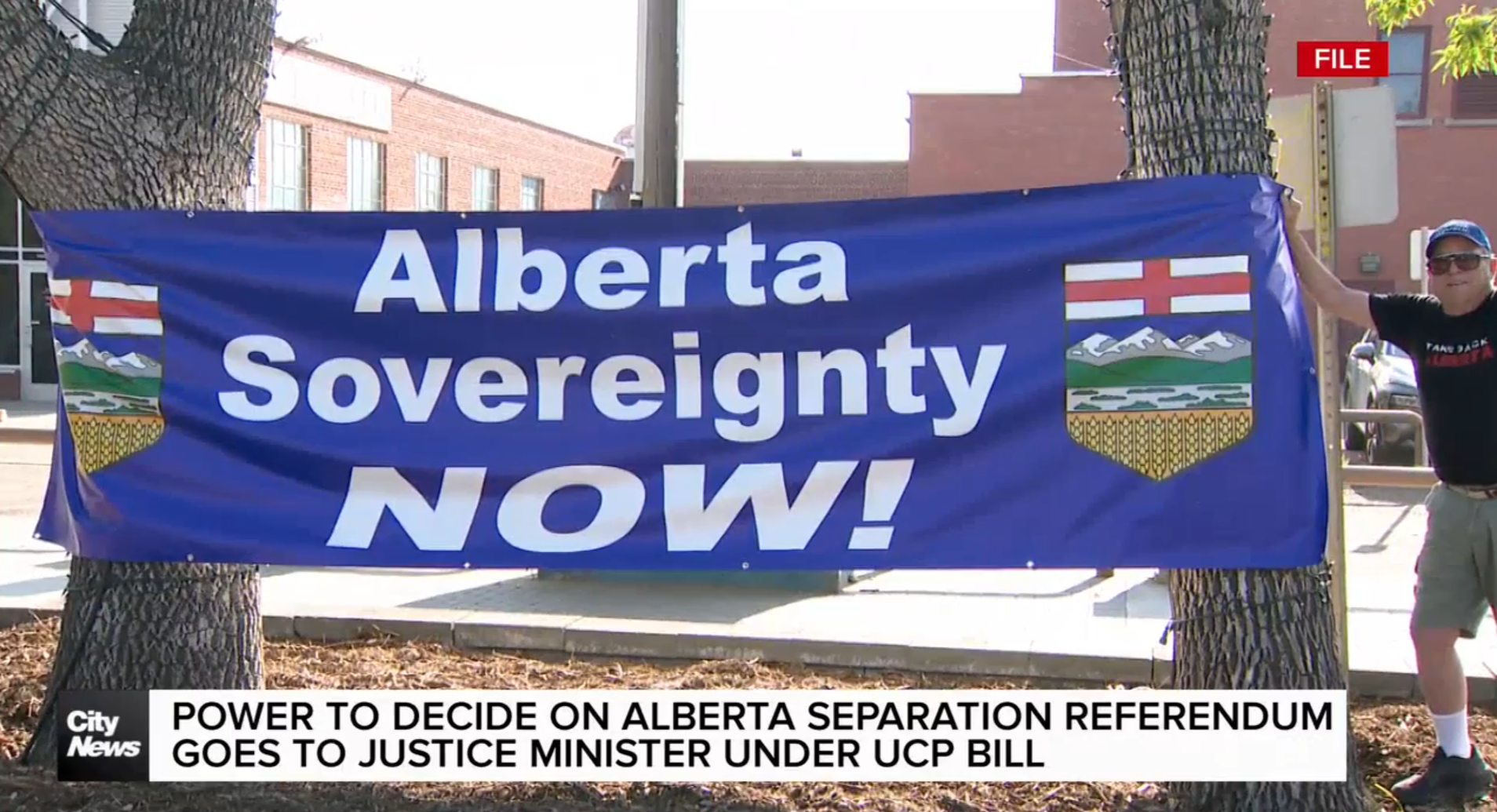
While many people have dismissed the potential for an Alberta independence referendum to succeed, in these conditions, anything is possible. While only 28 per cent of Albertans in recent polls say that they would vote yes, a referendum tends to focus the mind and can play out very differently than expected. This is exactly what happened with the 1995 referendum in Quebec. It was only during the campaign that the desire for independence peaked, only barely falling short of the mark.
Moreover, with the economic crisis bearing down and Carney being unable to deliver on any of his promises, anger against the Federal government will increase. In this context, a referendum directed against that same government could gain support and in a distorted way, express working class discontent, similar to what we saw with the Brexit referendum in 2016.
What is the position of Communists on the prospect of Alberta separation?
Alberta has long been the bastion of the right-wing in Canada and this referendum is being driven by the most fringe right-wing elements imaginable. In fact, representatives of the Alberta Prosperity Project recently met with representatives of the Trump administration!
It is likely that an independent Alberta would end up voluntarily joining the United States, as it sends most of its oil there anyway. Either way, an independent Alberta under control of the right-wing would be hell for the working class. They would quickly move to privatize healthcare, attack unions and cut anything that stands in the way of corporate profits.
But this does not mean that communists support the federal government, the Liberal party, Mark Carney, or his hypocritical “Team Canada”. There are many good reasons to oppose the Canadian federation, the federal government, etc. The coming years will only provide more reasons to oppose it, as Carney’s agenda becomes clear for all to see.
This is why it is completely wrong to counter this separatist sentiment by uniting to “defend Canada.” In this context, this idea simply means defending a Canada in which living conditions are falling and it is harder to make ends meet. Any party that does so, as the NDP and the labour leaders have done, would discredit itself. And rather than undermining the desire for independence, it enhances it.
What is needed is an independent working class way forward.
Everywhere the bourgeoisie tries to divert the attention to some sort of foreign threat. In Alberta they blame Ottawa and the “eastern bastards.” But in the rest of the country, the Liberals and the NDP blame Trump for everything. In both cases, they are letting off the hook the very people who control the main levers of our economy and make all of the major economic decisions that are making our lives worse.
It is Galen Weston, not Donald Trump, who has driven up grocery prices. It is the five big Canadian banks who gouge consumers with predatory rates. It is the big telecom monopolies who charge us some of the highest rates in the world. In Alberta, while the price of oil rises and falls—the oil barons never lose out. They are very well adapted at passing the cost of these fluctuations on to the workers of Alberta in the form of job losses and cuts to social services.
But oil and gas companies in Alberta raked in $35 billion in profits in 2023 alone. This is more than eleven times the $3 billion Alberta paid in equalization payments that year.
Communists point the finger where the finger deserves to be pointed. We fight for the nationalization of the oil and gas industry. Only by bringing the energy sector under common ownership can we use the immense wealth to solve the problems facing working class people in Alberta. Coincidentally, the Alberta separatists and the Federal Liberals would join hands to fight against this—showing their real priorities.
We fight to unite the working class across the entire country to overthrow the entire federal state and the system it defends. With the expropriation of the big parasitical industries and the institution of the democratic socialist plan of production, the antagonisms dividing the working class would die away, as workers’ fear for their future would be eliminated.
If Alberta were to separate, this would be completely disastrous for Canadian capitalism. Canada would lose the province with the third largest share of Canadian GDP, at 15 per cent. The viability of Canada as a nation state would be brought into question. And this is without even bringing up Quebec, where a referendum is also possible in the near future.
Perspectives for Quebec
The Coalition Avenir Québec (CAQ) has been in power since 2018 in Quebec. Under their watchful eye, the healthcare crisis has reached critical levels, with thousands of nurses quitting. Education, which CAQ leader Legault had promised he would fund, has been drastically cut. The CAQ has also attacked trade unions, passing a law which allows the government to violate the right to strike on a whim.
The result is that the CAQ has dropped to just 14 per cent in the polls. If an election were held tomorrow, they would be wiped off the map.
In these circumstances, one would think that Quebec solidaire (QS), the left party in Quebec, would see this as a golden opportunity to rally the working class against the CAQ and all the other establishment parties.
But quite the contrary—QS has been unable to make any political headway and is now actually garnering less support than they did 10 years ago. While the CAQ is fourth place in the polls, QS is dead last at just seven to 10 per cent support.
QS is a contradictory formation. It was founded as an anti-capitalist party in 2006 in a period when the class struggle was heating up in Quebec and around the world. After the 2008 crash, they even published a manifesto arguing to “move beyond capitalism”. However, the leadership is constantly under the pressure of the establishment to abandon its anti-capitalist ideas, and instead be more “reasonable” and “moderate”. This contradiction has now fully come to the surface.
For years, the party leadership around Gabriel Nadeau-Dubois conspired against the membership of their own party to destroy its anti-capitalist roots and make the party more acceptable to the capitalist establishment.
The latest to admit this was Vincent Marissal, who quit the QS caucus, stating: “I tried to change that party, and I failed […] much like Gabriel Nadeau-Dubois wanted to do, and then we teamed up at some point on that issue. The word ‘recentering’ is a bit of a taboo at QS, but so that everyone here understands, I won’t get into the jargon. It’s a question of recentering, of rationality, of not being too left-wing.”
Over the years, QS abandoned their long-standing position for free tuition in a first mandate. They rejected nationalizations, which they never talk about even though it is still in the program. Their current proposal to fight skyrocketing rents is not even a rent freeze, but merely adjusting rents to inflation! Instead of being tribunes of the people working to expose the capitalist government, they collaborate with them, amending their bills and participating in their parliamentary theatrics.
As a result, QS is not seen as a party of unapologetic fighters for ordinary Quebecois workers. QS offers no demands to enthuse workers—in fact, they hardly talk about the working class at all. At a time where people are yearning for change, QS has become a laughing stock that no one takes seriously.
With the meltdown of QS, the Parti Québécois (PQ) has been able to position itself as the main vehicle for those who want “change” after eight years of the CAQ. The turn of the tide began when the PQ took a principled position on opposing the oath to the King after the last election, while QS shamefully had their MNAs swear the oath. The result is that the PQ has been leading every single poll since November 2023.
But nothing is written in stone. The political situation in Quebec is extremely volatile and almost anything can happen. Even the ragtag right-populist Conservative Party of Quebec are now third in the polls and could have a breakthrough. The only thing that seems certain is that the CAQ will be crushed and QS will not be able to capitalize on the prevailing anger.
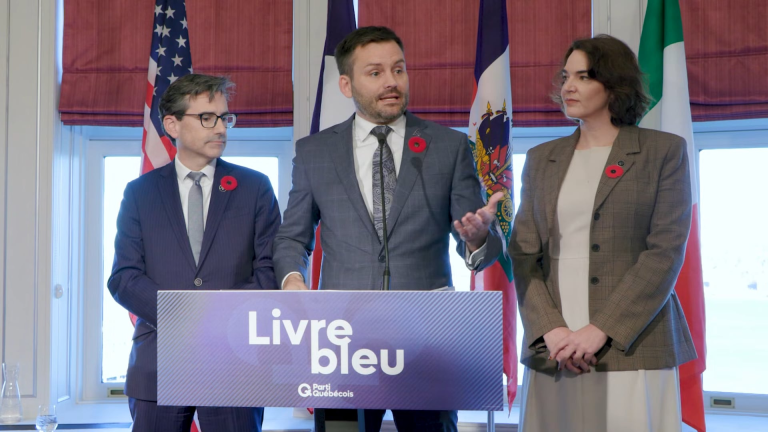
While the PQ had a comfortable advance in the polls for most of the past period, their support has declined. The PQ is walking a fine line, trying to please everyone. They still try to present themselves as “social-democrats”, while trying to prove to the ruling class that they will be a responsible captain. They still talk about the party’s “favourable prejudice towards the workers”, while also saying that they will have to make “tough choices” with public finances—which will mean austerity. By trying to please workers and capitalists, they risk alienating both.
Their “social-democratic” image has taken a beating recently. For example, in the fall of 2025, PQ leader Paul St-Pierre Plamondon (PSPP) attacked the STM workers in Montreal during their strike for holding the population “hostage”. PSPP even refused an invitation by the FTQ (the largest trade union federation in the province) to attend their congress, because he didn’t like its leader’s comments on the need to “paralyze Quebec” with a strike for May Day.
He has also criticized Carney’s trade deal with China, stating: “Our loyalty begins with the rest of Canada and the United States, which are our natural partners.” The PQ also said that a sovereign Quebec will join NATO and respect its demand for military spending to go up to five per cent of GDP. Considering the Quebec national liberation struggle was fought primarily against Anglo-Canadian and American imperialism, these statements are incredible coming out of the mouth of Quebecois nationalists.
What we see is that the PQ has merely been riding the anti-CAQ wave for two years. But as they act more and more as the government-in-waiting, they are forced to concretize what they stand for, and lose support in the process.
Another important element is the perspective of a referendum on Quebec sovereignty, which PSPP has promised within a first mandate. In the current context of economic instability and trade war, support for sovereignty is low, and seems to be a factor in the PQ losing support.
This has allowed the Liberal Party, with their new leader Charles Milliard, to make a comeback, drawing neck and neck with the PQ. But whoever wins, austerity and attacks against the workers are on the horizon.
If the PQ wins the next election, while a referendum would likely be a few years down the line, it would immediately bring the conflicts between the federal and Quebec government to a whole new level.
In such a situation, in English Canada the primary task of Communists is to fight against any and all attempts by the Canadian state to deny Quebec’s right to self-determination. We also fight against the nefarious narratives spun in the English media which seize on every injustice in Quebec and use that to attack the national aspirations of the Quebecois. Any manifestation of anglo-chauvinism should be denounced and fought.
On the other hand, the emphasis of the propaganda of the Communists in Quebec is different: the main task is to sharply expose the class differences within the nation. We need to explain why the PQ is not a friend of the working class and we should place no hopes in them. Their argument that independence is “neither left or right, but forward,” is an argument used to make the left abandon its criticism of the Quebec ruling class. We oppose the tendency of the trade union leaders to befriend the PQ and put the lid on the class struggle in the name of the fight for sovereignty. We argue that the working class of Quebec needs its own party independent of all capitalist parties.
The political situation in Quebec is wide open for Communists. The status quo is detested, and the PQ is already alienating workers and youth even before taking power. Many workers and young people do not recognize themselves in any of the establishment parties. By boldly fighting for class independence, by explaining the need to overthrow capitalism to achieve social and national liberation, and by building a party that unites Quebecois and English Canadian workers in a struggle to overthrow the state and the capitalist system, we can make big gains.
Crisis of the left
Paradoxically, in this situation, where the capitalist system is being exposed at every level, the left has never been in a more abysmal state.
But for Marxists, there is no contradiction here. The death of a system is accompanied by a death of the ideas of the old society. In this regard, the main weakness of the left is above all an ideological one. Holding onto bad ideas inherited from the period of stability, the left today finds itself like a ship without a compass.
A period of flux, like the one we are living through, ruthlessly exposes false theories and the individuals and organizations which defend them. And we have seen this lesson play itself out in real time, with the crisis pitilessly exposing reformists, identity politics liberals and sectarians alike.
The reformists—who based themselves on the idea that they had to adapt their demands to what is possible under capitalism—now stand for nothing, as capitalism can give no reforms and on the contrary demands counter-reforms. Identity politics, represented by the various theories being churned out of billion dollar bourgeois institutions in the imperialist west, has contributed to setting workers against each other, while shielding members of the ruling class from criticism. The disgust for these ideas among the working class has been capitalized on by the Trumpians. The sects, who capitulated to all manner of alien class ideas in the previous period have simply collapsed, riven with internal contradictions.
Only our International refused to bend, refused to capitulate and refused to abandon the genuine ideas of Marxism for the latest fad. During periods of reaction, while others capitulated, Marxist theory was our bedrock. This has given us enormous strength, has given our comrades something to fight for and has guarded us against demoralization which has become endemic on the so-called “left.”
Unsurprisingly, none of these tendencies have been able to explain what is happening or why. The common perspective that is accepted as good coin among liberals, sectarians and reformists alike is that we are going through a period of reaction and that we are hopelessly drifting towards fascism. This is backed up by pointing to the various bad things Trump is doing with very little understanding of why he is doing what he is doing and the broader implications of his actions.
What we have explained is that we are living through the most severe crisis the capitalist system has ever faced. Ever since the 2008 financial crash, the capitalist system has been unable to find its equilibrium.
Unable to maintain themselves amidst this political disintegration, the traditional political elite which had carefully constructed the post war global order has been elbowed aside in many countries—most notably the United States.
The strength of right populists like Trump derives from the fact that the so-called “left” abandoned the working class and failed to provide a way out of the crisis. Instead, the left has instead attached itself to the liberal establishment. This has allowed right populists like Trump to opportunistically appeal to the working class against the “elites” and in doing so garner support.
But what do you expect? Implicit in the idea we are in a “period of reaction” is the belief that workers are stupid for not continuing to support establishment liberals or reformists. But nature abhors a vacuum. Because the left refused to channel the anger into a movement against the system, this mood has been capitalized on by the right wing.
Communists have immense faith in the working class and therefore we have immense faith in the future. This is because we have a perspective that enables us to see beyond the current situation. We know that demagogic politicians like Trump have absolutely no solution to the problems facing working class people. Therefore, they will inevitably discredit themselves. As much as they may try to stop this, they are only preparing the way for a massive swing to the left.
While the current right reformists have led the movement into a blind alley, at a certain point left reformist figures will arise. The old ideas of class collaboration and parliamentarism are being proven to be manifestly useless in the eyes of millions and there is a crisis of ideas on the left.
Our task is not to moan and cry about the temporary popularity of right-populist figures or trends but to help as many people as possible to understand what is going on so we can prepare ourselves for the coming events.
The death of the old
As we have demonstrated in this document, the economic foundations of modern Canada were built upon the post-war order. Upon this, all of the dominant political traditions were built. But as the economic base declines, these traditions enter into crisis.
The Liberals, who carefully crafted their political message to undercut the NDP and pose as a so-called “progressive” vote for workers, are now forced to attack all of the tokenistic policies they implemented in the past.
The Conservatives, normally the party of big business elites—has been forced to refashion itself into an anti-establishment party that appeals to the working class—as the only way to stay relevant.
The NDP, having adapted themselves to the capitalist establishment for so long, have adapted themselves into irrelevance. Unsurprisingly, workers and young people fled the party in droves during the last election, resulting in their worst showing in history.
The trade union leaders, more accustomed to collective bargaining than open struggle, have been clutching at the edifice of class collaboration while the building collapses around them.
This whole political system, carefully constructed by the Canadian ruling class is deteriorating as the capitalist system declines.
Carney’s attempts to reorganize the Canadian economy (if it is even possible) will come at great cost. While he has politically given the ruling class a new lease on life, this is only temporary. His popularity is based more on hope than reality and therefore will eventually wither away, when the real consequences of his “solution” become clear.
The American economy is already showing signs of a weak foundation. This has led Jamie Dimon, the CEO of JPMorgan Chase, to compare the current bubble to the years prior to the 2008 crash. A collapse in the U.S. would have a disastrous effect for Canadian workers, as a majority of pension funds and personal registered retirement savings are invested in the U.S.
One way or another, sharp crises, and even economic collapse of entire industries or even sharp depressions affecting the whole economy are on the order of the day. Even if the winding down of the postwar order takes place gradually, the effects will be disastrous for the working class.
This situation has revolutionary implications built into the foundations.
A new society seeking to be born
But as the old society, with its ideas and institutions is dying on its feet, beneath this, a new society is struggling to be born. There is a deep process going on in the minds of the masses. Everything they grew up with, everything they were taught, is turning out to be false.
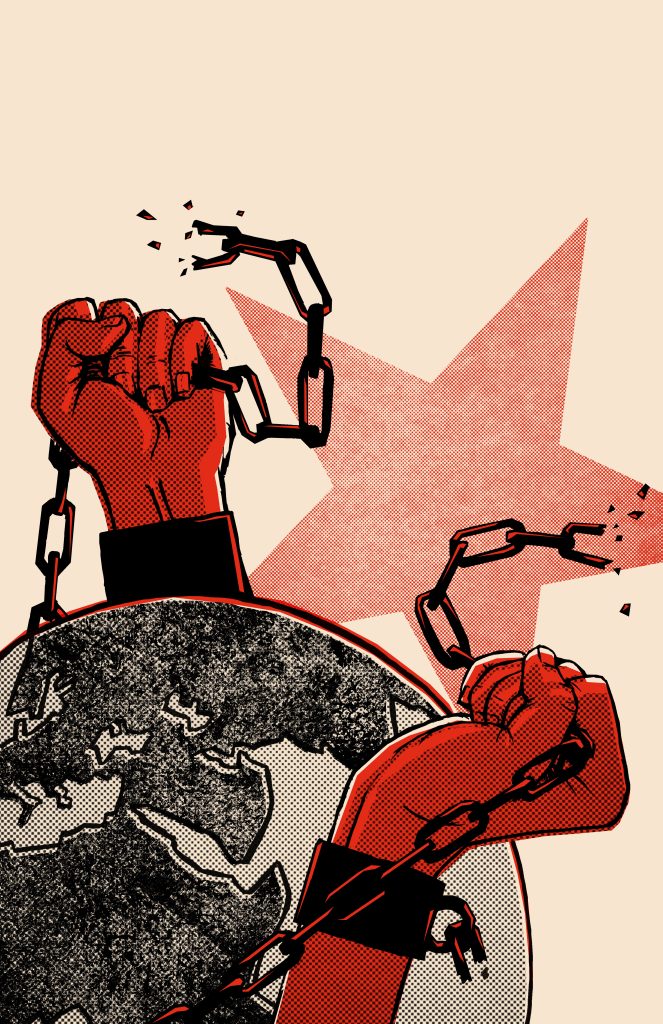
The future will hold many swings to the left and to the right as the masses search for a way out. This is inevitable, as the forces of Marxism are too weak to lead the workers towards the seizure of power.
On the left, the old ideas defended by “respectable” parliamentary reformists have been fully exposed by the crisis. They therefore are seen to stand for nothing and they have collapsed in support. This has created a vacuum on the left. But this cannot last forever. The depth of the crisis creates the conditions for anti-establishment leftwing “socialist” figures to rise and become polls of attraction. This can be seen all over the world with the rise of figures like Zohran Mamdani in New York City and Zach Polanski in the U.K. We are already seeing some early signs of this in Canada with Emily Lowan, a young “eco-socialist,” becoming leader of the B.C. Green party under the slogan “Fight the Oligarchs, Fund Our Future.”
More importantly, the front runner in the federal NDP leadership race, Avi Lewis, criticizes capitalism and is not afraid to call himself a socialist. He has also spoken in favour of a general strike and argued for the nationalization of plants being shut down due to the trade war. If he wins, this would represent the most left-wing leader of the party in recent memory.
We could equally see the radicalization express itself in the form of militant trade union struggles. As Carney and provincial governments move to bring down their deficits, public sector workers will increasingly see themselves targeted. Already there have been tens of thousands of jobs cut across the country at the federal and provincial levels.
At some point, the old crust at the top of the movement will be elbowed to one side by fresh layers who cannot wait any longer. There is certainly no shortage of anger. And there will be no shortage of fresh layers moving to transform society.
What is missing is the ideas. As the old ideas die, millions will be searching for answers.
None of the reformists, even of the most left variety, have any solutions to the crisis of the capitalist system. For a time they can speak very militantly and in doing so garner much support from the working class. But unless they mobilize the working class to go all the way and eliminate capitalism, they will eventually disappoint.
It is the role of communists to navigate these choppy waters, patiently explaining our perspective to the best workers and youth as they enter the struggle. Our party, which we have patiently built during a period of relative stability represents the only vehicle that can allow us to do this.
Out of the human material thrown into political action we will weld together the best class fighters into a vanguard capable of leading the working class towards the conquest of power and the elimination of capitalism—once and for all.

