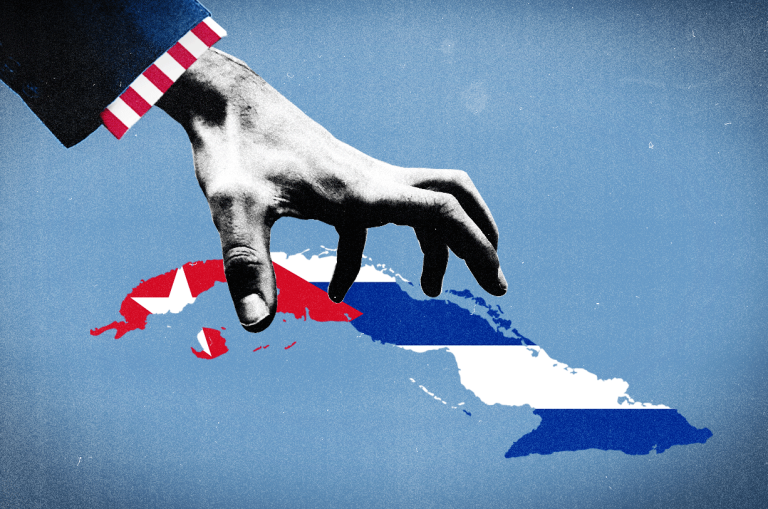
This statement was passed unanimously at the summer meeting of the leadership of the Revolutionary Communist International. We say: Defend the Cuban revolution! Defeat US imperialism! Fight for world socialism!
Emboldened by the immediate success of its January 3 attack on Venezuela, US imperialism has launched an unprecedented campaign of economic asphyxiation and military bullying of Cuba.
The 60 year old blockade has been strengthened since the beginning of the year with a near complete oil blockade which has decimated Cuba’s ability to produce energy with devastating effects on the daily lives of millions. A systematic criminal and very effective campaign of secondary sanctions and diplomatic pressure has targeted all aspects of Cuba’s economy (tourism, mining, the export of medical services, shipping, trade). This is a brutal and cruel medieval siege with the aim of achieving surrender by hunger.
Economic measures have been supplemented by arrogant statements by Trump and Marco Rubio, the trumped-up indictment of Raul Castro, threats of military action and provocative intelligence-gathering military flights over the island.
The primary motivation for the decades-long assault on the Cuban revolution is the fact that in 1959, a small island 90 miles away from the most powerful imperialist power in the world decided to assert its sovereignty and, in order to do so, overthrew capitalism, establishing a planned economy. This is why US imperialism feared and still fears the Cuban revolution as a threat to its interests throughout the continent.
All the impressive gains of the Cuban revolution were achieved on the basis of the planned economy and the abolition of capitalism. Ending illiteracy, a free and universal education system from pre-school to university, a health care system second to none, free housing, life expectancy higher than that in the United States, etc. Despite decades of imperialist blockade, Cuba’s gains in human development and living standards were miles ahead of her Latin American counterparts and compared favourably with advanced capitalist countries. They provide a glimpse of what a planned economy can achieve.
However, socialism cannot be built in one country. The history of the Cuban revolution and its predicament today are a stark reminder of this fact. The only two periods in which the Cuban revolution had some breathing space were when it was linked to the Soviet Union and when it was linked to the Bolivarian revolution in Venezuela.
While capitalism was abolished and there was mass enthusiasm for the new revolutionary regime, in Cuba there never was a genuine workers’ democracy. There were no institutions through which the workers and peasants could directly exercise power. The bureaucratisation of the Cuban revolution has different sources but was strengthened and solidified by the influence of the Soviet Union, particularly after 1970.
A regime of planned economy cannot work properly without the direct control and participation of the masses in the running of the economy and the state. Bureaucracy inevitably leads to mismanagement, waste, privileges for the few and corruption.
Eventually, as in the Soviet Union, a section of the bureaucracy would seek to become the owners of the means of production rather than just their managers.
Now, under the extreme duress of the redoubled assault by US imperialism, the Cuban leadership has approved a series of economic measures which, if implemented, would mean the end of the planned economy and the full domination of the capitalist market. Many among them are looking to the Chinese or Vietnamese model, where capitalism has been restored, but the so-called “Communist” Party remains in power.
To some this appears as a way forward out of the current impasse, and there is the illusion that these measures would produce economic growth while allowing Cuba to retain sovereignty. We must warn sternly: the abolition of the planned economy would mean the destruction of all the gains of the Cuban revolution (which still exist though much weakened). Cuba would return to 1958: a country dominated by and chained to US finance capital, economically and politically. A small minority would enrich themselves, the overwhelming majority would suffer poverty, unemployment, and destitution.
When the Soviet Union in the 1920s, faced with international isolation and economic collapse, was forced to make partial concessions to the market, Lenin explained clearly that these represented a step back. Those concessions were accompanied by measures to strengthen workers’ control and oversight. It was a question of gaining some breathing space, which was used to foster the world revolution by all means.
The latest economic measures approved in Cuba have opened a debate in the island. Many who can see clearly the dangers involved are asking – what is the alternative?
The root cause of the problems facing the Cuban revolution can be found in its isolation. The renewed assault on the Cuban revolution by US imperialism has also revealed the bankruptcy of the idea of a multi-polar world as a progressive way forward. Neither China nor Russia have done much more than issue statements, and none of the so-called “progressive” governments in Latin America have dared to defy US bullying.
The only way to break it is by spreading the revolution to other countries. In the 1960s, the Cuban leadership pushed in that direction, with Che Guevara talking of creating two, three, many Vietnams. The general idea was correct, though the method of the guerrilla foco adopted was proven to be wrong in practice.
The policy of spreading the revolution was later abandoned, and Cuba aligned its policy with that of the Soviet Union. The Nicaraguan Sandinistas were advised not to abolish capitalism but to keep a “mixed economy” with disastrous results. The advice given to the Bolivarian revolution in Venezuela was not to follow the example of Cuba (expropriating capitalism), again with disastrous results, which had a direct negative impact on the Cuban revolution, reinforcing its isolation.
The only reliable allies that the Cuban revolution can count on, are the world’s working class and poor masses. The only way forward is a policy of world socialist revolution (as opposed to “multipolarism”, or the “struggle against neoliberalism”). The fate of the Cuban revolution will be ultimately decided in the arena of the international class struggle.
Certain concessions to the market may be necessary, but it needs to be explained that these are setbacks and do not represent the “perfecting of the Cuban socialist model”. They must be counter-balanced by a sharp struggle against corruption and the bureaucracy, which can only be fought through the widest participation of the working class in the running of the state and the economy.
The Revolutionary Communist International reaffirms its unconditional support for the Cuban revolution and commits its forces to the broadest possible struggle to defend it. A defeat for the Cuban revolution would be a step back for the whole of the world’s working class and revolutionary movement. It is a particular duty of our US section, the Revolutionary Communists of America, to continue taking up the banner of the defence of Cuba against Yankee imperialism.
In the last instance, the isolation of the Cuban revolution which threatens to seal its fate is the result of the delay in the building of the necessary revolutionary leadership around the world that can lead the working class to power. We recommit ourselves to redouble the efforts in building the forces of revolutionary communism around the world.
Down with US imperialism – Defend the Cuban revolution – Workers of the world unite!

